Introduction
RAm Report will be about reptiles and amphibians. A category just a touch different from the ones up to now on the bog … flowers, pretty insects etc. … reptiles and amphibians are not most people’s cup of tea, with a fear of snakes and finding those slimy toads gross. I don’t have a fear, but I have a respect of snakes and you won’t see me try to handle one even if I know it to be harmless. In the venomous department, there are two snakes out there I can come across here, one is quite common. For the rest it is mainly amphibians and lizards.
Here’s a story that shows some of the poor knowledge about these animals.
I recently was at someone’s house and we were in the garden, I was talking about wildlife etc. and they told me they had a snake in their garden. I was excited and asked where it lived … the husband said that he killed it and had thrown the body on the compost heap. I wasn’t too keen on it being dead, but I wanted to see it none-the-less, so I went to have a look. I was expecting some massive beast from the story I’d just heard … what I saw was a dead Slow Worm (Angius fragilis) … sigh … and yes, it really was a big one, but still …
European Iberian Grass Snake
EDIT (24.x.17): This post was written prior to the taxonomic split. I’ve edited the text below a touch to reflect that.
Natirx natrix is found across Europe and all the way across to eastern Asia. There are multiple subspecies. In Spain a seperate species of grass snake exists, Natirxastreptophora, and it is found throughout the Iberian peninsula. In the north, where conditions are more humid and thus more favourable, it is apparently fairly common.
The habitat is almost anywhere really, as long as it is a bit humid/damp. These snakes also like water and are good swimmers. Therefore, can be found in damp fields, along rivers, near small lakes etc. They can also be found up to 2400m in the south.
I have to state this clearly … the Grass Snake is NOT poisonous and NOT dangerous to human beings. The chances that it will strike are low and then it most probably will not strike with an open mouth. Furthermore, they often play dead if bothered too much. It can secrete some smells and blood etc. but this is also NOT dangerous.
That said, I’m sure that if one comes across an adult at full size, it might freak you out. They can grow to quite a decent length, normally around 120cm and even up to 200cm! That may be good enough to get the adrenaline flowing in most people.
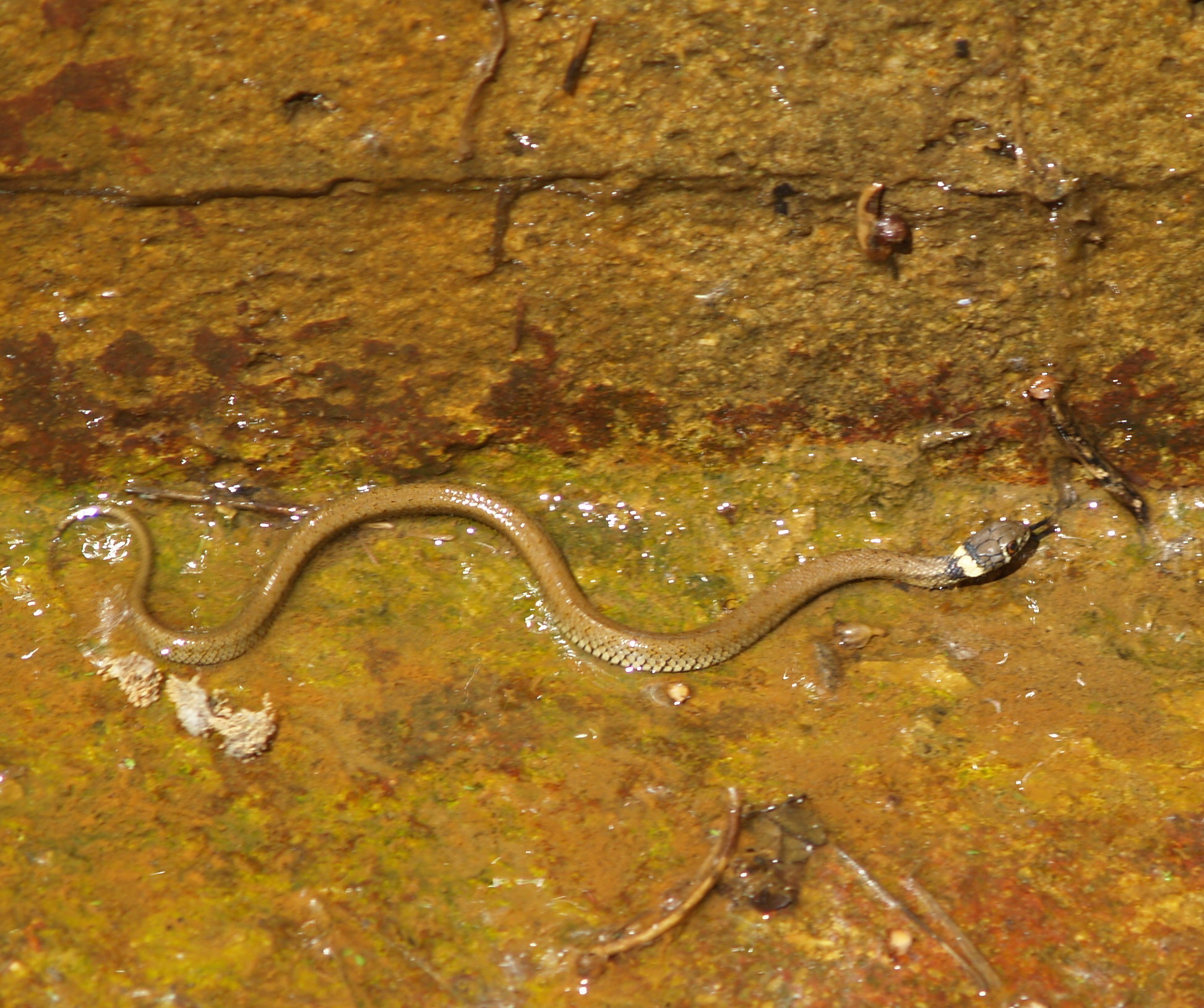
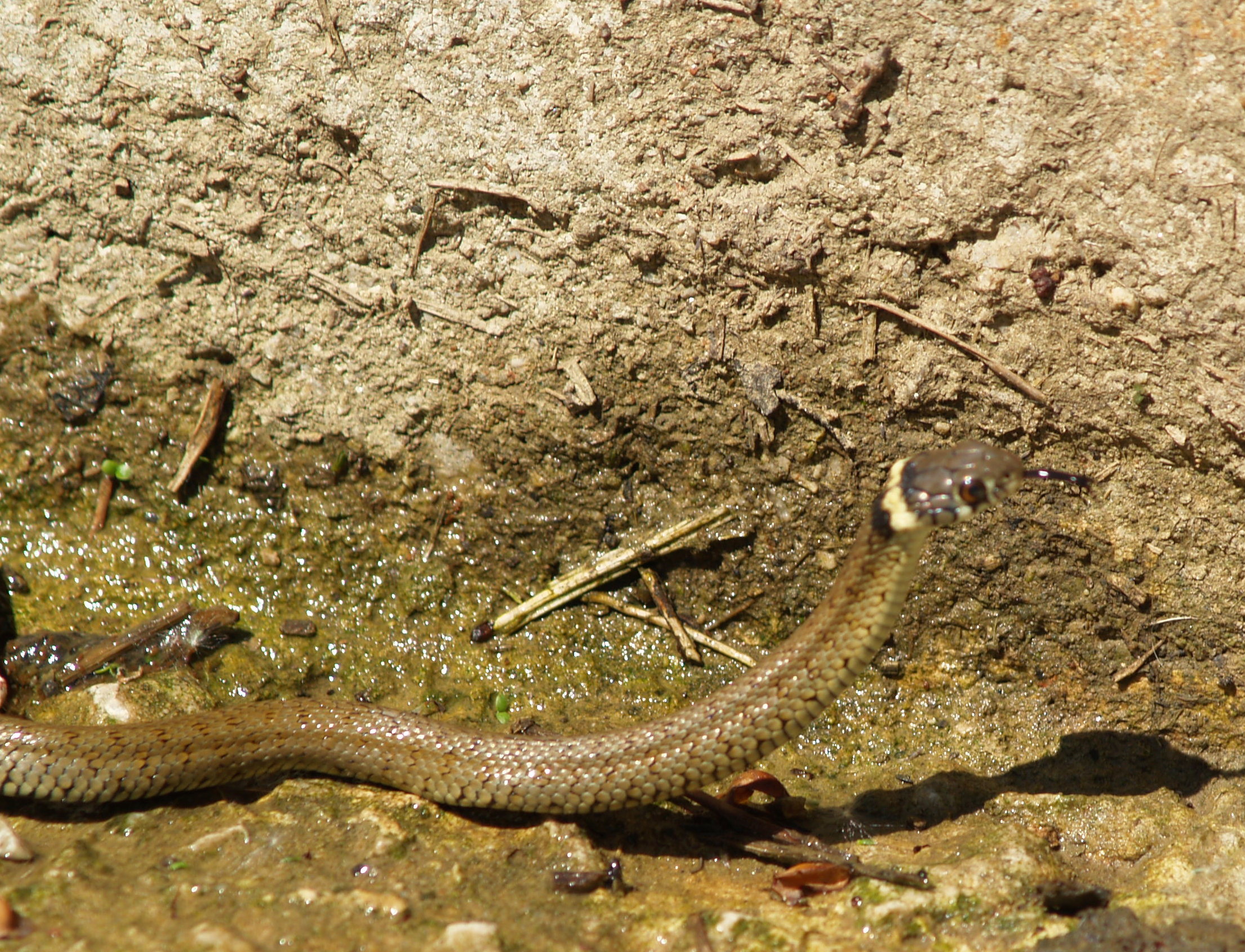
Grass Snakes are reasonably variable in appearance, but they usually have a ring of white just behind the head.
Grass Snakes feed on amphibians (frogs, toads), slugs, very small mammals and baby birds.
Well, all that makes the area where I live perfect for these snakes! The fields are damp, there
are plenty of amphibians around and there are little streams, creeks etc. everywhere, even a medium speed flowing river.
The little one I saw was just a baby, maybe 15-20cm in length. Hatchlings are independent the minute they hatch, so this one was maybe a day old or so (hatchings are between 14-22cm). It was attempting to climb up into a water trough along the road (where cows stop to drink) … in the water trough was food, an plenty of it … I saw maybe 50+ tadpoles and around 20+ newts (Palmate Newt – Lissotriton helveticus). Anyway, these fall smack in the diet of hatchling Grass Snakes!
As far as I can remember, this is the first time I’ve ever seen a snake in the wild so I was a bit taken back when I saw it wiggling and moving around. I was able to watch it for a good 30 seconds before it slipped into the undergrowth. Due to my excitement the resulting photos were not stellar.
The result has also been that now I’m always slightly cautious when “diving” (you’ll have noticed I use that word a lot when pursuing butterflies) into fields with tall grasses and lots of bushes … heh, don’t want to step on its mother!
Further Reading
– A PDF by the Spanish government on the species. Covers distribution, red list status etc.. In Spanish and can be difficult to understand for non-Spanish speakers.
– A list of my sightings of this snake on Observation.org.
– I use the Collins Fieldguide to help me ID, by Nicholas Arnold and Denys Ovenden.



 Searching for Cullum's Bee