Introduction
When I woke up, at around 7am, it was still fairly dark out but I could see if would be a nice morning. By 10am I was ready to go and knew that I’d still have a window of sunshine before the rain would come back. Since the start of the month it has been raining almost non-stop.
Recorrido A – 13.02.16 – 30TVN09, Casar de Periedo
The weather was quite good to start with, I didn’t need to wear a sweater. It was sunny with no clouds in sight and no wind at all, at 10am it was 14C. About halfway it was probably up to 17C or so, but towards the end of the route, the wind picked up a bit (not too much) and there was a lot of cloud cover all of a sudden, was back down to 16C when I got home around 12 noon. A little while later the rain was out (in good amounts too!).
I wasn’t expecting much … the rain had been almost constant over the previous days and the ground was really soggy everywhere in the fields. I stopped to look at some birds, when I spotted something dark flittering through this strange soggy/grassy area … I quickly aimed my binoculars in the distance and as I was focusing in saw flashes of white on the wing-tips
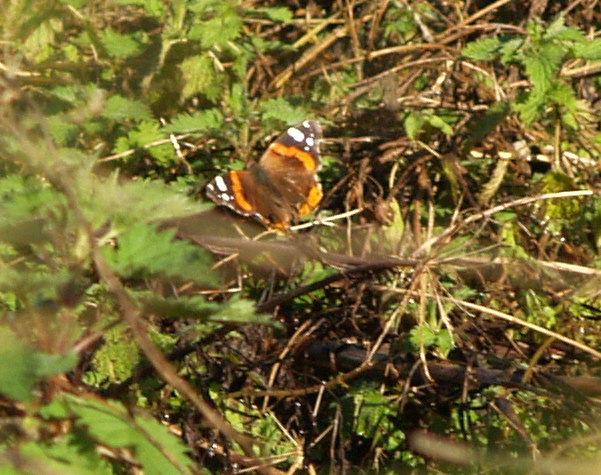
… I instantly recognised this from the previous year … Vanessa atalanta (Red Admiral) … the butterfly dipped behind a large tussock of grass and so I dived into the soggy field to get confirmation (mostly for myself, as I really like to be sure about an ID, especially so early in the year). With some difficulty I was able to get a couple of bad photographs in (that thankfully do show the required characteristics) for a positive ID.
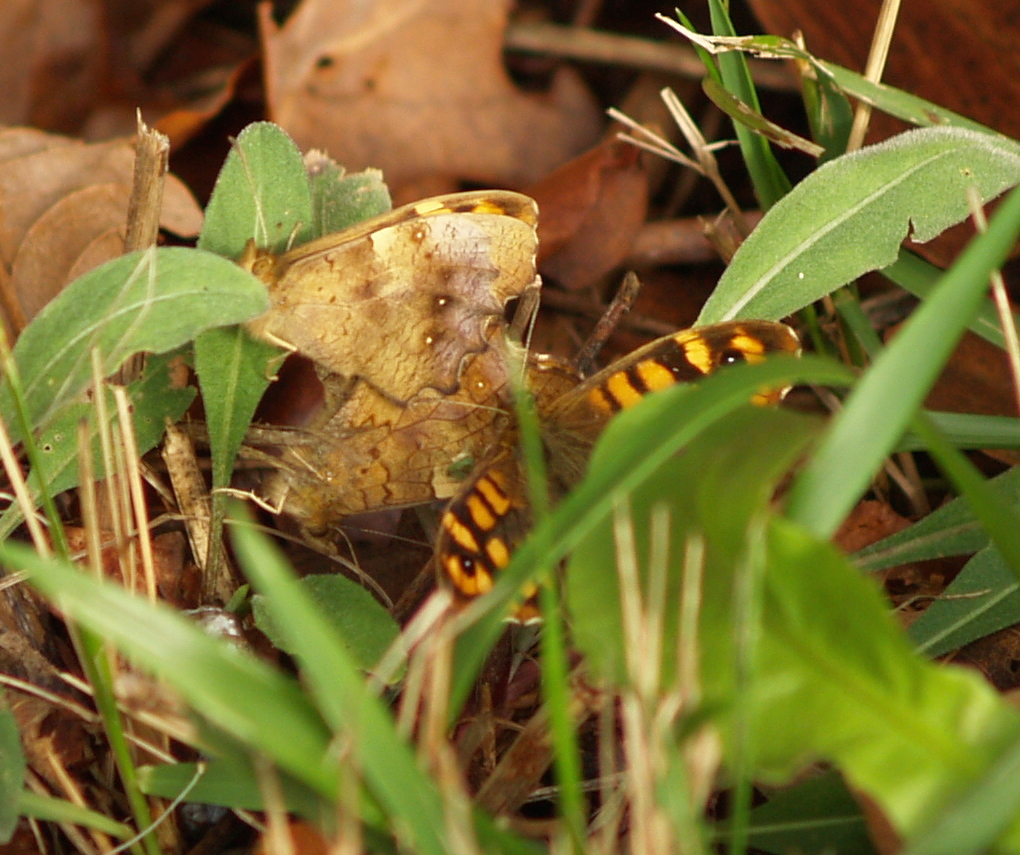
After a short while there were three in fairly quick succession along the route (I took a 15 min. detour to see if I could buy something for my son at the gas-station) and those were the regular patrons along the transect; Gonepteryx rhamni (Brimstone), Pieris rapae (Small White) and Pararge aegeria (Speckled Wood). At one point I’d seen so many Speckled Wood that I stopped counting, I also didn’t take pictures anymore, they were just everywhere. Although, I did take one funny snapshot of a copula and a male sitting on the two, waiting.
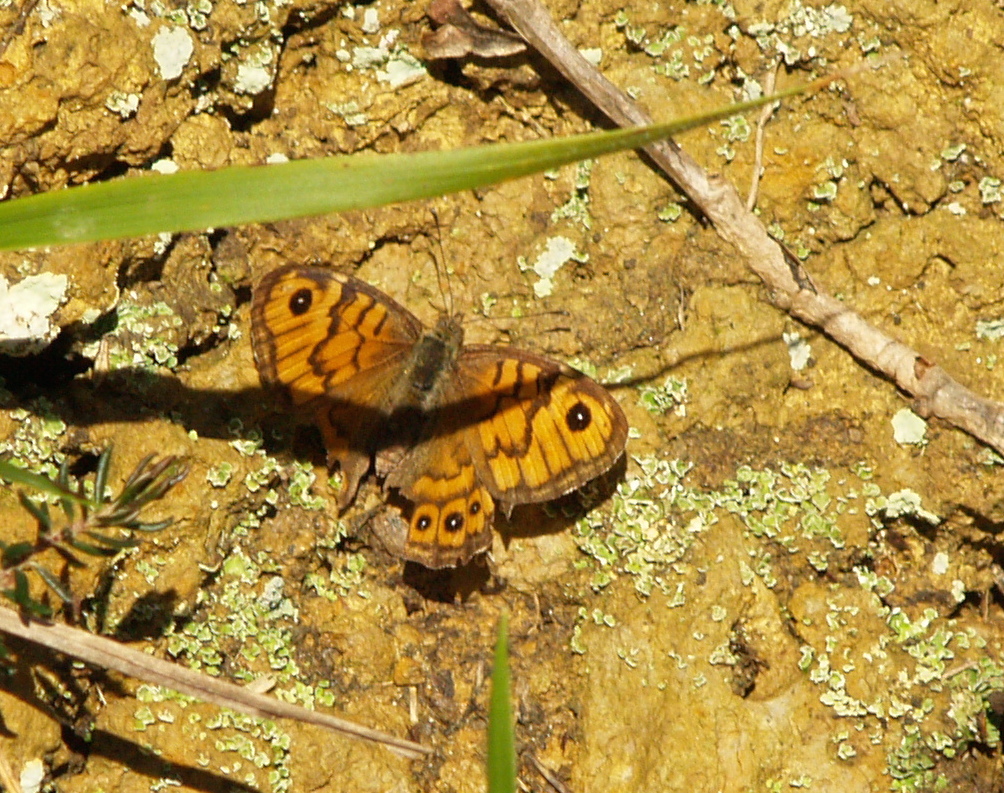
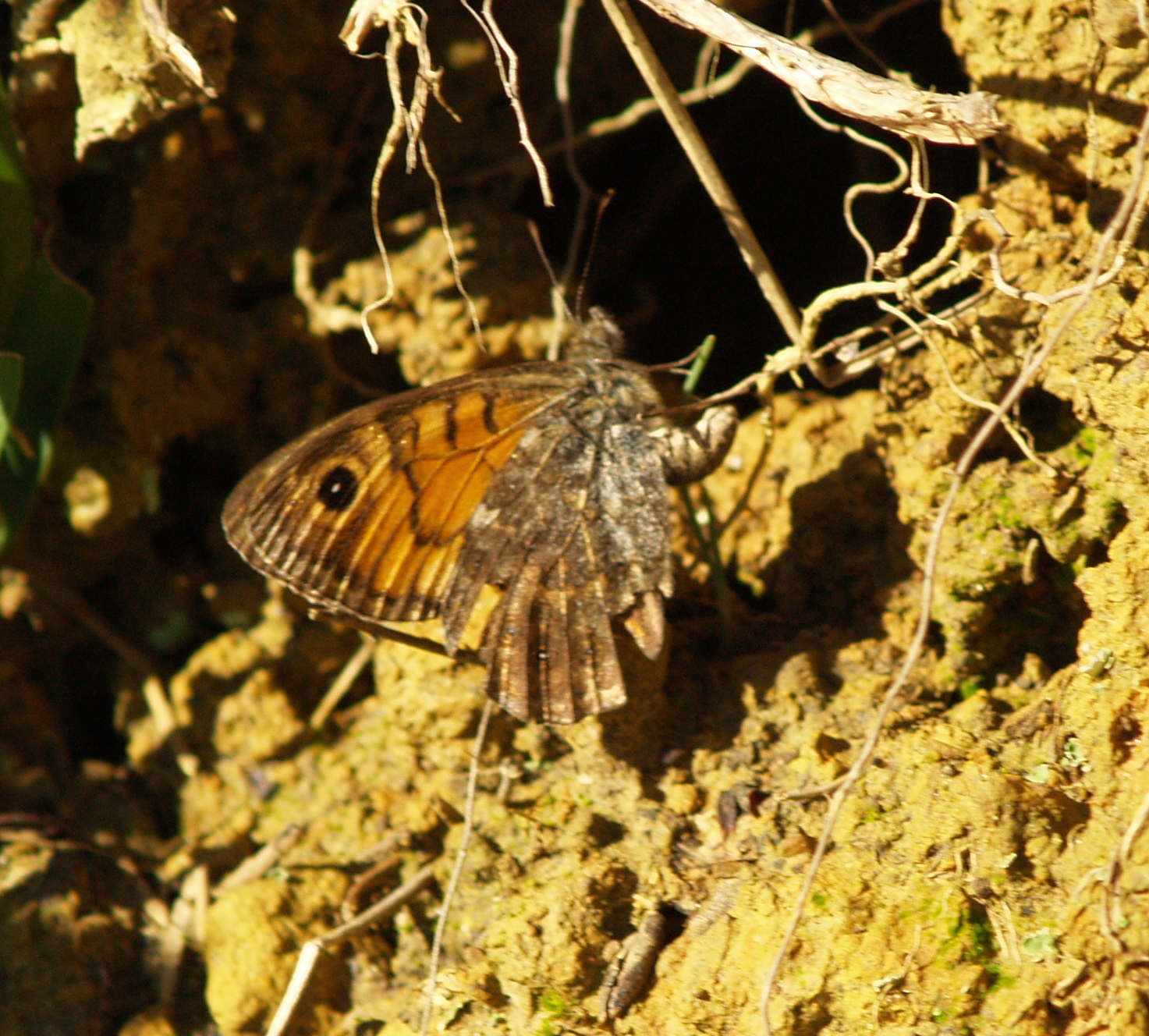
It was at my favourite spot along the transect that I spotted something odd … I thought it was a Speckled Wood by the general colouring, but I found it strange that the butterfly was so small (max. 2/3 of what I’d normally expect) and it was behaving in a strange manner. It hugged along a vertical embankment along the road, stopping here and there, usually under grass, twigs etc. What was this? I took many pictures, hoping to get an underside picture, but that proved very difficult (though in the end I managed it). I had an idea what it might be, but I’d only seen this butterfly once before and it had been exceptionally difficult to photograph too. Later when I got home I conformed my suspicion … Lasiommata megera (Wall Brown) … and I also saw that she was placing eggs (or so it seems!). I cursed that I hadn’t picked up that detail in the field.
I continued on, within a minute both a Colias croceus (Clouded Yellow) and Aglais io (Peacock) flew by at great speeds. Luckily those are fairly easy to ID in flight, especially as the Clouded Yellow was a male. A week earlier, on a walk nearby I’d been surprised to see a Clouded Yellow … I’d been pushing the stroller, looking at the ground and spotted a strange yellow leaf, strange as everything else was brown in mud, fallen leaves etc. I was able to get really close to it (was practically next to me anyway when I walked past it) and got some good pictures.
On I went, looking at butterflies through my binoculars, checking out the Buteo buteo (Common Buzzards) circling overhead … and then, as I was looking at a Brimstone (or so I thought) zip by I noticed flashes of orange … wait a minute … Brimstone don’t have orange, but Cleopatra do! I jogged along after it till it settled down (luckily not far off) and took some pictures. I also made sure to take one just as it set of for its next short journey, the flash of orange was clear on the picture, Gonepteryx cleopatra (Cleopatra), my first confirmed ID of this species by photo.


Picking up the pace a bit I headed home, the wind was picking up and it was starting to feel a bit chilly (had left my jacket at home), but was happy that I’d spotted a new species (the Cleopatra) for the UTM square I am monitoring.
Summary
– Vanessa atalanta — 1 (first of the year).
– Gonepteryx rhamni — around 10 in total.
– Pieris rapae — 3.
– Pararge aegeria — I stopped counting after 20 … maybe 30 in total?
– Lasiommata megera — 1 (first of the year).
– Colias croceus — 1 (I’d seen one a week earlier but not along this transect).
– Aglais io — between 10 and 15 in total.
– Gonepteryx cleopatra — 1 certain, probably 2 (first of the year).
Species year total — 9 (2015 – 45).
Further Reading
– My sightings for the day on Observation.org.
 Searching for Cullum's Bee