Book Club – Books on Moths

I’ve decided to move the Book Club posts to Fridays … they might not drop each week, as there is only so much I can read. This will allow me to highlight species and excursions etc. on Tuesdays each week, there is a lot more I want to cover there.

Just like the other Book Club entry where I discuss reference books on butterflies, this one is on moths (Lepidoptera). Now, I have nowhere near the same number of books on moths as I do on butterflies, but still I think it might be interesting none-the-less … so without further ado …

General

  • Sterling, Phil, Mark Parsons & Richard Lewington (illus.) – Field Guide to the Micro Moths of Great Britain and Ireland – 2012 (reprint 2015) – Bloomsbury – 416 pp. – Great companion piece to the above below, they go together really. Again, this will cover a lot of what you can find in Cantabria, but because these moths are so much more difficult/complex to ID, care does need to be taken when doing so. A must-buy for those interested in moths. Just excellent.
  • Waring, Paul, Martin Townsend & Richard Lewington (illus.) – Field Guide to the Moths of Great Britain and Ireland – 2nd edition – 2009 (reprint 2015) – Bloomsbury – 444 pp. – An excellent guide for macro moths (the “larger” species) and even in Cantabria it covers most of what you’ll find here (we have a similar climate to the UK). The more south you go and the higher the altitude (e.g., Picos de Europa) is where you’ll find the most gaps. Still, great to have and a must-buy if you want to start an interest in moths. Stunning book.

Spain

  • Redondo, Víctor, Javier Gastón & Juan Carlos Vicente – Las Mariposas de España Peninsular: Manual ilustrado de la especies diurnas y nocturnas – 3a edición – 2019 – Prames – 464 pp. – In Spanish and it includes butterflies, but it does not include micro moths. All pictures are of collection specimens with their wings spread, which makes it a bit weird because that is not how living specimens usually rest (wings open etc.), although some families do. Very basic distribution information. However, it does a decent job of covering most, if not all, the species present in peninsular Spain. This means that it has some of the warmer climate species that my other books do not mention. Okay I guess but only really needed if you are going south of the area I live (Cantabrian mountains).
  • Sesma, José Manuel, Juan Ramón Córdoba, Luis Carlos Herrero, Óscar Ventura & Diego Gil Tapetado – Guía de indentificación de las gitanillas (Zygaena) ibéricas – 2019 – Asociación Fotografía y Biodiversidad – 84 pp. – This thin book covers the distribution etc. of the 22 Burnet species found in Spain. Pretty informative with lots of photos, but still makes identification of some species difficult without dissection etc. Much of the distribution data is based on citizen science websites. I’d classify this book under nice-to-have for the completionist.
    However, it is also a bit (understatement) frustrating because the book is labelled as “Volume 1” on the cover … so you’d think there would be more publications on other families etc. by the publisher … but so far no. Also, the publisher’s website is not good, or up-to-date and the main source of observations (biodiversidadvirtual.org – the publisher runs this site) is massively frustrating to use … so were this the business world this would fail spectacularly … If I owned a citizen science website/company (or was a millionaire with a passion for nature), I’d buy up the site, and everything associated with it, and consolidate all the data into a decent repository (e.g., Observation.org), a merger as it were … not to detract from the amazing work done by the publisher/site (volunteers, experts, etc. etc.) but it basically ticks all the boxes of what you can do wrong … if you want the general public to care, and be interested in nature, it needs to be a lot, and I mean a lot, more accessible (modern phone app etc.) … in 2023 it has to be much better and it should be with all the innovative technology at hand (using AI to help with IDing species, detailed mapping of species in Spain (i.e., where spieces have been recorded and where they might be found if we take ecosystem requirements into consideration) etc. etc.) … rant over.

Specific Regions in the Cantabrian Mountains (my area of interest)

  • Sanz Román, Pablo & Juan Manuel Marcos Gómez – Mariposas y Ecosistemas Cántabros – 2004 – Cantabria Tradicional S.L. – 196 pp. – I’ve not had this book too long, but I’ve read parts of it many times. It is in Spanish, has photos and maps of some moth (and most butterfly) species in Cantabria. Long since out of print (the publisher went bankrupt years ago) and hard to get. The selection of moths is strange, some are day-flying but not all are covered in the book. Then there are some night-flying moths, but only a select few. There is also extensive information on larval host plants (LHP) for the species in the book, Yes, interesting species (some mistakes there), but all quite random. Not really useful for moths, a bit of an oddity. Only for completionists.

Comments

Now … the moth book publishing world is massive … you can get huge, expensive tomes in multiple volumes on one moth family of in Europe (Palearctic region). I do not have the space or money for these at present, but boy can you go down the rabbit hole in this area. I’ve also noticed that people interested in moths are a bit special/weird but in a good way. Once you start with this hobby it can get quite carried away, you need a special light trap etc. etc. With the above list I’ve only just grazed the surface.

For information on specific regions in Spain you’ll have to consult scientific publications. There are extensive lists of moths for Palencia and other regions in the north.

However, the best source to help ID your moth pictures is through Facebook groups. There is a specific one for Spanish moths (in english) that is great and really helpful … sorta (some people there can be a bit … scientific, lets say).

Book Club – Books on Moths

Moth Matters – Valeria jaspidea (Villers, 1789)

Introduction

So, I’ve set out the moth trap on the balcony a couple of nights so far in 2023 … zero, zilch, no luck. As I stated in a previous post, the street lighting has been changed to LED … great for the environment when it concerns energy usage but poor when it comes to light polution. Unfortunately, I’ve not had to time to set the trap in a friend’s garden, so the best thing I can do, for the moment, is to write up on some interesting species I’ve managed to see.

However, if all goes well I will set up the trap this evening at a friend’s house and then this weekend I will do it again in Salinas de Pisuerga, Palencia, where another friend lives. I’ve identified a number of species (moths, butterflies and dragonflies) I’d like to see this year, which includes Valeria jaspidea, and put all related data into an Excel sheet. Below is a screenshot of the moth section to give you an indication of what I’ve done. Will add to it as I come across other interesting species.

Overview of interesting moth species to try and see during 2023.
Fig. 1 – Overview of moth species in the Cantabrian mountains that I’d like to see over 2023.

Valeria jaspidea

Valeria jaspidea falls under the Noctuidae family of moths and is quite similar to Valeria oleagina ([Denis & Schiffermüller], 1775). I cannot find the paper that details the difference and if it is widely accepted or not, but Lepiforum (see links below) has them as different, so I’ll keep it at that too. Apparently,Valeria jaspidea occurs in the western part of southern Europe, whereas Valeria oleagina in the eastern part. I also cannot find a map of where the split would be, and if they overlap.

(Ugh … getting used to using this tool again and lost half of the post in trying to update it … oops) The moth can be found throughout the Iberian peninsula, but it is rare. To be honest, with the continual growth of eucalyptus plantations in Cantabria (which dry out suitable habitats) this species looks to need to be ready for a struggle to continue surviving in the region. Also, with the changes in landscape management (farming techniques) this will only add to the struggle they already face.

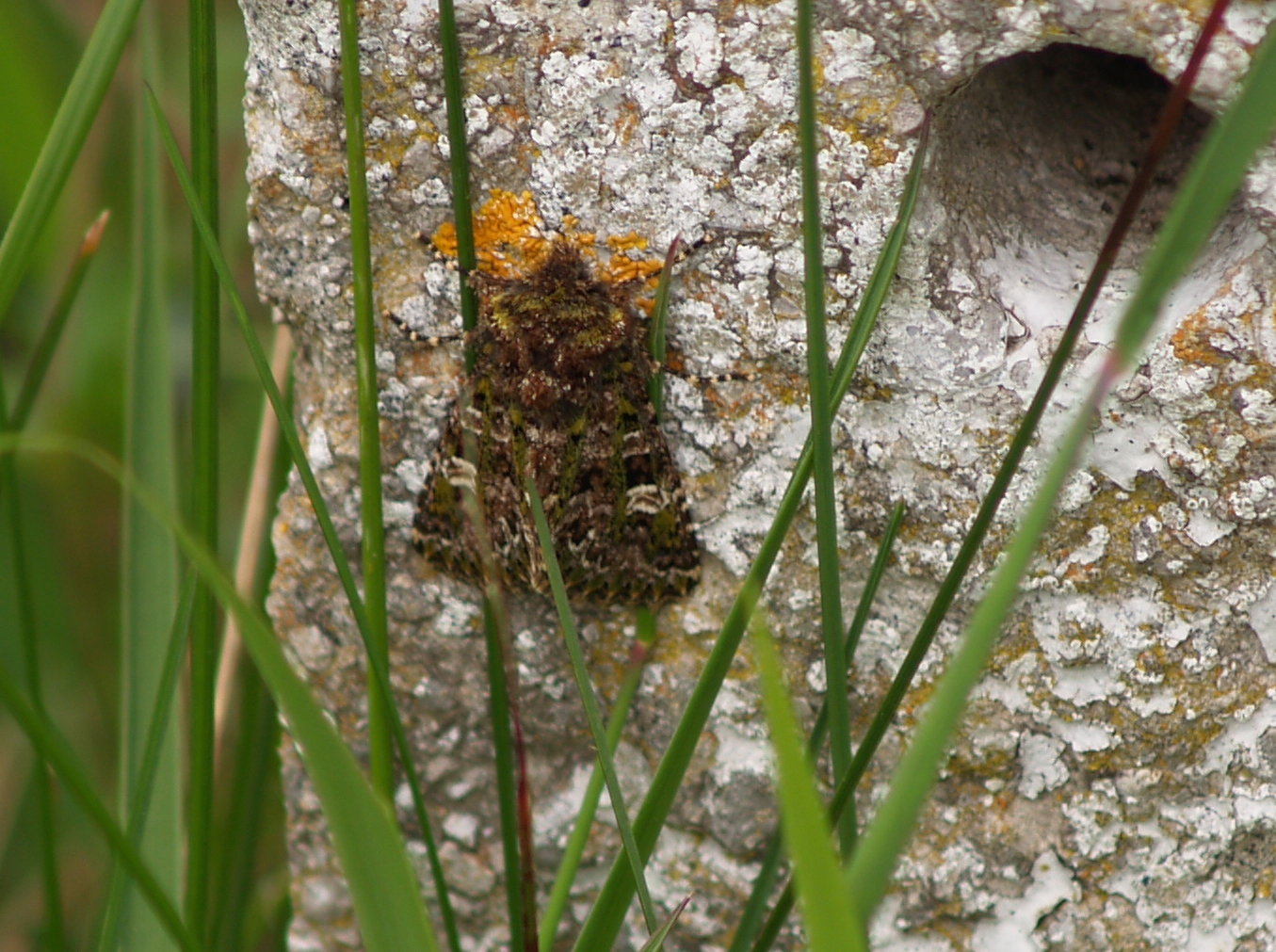
The caterpillars of Valeria jaspidea feed on Prunus spinosa (blackthorn) and also Crataegus sp. (hawthorns). The moths fly from March to May and can often be found at rest at the bottoms of walls and stones. They have these stunning streaks of green that make them look like a moss that might grow on a blackthorn.

A photo of Valeria jaspidea.
Fig. 2Valeria jaspidea, 19.iv.16 – Casar de Periedo (Cabezón de la Sal), Cantabria, 30TVN09.

Further Reading

  • I have written a blog post about the moth resource books I use. It will be published on Friday (30.iii.23) after which you can find it here(will add link).
  • This is a link to a great site called Pyrgus.de that I reference a lot. Excellent information and photos. He hasn’t updated or added Valeria jaspidea yet (not sure why) but the info can be found here under Valeria oleagina.
  • No moth reference list is complete without a link to Lepiforum, an incredibly in-depth site. Here is a link to the moth’s page.
  • All sightings in my region of Spain as recorded through Proyecto Lepides.
  • I actually wrote a blog about walking the transect when I saw this species, see here.
Moth Matters – Valeria jaspidea (Villers, 1789)

Bee-news – Shrill Carder Bee – Bombus sylvarum (Linnaeus, 1761)

Introduction

Hymenoptera (or wasps, bees, and ants as some might call them) can be really difficult to identify. Not only due to their small size but also due to the similarities between the species. Bumblebees (which fall under bees) are no different. Add to that fact that documentation of bumblebee species in Spain, and as always in this area of Spain, is spotty at best. As well as the fact that bumblebee species look differently here, as they do in other parts of Europe (differences in band colouration can be striking due to the multitude of subspecies present). Ugh, why did I start looking into this group of insects then if they only bring headache when trying to identify them? Long story for another day, but this site is named after a species of bumblebee (Bombus cullumanus) …

Bombus sylvarum (female), 24.vii.2016 - Cabezón de la Sal, Cantabria.
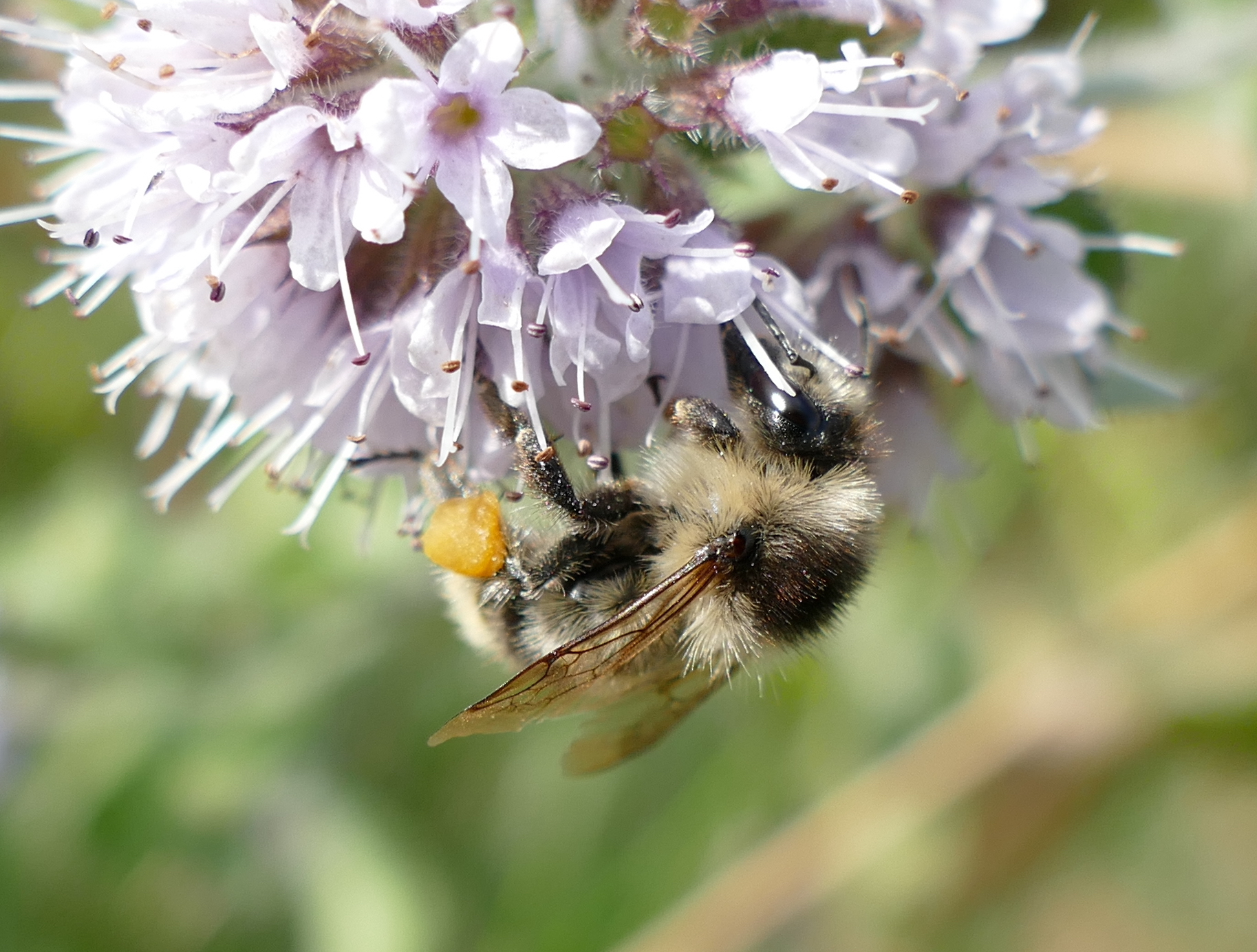
Bombus sylvarum (female) on Mentha sp. (a mint), 24.vii.2016 – Cabezón de la Sal, Cantabria.

Shrill Carder Bee

So its English name comes down to the high-pitched sound it makes while flying around flowers, it really is distinctive. The species usually flies a bit later in the year/season than other bumblebees, I usually see them in August to October, but have seen them flying earlier.
They are quite common around the village where I live, as they need “rough” farmland with lots of different types of flowers … therefore, due to agricultural changes, across most of Europe Bombus sylvarum is struggling a bit. In Spain, the occur in the northern stretch along the Cantabrian Mountains and in some higher altitude areas along the east coast and towards Madrid. Apart from near my village I’ve also seen them along the coast (Cuchía), in the mountains (Alto Campoo ski resort) and in Palencia.

There aren’t any big differences between males and females. The most distinguishing characteristic is the black band between where the wings attach to the thorax. However, as previously stated, depending on where you live IDing the species can be difficult. For example, it gets more complicated here at higher altitudes, as there are other bumblebee species that might look similar. At lower altitudes it is reasonably certain, especially if you can hear the bee flying around too.

Bombus sylvarum (female) on Trifolium sp. (a clover), 10.v.2020 – Cabezón de la Sal, Cantabria.

Very Rare Form

Sometimes you can spot an unusual variation of a species (called forma – abbreviated as f.), which will have a specific name. Some variations can be fairly common, as they might occur due to climactic variation, but others can be very rare. I’ve been lucky to spot a Bombus sylvarum f. nigrescens. Initially I had no idea what it was because the coloration did not fit with anything that I might find in this area. The only reason I found out the species was because I got into contact with Leopoldo Castro, the bumblebee expert in Spain, and he was able to ID it for me, not 100% certain but highly probable.
In the picture below you can see the thin light-yellowish bands that it has (running along the edges of the tergites) within the mass of black hairs on the abdomen, with a bit more around the connection between thorax and abdomen.

Bombus sylvarum (male) on Centaurea sp. (a knapweed), 10.ix.2016 – Mazcuerras, Cantabria.

Further Reading

  • The IUCN Red List page – general information about the status of the species in Europe.
  • Atlas Hymenoptera – the best site on information and distribution of Hymenoptera species in Europe. Run by Pierre Rasmont, Belgian expert.
  • Bumblebee Conservation Trust – page on the trust’s site dedicated to the species in the United Kingdom, where it is a rare bee.
  • Steven Falk’s Flickr page – he wrote the field guide for bees in the UK. Awesome photos, great resource.
  • Observation.org – citizen science website that would benefit from your contributions. You can find all my observations there.
Bee-news – Shrill Carder Bee – Bombus sylvarum (Linnaeus, 1761)

Book Club – Books on Butterflies

So, for this, and the following Book Club posts, I think I’ll just concentrate on the books I use to help me ID species or general reference books I use. I won’t go into any scientific papers, or PDF documents, as that would make each post massive. The idea here is to get an idea of the books you might like to look into getting if you are interested. I’ll make sure to start from a general overview to a more Spain/regional specific base.
Also, this list will now be used as a reference when I post on butterflies, saves me having to list the books each time around.

Oh, and I’ve got books like Nabokov’s Blues, the ones by Dave Goulson, and many more but I’ll discuss those seperatly … this really is only reference books.

General

  • Haahtela, Tari, Kimmo Saarinen, Pekka Ojalainen & Hannu Aarnio – Butterflies of Britain and Europe: A photographic Guide – 2011 – A&C Black – 384 pp. – Pretty decent, more modern than the two listed here. I had this an the Tolman as my only books for ages. I liked the idea of having one illustrated and one photo book (this one also has living butterflies). This was an accidental buy, but it turned out to be worth it (it also was not expensive at all). There is a new edition out (2019 – Bloomsbury Wildlife – great publisher) and it has been translated in French and English. Unless Tolman comes with a new edition soon, this might be a better buy (it is less than 10 GBP on Amazon), as the photos really are good.
  • Lafranchis, Tristan – Butterflies of Europe – 2004 – Diatheo – 352 pp. – This book has an ID key in it that can be really helpful if you like to use those … based on photos of living buterflies … good companion to Tolman. There’s a French and Dutch version of this book. The Dutch version was published by the KNNV in 2009 and is expensive (currently one for sale for €75), as it is now out of print.
  • Tolman, Tom & Richard Lewington (illus.) – Collins Butterfly Guide – 2009 – William Collins Books – 384 pp. – Pretty much the reference book on everything to do with butterflies in Europe. A must have, stunning illustrations, maps, excellent info on each species … needs an update though (due to taxon changes etc.). I cannot think of a better book to own if you are interested in butterflies. You can also get it in Spanish and, probably, other languages.

Spain

  • Redondo, Víctor, Javier Gastón & Juan Carlos Vicente – Las Mariposas de España Peninsular: Manual ilustrado de la especies diurnas y nocturnas – 3rd edition – 2019 – Prames – 464 pp. – In Spanish and it includes moths (not micro moths). It is okay, not really worth it for the butterflies though. I got it for the moths. The pictures are of collection specimens so it looks really unnatural and the colours are not very vivid. No maps, very basic info on distribution. Basically a book for those who have already read a lot and just want to have something new for their butterfly library. Still in print and will probably remain so with a new edition coming out every once in a while.
  • There’s a better book on Spain, but I only have it as a PDF … written by E. García-Barros, and others, in 2004. It is good, though is only based around distribution, has no photos or illustrations, because it is based on scientific papers you can really pinpoint species in specific regions. You can probably find this on the internet. It has both Spanish and English text! I used it a lot in the early days.

Specific Regions in the Cantabrian Mountains (my area of interest)

  • Sánchez, Juan Manuel, Rafael Obregón & Tomás Sanz – Mariposas diurnas de Somiedo – Asturias: Pequeña guia para senderistas – 2018 – Ayuntamiento de Somiedo – 96 pp. Small, informative, handy, and in Spanish … so, great if you are going to visit this stunning national park (I haven’t yet but one of the authors was associated with Proyecto Lepides so I got this book). Maybe you can pick up a copy on a visit to the park, it cost me €5, so why not. There’s a new version (2022) out (without Tomás Sanz) that is double the page number. No idea what the difference is, but I’m sure it is pretty decent
  • Sanz Román, Pablo & Juan Manuel Marcos Gómez – Mariposas y Ecosistemas Cántabros – 2004 – Cantabria Tradicional S.L. – 196 pp. – I’ve not had this book too long, but I’ve read parts of it many times. It is in Spanish, has photos and maps of butterfly (and some moth) species in Cantabria. A good place to start to get an indication where you might find certain species of butterfly in this ecologically diverse province … but websites are better these days because they are more current. There is also a whole section on larval host plants (LHP). Mistakes do occur in this book, the names are really far behind regarding taxon (Lafranchis, from the same year, is way more up to date), so my copy is full of pencil corrections. It is like you’re reading a book from the 1980s. You can get by without this book when you visit Cantabria, for the completionist, as it shows its age and needs a refresh/update for sure. Long since out of print (the publisher went bankrupt years ago) and hard to get.
  • Verhulst, Georges, Joseph Verhulst & Hugo Mortera – Mariposas dirunas del Parque Nacional de los Picos de Europa – 2005 – Organismo Autónomo Parqeus Naturales Ministerio de Medio Ambiente – 184 pp. – Book in Spanish written by two Belgian brothers and an expert on butterflies in Asturias (I have Mortera’s book on butterflies in Asturias in PDF format – also excellent and available on the internet). A bit old, but quite cool and quirky (has common names in 4 different languages), as it also includes some pictures of caterpillars and pupae. The photos are okay, both of living and collection specimens. There are some mistakes but those aren’t really an issue. You’ll need to buy this online, with the best/cheapest option being Oryx in Barcelona (how I got it). Take care because this book can be very expeinsive on other sites, and it probably isn’t worth that unless you are a completionist.

Comments

The region-specific books can be really hard to get a hold of. If you want to pick them up for a vacation to Spain it is best to do so well in advance. Most of them are out of print. For example, the Lafranchis I’ve seen with quite a high price-tag (e.g. there’s currently one for sale for €40 online – I got mine for €10 – but there’s one on Amazon for GBP 155!). If you want to get a good overview of butterflies in a specific region in Spain then the García-Barros PDF is an excellent place to start and get a checklist going. You’ll need something like Tolman for IDing the butterflies you see though (even though it desperatly needs a refresh).
Also, I have a lot of PDFs for other regions outside of the Cantabrian Mountain range, I’m sure you can find those PDFs on the internet.

Do take care when picking up any odd butterfly book. I once got one as a present that had a ton of mistakes and wasn’t really helpful in any way (terrible photos), so just gave it away again (should have had the foresight to keep it and give it a negative review here – cannot remember the author or title). Also, many of the multi-insect guides are not that great, just get one that is specific to butterflies. Tolman is not expensive.

I’m always looking for new books, and on my travels to regions in Spain I do keep an eye open for region-specific books. There are quite a few. This means that I’ll try and keep this list evergreen …

Final Note

My list of non-reference works includes: Nabokov’s Blues, The Butterfly Isles (already discussed), Fine Lines, In Pursuit of Butterflies, The Jungle Garden, Rainbow Dust, The Collector, A Buzz in the Meadow (also discussed), and some that I am probably forgetting.

Book Club – Books on Butterflies

Odonata Update – Orange-spotted Emerald – Oxygastra curtisii (Dale, 1834)

Introduction

The year was 2015 and it was one of those chance meetings. Something flew by, landed on a desiccated bracken leaf for a few seconds and then flew off. In those split seconds I was able to wrestle with a camera I was not familiar with (my partner’s) aim it where I thought that something had landed and take one, single, photo. I didn’t really know how to use the camera, so it was not until I’d uploaded the picture to my computer that I could see I’d taken a reasonable picture of a dragonfly … back in 2015 I was new to all of this so had no idea which species it might be and with no books on the subject searched internet … with little success. I posted the picture to Observation.org and then went to the Dutch forum the site has to ask is anyone might know what I’d taken a picture of. They quickly helped me out there, as it was quite easy to identify … if you know what to look for … but it still did not dawn on me just what it meant.

Oxygastra curtisii (male), 27.vi,15 – Río Saja, Cantabria.

I had slowly been scouring the internet on PDFs, articles, etc. for species on insect and animal that were present in either Cantabria or the general region of northern Spain. I’d also check the IUCN Red List to see if I could find anything there.

A little over a year later, during a visit to one of my favourite parks to spot wildlife, I was walking back to the car with my partner and our kids, and something zipped by us and landed in front of us on the path. I took my (new) camera and we all stood very still while I took a few pictures, as we inched closer it flew off. Again, I had a hunch it was something interesting … back at home I saw that it was a female of the same species I’d seen a year earlier …

Orange-spotted Emerald

The family affiliation of Oxygastra curtisii (Dale, 1834) – Orange-Spotted Emerald in English – is uncertain but it does fall under Anisoptera, which is a suborder of Odonata that includes all true dragonflies (as opposed to damselflies – Zygoptera). So, it is a bit of a unique species, although it does look a bit like Somatochlora (Striped Emeralds) and Cordulia (Downy Emeralds) – both of which do not really occur here on the Iberian Peninsula. On top of that, the Orange-Spotted Emerald is only found in south-western Europe and small populations in Morocco (Northern Africa).

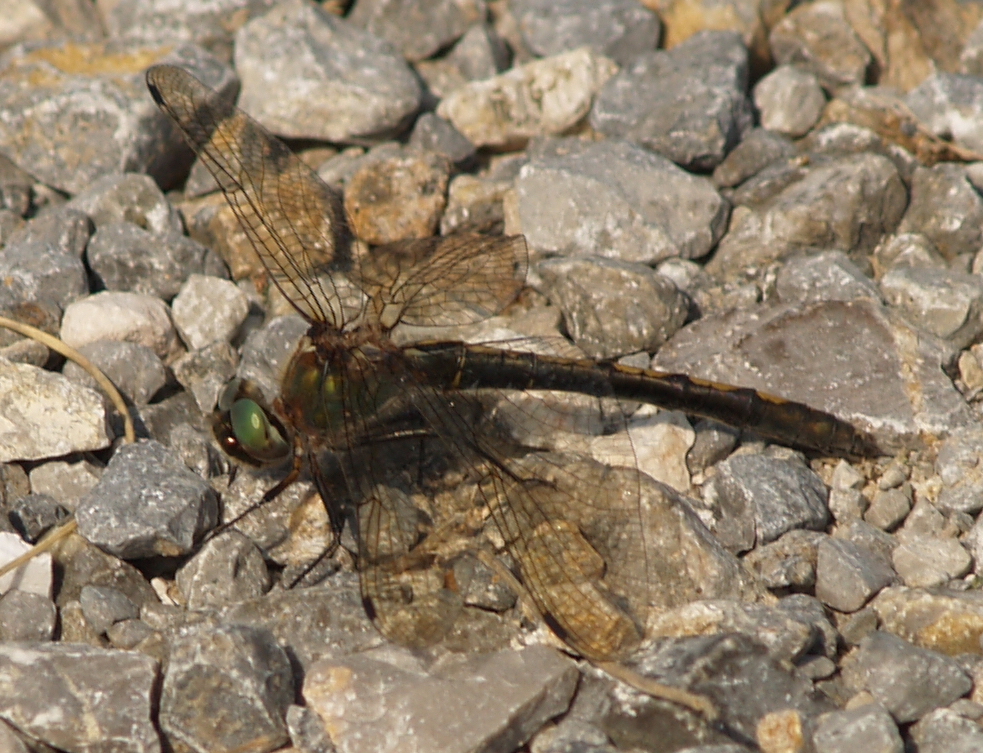
Oxygastra curtisii (female), 10.vii,16 – Cuchía, Cantabria.

It needs slow moving rivers to breed in, which does fit this area of Cantabria where the rivers have calmed down a bit on their way to the Cantabrian Sea after having rushed down the mountains nearby. But the waters need to be really, really clean for it to have a chance to survive and until the early 2000s the factories were not always focused on dumping clean water into the rivers here. This has changed and improvements have been monitored by local organisations here, so who knows, we might start seeing an increase in sightings. It still remains incredibly rare here in Cantabria and I have tried to spot another, but to no avail so far …

However, the IUCN Red List classifies the species as Near Threatened NT and that assessment is probably right on the money. It is also listed as a protected species in Spain.

Our Article

So, the observations were so interesting we, when I was still part of Proyecto Lepides (organisation now defunct), decided to send a scientific article to a reputable publication here in Spain, the Boletin Sociedad de Entomologia de Aragon (or SEA). Jorge Garzón wrote it in Spanish after I sent him an English version of the events. He dressed the text up a bit so that it was all a bit more official, as I’d never done something like it before. I’m still super proud of it and I see it as part of the foundation to help justify all the time I’ve spent out in nature, observing, having fun … there’s nothing like a little recognition for your work … now if I could only publish more articles … hmm … (stay tuned).

Further Reading

  • Klass-Douwe B. Dijkstra, Asmus Schröter & Richard Lweington (illus.). Field Guide to the Dragonflies of Britain & Europe – 2nd edition. 2020. Bloomsbury, 336 pp. – Pretty much the go-to guide at the moment. Pretty stunning book.
  • Christophe Brochard, Dick Groenendijk, Ewoud van der Ploeg, Tim Termaat. Fotogids van Larvenhuidjes van Libellen – 2e druk. 2016. KNNV Uitgeverij. 320 pp. – In Dutch but great pictures of the skins (exuvie) Odonata leave behind.
  • Christophe Brochard, Ewoud van der Ploeg. Fotogids Larven van Libellen. 2014. KNNV Uitgeverij. 236 pp. – Same as the above, also in Dutch, but then of living larva of Odonata. Again, stunning photos.
  • My SEA article that I wrote together with Jorge Garzón.
  • A list of sightings in our area on our (now defunct) project page of Proyecto Lepides on Observation.org.

Odonata Update – Orange-spotted Emerald – Oxygastra curtisii (Dale, 1834)