Introduction
So, I’ve set out the moth trap on the balcony a couple of nights so far in 2023 … zero, zilch, no luck. As I stated in a previous post, the street lighting has been changed to LED … great for the environment when it concerns energy usage but poor when it comes to light polution. Unfortunately, I’ve not had to time to set the trap in a friend’s garden, so the best thing I can do, for the moment, is to write up on some interesting species I’ve managed to see.
However, if all goes well I will set up the trap this evening at a friend’s house and then this weekend I will do it again in Salinas de Pisuerga, Palencia, where another friend lives. I’ve identified a number of species (moths, butterflies and dragonflies) I’d like to see this year, which includes Valeria jaspidea, and put all related data into an Excel sheet. Below is a screenshot of the moth section to give you an indication of what I’ve done. Will add to it as I come across other interesting species.

Valeria jaspidea
Valeria jaspidea falls under the Noctuidae family of moths and is quite similar to Valeria oleagina ([Denis & Schiffermüller], 1775). I cannot find the paper that details the difference and if it is widely accepted or not, but Lepiforum (see links below) has them as different, so I’ll keep it at that too. Apparently,Valeria jaspidea occurs in the western part of southern Europe, whereas Valeria oleagina in the eastern part. I also cannot find a map of where the split would be, and if they overlap.
(Ugh … getting used to using this tool again and lost half of the post in trying to update it … oops) The moth can be found throughout the Iberian peninsula, but it is rare. To be honest, with the continual growth of eucalyptus plantations in Cantabria (which dry out suitable habitats) this species looks to need to be ready for a struggle to continue surviving in the region. Also, with the changes in landscape management (farming techniques) this will only add to the struggle they already face.
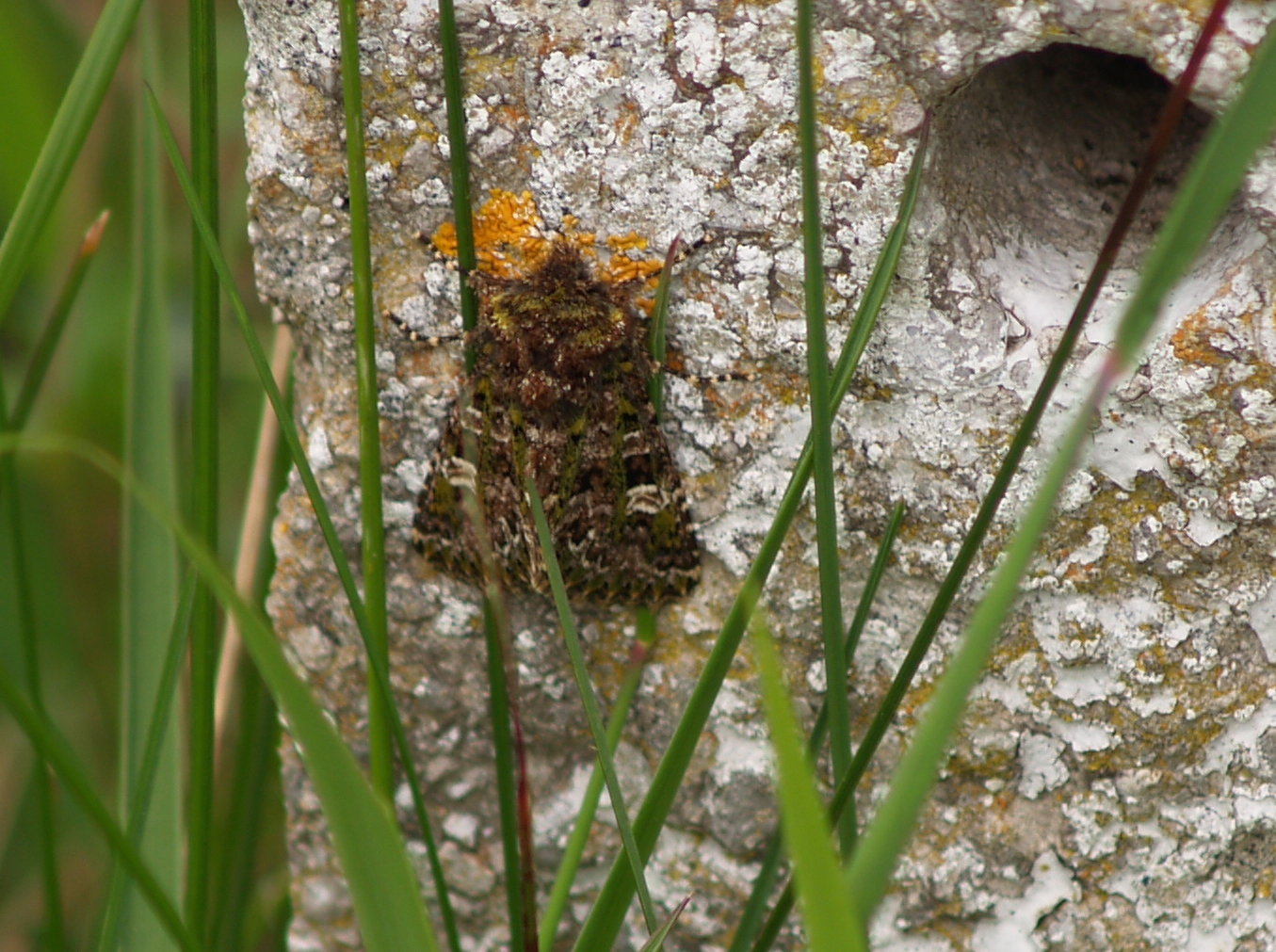
The caterpillars of Valeria jaspidea feed on Prunus spinosa (blackthorn) and also Crataegus sp. (hawthorns). The moths fly from March to May and can often be found at rest at the bottoms of walls and stones. They have these stunning streaks of green that make them look like a moss that might grow on a blackthorn.
Further Reading
- I have written a blog post about the moth resource books I use. It will be published on Friday (30.iii.23) after which you can find it here(will add link).
- This is a link to a great site called Pyrgus.de that I reference a lot. Excellent information and photos. He hasn’t updated or added Valeria jaspidea yet (not sure why) but the info can be found here under Valeria oleagina.
- No moth reference list is complete without a link to Lepiforum, an incredibly in-depth site. Here is a link to the moth’s page.
- All sightings in my region of Spain as recorded through Proyecto Lepides.
- I actually wrote a blog about walking the transect when I saw this species, see here.
 Searching for Cullum's Bee