Butterfly Bulletin – Map Butterfly – Araschnia levana (Linnaeus, 1758)

Introduction

Climate change means that over time micro adjustments in local environments slowly transform habitats to be suitable, or unsuitable, for certain species. We normally associate climate change with increase in temperature, which means that, in Europe, southern species expand northwards. So, Mediterranean dragonflies slowly start to appear in places like Cantabria, as the general temperature of suitable bodies of water increases, or instead of being permanent bodies of water they become ephemeral (not suitable for fish, so dragonfly larva have a better opportunity to grow to full size and transform into imagoes).

Today the curious case of a butterfly that appears to be expanding southwards and westwards further along the Cantabrian coast.

Map Butterfly

No matter which books you dive into, distribution maps of the Map butterfly (Araschnia levana) show the southern limits of the range just creep into Spain into the Basque Country around San Sebastian. I always found this fascinating, as in Cantabria we have a fairly similar climate to countries like the UK and The Netherlands and with the larval host plant (LHP) being nettles (Urtica sp.), abundant here, it seemed like a no-brainer that this species should be found here. However, there is no mention of the species in Pablo Sanz Román’s book, and he was an avid collector of butterflies … if it flies here, he has it pinned in his collection.
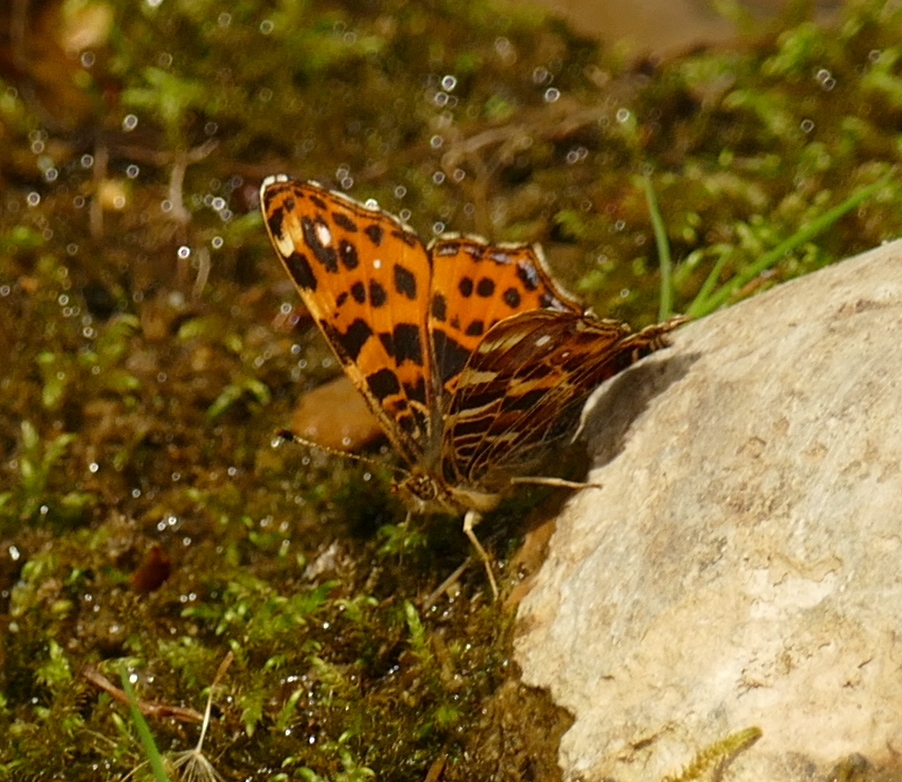
Picture of a Map butterfly.
Fig. 1 – Map butterfly (Araschnia levana), first generation, 24.iv.21, Arredondo, Cantabria, Spain, 30TVN58. Photo Bart van Hoof.

In 2019 I got news from some friends that they had seen Araschnia levana near Liérganes, a village quite near to where I live (say 40 km east as the crow flies). However, it wasn’t until 2021 that I’d see the butterfly myself. After a lovely hike with the family around the Collado de Ason (a waterfall), we’d made our way back down to a picnic area near Arredondo. After a good meal I took my camera to scout the area a bit and almost straight away saw it flying and land to take some moisture from water coming from a natural spring nearby.

I’ve not seen the species since, but it was recorded a reasonable number of times in 2022 (in the Basque Country) and it was even seen last week in Cantabria (with photo evidence)!

Distribution map for the Map butterfly in the Cantabrian region.
Fig. 2 – Distribution map for the Map butterfly (Araschnia levana) in the Cantabrian Mountains. Screen capture of the Observation.org page (see links below), taken on 23.iv.23.

An interesting thing about the Map butterfly is that it has two flight periods (called generations) in a year, the first from April to June and the second from July to August. The cool thing being that it shows seasonal dimorphism … this means that both generations look markedly different, with the first being more orangey (the one I saw, see above) and the second being almost all black! (the one my friends saw).

If we look at the screenshot above (Fig. 2), the species seems to be creeping westwards along the coast (each red square is a 10×10 km UTM square). The observation in the Picos de Europa (the left-most red square on the map) was in 2022 but is not supported by a photo, so we can’t validate it. My sighting in 2021 is the square at the bottom of the “cross” near Santander, with Liérganes being the left-most of that “cross”.

Conclusion

So, what is going on here? The species clearly seems to be expanding towards the west across Cantabria … where in literature there is mention of it expanding northwards in Europe into Finland and Scandinavian countries (as you’d expect with climate change). My speculation … and I clearly want to state that this is just a first idea … is that Cantabria is becoming drier (less rain during the winter – another friend has a weather station and he mentioned this to me a while back) and maybe it was the humid (temperate) conditions that the butterfly was not adapted to.

Anyway, this would be an interesting scientific paper … and is on my list to write up (I need to connect with some scientists on this topic). One of the difficulties is that because the LHP is nettles it is not a butterfly that you can pinpoint in an excursion (as you might a high-mountain species or one that has a very specific LHP) … so you basically have to luck into seeing it here. It is the perfect species for a general monitoring scheme that they have in many European countries because volunteers walk the same transects throughout the year and will therefore spot changes earlier. Since 2019 my eyes have been peeled around this time of year … but I’ve only been lucky once.

This species also illustrates that while something might be common (read: slightly boring) in the temperate, central-European landscape … here (also considered temperate), at the fringe of its distribution range, it is still an exciting, rare sight.

Further Reading

  • As always, the Proyecto Lepides Observation.org page to keep up to date on current sightings.
  • The list of the butterfly books I own.
  • The Dutch butterfly organisation (Vlinderstichting) has a good page on it, in Dutch but easy to get the basic info from it even if you do not read Dutch.
Butterfly Bulletin – Map Butterfly – Araschnia levana (Linnaeus, 1758)

Nature 101 – Base Knowledge – Naming

Introduction

I should have posted something like this earlier because it will cover the basics in all past and future posts. So, what am I talking about? There are some Nature 101 subjects that might not be known by readers, but if you know the basics, a whole world can suddenly materialise in front of you. For example, the naming conventions I use in my posts, which includes common names, scientific names, families, etc.

Not all readers will have a background or interest in what I cover in my posts but might stumble upon it through a link or a random internet search. This means that those readers might think; “Huh, why is he writing this?” or “What does that mean?”. By providing a little bit of background information it might entice the reader to want to look deeper into certain aspects I cover or into things they come across in their daily lives. For example, they might be out on their daily walk and come across an interesting flower … maybe something they’ve picked up in the Nature 101 series will help them find out more about that flower.

As a side benefit, this will be a longish post and will therefore help me build up my writing style again. I’m a Technical Writer by profession and so my daily work has meant I’ve had to strip some of the creative/random flourishes from my writing to be able to meet my client’s demands. I used to write a lot in my free time but now, after a day of work I don’t always feel like sitting down and doing more writing, I might choose to go out and go for a walk, or do something with me kids etc. Anyway, without further rambling, let’s get into it …

1.0 Naming

I’ll start with a very broad statement … all plants and animals have a scientific name, but not all plants and animals have a common name. Broad because, well, there are of course plants and animals that have yet to be discovered by science and so have not yet been given a scientific name, but you get the general idea.

1.1 Common Names

When I first started out, I was talking with Spanish and Dutch friends about what we’d come across in the field. I was also reading English books to help build up my knowledge. This means that for a specific bird I might have to know the Spanish, Dutch and English common name so that I could talk and have a decent conversation with all my friends … I quickly realised that I would go nuts if I have to learn all those names for everything that I had an interest in … solution, learn the scientific names because those are the same no matter what language I’m talking in. For example … know what a Gyps fulvus is instead of a vale gier (Dutch), Eurasian griffon vulture (English) or buitre leonado (Spanish) (writing convention – the Spanish and Dutch names are in italics because I’m writing this article in English).

That is why I’ve moved away from common names … I still do use them but prefer scientific names because I have noticed that there has sometimes been confusion when using a common name in a conversation where I realised that we weren’t talking about the same species of butterfly. However, I realise my situation might not be a regular case and I might be a bit nerdy in this regard.

There is a case for common names because they stimulate the imagination and so can be a great entry point in building an interest in nature. For example, Spotted redshank sounds great compared to Tringa erythropus.

However, sometimes you are forced to learn the scientific name, because not all plants and animals have been given a common name in a certain language. The English language is pretty good at slapping a name onto everything though.

1.2 Scientific Names

Scientific names can be daunting because they are in Latin and often you might not even understand what it means. I’m not going to explain what the names mean but I will provide an insight into what they are based on.

1.2.1 Taxonomy

The first thing to understand is that the names are based on taxonomy systems first set out by Linnaeus in 1735. However, this system has been continually updated as we have built on our understanding of nature, our planet etc.  This is also one of the main reasons that scientific names can change over time (more on that below).

Here is an overview for a certain species on the taxonomy behind the name:

  • Order – Family – Genus – Species
  • Odonata (dragonflies and damselflies) – Aeshnidae (hawkers/darners) – BrachytronBrachytron pratense (Hairy hawker)

Now a family might have numerous genera (plural for genus) within it … in this case, in Europe the genera of Anax, Aeshna, and Boyeria also fall under the family of Aeshnidae. Some of these genera have more than one species within them … e.g., Anax imperator and Anax ephippiger (among others). The genus of Brachytron only has one species within it (in the whole world).

The stuff about orders is well set out, however, the changes occur in the three levels below that (so a species might shift into a different genus based on DNA analysis). To complicate things a bit more … there are also classifications that fall between the four general levels above, such as Subgenera, Infraorders (under orders … in this case Anisoptera, to distinguish dragonflies from damselflies (Zygoptera)), and Superfamilies (below infraorders but above families).
Okay … the main thing that needs to stick in the beginning is the order and species. The order because you want to at least have a basic understanding of what you are looking at and to be able to differentiate between a dragonfly and a butterfly (order – Lepidoptera). Species because that is probably what you are interested in finding out … only later will you realise that a species is not always possible to get to through photos made out and about and so the best you’ll be able to do is genus. But hey … first things first.

1.2.2 Scientific Naming

So, what do various styles of scientific names mean?

  • Brachytron pratense (Müller, 1764) – This is the binomial name. So, we know that the species is Brachytron pratense and that we have to put that in italics. But the rest? Müller is the name of the person who first described the species, and they did that in 1764. You can Google the name, it is Otto Friedrich Müller, a Danish naturalist. His name and date are in brackets because when he described it, he named the dragonfly Libellula pratense. Over time it has become clear that the genus Libellula has different characteristics and Brachytron was described by another scientist (William Frederick Evans) in 1845. So, the brackets mean that there has been a change in the original name.
    Why do they add the person’s name? So that the reader is 100% certain they know the correct species being discussed in a paper.
  • Anax sp. or Anax spec. – Sometimes when we’re out in the field taking photos, we can’t quite ID an insect/plant/etc. down to a species level, but we can identify the genus … then we add either sp. or spec. after then genus … it basically means “I know I’ve seen an Anax dragonfly, but I’ve not been able to identify the exact species.”
  • B. pratense – Sometimes the genus is shortened to the first letter (and a period) … basically the writer is writing about that species and does not feel like writing the whole name out each time. Care must be taken when writing about multiple species that have a genus that starts with the same letter … e.g., A. imperator and A. isoceles, where the first is Anax imperator and the second is Aeshna isoceles. Does the reader know they both aren’t Anax?

Conclusion

Okay, this has been one long post even though I’ve tried to keep it basic and brief … but hopefully you’ve picked up one of two things to take with you when you read a future blog post of mine. I’ll try to see if there are other Nature 101 subjects I can cover in future posts (maybe some about specific orders). Also, I think I’ll post these on Fridays from now on because the topics fit well with the Book Club stuff. I’m still figuring this out a bit. Finally, I’ll make sure that there is a list for all Nature 101 and Book Club posts on a general page.

Thanks for making it down this far!

Nature 101 – Base Knowledge – Naming

Local Hotspots – Canteras de Cuchía

No post last Tuesday because I ended up quite a few days in bed with fever. I had expected to head off to a small village in the north of Palencia to put out a moth trap for the night and then, upon returning home I’d write up a piece on how it had gone. Friday I already felt terrible shambling about the place and by the next day I couldn’t move … last Wednesday I ended up running some errands but still in a groggy state … ah well.

Introduction

So, no moth report, but I did end up going to the Canteras de Cuchía on the Thursday, and again the past Sunday. This is one of my favourite local spots to go check out wildlife. It is an old quarry (cantera) site for a local chemical plant (Solvay) near Torrelavega. I think they used the carbonate rocks. The site is situated across the river from Suances, and it is where the Saja River meets the Cantabrian Sea. Basically, a whole hill was quarried away and what is left is a dip in the landscape. The site was granted to SEO BirdLife, and they’ve been custodians for quite some time. One of the biggest issues has been invasive species that have come to completely dominate the site, or until recently. The main culprit has been pampas grass, which was just everywhere, and it grew to massive proportions. An organisation was set up … http://stopcortaderia.org/language/en/news/ … and slowly the site is starting to win the struggle against the pampas grass. Below is a Google Maps screen capture of the area, with the large lake in the middle of the site.

Fig. 1 – Google Maps screen capture of the area. The main dark rectangle in the middle is the large lake. Cuchia (Miengo, Cantabria – 30TVP10)

The site is characterised by the cliff faces that surround a fairly unique habitat here in Cantabria, lots of wet, marshy areas (temporary lakes – critical for amphibians and insects) and many little microclimate zones that can be really warm compared with the surrounding area. They are using livestock to keep the areas clear of pampas grass, with horses and donkeys being key to keep it at bay (see Fig. 2). I always figured that this area would be great for Mossy Earth (https://www.mossy.earth – see the quarry project in northern Portugal) to be a part of the project here and really take it to the next level where the whole area is fenced off to let the livestock really roam about the area. I know that in The Netherlands there have been similar projects that have had great success (the ENCI groeve near Maastricht is stunning – https://www.amazingplaces.com/netherlands/enci-groeve-nature-park/).

These wet zones are a haven for bird and insect life, and you can even spot larger mammals like badgers (Meles meles), otters (Lutra lutra), foxes and others from the weasel family. Hares have also recently taken a spot in some of the cleared areas.

Fig. 2 – Some of the area to the right (southeast) of the main lake that has been cleared and is maintained by horses.

Getting Around

The best spot for parking is on the north side (centre top of Fig. 1). Towards the beach there’s a wet/reedy area that has a couple of board walks running through it, the dune area is quite nice, but it does need better management. However, it gets a lot better once you make your way up and over the hill in a southward direction and head down into the quarry. Most of the area to the west of the main lake is closed off and you must stick to the paths. However, everything to the east of the lake is open, although you might have to pass over some makeshift fences that are there to keep the horses in, that leads you to the likes of Fig. 2. You are surrounded by cliff faces and on a sunny day with little wind it can get really hot down there. It is a bit wild there, no real set paths to follow, or signpost to help navigate you around the area. You have to just go for a small adventure.

If you want, beforehand you can walk from the car park to the lookout point and get an overview of where you’ll be walking later, but that area around the car park is not the nicest spot. But when you are down there between the willows and reeds you might lose your orientation, so it might help you set some bearings for when you go down.

I should also note that there’s a parking near the small port in the southern area, but I never go there. Lots of pampas grass and not the best spot (garbage about etc.).

Conclusion

Take a hat for the sun, some snacks and some water and you’re set for 3-4 hours at least. I like getting there around 9 AM at the latest. Highlights are birds and insects (dragonflies!). Visits are interesting all year round, with lots of migratory birds passing through.

There is still a lot of work to do to keep invasive species in check, but if they keep it up this will be amazing in 5-10 years’ time. I personally hope they get rid of some of the eucalyptus and plant birch instead.

Local Hotspots – Canteras de Cuchía

Book Club – Books on Dragonflies & Damselflies

Another post in the same veis as the previous Book Club posts, which focussed on the books I use to help me ID species or general reference books I use. This time on Odonata … although each book states dragonflies, they all include damselflies too.

General

  • Askew, R.R. – The Dragonflies of Europe – revised edition – 2004 – Harley Books – 308 pp. – Although older than the Dijkstra books (and you can tell – it was first publised in 1987(?)) it is often used as a reference citing in scientific papers because it is a touch more in-depth in the information given. Richly illustrated (not as good as Lewington – see below – though) some of the detailed illustrations are excellent. Out of print.
  • Bos, Frank, Marcel Wasscher & Weia Reinboud – Veldgids Libellen – herzine editie, 10e druk – 2022 (1st edition 1997) – KNNV Publishing – 290 pp. – Really nice field guide. In Dutch with a focus on the Benelux (Belgium, the Netherlands. and Luxembourg) region it does cover some southern European species. A recent addition to by “library”. I still prefer Dijkstra for IDing because the illustrations are just so good. However, there’s a lot of excellent information (maps, bibliography etc.) in this book, which includes Red List data. A great addition for anyone who lives in the Benelux and those who can read Dutch.
  • Boudot, Jean-Pierre & Vincent J. Kalkman (eds.) – Atlas of the European dragonflies and damselflies – 2015 – KNNV Publishing – 382 pp. – A bit more of a scientific overview where there is a large list of scientists who describe specific individual species, including notes on conservation. Has a massive bibliography at the end to really help you dig deeper into specific countries/regions etc. if you’d like. Some photos (by Fons Peels) of each species, but not really meant to help you ID. While intersting and in-depth, I’d say more for the completionist. Out of print. Hardcover, in English.
  • Dijkstra, Klaas-Douwe B. & Richard Lewington – Field Guide to the Dragonflies of Britain and Europe – 2014 reprint (2006) – British Wildlife Publishing – 320 pp. – The modern reference work on Odonata … now available in a second edition (see below) … the copy I own of this book is all beat up and heavily used. Stunning, with Lewington illustrations of all species and some photos.
  • Dijkstra, Klaas-Douwe B., Asmus Schröter & Richard Lewington – Field Guide to the Dragonflies of Britain and Europe – second edition – 2020 – Bloomsbury – 336 pp. – An updated version of the above. I havn’t really checked what the updates are. A must buy for any dragonfly enthusiast, as it is absolutely amazing. In my opinion, hands down the best book available to help ID species.
  • Brochard, Christophe, Dick Groenendijk, Ewoud van der Ploeg & Tim Termaat – Fotogids van Larvenhuidjes van Libellen – tweede druk – 2016 (1st edition 2014) – KNNV Publishing – 320 pp. – Companion piece to the previous book. Another stunning photo book on the skins that dragonflies leave behind after they’ve emerged from their larval state. Again, does not cover all of southern Europe’s species, but essential for reference and ID if you want to get deep into Odonata. Hey their skins are quite easy to find, and you can take them with you without harming anything. I’d get this book (or something similar in a different language) over the previous one, if you need to choose between the two, because of that. Out of print. Hardcover.
  • Brochard, Christophe & Ewoud van der Ploeg – Fotogids Larven van Libellen – 2014 – KNNV Publishing – 242 pp. – In Dutch … but oh man … a bit specialist, but essential if you want to get a bit deeper into dragonflies. Stunning photos and amazing, in-depth information on dragonflies in their larval stage. Does not include all species in southern Europe. There are English (and French, German and 1 Spanish) books available on the subject, but if you can read Dutch this is excellent. Out of print. Hardcover.

Spain

Specific Regions in the Cantabrian Mountains (my area of interest)

  • Gainzarain, José Antonio – Atlas de las Libélulas de Álava – 2a edición – 2018 – Diputación Foral de Álava – 166 pp. – In Spanish. This on dragonflies in one of the provinces in País Vasco (the Basque country) by one of the Spanish experts on dragonflies. The ecology is slightly different to where I live, many more dry/hot areas in Álava. However, the book is very well written and given a great overview of what you can potentially find here. The great thing about regional books is that you get a better feeling of where on the scale of common to rare a species is. There’s also better information on the types of habitats that you might find the species in. Not really required if you are just visiting the region, as some of the general books (i.e. Dijkstra) do a good job already. So, more for the completionist.

Comments

The other books I’m keen on getting are one (or two) by Corbet …
Again, the out of print books can be costly to get a hold of these days.

So … it should be obvious that for Spain there is no book easily available that is not a translation of one of the above. Also, the above are all so good that I’ve not seen the benefit of picking up anything related to Spain in general. There are PDFs for specific regions (e.g. Pais Vasco, Extremadura, Andalucía) you can find on the internet. I do think these regional reports hold value due to the specific requirements habitats need to have for certain species and so a regional overview can really zoom in on suitable locations.

Again, I’ll try and keep this list evergreen …

Final Note

My list of non-reference works includes: Dragonflight and The Dragonfly Diaries … but they are not that great (spoiler if I get around to discussing them).

Book Club – Books on Dragonflies & Damselflies