I thought I’d write up another Local Hotspot post, mainly to see how I could improve them and develop them so that they are useful for any nature enthusiasts who travel through the region. Again, I’m trying to highlight some locations that might not be known or evident for the traveller from outside of Cantabria. They might not be worth visiting if you are just passing through, but if you are here for a week or two then they are something to consider.
Introduction
So, without further ado … El Minchón … along this stretch, the Saja River (which also runs along the other Hotspot, Canteras de Cuchía) forms the boundary between the municipalities of Cabezón de la Sal and Mazcuerras. On the Cabezón side there are the villages of Vernejo and Ontoria that have access to the area. In the case of Mazcuerras, it is the main village itself and Villanueva de la Peña.
Below (Fig. 1) is a a Google Maps screenshot of the area. Not sure it works, but I’ve blurred most of the area around the location just to try and accent it more. I’m thinking I should maybe remove the colour from the image in areas that are not part of the location … will look into it and make a change in the future (and for all Local Hotspot posts).
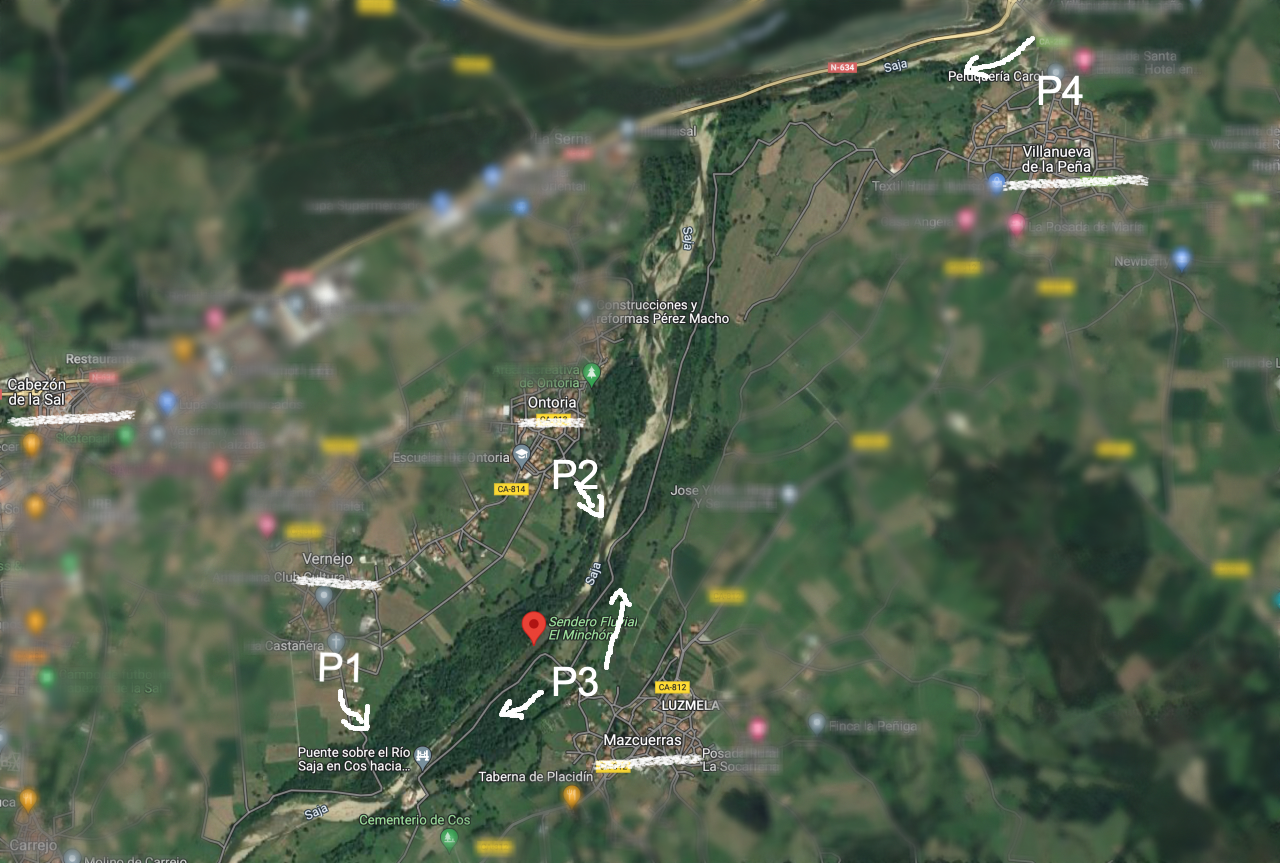
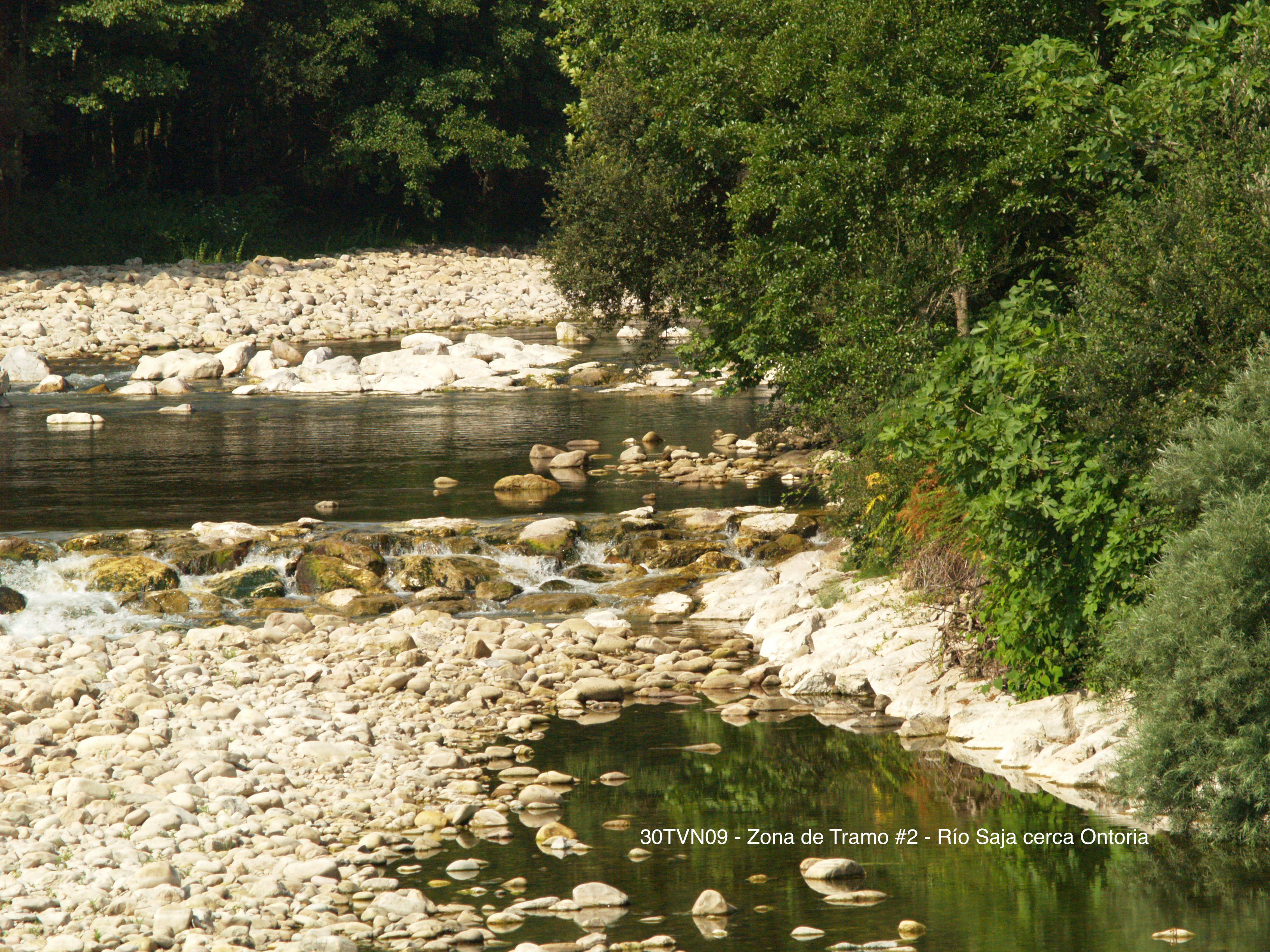
El Minchón is a wooded area around the Saja River, it covers both banks and for the most part is surrounded by farmland. The trees are mainly poplar (Populus sp.), birch (Betula sp.) and willow (Salix sp.) with lots of areas of low growth shrubs, ferns, or open grassy patches. There’s a great mix of areas that are a bit drier and ones that are quite wet … and then there’s the river itself with all the little streams that flow around and into it.
On the side of Cabezón de la Sal (the section between Vernejo (P1) and Ontoria (P2)) some farmers have been allowed to let their livestock (sheep and horses) roam around freely in areas that they set off with temporary fences. This helps create little microclimates, open areas etc. … great for all sorts of wildlife (more on that below). There are little paths that make their way through the area, almost always coming back to the main gravel path that runs parallel to the river. The only area to cross the river (without getting your feet wet) is near P1 where a prominent footbridge provides great views up and down the river.
On the Mazcuerras side there is a large field and picnic area (P3). The path that leads back upriver takes you to the only bridge crossing in the area (near P1). The path down river is a bit hidden at the back of the football field, it is not well maintained, can be slightly overgrown in parts, and can be a muddy, narrow dirt path at times, but it eventually leads to you Villanueva de la Peña (P4) where you end at a small church hugging a cliff face, some picnic tables and the new bridge (you can’t miss it).
Getting Around
The 4 areas where you can park a car all have different benefits:
- P1 – This is where I usually go in, as I prefer the area between P1 and P2 for wildlife spotting. I usually park near a small church, but parking is limited, and roads are narrow so beware. Once you enter the area through a wooden gate there are tracks leading off left and right, great to explore the area. The river near P1 has been altered quite a bit by man, but recent heavy floods have smashed some of the barriers to bits (see Dam Removal Europe on why removal of these types of barriers (non-essential) is critical), creating some swimming areas etc.
- P2 – There is a dirt parking area near the river, but not maintained, so it can be rough on your car. You can’t really walk downriver from here but have to go up towards P1. However, this is a fairly natural stretch, so easy to get to the river and see if you can spot trout or salmon (or emerging dragonflies).
- P3 – An adventure to get there because you go through very narrow streets (keep your fingers crossed you don’t meet someone coming the other way!) of Mazcuerras and just before you get to the parking area you have to drive through a stream. P3 is great if you are with family and friends. They can relax and play while you explore the area. Also, the path to the main bridge is well maintained and easy to walk with little kids, lots to see. Going from P3 to P4 is slightly more adventurous though, but an excellent area for birds.
- P4 – More for if you want to go for a walk. Because the route is not circular it is basically towards P1 and back, hence I never really go there. Also, they just finished the new bridge (April 2023) in Villanueva and the path starts just where they were doing a lot of groundwork for that side, it has been a messy construction site for years, it used to be a nice playground for kids, so maybe they will set that up again.
So, it depends on what you want to do. For Proyecto Lepides I used to walk a transect from P1. I can easily spend a couple of hours exploring the area. Hence, starting at any of the other locations means I just have to walk more to get to the area that is most interesting from my viewpoint. But for a relaxing morning/afternoon out then P3 and P4 can be great options. We go to P2 when we want to take the kids to the river to explore and swim.
Wildlife Highlights
I haven’t even really touched on what you can see there … I don’t know much about plants, but there are orchids in the area (between April and June). My focus is insects and animals … well, the area is known for its snakes (mostly the non-poisonous ones), and I’ve seen a fair amount, including Seonne’s Viper (Vipera seoanei) which is endemic to the Cantabria mountains! Plenty of other reptiles and amphibians to see too.
Birds are great too, with plenty of dead trees left standing there are lots of woodpeckers, and small passerines. From April onwards you can hear Golden Orioles (Oriolus oriolus), and throughout the year there are plenty of birds of prey to spot. Along the river there are Dippers (Cinculus cinculus) and kingfishers.
I’ve seen a wild boar once but I’m certain there are all sorts of other mammals you can come across.
On the insect front, where to start? Flies, beetles (Stag beetles – Lucanus cervus) a plenty … for butterflies and moths it is amazing, such as the Lesser Purple Emperor (Apatura ilia – rare here), Weaver’s Fritillary (Boloria dia) and many, many more … in some of the clearings there are so many butterflies you don’t know where to point your camera first. For Odonata one of the highlights for many will be the Mercury Bluet (Coenagrion mercuriale (a European protected species!)), which is present in very large numbers here from April to October. The rocky bedding in the river also provides a great breeding ground for pincertails and a multitude of other dragonflies (e.g., Oxygastra curtisii – Orange-spotted Emerald).
Conclusion
This is the kind of spot that is great to have near your home. It is small enough to be able to follow the changes during the year, while at the same time being diverse enough in habitat to have an abundance of species within that small area. It also makes it a decent place to visit if you are keen to see a whole list of species.
Furthermore, most of the locals keep to the main path, walking their dogs, riding bikes or jogging, which means the small paths are a quiet domain giving you plenty of time to take great pictures.
 Searching for Cullum's Bee
Bart, I love to read these stories about tips in the vicinity of Cabezón de la Sale. Cannot wait to explore a few of the areas myself. Keep writing, making people part of your enthusiasm for the nature around you.
LikeLiked by 1 person
Hi Guus. Thanks for your reply!
Will try and make this series a regular. Have some ideas for possible future editions, including the old mine area around Udías.
Cheers.
LikeLike
[…] Local Hotspots – El Minchón […]
LikeLike
[…] humid, uncultivated grasslands. I’ve seen it in El Minchón (here is a link to the Local Hotspots post) and “rough” areas around flower-rich fields used for hay. The taller the grasses the better, […]
LikeLike