Personal & Blog Background

Introduction

So, I have been asked to give a little background on both the blog/site and myself. It seemed an opportune time to do this, because as you read this I’m on a 2-week business trip and I’ve written this piece during the late hours while the others are asleep and during various short breaks from some urgent work that needs to be completed (yes I know, I should be walking around stretching and not behind a screen for 5 minutes … but I do not want to accidentally wake anyone up).
Anyway, feel free to skip this post if you’re here for nature …

Personal Background

I studied Architecture at the Delft University of Technology and finally did get a BSc in Architecture, Urbanism and Building Sciences. I am super proud of that because Delft is very highly rated both in Europe and in the world for engineering and architecture (top 3 in the world since 2012 right up there with MIT and UCLondon). But I realised fairly soon that I did not want to be an Architect per se, though I really loved the theory and architectural history aspects of the degree. Hence, I did English Language & Literature at the University of Leiden at the same time. So much fun (outside of Old English, oef).

After going through a difficult personal period, where I actually worked as a house painter and went through a 6-year vocational study in 2 years (I am officially one step below a Master Painter in The Netherlands – I have the skills (I can do fake marbling etc.) but not enough experience time-wise). I ended up moving to Spain, in 2010, with a lovely woman I met while living in Brussels (we met at the Institute Supérieur de Peinture Van der Kelen-Logelain where my partner and I got the highest grades of our year).

In Spain I again switched focus and started working for an oil & gas major in the Knowledge Management department. I’ve worked my way up (slightly) to be the Lead Technical Writer heading up a very small team. It has been an immense learning period for me, and it is super interesting as the company heads into the energy transition, lots of stuff on electric mobility and such (I daily drive a fully electric car and love that technology!). A great part of the work is that I’ve been able to work from home since I started there. The team I work in is based in The Netherlands.

We have two kids, aged 9 and 7. I’m not the greatest dad, but I’m as good as I can be and always trying to be better … the learning curve has been far steeper in how to be a good parent than the curve for learning about nature that’s for sure.

Blog Background

Everything I know about nature has been gained through self-study. I have done a lot of reading and trying to put that knowledge into practice in the field. At times I’ve had help from experts and knowledgeable friends. I sometimes wish I’d followed my kid dreams while living in New Zealand of being a Marine Biologist or followed through on a visit I made as a teenager to the University of Wageningen, but hey.

Even without the correct education I’ve been able to publish some pieces in reputable scientific publications, so I’m happy.

I set up the blog because I had the urge to “speak” to someone about the stuff I was learning. Yes, I have friends in Spain, and I’ve picked up Spanish quite well, but I wanted more … to have conversations with people who are interested in the same stuff as I am and to be able to learn from them. So basically, the blog is there to speak to the reader, and indirectly myself, and help me process my thoughts and knowledge about certain aspects and topics dealing with the natural world around us. I guess I needed a way to validate what I know.

The name of the blog/site is Searching for Cullum’s Bee, here is some background to it:

  • Cullum’s Bee is a bumblebee, Bombus callumanus, it used to be present in Cantabria, in high mountainous areas, but is probably extinct in the region (though not the world, where it is still a very rare bee).
  • Waiting for Godot is an inspiration. A play by Samuel Beckett about two guys waiting by a tree for another person, Godot, to meet them there … but Godot never comes.
  • Waiting for Guffman is another inspiration. A mockumentary by Christopher Guest about a bunch of unique people in a small town and performing in a talent show, all waiting for Guffman to review their skills, but he never shows up.

I think you can see where I’m going with this. The change I made was to switch out waiting for searching because I wanted a more active verb … I, the blog writer, am not just sitting around, I’m actually doing something until I sit here in my chair writing the blog posts. Anyway, all these unique characters are the insects, reptiles etc. that I write about and I’m taking you on a journey where I chat to you (the reader) about this and that (like Valdimir) in our search to gain knowledge about nature … and there is that one elusive species, which we will probably never end up seeing … that empty chair in the audience with a special guest ribbon on it … Cullum’s Bee.

Remember to take it all with a bit of humour and not get too serious.

Conclusion

So that about covers the basics. If you want to know more, just ask, I’m very open about everything. I won’t be posting next week, too busy with work. Back in July!

I do want to mention one last thing that I am proud of … I’m dyslectic … couple that with studying English, all the writing I do (I’m a Technical Writer in my job! And I’m good at it), learning languages and all the reading I do to make sure I continually learn and gain knowledge … I never take the easy route … and so I write a blog about a topic that I know I do not really know a lot about, and push myself to know more with each post.
Personal & Blog Background

Nature 101 – Base Knowledge – Citizen Science

Introduction

Due to workloads I’ve had to shift some things around and delay a couple of posts. I’ve decided to post this one now, as it links into some issues I’ve mentioned in recent posts.

First let me briefly cover what citizen science is and then below I will mention some methodologies and organisations. It comes down to where non-scientists help the scientific community to gain data on the environment around us. This can be through monitoring insect populations, having a weather station on a property, being part of a bioblitz (an intensive field study over a period of time, maybe only a day or a week), and many more methods. Why is this done? Because scientists end up spending a lot of time doing paperwork, processing data, attending conferences and meetings etc. and the actual time that they are out in the field can be fairly limited (although I’m sure most wish they could be out there every day, for hours on end).

We cannot expect scientists to be out there gathering information, and at the same time formulating theories and opinions on what is happening in our natural environment, influencing regulatory bodies etc. etc. etc. There are many changes happening very fast (urbanisation, climate change etc.).
At the same time, there have been massive leaps in technological advancements (DNA genome sequencing), which provide the opportunity to obtain a deeper and broader understanding of the natural world. But DNA sequencing takes time and a lot of effort. How can scientists keep pace with all these developments and advancements?

Meanwhile, there are sections of the scientific community that are very conservative and do not fully appreciate citizen science. I’ve witnessed this first-hand in Facebook groups. This can be incredibly disheartening, as the expert is basically telling you your observations are worthless because you do not have a scientific background. For someone who loves learning and is not afraid to speak their mind (like me) this is infuriating. However, we cannot let this minority in the scientific community hold back positive advancements.

Methodologies

There are two general ways to approach citizen science:

  • Scientific-community driven.
  • Individual driven.

And then there are of course hybrid forms of the above.

Scientific-community driven

Scientists, organisations, universities, and such can set up activities, in which regular citizens take part, to create large data dumps, which can then be used for trend analysis and more. Examples might include:

  • An annual bioblitz to build up a species database for a local nature zone.
  • A national, annual day where interested parties record which birds or butterflies are seen in their garden.
  • An elaborate monitoring scheme where citizens walk the same transect over a period of time every week or two.

In many cases, scientists will be present to help with identification (a bioblitz) and in others there will be a public information campaign, where due to the massive load of data coming from the activity any mistakes in identification (anomalies) will fade away into the full data set (yay, statistics!).

Individual driven

This is where individuals are keen to record what they see in the natural environment, be it their garden, on vacations, and on daily walks. Where 40 years ago those observations might have been recorded in a diary, they can now be uploaded into online databases.

I’m an example in this space … I started recording things that interest me using an app that was recommended to me by a friend. Since then, I’ve recorded 1000s of observations in many locations. I’ve taken pictures to be able to back my observations and uploaded those to a public database. Many of these have subsequently been verified by experts.

Data Storage & Organisations

There are countless non-governmental organisations (NGO) that you can become a member of and who support and stimulate citizen science in many ways. While they are critical, what it comes down to for the general scientific community is how all that data is stored … e.g., those bioblitz datasets can be stored in online data repositories or they can keept in an Excel sheet on a PC.

There are some brilliant data repositories:

  • eBird – Set up by Cornell University (was looking at studying there back in the day, wish I’d made more of an effort to go there) in the USA, an absolutely stunning site and app. If you are only interested in birds, this is quite something. But that is its limitation … only birds. https://ebird.org/home
  • iNaturalist – Set up by someone at UC Berkley this has grown into a massive database covering everything. There is a focus on North America so a recommendation if your live there. Used by millions of people. https://www.inaturalist.org
  • Observation.org – Initially set up in The Netherlands and Belgium it has become a massive global database that covers everything. Also used by millions of people and organisations. I use this site and app and I highly recommend it; your photos are verified by volunteer experts/scientists. https://observation.org

The above all share their verified data with GBIF, which is important for scientific studies and data analysis. A new developmen has been that those apps are incorporating AI to identify species based on the photos you upload. Are there limitations? Yes, but it is amazing … and will only get better as AI is trained to identify more and more species and so help process data.

I would personally advise against using other data repositories than the three mentioned above. For example, a while back I had a little rant about Biodiversidad Virtual, a well-intentioned Spanish citizen science site, but extremely limited in scope (Spain) and with an interface that is far from user-friendly. Last month they communicated the intention of migrating all the data to Observation.org and joining forces. Amazing stuff! (Since then this has happened, all data has been migrated, and annotated, into the Observation.org database).

If enough people upload their observations, slowly those empty gaps in distribution maps (see Tuesday’s post) will be filled up. However, we need to realise that most observations will be in nature hotspots (national parks etc.) and in cities/urban areas, and most observations will be biased towards species that are easy to identify, come across, and species groups that most people have an interest in (e.g. birds). Furthermore, observation numbers will grow with user numbers. This does not mean that even though numbers are increasing, certain species are becoming more common. Finally, if a special species is seen and recorded, it often means that others will go to that same location to see the same animal or flower. So, one individual might be counted 100s of times (as is the case for vagrant birds), which is reflected in the numbers in the data base but does not mean it is a very common species to see.

However, even considering all the negatives, what we cannot lose sight of is the massive data set that we are slowly building up.

Conclusion

Of course there are issues with citizen science, and those need to be addressed if they can. Most of the issues concern verification. If there are many users, the number of photos that come in daily can be overwhelming for volunteers to deal with. Imagine a warm summer day across Europe and the 100s of butterfly pictures coming in on that day. Then there’s the issue with being able to properly identify species based on photographic evidence.
However, the data is there, and a scientist can use verified data or take non-verified data as a starting point for an investigation. It is better to have a data set that will include some faulty data than to have no data set at all.

I am also aware of the Dunning-Kruger effect, which comes down to people with limited expertise overestimating their knowledge in an area. The way to educate those with overconfidence in their abilities, is to do just that, educate them, show them that there is more to know than what they know. I am very self-critical and “I know that I know very little”. I need to be conservative with my observations, where if I don’t know something, I put it as uncertain or do not record it if I do not have evidence. I came to realise this because I actively went out to learn more and more, others might need a gentle push.

Therefore, we must push forward, knowing the limitations of the system, and develop, and adapt emerging technologies and solutions to help process the data. Proactive scientists are already using citizen science data to achieve amazing results and I’m super excited to know that I am playing an infinitesimally tiny part in the application of all this data and knowledge.

Sorry, it has been a long one, but I’m a bit passionate about this topic. As always, I’ve left out a lot, but feel free to go out and educate yourself further … it is not difficult, it can start by posting a question here.

Nature 101 – Base Knowledge – Citizen Science

Orthoptera Quarterly – Burr’s Wide-winged Bush-cricket – Zeuneriana burriana (Uvarov, 1935)

Introduction

The previous Tuesday post’s common species found across large parts of Europe; we go to one found only in the Cantabrian Mountains region. The goal today is to set us up for the upcoming Nature 101 Biogeography post. Well, and to show you an interesting species you can find here.

Orthoptera, in regular language grasshoppers and crickets, have not been a part of any extensive scientific studies in the region, so any distribution maps have massive gaps in them. This makes it a difficult order to study here without having in-depth knowledge yourself … where can I best find suitable habitats for specific, maybe rare, species? To give a bit of an indication, a new species was found in 1992 in Cantabria, which has a very restricted distribution, it is called Metrioptera maritima and is closely related to today’s species …

Burr’s Wide-winged Bush-cricket – Zeuneriana burriana

Before we go any further, lets quickly cover the naming aspects.

Order – Suborder – Family – Genus

Orthoptera – Ensifera (crickets only) – Tettigoniidae (katydids/bush crickets) – Zeuneriana

Zeuneriana burriana is also part of a genus group of crickets that all have fairly similar characteristics called Metripotera (to which Metripotera maritima also belongs). Now, I’m not going to go any deeper into this because it gets quite complicated how the taxonomy came about, but if you are interested there are plenty of scientific papers and web sites that can help you learn more. I’ll put some links below.

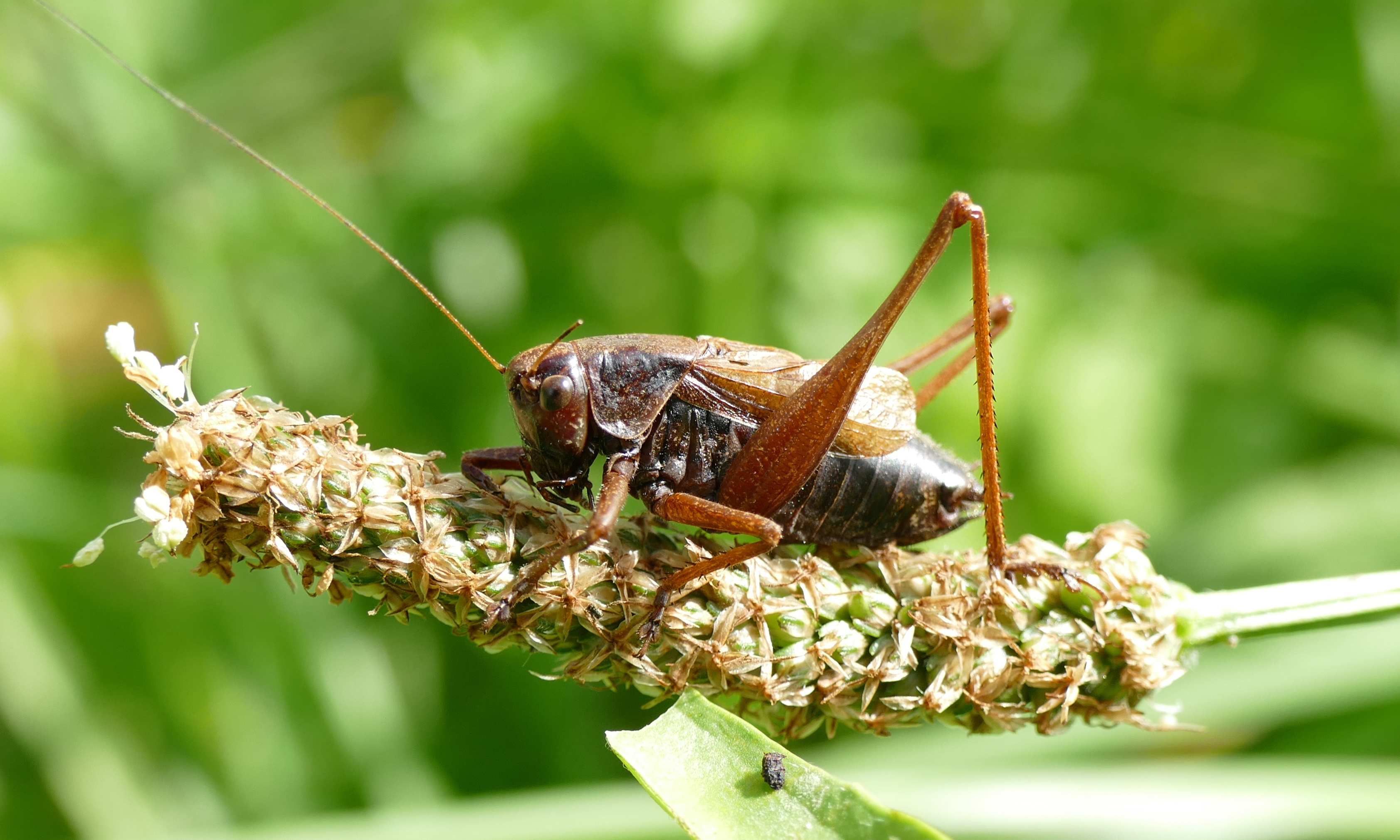
Picture of male Zeuneriana burriana.
Fig. 1Zeuneriana burriana, male. Mazcuerras, Cantabria, 30TVN09. Normally, the long antenna mean that it is a cricket and not a grasshapper.

Most of the species within the Metrioptera genus group have an extremely limited range. Within Zeurneriana there are only 4 species, of which today’s focus species has the largest range. For example, Zeuneriana marmorata (Adriatic Wide-winged Bush-cricket) is only found in a tiny region in northern Italy and Slovenia and is listed as Endangered (EN) on the IUCN Red List.

Zeuneriana burriana is rare, though found in Cantabria, Asturias, the Basque County, Leon, Galicia, and a tiny bit of France. It is found in humid, uncultivated grasslands. I’ve seen it in El Minchón (here is a link to the Local Hotspots post) and “rough” areas around flower-rich fields used for hay. The taller the grasses the better, as normally I’ll be wading through grass that easily reaches my hips.

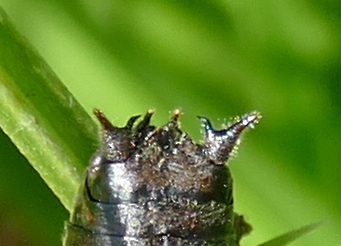
Cerci of male Zeuneriana burriana.
Fig. 2Zeuneriana burriana. Detail of male cerci.

I am not good at identifying grasshoppers and crickets, so usually ask for help from experts on the various forums. What makes the Metrioptera genus group so difficult is that when the insects are not yet adults, so in their nymph stage and the wings have not yet fully formed, they are very small and have very similar characteristics. The best way to ID species is to get good pictures of the male appendages (called cerci) at the end of the abdomen (Fig. 2). The females have a dagger-shaped ovipositor at the end of their abdomen (not used for stinging! Egg-laying only), however, I am not sure how to tell the difference between species when it comes to females. It probably has to do with the curve/shape of the ovipositor.

Conclusion

Orthoptera are difficult, but that should not hold you back from getting interested and informed about them. They are stunningly beautiful when you really get into the details, not just brown or green insects, but with flashy yellows, blues, and oranges. As mentioned, many are only found in very specific habitats (e.g., dune landscapes) so it is also a great way to be introduced to this style of nature observation, where you plan a day out to visit one or two specific areas and take your time investigating them (e.g., learning where to look etc.). You really start to learn a lot doing this, building up your knowledge base for when you go visit more generalised areas where you can spot a wider variety of species.

Another post where I’ve tried to keep it short and to the point.

Further Reading

I mentioned previously that there can be difficulties identifying Orthoptera, especially in the nymph life stage, where even there I think you’ll struggle to get definitive answers. Here are some sites:

Orthoptera Quarterly – Burr’s Wide-winged Bush-cricket – Zeuneriana burriana (Uvarov, 1935)

Book Club – Other Reference Books

Amphibians & Reptiles

  • Arnold, E. Nicholas & Denys W. Ovenden – A Field Guide to the Reptiles & Amphibians of Britain & Europe – second edition reprint with corrections – 2004 (1978 first edition) – William Collins – 288 pp. A pretty decent overview but it shows its age. The book by Speybroeck et al has just surpassed this in most aspects. The information is good, but I found it slightly difficult to use because all illustrations are in the middle and so you are flipping back and forth all the time. Have the hardcover version.
  • Speybroeck, Jeroen, Wouter Beukema, Bobby Bok, Jan Van Der Voort & Ilian Velikov – Field Guide to the Amphibians & Reptiles of Britain and Europe – 2016 – Bloomsbury – 432 pp. Another entry in the British Wildlife Field Guise series and another great one. A must buy.

Note

Although not a book, you can get a decent pamphlet for amphibians in Cantabria from Red Cambera in PDF format here. I was able to get a physical copy when I did some volunteer work with them, they might still have some so try and contact them if you are interested.

Birds

  • Svensson, Lars, Killian Mullarney & Dan Zetterström – Birds of Europe – second edition – 2009 (1999 first edition) – Princeton University Press – 447 pp. My copy is absolutely beat up, which should indicate just how good this book is, as I take it with me everywhere I go. This summer (2023) a third edition will be released, it will be a must-buy for me. Everything is goof about this book, I’ve seen books on European birds by others, but they all pale in comparison. I cannot recommend this book highly enough.

Note
Birding is probably the #1 hobby for those who enjoy nature observation … and while I love it and it was the gateway for me into the world of butterflies, dragonflies, and other insects, I feel hopelessly inadequate when it comes to IDing birds. Not in the first part because I’m terrible at bird calls. However, I continue to get enjoyment from it even though I have my deficiencies … but if I ever did nature tours etc. in Cantabria, this is the area I’d need help in. It is also the main reason why I do not write much about birds, too many other people know much, much more than I do so I do not feel like I’m adding to the conversation at all.

Hymenoptera (Bees, Wasps, & Ants)

  • Falk, Steven & Richard Lewington – Field Guide to the Bees of Great Britain and Ireland – 2015 – Bloomsbury – 432 pp. Lewington illustrates this excellent introduction and overview of bees. The main issue is that here in Spain there are many more species, especially in the difficult families. However, a valuable learning tool that is even better when coupled with Mr Falk’s Flickr page. An excellent entry in the British Wildlife Field Guide series.

Note
Bees, and then especially bumblebees, are a passion. I love them, but … they are so difficult to ID without catching and collecting them so that you can take detailed pictures. That is not something I’m ready to get into now. My goal is to one day write a big article on the bumblebees of Cantabria. I live with the realisation that I’ll continue taking pictures of bees I spot in the wild but will probably not get further in IDing them than a family and a handful of possible species it might be. Still …
As far as ants and wasps are concerned … they are even more difficult.

Orthoptera (Crickets & Grasshoppers)

  • Bellmann, Heiko, Florin Rutschmann, Christian Roesti & Axel Hochkirch – Veldgids Sprinkhanen en Krekels van Europa – 2020 – KNNV Publishing – 432 pp. Another great publication by the KNNV … but in Dutch. There is a German version available too. It does not cover all Orthoptera in Europe in detail with mainly very specific species in southern Europe only briefly covered. However, several of the authors also volunteer their services IDing photos that users upload to Observation.org so with their input there you can get far. A must buy for those interested in these insects.

Other

  • Fitter, Richard, Alastair Firrer & Ann Farrer (illus.) – Collins Pocket Guide: Grasses, Sedges, Rushes & Ferns of Britain and Northern Europe – reprint 1992 (1984 first edition) – Collins – 256 pp. A really excellent introduction. I do not know much about grasses etc. but this has been a great source of information. The maps don’t show Cantabria, but many of the species discussed occur here as well.
  • Jahns, Hans Martin – Collins Guide to the Ferns, Mosses & Lichens of Britain and Northern and Central Europe – 1983 – Collins – 272 pp. Another topic I know nothing about, but the book has helped out greatly. Both this and the grass book have been excellent to figure out what some of the larval host plants are of butterflies and moths.

Comments

More will be added if I pick up other books … am still looking for one on European mammals and maybe some other interesting insect groups, like beetles.

Book Club – Other Reference Books