Book Club – Other Reference Books

Amphibians & Reptiles

  • Arnold, E. Nicholas & Denys W. Ovenden – A Field Guide to the Reptiles & Amphibians of Britain & Europe – second edition reprint with corrections – 2004 (1978 first edition) – William Collins – 288 pp. A pretty decent overview but it shows its age. The book by Speybroeck et al has just surpassed this in most aspects. The information is good, but I found it slightly difficult to use because all illustrations are in the middle and so you are flipping back and forth all the time. Have the hardcover version.
  • Speybroeck, Jeroen, Wouter Beukema, Bobby Bok, Jan Van Der Voort & Ilian Velikov – Field Guide to the Amphibians & Reptiles of Britain and Europe – 2016 – Bloomsbury – 432 pp. Another entry in the British Wildlife Field Guise series and another great one. A must buy.

Note

Although not a book, you can get a decent pamphlet for amphibians in Cantabria from Red Cambera in PDF format here. I was able to get a physical copy when I did some volunteer work with them, they might still have some so try and contact them if you are interested.

Birds

  • Svensson, Lars, Killian Mullarney & Dan Zetterström – Birds of Europe – second edition – 2009 (1999 first edition) – Princeton University Press – 447 pp. My copy is absolutely beat up, which should indicate just how good this book is, as I take it with me everywhere I go. This summer (2023) a third edition will be released, it will be a must-buy for me. Everything is goof about this book, I’ve seen books on European birds by others, but they all pale in comparison. I cannot recommend this book highly enough.

Note
Birding is probably the #1 hobby for those who enjoy nature observation … and while I love it and it was the gateway for me into the world of butterflies, dragonflies, and other insects, I feel hopelessly inadequate when it comes to IDing birds. Not in the first part because I’m terrible at bird calls. However, I continue to get enjoyment from it even though I have my deficiencies … but if I ever did nature tours etc. in Cantabria, this is the area I’d need help in. It is also the main reason why I do not write much about birds, too many other people know much, much more than I do so I do not feel like I’m adding to the conversation at all.

Hymenoptera (Bees, Wasps, & Ants)

  • Falk, Steven & Richard Lewington – Field Guide to the Bees of Great Britain and Ireland – 2015 – Bloomsbury – 432 pp. Lewington illustrates this excellent introduction and overview of bees. The main issue is that here in Spain there are many more species, especially in the difficult families. However, a valuable learning tool that is even better when coupled with Mr Falk’s Flickr page. An excellent entry in the British Wildlife Field Guide series.

Note
Bees, and then especially bumblebees, are a passion. I love them, but … they are so difficult to ID without catching and collecting them so that you can take detailed pictures. That is not something I’m ready to get into now. My goal is to one day write a big article on the bumblebees of Cantabria. I live with the realisation that I’ll continue taking pictures of bees I spot in the wild but will probably not get further in IDing them than a family and a handful of possible species it might be. Still …
As far as ants and wasps are concerned … they are even more difficult.

Orthoptera (Crickets & Grasshoppers)

  • Bellmann, Heiko, Florin Rutschmann, Christian Roesti & Axel Hochkirch – Veldgids Sprinkhanen en Krekels van Europa – 2020 – KNNV Publishing – 432 pp. Another great publication by the KNNV … but in Dutch. There is a German version available too. It does not cover all Orthoptera in Europe in detail with mainly very specific species in southern Europe only briefly covered. However, several of the authors also volunteer their services IDing photos that users upload to Observation.org so with their input there you can get far. A must buy for those interested in these insects.

Other

  • Fitter, Richard, Alastair Firrer & Ann Farrer (illus.) – Collins Pocket Guide: Grasses, Sedges, Rushes & Ferns of Britain and Northern Europe – reprint 1992 (1984 first edition) – Collins – 256 pp. A really excellent introduction. I do not know much about grasses etc. but this has been a great source of information. The maps don’t show Cantabria, but many of the species discussed occur here as well.
  • Jahns, Hans Martin – Collins Guide to the Ferns, Mosses & Lichens of Britain and Northern and Central Europe – 1983 – Collins – 272 pp. Another topic I know nothing about, but the book has helped out greatly. Both this and the grass book have been excellent to figure out what some of the larval host plants are of butterflies and moths.

Comments

More will be added if I pick up other books … am still looking for one on European mammals and maybe some other interesting insect groups, like beetles.
Book Club – Other Reference Books

Odonata Update – Western Willow Spreadwing – Chalcolestes viridis (Vander Linden, 1825)

Introduction

Just a short one on this Tuesday that covers a common damselfly found across much of Europe. Even though it is common, there are a few interesting aspects to this species, some of which were covered in the recent Nature 101 post on Odonata.

A quick refresh in case you do not want to re-read that post …

The Western willow spreadwing is part of the order Odonata (dragonflies and damselflies) and falls under the suborder Zygoptera (only damselflies). It belongs to the Lestidae family, which in turn has three genera (in Europe); Sympecma, Lestes and Chalcolestes. Today we are most interested in the third of those two genera (I’ve put in bold the taxonomy line we need to follow to get to the species. For an introduction to taxonomy see Nature 101 Naming).

The goal for today is to link what we learnt in a recent Nature 101 post with a specific species. How does it relate to other species, but probably more importantly, where does it differ? By choosing a common species found across large parts of Europe, even a frequent garden pond visitor, it means we have a good chance of spotting it in the field and allowing us to experience the insect first-hand.

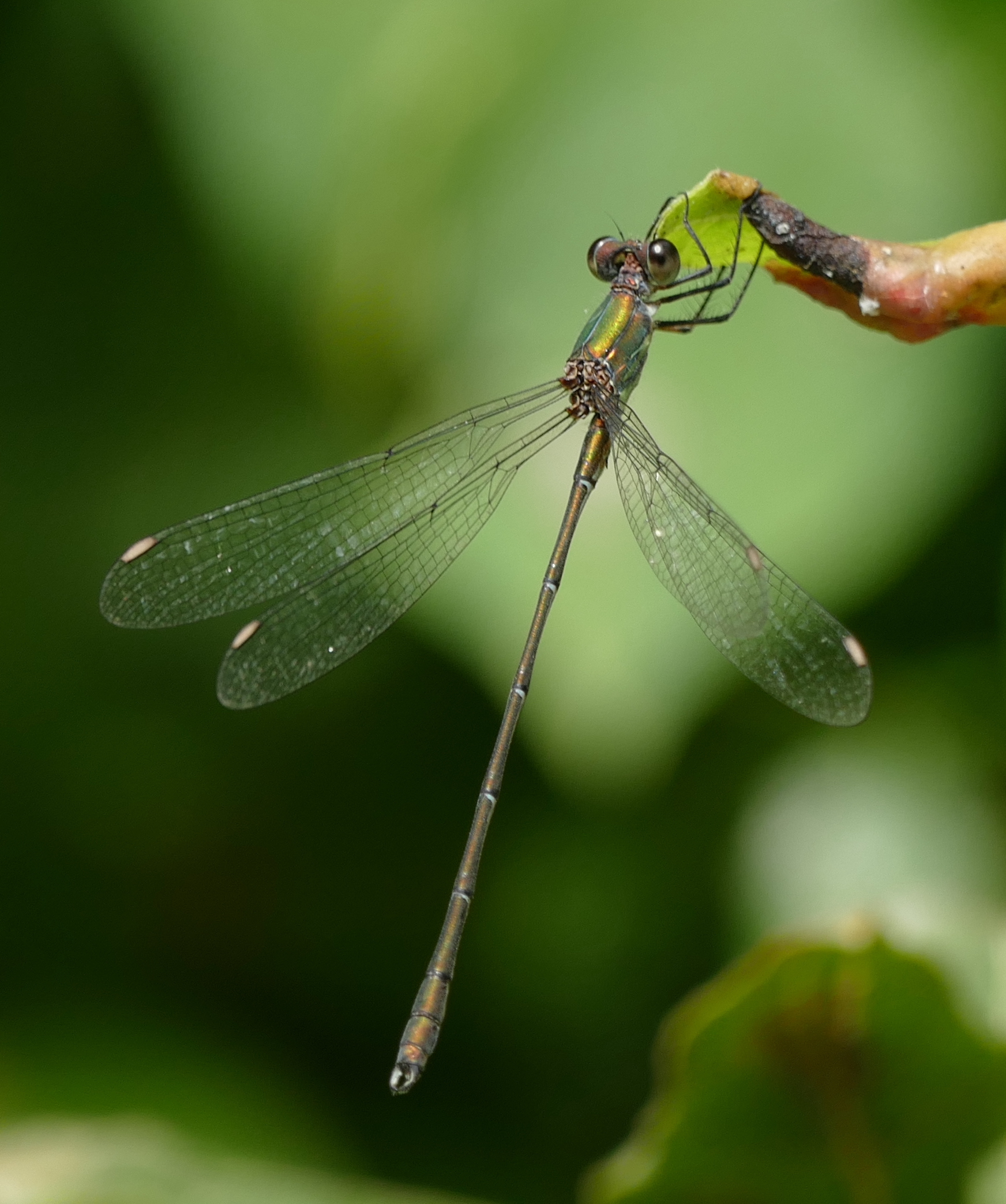
Chalcolestes viridis, male, in Cantabria.
Fig. 1 – Chalcolestes viridis, male. Santander, Cantabria, 30TVP31. 04.ix.16. Notice the spread wings and tip of abdomen.

Western Willow Spreadwing – Chalcolestes viridis

If we look at the name, Western willow spreadwing, we can assume that there is an Eastern variant too … and yes there is, Chalcolesets parvidens. Almost indistinguishable in the field, with the eastern species (previously thought to be a subspecies), found from Italy to the Balkans and further eastwards.
These are the only two species worldwide, that we know of, found in the genus of Chalcolestes.

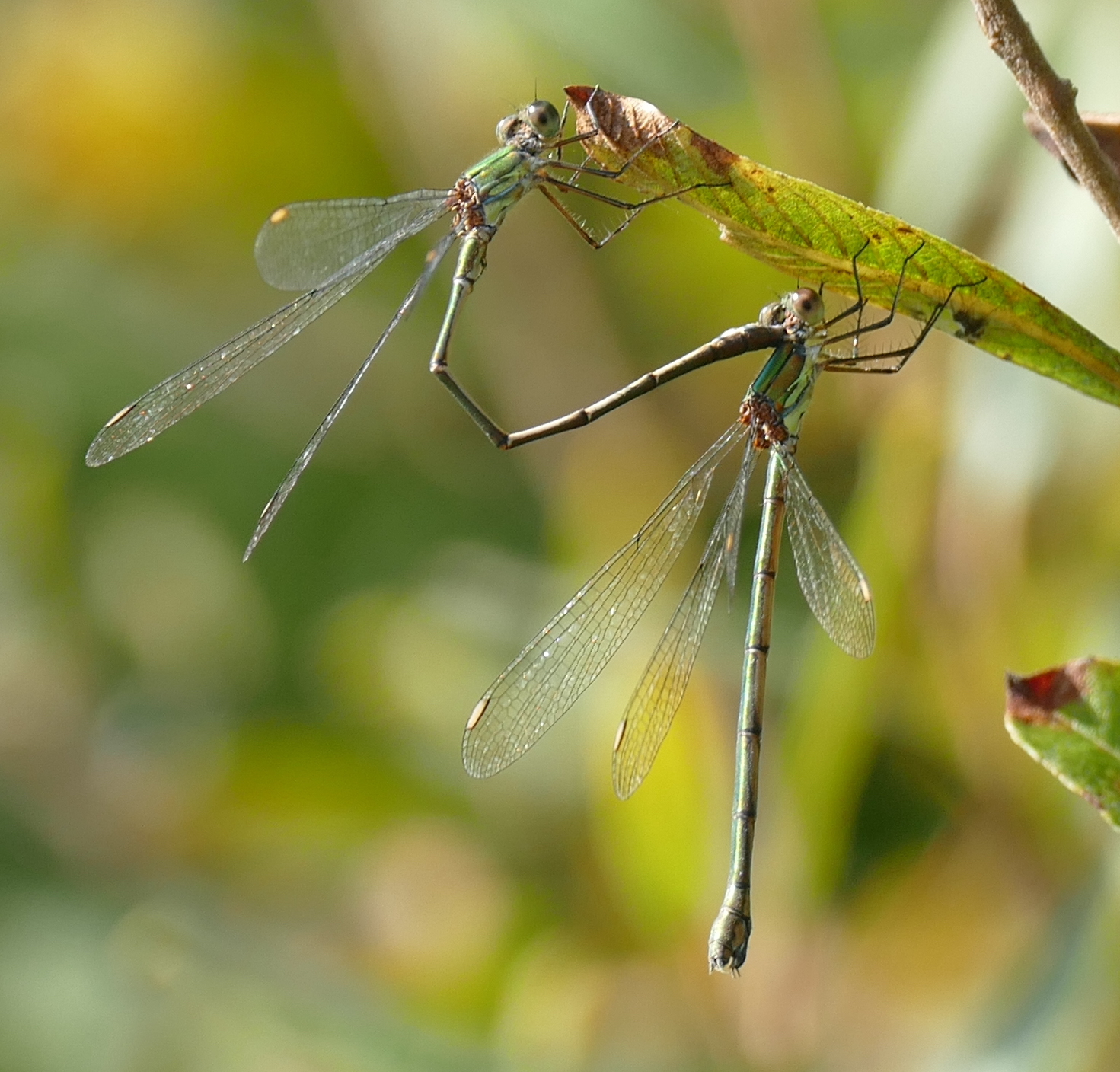
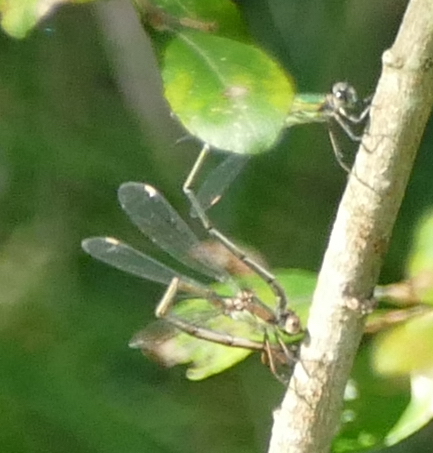
Tandem of Chalcolestes viridis ovipisiting.
Fig. 2 – Tandem ovipositing. See note 1 below.

What makes them different form Lestes and Sympecma species is that they lay their eggs in living, woody material such as reed stems or under tree bark, see Fig. 2 (sorry for the photo quality). For Odonata, and many other insects, egg laying is done through an ovipositor, which is a tube-like organ, and so is called ovipositing. The two Chalcolestes species are the only species in Europe that do not oviposit directly in water.

When in tandem (Fig. 3), they fly to an appropriate location and the female creates scratches into the bark of a twig with the rough teeth at the tip of her abdomen. In the photo of the tandem we can see the male has the female in his prong-like appendages located at the tip of his abdomen (see Fig. 1) and he is holding her by the back of her neck.

The damselfly requires slow moving to still waters with plenty of bushy vegetation around. The ponds and bodies of water cannot be ephemeral (i.e., drying up during the summer). The flight period is generally late summer and on into November. The species is common and can be found throughout Cantabria wherever there is suitable habitat.
Even though they are large compared to other damselflies, they can be a bit tricky to spot, often dangling from the underside of leaves. As with Lestes species (not Sympecma), Chalcolestes viridis holds its wings spread open when at rest (Fig. 1). In the Nature 101 post we saw that normally damselflies hold then wings along their bodies when at rest.

Tandem of Chalcolestes viridis.
Fig. 3 – Chalcolestes viridis in tandem. Miengo, Cantabria, 30TVP10. 25.ix.21. The male is holding the female, by the back of her neck, with the “claw-like” appendage at the tip of his abdomen. Also notice the tip of the female abdomen to help scratch and oviposit under bark.

Conclusion

As I mentioned, wanted to keep it short to be able to provide an easy case study for some of the things we have picked up in pervious posts, especially in the Nature 101 series. Because it is a common species it is easy to spot it in your own garden, or while you are out for a walk. This will allow you to pick up experience spotting specific insects out in nature and hone your observation skills.

Probably no post on Friday this week, am a bit busy. Thanks for reading and see you in the next one!

Further Reading

  • The list of Odonata books I own.
  • The British Dragonfly Society has a nice page.
  • The Vlinderstichting also has a good page, in Dutch. Odonata are part of De Vlinderstichting’s remit.

Notes

1 – Fig. 2Chalcolestes viridis tandem ovipositing. Mazcuerras, Cantabria, 30TVN09. 29.ix.21.

Odonata Update – Western Willow Spreadwing – Chalcolestes viridis (Vander Linden, 1825)

Nature 101 – Base Knowledge – Odonata

Introduction

As with the previous Nature 101 on Lepidoptera, today we will cover a specific order within insects. Just to remind you, the taxonomic term “order” deals with a group of insects (in this case) that have similar characteristics.

As was the case with Lepidoptera (butterflies and moths), Odonata can be split into two groups … actually, in this case it already gets a bit more complicated than Lepidoptera because there have been several taxonomical developments in the last few years …:

  • Zygoptera – this is the suborder that contains all damselflies.
  • Epiprocta – this suborder contains both Anisozigoptera and Anisoptera as infraorders. The first of which (in the past a separate suborder of Odonata) does not have any representatives in Europe (only Asia), and the second of which used to be a separate suborder too and contains all true dragonflies.

Phew, okay that was the first step. So, basically, we know that here in Europe (or the Americas) we’re trying to identify the differences between damselflies and dragonflies.

Again, I’ll refer you to the Nature 101 Naming post that gives a better/basic overview view of how the taxonomy system fits together.

1.0 Common Aspects

There are no strong characteristics that set Odonata apart from other insects (like scaly wings), but it is usually pretty clear that the insect you are looking at (in the imago stage) is a dragonfly or damselfly. They have long, slender abdomens with 4 large wings (compared to body size), very short antenna, and big eyes. In both larval and imago life stages they devour other insects (and even small fish and tadpoles) like there’s no tomorrow.
When they are still in the larval stage most people wouldn’t have a clue that they are looking at a dragonfly. How can those strange, drab (they are usually brown and covered in mud) alien creatures turn into vibrant metallic-coloured dragonflies?

With regards to life stages there are:

Egglarva (naiad/nymph) – imago (dragonfly or damselfly)

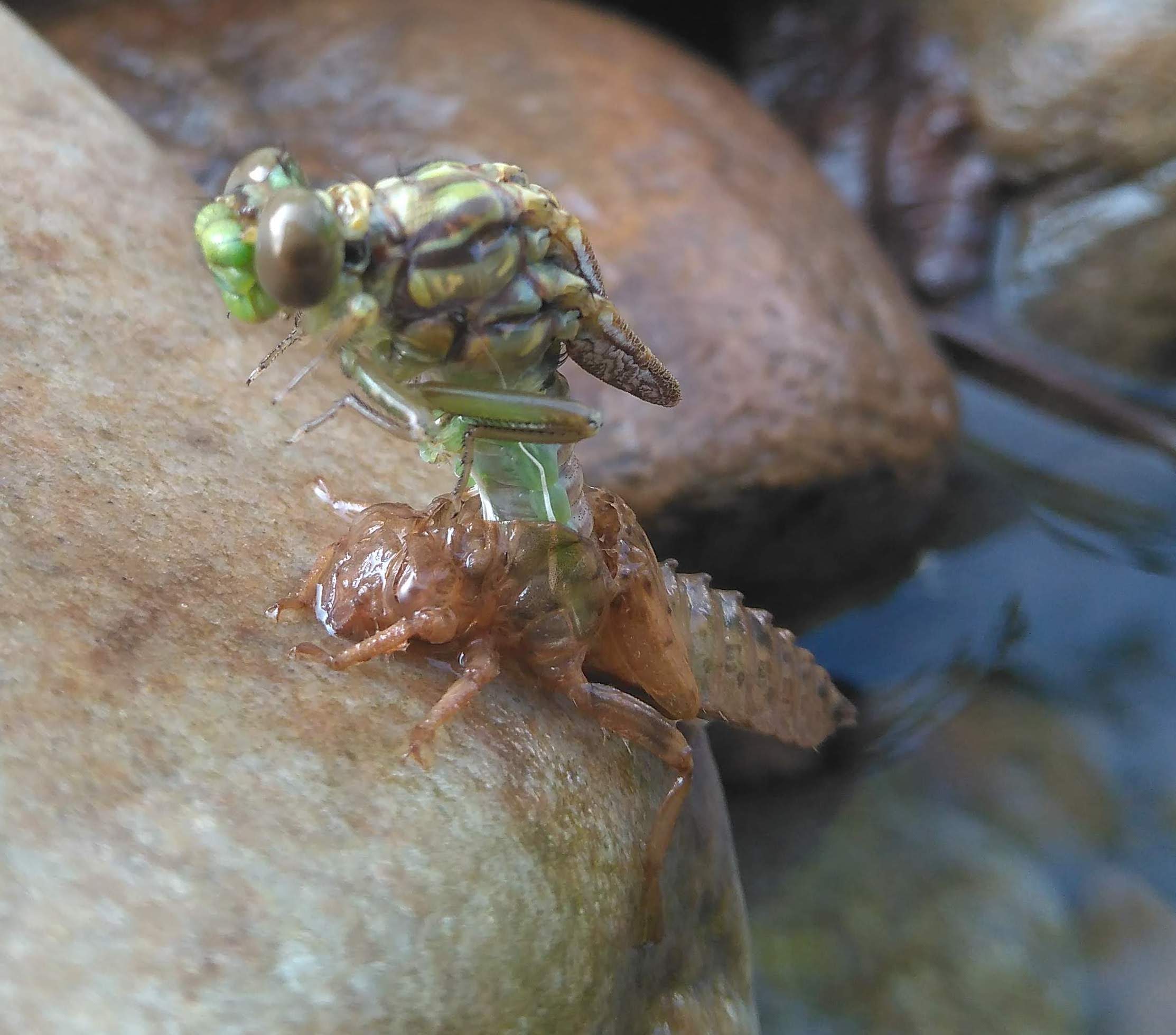
So, there’s no pupa stage. Larvae crawl out of the water up onto rocks or vegetation, break open the back of the larval shell and emerge as an imago, slowly pumping insect blood (haemolymph) around their bodies and wings (Fig. 1). It is quite stunning to see. They leave behind the shell of the larval body, called an exuvia, and that is absolutely critical (see below) when considering that Odonata can live up to 5 years in the larval stage! We notice them as imagoes, and most will only fly for a few weeks.

Metamorphoses of a Large pincertail.
Fig. 1Large pincertail (Onychogomphus uncatus), male, emerging from larval form. Cabezón de la Sal (Río Saja), Cantabria, 30TVN09. 12.vii.18. Notice that the eyes do not touch at the top of the head (see exceptions below).

Odonata life is strongly associated with water, but each species usually has quite some restrictions to the preferred habitat … running water or stagnant (e.g., a pond), no fish presence (or doesn’t matter), sandy or rocky bottom of the body of water, lots of vegetation or very little, and so forth. Most lay their eggs in the water, stuck to clumps of vegetation, and all larvae develop in water (or mud). Anisoptera imagoes are great fliers and can be found far from bodies of water, where Zygoptera are generally “weaker” fliers.

There are insects that could be mistaken for Odonata, which include owlflies and antlions. Owlflies strange-looking insects that are not directly associated with water and have long antenna with a bulb ending (similar to butterflies). Antlions are also not associated with water, have longish antenna and hunt ants (what’s in a name, eh?). Both owlflies and antlions are more common in drier, warm climates and fly towards the end of the day into the night. Both are part of the order Neuroptera, which is just filled with wonderful weirdness … but that is for a future post (with pictures).

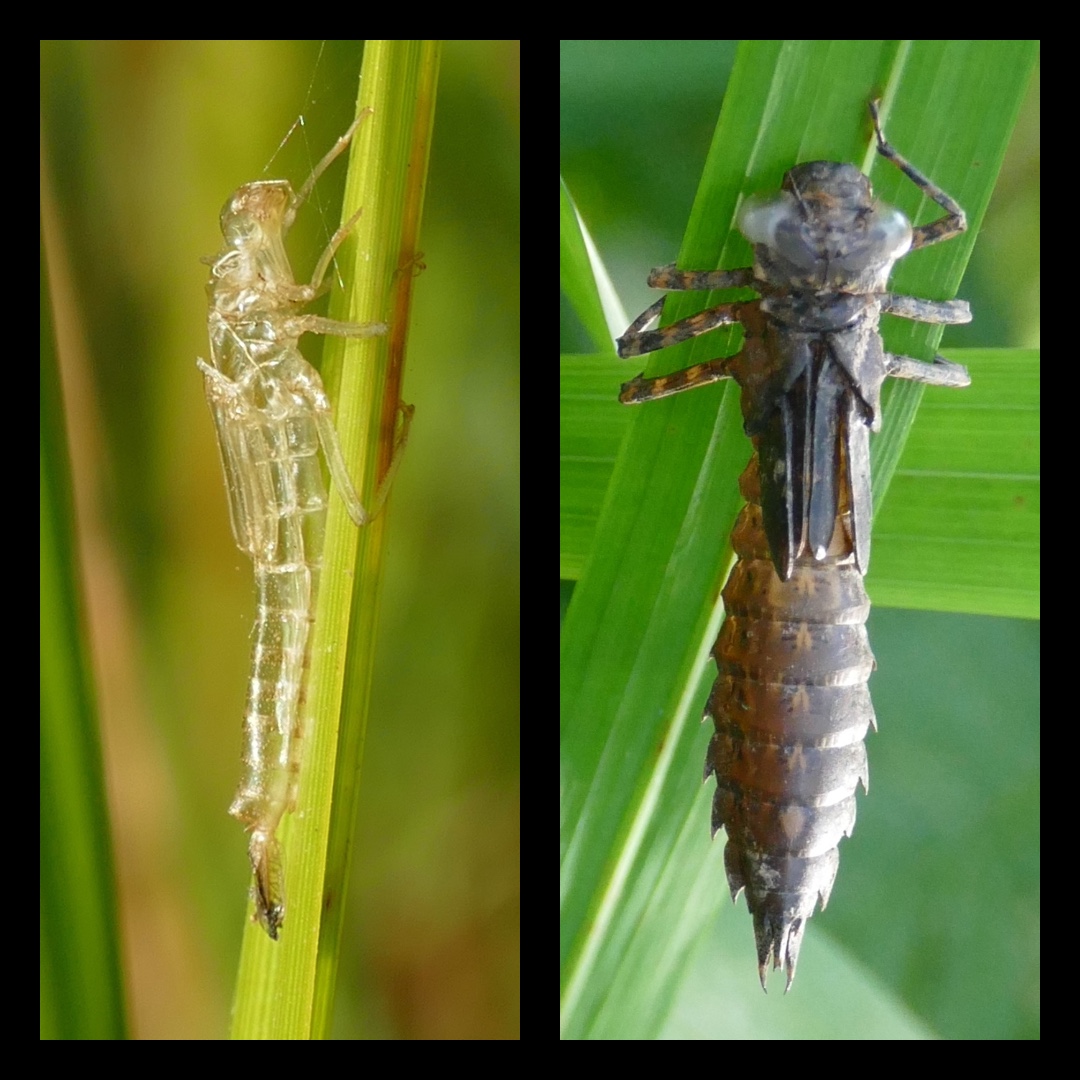
Exuvie of two different Odonata.
Fig. 2 – Evuvie. Common bluet (Enallagma cyathigerum), Miengo, Cantabria, 30TVP10. 20.vii.20. The proct has the dark “vein” running through it at towards the bottom of the exuvie.; Western spectre (Boyeria irene), Mazcuerras, Cantabria, 30TVN09. 10.ix.16. The bottom ends in three sharp points.

2.0 Differentiating Aspects

There are three fairly clear ways to tell damselflies and dragonflies apart, although one is during the larval stage only:

  1. Larval stage only – damselfly larvae have 3 “feather-like” appendages (called procts), which are actually their breathing apparatus, sticking out of the tip of their abdomen (see Fig. 2).
  2. Eye placement – during the imago stage, the eyes are placed differently on the head, with dragonflies having eyes that are placed close together on the head, often touching, and damselflies having each eye quite distant and separate from the other (Fig. 3).
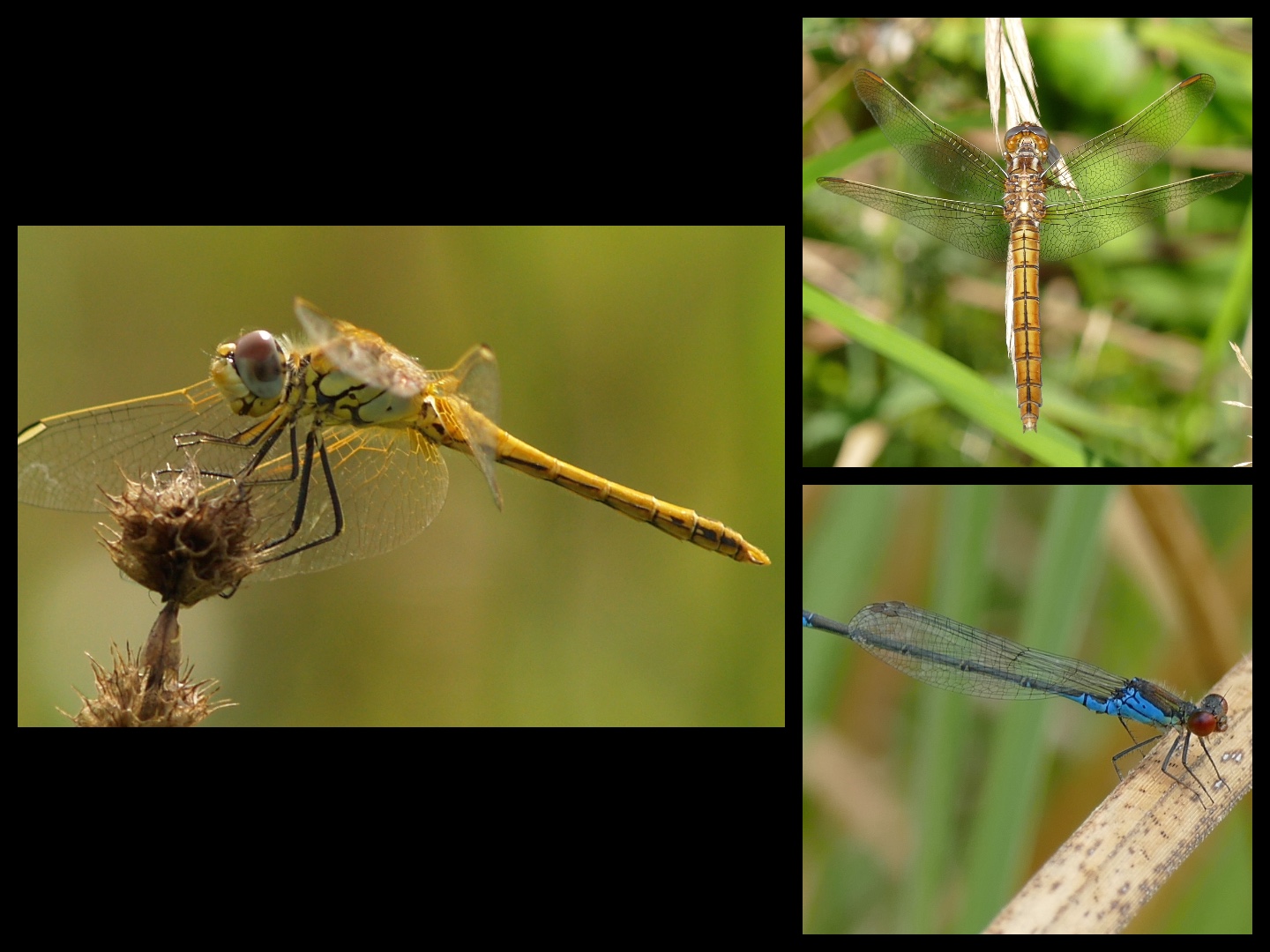
  3. Wings at rest – when at rest, dragonflies hold their wings spread out from their body, whereas most damselflies fold their wings in along their abdomen. This can make damselflies very difficult to spot when at rest (Fig. 4).
Eye position of Odonata.
Fig. 3 – Eye placement. Vagrant emporer (Anax ephippiger) (left), Miengo, Cantabria, 30TVP10. 30.iii.23. A dragondly with large eyes clearly connected at the top of the head.; Migrant spreadwing (Lestes barbarus) (top right), Miengo, Cantabria, 30TVP10. 06.v.22. A damselfly with the eyes at opposite ends of an elongated head.; Green-eyed hawker (Aeshna isoceles) (bottom right), Miengo, Cantabria, 30TVP10. 20.vii.20. Another dragonfly with eyes joined along the middle of the head.

There are of course exceptions, as was also the case in the Lepidotera post, to the statements above.

  • Dragonflies in the Gomphidae family (clubtails, pincertails and hooktails) do have a noticeable space between their eyes, see Fig. 1. But their wings are always held open at rest.
  • Damselflies in the Lestidae family (spreadwings) hold their wings … spread out … at rest. The nameplate states it. Though their eyes are clearly far apart. One interesting characteristic about Lestidae is that some place their eggs in plant tissue (e.g., under tree bark), well out of the water.
Different wing positions of Odonata.
Fig. 4 – Wing position at rest. Red-veined darter (Sympetrum fonscolombii) (left), Cabezón de la Sal, Cantabria, 30TVN09. 00.ix.15. Dragonfly with wings spread wide.; Keeled skimmer (Orthetrum coerulescens) (top right), Cabezón de la Sal, Cantabria, 30TVN09. 25.viii.21. Another dragonfly with wings spread wide.; Small redeye (Erythromma viridulum) (bottom right), Miengo, Cantabria, 30TVP10. 25.ix.21. Damselfly with wings held close to the abdomen.

Conclusion

Damselflies and dragonflies are not that difficult to differentiate, but maybe reading the above has shown you that there are many subtle variations that you can take into account when observing nature.

Finally, it is often stated that dragonflies are good bioindicators of the health of an ecosystem. I was going to write a paragraph on just what makes them so useful, but as I was writing it I felt I was adding too much extra to an already information-loaded post. I will copy/paste that piece into a future Nature 101 post on Citizen Science or Ecosystem Monitoring … stay tuned.

Again, feel free to ask any questions. Up next in the series will be something on Biogeography or Phenology (cycles in nature), not sure which yet.

Nature 101 – Base Knowledge – Odonata

RAm Report – Seoane’s Viper – Vipera seoanei Lataste, 1879

Introduction

It has been a minute since I’ve posted a RAm Report … a what?! … a report on Reptiles & Amphibians. Just a side track first, RAm is a little play on words, as in my daily work I often come across a risk assessment matrix (RAM) reference when it concerns projects. When people think about reptiles, snakes are often first to their mind, the poisonous ones, so you might need to do a little personal risk assessment if you come across one in the field.

Anyway, silliness aside, snakes can be split into various families, with vipers (Viperidae) being one. I will not be going into the others now, too much there for this post. In our region (Cantabrian Mountains more or less) there are three species of viper:

  • Asp viper (Vipera aspis) – found from about a north/south line through Santander to the east. Also found in large parts of Europe. A protected species under the Berne Convention.
  • Lataste’s viper (Vipera latastei) – found from around the southern border of Cantabria southwards, likes a warmer/drier climate. I’ve seen this species near Burgos. A rare species and listed as Vulnerable (VU) by the IUCN in 2008 (needs updating!) and is a strictly protected species under the Berne Convention.
  • Seoane’s viper (Vipera seoanei) – Almost endemic to the Iberian peninsula, with just a tiny corner in SW France. The range is basically the Cantabrian mountains and Galicia. Listed as Least Concern (LC) by the IUCN (also here, update required!) and is a protected species under the Berne Convention.

All three vipers are poisonous and so require medical attention if you are bitten. The only other poisonous snake in the region is the Western Montpellier snake (Malpolon monspessulanus – similar range to Lataste’s viper). When you spot a snake in the wild, you’ll know it is a viper (and so more or less if it is poisonous) by looking at the eyes, where non-vipers (for the most part) have round, black pupils and vipers have black vertical slits as pupils (like those of a cat), see Fig. 1. Something to take into consideration when doing your risk assessment …

An image of a female Vipera seoanei.
Fig. 1Vipera seoanei (female), Cabezón de la Sal, Cantabria, Spain. 24.ix.17. 30TVN09. Notice the verticle black slit shape of the pupil and also the size of the leaves and grasses around her to get a reasonale size estimate.

Seoane’s Viper

So, I’ve seen Seoane’s viper several times, one of them being in El Minchón, one of the Local Hotspots I recently highlighted. When you see one, if you remain fairly quiet, you can watch it for quite a long time. You can often spot them, curled up, just along the edges of brambles or gorse, in sunny spots at the edges of fields or openings in the woods. There is quite some variety in the colours of the pattern they have with some, even being quite monotone in colour (blackish brown). The was the case for the one I saw in El Minchón, which was a bit strange, as I was told by a reptile expert, because those colour variants are usually found at higher altitudes in the mountains.

They mainly feed on small mammals, and probably also lizards and larger grasshoppers. So usually, if I spot a few larger lizards in the undergrowth (like Lacerta bilineata), I’ll walk on a bit, as I’m sure they wouldn’t be out and about with a viper lying around.

Before I round off … they are not big, maybe around 50 cm (20 inches) in length. They can be bigger (up to 75 cm – 30 inches), but when you go looking for them do not expect to see a massive snake. What also makes them look smaller is when they are curled up, they are quite compact. You can compare the size of the snake in the picture (Fig. 1) with the size of the leaves around her (yes, I was told this is a female). The big snakes in this region are the non-poisonous ones like Natrix astreptophora (Iberian grass snake), which can grow up to 2 meters.

Conclusion

For a nature enthusiast, these kinds of species are always interesting, and that is because you can only really find it in a limited area in Europe. It is this kind of species that will provide a tingling sensation to someone who’s keen on snakes/nature and it will be a cornerstone for a spring/summer vacation trip planned during the cold winter months. There is a whole segment of the tourism industry built on birding or nature trips and I’m sure the guide will be over the moon when they can show their clients a species like this … something unique and which they probably cannot see at home.

Further Reading & A Comment

  • Speybroeck, Jeroen, Wouter Beukema, Bobby Bok, Jan van der Voort – Field Guide to the Amphibians & Reptiles of Britain and Europe – 2016 – Bloomsbury – 432 pp. – part of the British Wildlife Field Guides by this publisher, as always stunning. Great illustrations (by Ilian Velikov), excellent text. A must own if you are into reptiles and amphibians, or nature in general for that matter.

Remember that small rant I went on in the Book Club post Books on Moths about Biodiversidad Virtual (hit that link if not)? Well, what I was hoping for has happened, the site will combine with Observation.org! Hot off the press (22.v.23), see their blog post here. Excellent news and congratulations to all involved. All be best migrating data and consolidating the databases etc. I do hope the publications are kept going.

RAm Report – Seoane’s Viper – Vipera seoanei Lataste, 1879

Fly Facts – Milesia crabroniformis (Fabricius, 1775)

Introduction

I’ve mentioned a few times in the other posts of the blog that one of my goals is to provide an opportunity for others to learn, with me, about that natural world around them. Because it is through a blog there will be some repetition, but that repetition will hopefully help the reader become aware of some of the details that make a difference when trying to identify or categorise what we see around us.

The Nature 101 series provides some of those building blocks that support our knowledge growth. These species highlights can be taken as a type of case study where we can not only apply that knowledge but also become aware of our limitations through questions that come up that we cannot immediately answer. This we can use as sustenance for our quest to gain more knowledge (a never-ending cycle if we’ve found something that interests us). So, without further ado … today a fly …

Image of Milesia crabroniformis.
Fig. 1 – Left, Milesia crabroniformis (female), 28.viii.22, Cabezón de la Sal, Cantabria, Spain; top right, Milesia crabroniformis (male) 09.viii.22, Cabezón de la Sal, Cantabria, Spain; bottom right, Vespa crabro (female), 21.iv.15, Cabezón de la Sal, Cantabria, Spain. All photos by Bart van Hoof.

Milesia crabroniformis

When we look at the images above, we notice that the fly looks a bit like a bee or wasp. They are active at the height of summer, especially in August and when you see them flying around you might have some concern if you’re not sure what you’re looking at because they are big, as they can be up to 25 mm in body length, as big as a European hornet (Vespa crabro), and one of the largest flies in Europe.

Here is where Nature 101 Naming comes in … crabroniformis (Latin) means “shaped like crabro”, the European hornet. Here’s another reason why I started learning the scientific names, so I could start seeing links between species “behind the scenes,“ as it were. This hoverfly (more on that later) mimics a hornet. So, there are two paths forward that we might be able to find an answer to with our current knowledge:

  • How can we tell it is not a wasp or bee?
  • What exactly is mimicry?

The latter I’ll leave for a Nature 101 post … I mean I have to create content for the blog. But it might first calm the mind a bit if we can figure out which details show us that this hornet-looking fly is actually a fly and not a hornet.

Milesia crabroniformis is part of the hoverfly family. The order name for flies is Diptera … from our Nature 101 Lepidoptera post we know that “ptera” means wing … “di”, well that means two … flies have two wings, compared to bees and wasps (Hymenoptera) who have 4. One of the tricky things is that Hymenoptera have little hooks that connect the two wings on each side making it look like they only have two wings in total, but if you look closely on a photo, you’ll actually be able to make out 4.

A second clue, and one that should jump out straight away … is the size and shape of the antennae. They are like two nibs that stick out from the middle of the face, whereas Hymenoptera have long, segmented antenna.

The third clue, but one that can be more difficult to determine, is the eyes. This does bring me to another interesting observation. If we go back up to the images above and look at the two Milesia crabroniformis there, have a look at the eyes … they are different. One has them touching ever so slightly in the middle, where the other has them clearly separated along the whole central section. What is going on here? In many hoverflies, males have eyes that touch whereas female’s eyes do not touch. We can therefore not only ID the species but also the sex.

Just before I round off the post, a few more details about this fly. It is mainly found in Europe from about mid-France southwards, as well as in Northern Africa. It is not very common, one of the reasons being that it needs mature woodland, oak trees, and beech trees, where it lays its eggs in rotting wood. You often find them feeding on the nectar of umbellifers (as seen in both photos), which have big “flower heads” made up of many tiny little flowers, so they do not need to have a long tongue to get down into the flower (like a bee or butterfly) but can hoover it up with their mouthparts.

Conclusion

I hope I’ve been able to show how just a little bit of knowledge and information can point us in a direction that can help us identify or understand and insect or animal better. We don’t have to know everything about it straight away, we can look up more in-depth information at a later date. However, we can start seeing connections to it and things we already know.

It is easier to bring this information across in the field … this is one of the basics of adult learning, where we learn best by doing and use all our sense to process information … but as I’ve said before, I am still trying to find a good way to package this information so that a large chuck will stick till the next blog post, and then we can go from there.

See you in the next one (hopefully on Odonata).

Fly Facts – Milesia crabroniformis (Fabricius, 1775)

March / April Review

Introduction

Back in late February this blog was kickstarted back into action … this being post lucky 13, I thought I’d provide a short overview of both the blog and what has happened these past 2 months.

Discussion

Firstly, a bit about what is coming up … as always, lots of plans … I have been enjoying writing the Nature 101 series, so I have some topics lined up for that including:

  • Odonata – to continue with the “order” series as started by Lepidoptera.
  • Biogeography – another one of these general knowledge ones that popped into my head when writing the recent species posts, as well as the Local Hotspots ones. This should provide some insight into why Cantabria and the Cantabrian Mountains are so unique and interesting.
  • Phenology – a topic I wanted to touch in the Lepidoptera post but skipped because I felt that post to be quite dense and this topic to be more broadly applicable. What does that word mean? Stay tuned (if you don’t feel like Googling it)!

The Book Club posts were also fun to write. Going forward the focus will be on individual books, and I’ll also write one on other reference books I have. I’m very happy that my book reading has picked up again since around the start of 2023. It had been down in the doldrums for ages due to family life with young kids. I just started Silent Earth (Dave Goulson) and that has given my inspiration and some ideas for topics.

Starting up the Local Hotspot series has been immensely fun. It will be a bit before I get going on future instalments because I need to do some pre-work. Still, this will turn out to be a great series for any visitors to the region.

Here is where you can find an overview of the above-mentioend posts.

The individual species posts have been both difficult and easy at the same time. I’ve focused on a number of species that have been emblematic for me personally, so the enthusiasm has been there … but I’ve struggled to find the right voice and tone for those posts. All the types of posts above require improvement through learning and experience, but it seems that this series really needs that added attention.

Outside of writing the blog, going out into nature has had its ups and downs. I am very pleased with how my “dragonfly”-goals have gone for 2023. It has surpassed even my high expectations and I’m only 2 months in. Three new species with great photos to ID them.

Fig. 1 – Updated year list of species keen to see. Those in blue have been seen in 2023.

On the flip side, I’ve not gone out for walks as much as I would have liked. Also, moth trapping has been abysmal, with no luck at all on nights I’ve set out a trap. Maybe this weekend …

The Species Schedule I’d set up at the start of the year is looking good, with May being the month where things really pick up. Some exciting times should be just around the corner.

Conclusion

So, I am pleased with how the blog is going, but I do feel I need to inject a smidge of professionalism into it (improve my blog design, “Photoshop” skills etc.). The writing itself feels like it is getting to where I want it to be and to be honest, it is something I’d read on a weekly basis if a link etc. dropped into my mailbox (in the style of treat people how you’d like to be treated – write stuff that you’d like to read).

As far as nature goes … it is the classic overpromise/underdeliver … in my case that’s – plan in too much and do not get around to doing it all … but that is okay, as I also realise that there’s a lot which is out of my direct control (weather, having the second car in the garage for coming up to 5 weeks when they said 2!, etc.). Furthermore, I do have a paid job requiring my attention … so, there’s that.

Glad you made it down this far! Take care.

March / April Review

Nature 101 – Base Knowledge – Lepidoptera

Introduction

Today we’ll cover the order of Lepidoptera … In the Nature 101 Naming post we discussed a little bit about where order fits into the taxonomy picture. Basically, order covers a whole group of animals/insects/plants/etc. that have fairly similar characteristics.

Within the order of Lepidoptera we have both butterflies (Rhopalocera – a clade, or natural group) and moths (Heterocera) … what are common characteristics and what makes them different? Is it the time of day at which they fly or is that more an over-generalisation?

1.0 Common Aspects

There are two key common elements within Lepidoptera:

  1. Scaly wings – Lepidoptera is a term that is derived from Greek … “lepis” meaning scale and “ptera” meaning wing.
  2. The life cycle – this can be split into:

Egglarva (caterpillar) – pupa (cocoon/chrysalis) – imago (butterfly or moth)

1.1 Scales

The closest insects to butterflies and moths are caddisflies, which are part of the order Trichoptera. The main difference is that their wings are covered in hairs (“trich”) and not scales! It can be really tricky to spot the difference. One of the ways to tell is that if you catch a moth in your hand and close it into a fist (don’t crush it!), when you release it you can notice that the palm of your hand is covered in a light dust, those are the scales that have fallen off (been knocked off) the wings while it was fluttering and trying to escape. A caddisfly won’t leave anything behind. But I’d suggest you take good macro photos and then you can sort of see the scales (or not).

1.2 Lifecycle

When it comes to life cycle, most of us only really notice the last stage, that of imago. It is during that stage when we see them fluttering (or zipping, some are amazing fliers) around, looking for a mate or food (nectar from flowers or minerals from mud, or rotting fruit or dog poo). They can have brilliant colours, but even the drab ones can catch our eye as they spring up to defend their sunny patch of woodland.

Eggs are tiny and you must know what you are looking for or spot them in big bunches for some species. So, they generally go unnoticed.

Larvae are either easy to spot or super difficult. Some are bunched by the hundreds is silky nests that look like giant spider webs. Other are brightly coloured. Then there are caterpillars that look like twigs or are within parts of a plant.

Then there are pupae … again something that is less common to see … most tend to be well camouflaged and hidden; some are even underground. But I guess that should be self-evident … the two life stages at which they are most vulnerable (egg and pupa – cannot do much against attackers) they are hidden and least noticeable.

There’s one area I want to touch upon but not really go into too deep because buy can it get detailed … but basically each moth or butterfly is associated with a plant or group of plants. This is because the imago will lay an egg on a specific plant so that when it hatches the larva has plenty of food that it can eat straight away. No use laying an egg on a blade of grass if the caterpillar is only interested in eating cabbage leaves. This plant is called a larval host plant (LHP), and this is super critical in the life of a moth or butterfly … either it can be labelled a pest if the LHP happens to be a plant us humans rely on for food (or really like). Or the moth/butterfly can get itself into a really tricky situation (nature conservation-wise) if that LHP happens to become scarce (think climate change or humans changing the landscape (e.g., drying out marshy areas)).

What this means is that the average moth or butterfly you see is probably a generalist regarding LHP (so can lay eggs on lots of different types of plants) or feeds on plants we do not value much (e.g., nettles). Therefore, if you really want to see different types of Lepidoptera it often means going to very specific ecosystems … which can be used as the basis for an adventure …

2.0 Differentiating Aspect

Before I go into the one key differentiating factor, first the following:

  • Not all Lepidoptera can fly in the imago stage. There are several moth species (in Europe) where the female is basically wingless (she has little stubs). Males find her (from quite far away) through a pheromone she emits. She just nestles tightly against the tree’s bark waiting for the males to figure out how to find her.
  • Butterflies fly by day but not all moths fly at night. Or in other words … there are day-flying moths. Quite a few actually, so no, the time of day is not always accurate. That said, a moth trap (a light trap emitting UV light) set out during the night is still the best way to see large numbers of moths.

So, what is that key differentiating factor? … if you know Greek you might have guessed by the name of their clades …

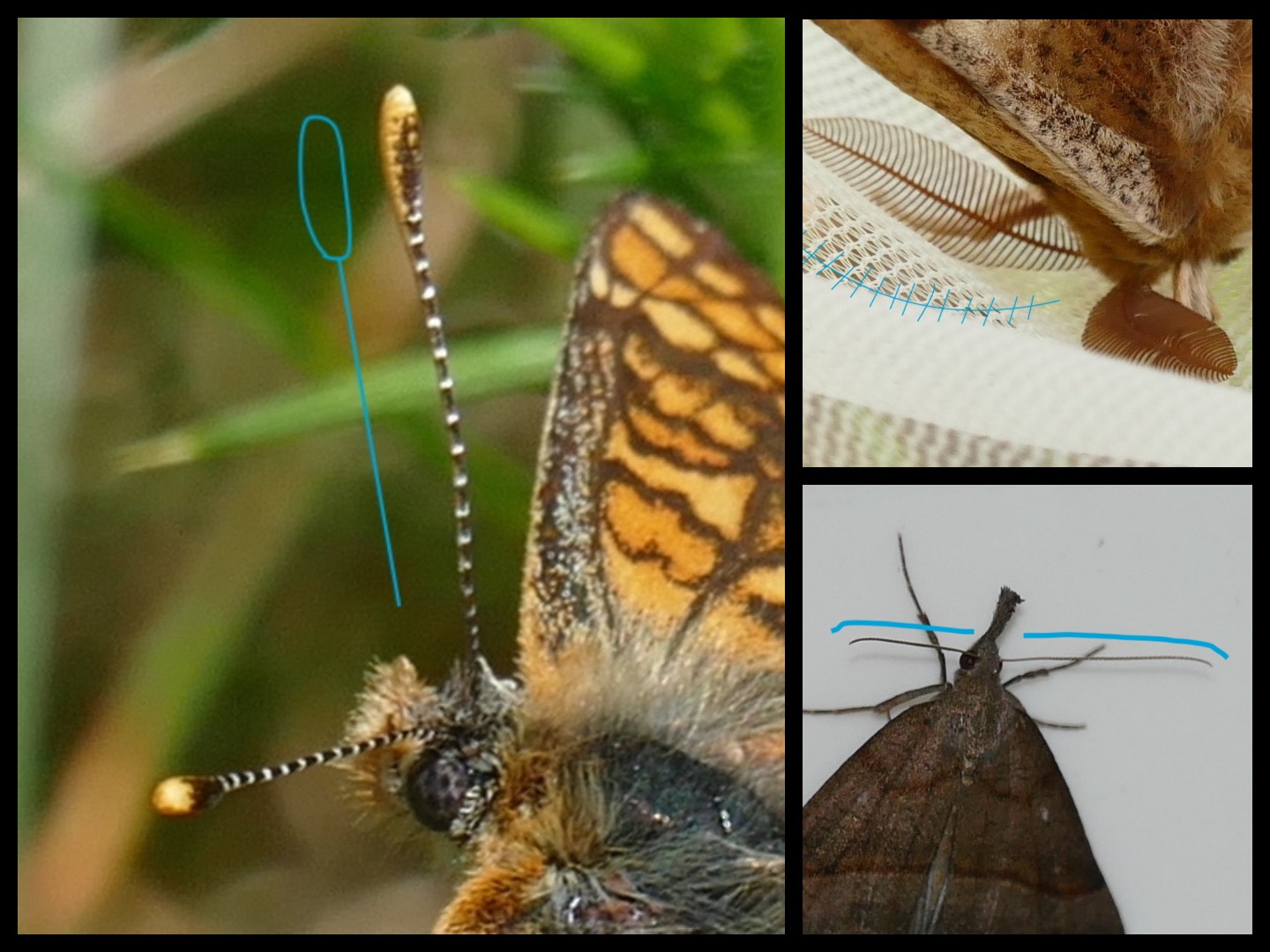
Butterflies have little clubs at the end of their antenna, whereas moths have straight or feathery antenna (see Fig. 1).

Three types of antenna for Lepidoptera.
Fig. 1Euphydryas aurinia (left), Rionansa, 17.vi.18 (butterfly with a club antenna); Aglia tau (top right), Valdáliga, 05.iv.19 (moth with a feathery antenna – males fly around during the day); Hypena proboscidalis (bottom right), Cabezón de la Sal, 15.x.21 (moth with a straight antenna – it came to my light trap at night).

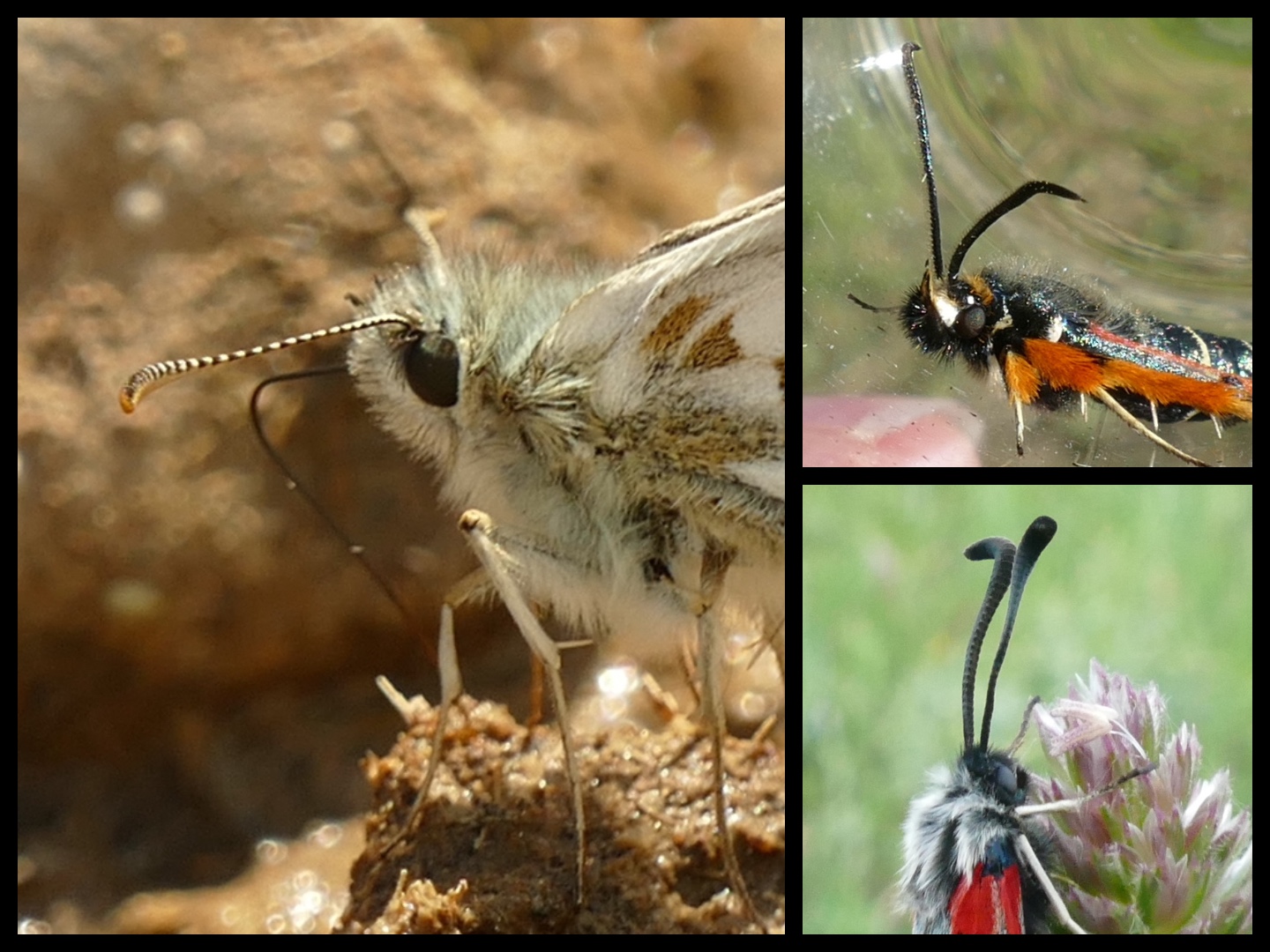
Now, as you might expect, it is not all as crystal clear as that (when is it ever?) … there are moths whose antenna look “clubby” in shape … examples are clearwing moths (Sesiidae) and burnet moths (Zygaenidae), both of which fly by day. There are also butterflies that have antenna that look less “clubby” in shape, such as skippers (Hesperiidae). (Fig. 2)

Fig. 2Pyrgus armoricanus (left), Valdeprado del Río, 08.v.21 (a butterfly with fairly flat antenna); Pyropteron chrysidiformis (top right), Camargo, 07.vi.17 (a beautiful dayflying moth from the Sesiidae family); Zygaena rhadamanthus (bottom right), Valdeprado del Río, 06.vi.18 (another stunning dayflying moth with chunky antenna).

Conclusion

Well, I hope this has been informative. Butterflies have been the insect that help draw me into nature observation. There is so much more I could cover, like flight generations etc. but that would make this post too long. I wanted to keep the post relatively short and not overwhelm the reader with too much (new) information in one go.

The next Nature 101 will probably cover Odonata, another favourite of mine.

If you have any questions, please feel free to ask I can either answer them below or decide to dedicate another Nature 101 to it if the topic is extensive (e.g., migration, lifecycles etc.).

Nature 101 – Base Knowledge – Lepidoptera

Local Hotspots – El Minchón

I thought I’d write up another Local Hotspot post, mainly to see how I could improve them and develop them so that they are useful for any nature enthusiasts who travel through the region. Again, I’m trying to highlight some locations that might not be known or evident for the traveller from outside of Cantabria. They might not be worth visiting if you are just passing through, but if you are here for a week or two then they are something to consider.

Introduction

So, without further ado … El Minchón … along this stretch, the Saja River (which also runs along the other Hotspot, Canteras de Cuchía) forms the boundary between the municipalities of Cabezón de la Sal and Mazcuerras. On the Cabezón side there are the villages of Vernejo and Ontoria that have access to the area. In the case of Mazcuerras, it is the main village itself and Villanueva de la Peña.

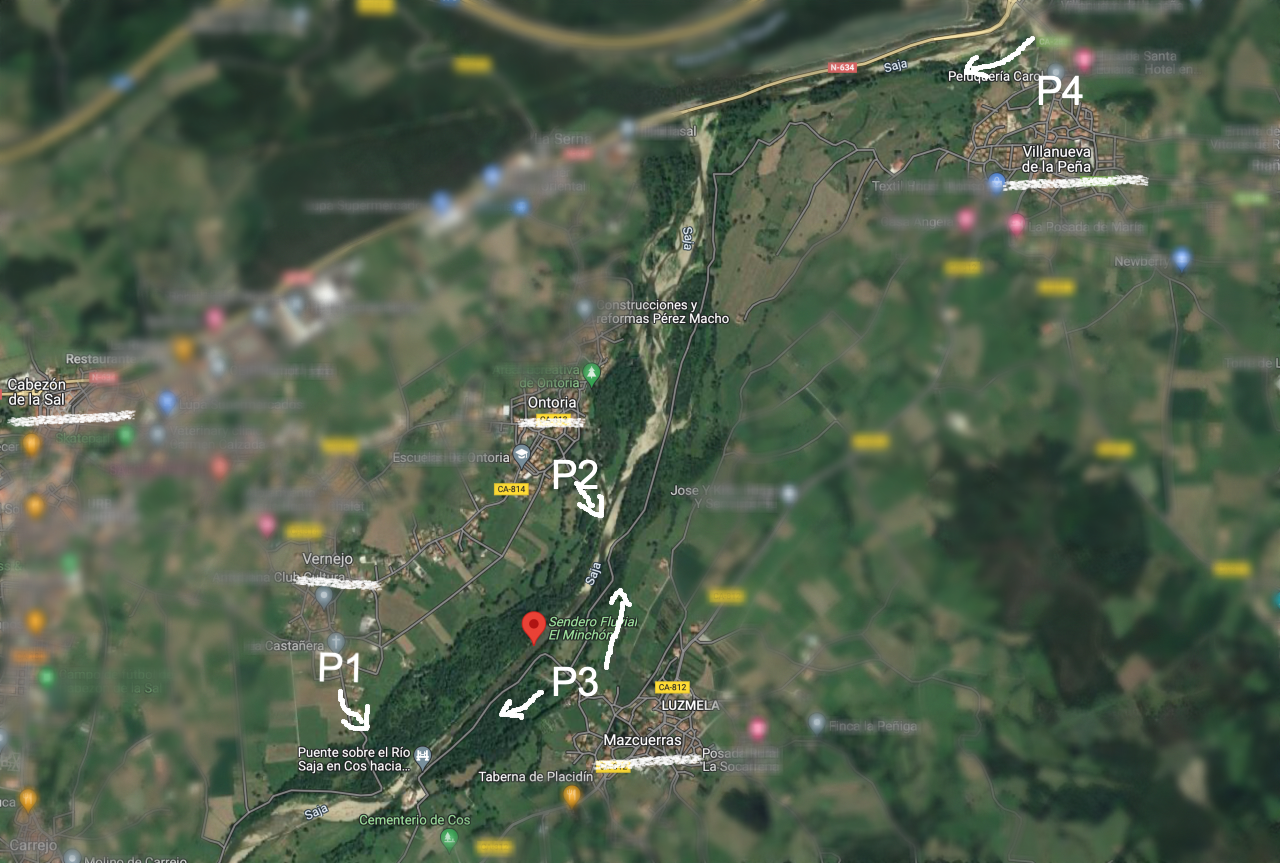
Below (Fig. 1) is a a Google Maps screenshot of the area. Not sure it works, but I’ve blurred most of the area around the location just to try and accent it more. I’m thinking I should maybe remove the colour from the image in areas that are not part of the location … will look into it and make a change in the future (and for all Local Hotspot posts).

Fig. 1 – Google Maps screen capture of the area. El Minchón (Cabezón de la Sal, Cantabria – 30TVN09)

El Minchón is a wooded area around the Saja River, it covers both banks and for the most part is surrounded by farmland. The trees are mainly poplar (Populus sp.), birch (Betula sp.) and willow (Salix sp.) with lots of areas of low growth shrubs, ferns, or open grassy patches. There’s a great mix of areas that are a bit drier and ones that are quite wet … and then there’s the river itself with all the little streams that flow around and into it.

On the side of Cabezón de la Sal (the section between Vernejo (P1) and Ontoria (P2)) some farmers have been allowed to let their livestock (sheep and horses) roam around freely in areas that they set off with temporary fences. This helps create little microclimates, open areas etc. … great for all sorts of wildlife (more on that below). There are little paths that make their way through the area, almost always coming back to the main gravel path that runs parallel to the river. The only area to cross the river (without getting your feet wet) is near P1 where a prominent footbridge provides great views up and down the river.

On the Mazcuerras side there is a large field and picnic area (P3). The path that leads back upriver takes you to the only bridge crossing in the area (near P1). The path down river is a bit hidden at the back of the football field, it is not well maintained, can be slightly overgrown in parts, and can be a muddy, narrow dirt path at times, but it eventually leads to you Villanueva de la Peña (P4) where you end at a small church hugging a cliff face, some picnic tables and the new bridge (you can’t miss it).

Getting Around

The 4 areas where you can park a car all have different benefits:

  • P1 – This is where I usually go in, as I prefer the area between P1 and P2 for wildlife spotting. I usually park near a small church, but parking is limited, and roads are narrow so beware. Once you enter the area through a wooden gate there are tracks leading off left and right, great to explore the area. The river near P1 has been altered quite a bit by man, but recent heavy floods have smashed some of the barriers to bits (see Dam Removal Europe on why removal of these types of barriers (non-essential) is critical), creating some swimming areas etc.
  • P2 – There is a dirt parking area near the river, but not maintained, so it can be rough on your car. You can’t really walk downriver from here but have to go up towards P1. However, this is a fairly natural stretch, so easy to get to the river and see if you can spot trout or salmon (or emerging dragonflies).
  • P3 – An adventure to get there because you go through very narrow streets (keep your fingers crossed you don’t meet someone coming the other way!) of Mazcuerras and just before you get to the parking area you have to drive through a stream. P3 is great if you are with family and friends. They can relax and play while you explore the area. Also, the path to the main bridge is well maintained and easy to walk with little kids, lots to see. Going from P3 to P4 is slightly more adventurous though, but an excellent area for birds.
  • P4 – More for if you want to go for a walk. Because the route is not circular it is basically towards P1 and back, hence I never really go there. Also, they just finished the new bridge (April 2023) in Villanueva and the path starts just where they were doing a lot of groundwork for that side, it has been a messy construction site for years, it used to be a nice playground for kids, so maybe they will set that up again.

So, it depends on what you want to do. For Proyecto Lepides I used to walk a transect from P1. I can easily spend a couple of hours exploring the area. Hence, starting at any of the other locations means I just have to walk more to get to the area that is most interesting from my viewpoint. But for a relaxing morning/afternoon out then P3 and P4 can be great options. We go to P2 when we want to take the kids to the river to explore and swim.

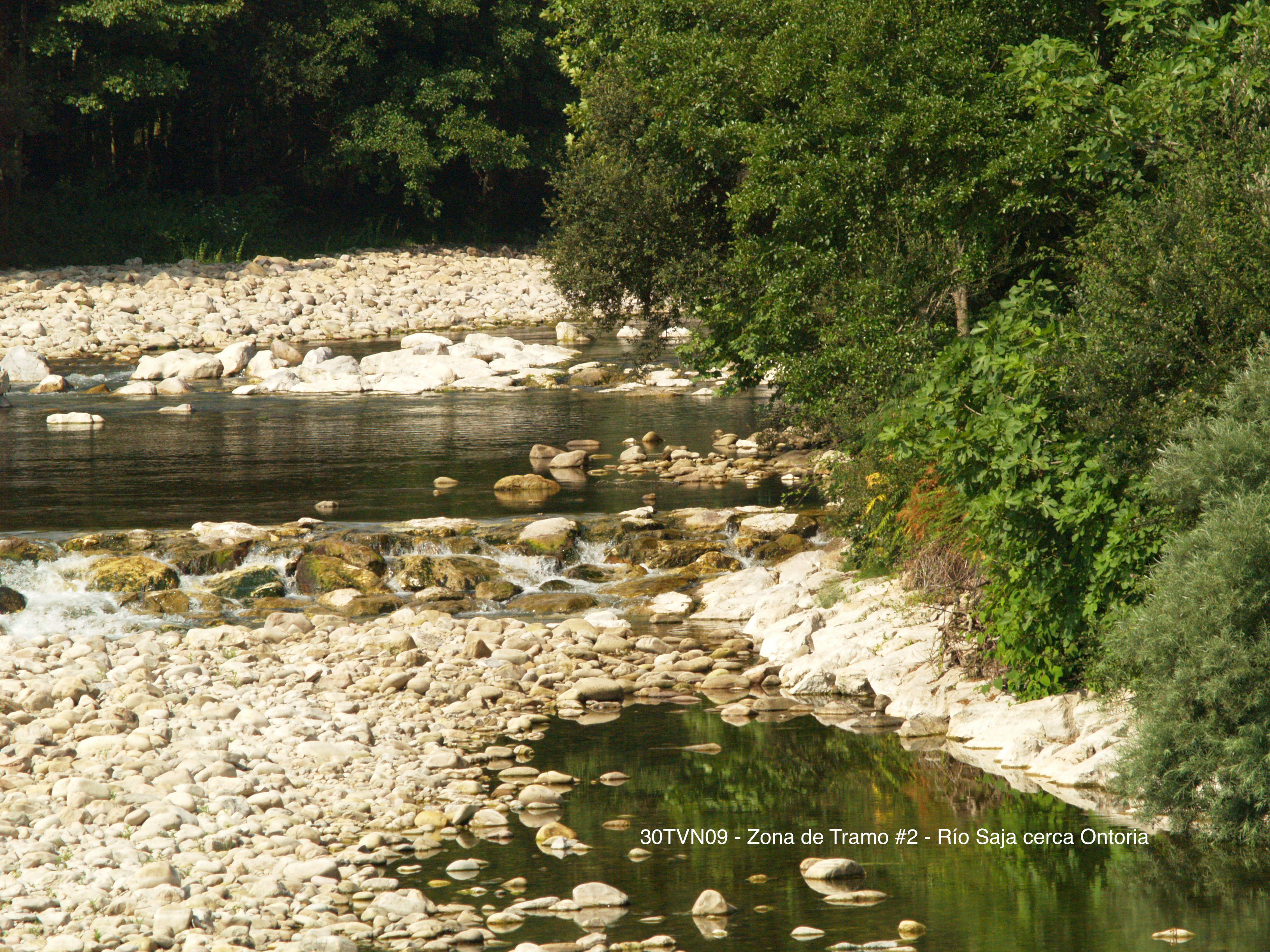
Fig 2. – Looking upriver from the bridge (puente), near P1, crossing the Saja River. This photo was used to illustrate an area of my Transect #2 for Proyecto Lepides. This part of the river has had the banks reinforces with boulders and there are small barriers crossing the river.

Wildlife Highlights

I haven’t even really touched on what you can see there … I don’t know much about plants, but there are orchids in the area (between April and June). My focus is insects and animals … well, the area is known for its snakes (mostly the non-poisonous ones), and I’ve seen a fair amount, including Seonne’s Viper (Vipera seoanei) which is endemic to the Cantabria mountains! Plenty of other reptiles and amphibians to see too.

Birds are great too, with plenty of dead trees left standing there are lots of woodpeckers, and small passerines. From April onwards you can hear Golden Orioles (Oriolus oriolus), and throughout the year there are plenty of birds of prey to spot. Along the river there are Dippers (Cinculus cinculus) and kingfishers.

I’ve seen a wild boar once but I’m certain there are all sorts of other mammals you can come across.

On the insect front, where to start? Flies, beetles (Stag beetles – Lucanus cervus) a plenty … for butterflies and moths it is amazing, such as the Lesser Purple Emperor (Apatura ilia – rare here), Weaver’s Fritillary (Boloria dia) and many, many more … in some of the clearings there are so many butterflies you don’t know where to point your camera first. For Odonata one of the highlights for many will be the Mercury Bluet (Coenagrion mercuriale (a European protected species!)), which is present in very large numbers here from April to October. The rocky bedding in the river also provides a great breeding ground for pincertails and a multitude of other dragonflies (e.g., Oxygastra curtisii – Orange-spotted Emerald).

Conclusion

This is the kind of spot that is great to have near your home. It is small enough to be able to follow the changes during the year, while at the same time being diverse enough in habitat to have an abundance of species within that small area. It also makes it a decent place to visit if you are keen to see a whole list of species.
Furthermore, most of the locals keep to the main path, walking their dogs, riding bikes or jogging, which means the small paths are a quiet domain giving you plenty of time to take great pictures.

Local Hotspots – El Minchón

Butterfly Bulletin – Map Butterfly – Araschnia levana (Linnaeus, 1758)

Introduction

Climate change means that over time micro adjustments in local environments slowly transform habitats to be suitable, or unsuitable, for certain species. We normally associate climate change with increase in temperature, which means that, in Europe, southern species expand northwards. So, Mediterranean dragonflies slowly start to appear in places like Cantabria, as the general temperature of suitable bodies of water increases, or instead of being permanent bodies of water they become ephemeral (not suitable for fish, so dragonfly larva have a better opportunity to grow to full size and transform into imagoes).

Today the curious case of a butterfly that appears to be expanding southwards and westwards further along the Cantabrian coast.

Map Butterfly

No matter which books you dive into, distribution maps of the Map butterfly (Araschnia levana) show the southern limits of the range just creep into Spain into the Basque Country around San Sebastian. I always found this fascinating, as in Cantabria we have a fairly similar climate to countries like the UK and The Netherlands and with the larval host plant (LHP) being nettles (Urtica sp.), abundant here, it seemed like a no-brainer that this species should be found here. However, there is no mention of the species in Pablo Sanz Román’s book, and he was an avid collector of butterflies … if it flies here, he has it pinned in his collection.

Picture of a Map butterfly.
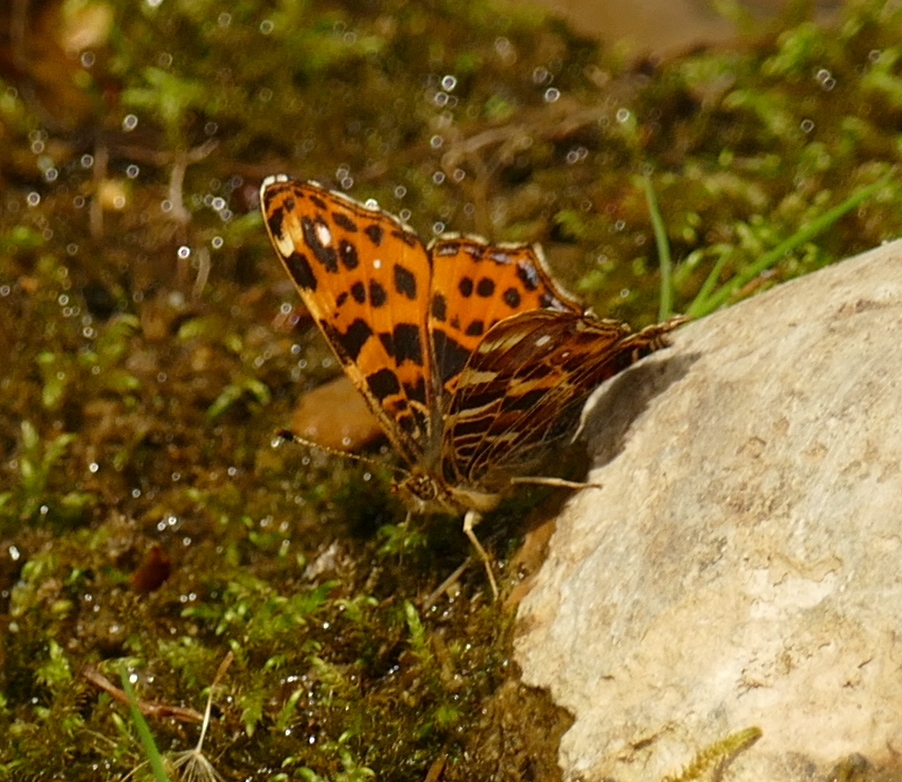
Fig. 1 – Map butterfly (Araschnia levana), first generation, 24.iv.21, Arredondo, Cantabria, Spain, 30TVN58. Photo Bart van Hoof.

In 2019 I got news from some friends that they had seen Araschnia levana near Liérganes, a village quite near to where I live (say 40 km east as the crow flies). However, it wasn’t until 2021 that I’d see the butterfly myself. After a lovely hike with the family around the Collado de Ason (a waterfall), we’d made our way back down to a picnic area near Arredondo. After a good meal I took my camera to scout the area a bit and almost straight away saw it flying and land to take some moisture from water coming from a natural spring nearby.

I’ve not seen the species since, but it was recorded a reasonable number of times in 2022 (in the Basque Country) and it was even seen last week in Cantabria (with photo evidence)!

Distribution map for the Map butterfly in the Cantabrian region.
Fig. 2 – Distribution map for the Map butterfly (Araschnia levana) in the Cantabrian Mountains. Screen capture of the Observation.org page (see links below), taken on 23.iv.23.

An interesting thing about the Map butterfly is that it has two flight periods (called generations) in a year, the first from April to June and the second from July to August. The cool thing being that it shows seasonal dimorphism … this means that both generations look markedly different, with the first being more orangey (the one I saw, see above) and the second being almost all black! (the one my friends saw).

If we look at the screenshot above (Fig. 2), the species seems to be creeping westwards along the coast (each red square is a 10×10 km UTM square). The observation in the Picos de Europa (the left-most red square on the map) was in 2022 but is not supported by a photo, so we can’t validate it. My sighting in 2021 is the square at the bottom of the “cross” near Santander, with Liérganes being the left-most of that “cross”.

Conclusion

So, what is going on here? The species clearly seems to be expanding towards the west across Cantabria … where in literature there is mention of it expanding northwards in Europe into Finland and Scandinavian countries (as you’d expect with climate change). My speculation … and I clearly want to state that this is just a first idea … is that Cantabria is becoming drier (less rain during the winter – another friend has a weather station and he mentioned this to me a while back) and maybe it was the humid (temperate) conditions that the butterfly was not adapted to.

Anyway, this would be an interesting scientific paper … and is on my list to write up (I need to connect with some scientists on this topic). One of the difficulties is that because the LHP is nettles it is not a butterfly that you can pinpoint in an excursion (as you might a high-mountain species or one that has a very specific LHP) … so you basically have to luck into seeing it here. It is the perfect species for a general monitoring scheme that they have in many European countries because volunteers walk the same transects throughout the year and will therefore spot changes earlier. Since 2019 my eyes have been peeled around this time of year … but I’ve only been lucky once.

This species also illustrates that while something might be common (read: slightly boring) in the temperate, central-European landscape … here (also considered temperate), at the fringe of its distribution range, it is still an exciting, rare sight.

Further Reading

  • As always, the Proyecto Lepides Observation.org page to keep up to date on current sightings.
  • The list of the butterfly books I own.
  • The Dutch butterfly organisation (Vlinderstichting) has a good page on it, in Dutch but easy to get the basic info from it even if you do not read Dutch.
Butterfly Bulletin – Map Butterfly – Araschnia levana (Linnaeus, 1758)

Nature 101 – Base Knowledge – Naming

Introduction

I should have posted something like this earlier because it will cover the basics in all past and future posts. So, what am I talking about? There are some Nature 101 subjects that might not be known by readers, but if you know the basics, a whole world can suddenly materialise in front of you. For example, the naming conventions I use in my posts, which includes common names, scientific names, families, etc.

Not all readers will have a background or interest in what I cover in my posts but might stumble upon it through a link or a random internet search. This means that those readers might think; “Huh, why is he writing this?” or “What does that mean?”. By providing a little bit of background information it might entice the reader to want to look deeper into certain aspects I cover or into things they come across in their daily lives. For example, they might be out on their daily walk and come across an interesting flower … maybe something they’ve picked up in the Nature 101 series will help them find out more about that flower.

As a side benefit, this will be a longish post and will therefore help me build up my writing style again. I’m a Technical Writer by profession and so my daily work has meant I’ve had to strip some of the creative/random flourishes from my writing to be able to meet my client’s demands. I used to write a lot in my free time but now, after a day of work I don’t always feel like sitting down and doing more writing, I might choose to go out and go for a walk, or do something with me kids etc. Anyway, without further rambling, let’s get into it …

1.0 Naming

I’ll start with a very broad statement … all plants and animals have a scientific name, but not all plants and animals have a common name. Broad because, well, there are of course plants and animals that have yet to be discovered by science and so have not yet been given a scientific name, but you get the general idea.

1.1 Common Names

When I first started out, I was talking with Spanish and Dutch friends about what we’d come across in the field. I was also reading English books to help build up my knowledge. This means that for a specific bird I might have to know the Spanish, Dutch and English common name so that I could talk and have a decent conversation with all my friends … I quickly realised that I would go nuts if I have to learn all those names for everything that I had an interest in … solution, learn the scientific names because those are the same no matter what language I’m talking in. For example … know what a Gyps fulvus is instead of a vale gier (Dutch), Eurasian griffon vulture (English) or buitre leonado (Spanish) (writing convention – the Spanish and Dutch names are in italics because I’m writing this article in English).

That is why I’ve moved away from common names … I still do use them but prefer scientific names because I have noticed that there has sometimes been confusion when using a common name in a conversation where I realised that we weren’t talking about the same species of butterfly. However, I realise my situation might not be a regular case and I might be a bit nerdy in this regard.

There is a case for common names because they stimulate the imagination and so can be a great entry point in building an interest in nature. For example, Spotted redshank sounds great compared to Tringa erythropus.

However, sometimes you are forced to learn the scientific name, because not all plants and animals have been given a common name in a certain language. The English language is pretty good at slapping a name onto everything though.

1.2 Scientific Names

Scientific names can be daunting because they are in Latin and often you might not even understand what it means. I’m not going to explain what the names mean but I will provide an insight into what they are based on.

1.2.1 Taxonomy

The first thing to understand is that the names are based on taxonomy systems first set out by Linnaeus in 1735. However, this system has been continually updated as we have built on our understanding of nature, our planet etc.  This is also one of the main reasons that scientific names can change over time (more on that below).

Here is an overview for a certain species on the taxonomy behind the name:

  • Order – Family – Genus – Species
  • Odonata (dragonflies and damselflies) – Aeshnidae (hawkers/darners) – BrachytronBrachytron pratense (Hairy hawker)

Now a family might have numerous genera (plural for genus) within it … in this case, in Europe the genera of Anax, Aeshna, and Boyeria also fall under the family of Aeshnidae. Some of these genera have more than one species within them … e.g., Anax imperator and Anax ephippiger (among others). The genus of Brachytron only has one species within it (in the whole world).

The stuff about orders is well set out, however, the changes occur in the three levels below that (so a species might shift into a different genus based on DNA analysis). To complicate things a bit more … there are also classifications that fall between the four general levels above, such as Subgenera, Infraorders (under orders … in this case Anisoptera, to distinguish dragonflies from damselflies (Zygoptera)), and Superfamilies (below infraorders but above families).
Okay … the main thing that needs to stick in the beginning is the order and species. The order because you want to at least have a basic understanding of what you are looking at and to be able to differentiate between a dragonfly and a butterfly (order – Lepidoptera). Species because that is probably what you are interested in finding out … only later will you realise that a species is not always possible to get to through photos made out and about and so the best you’ll be able to do is genus. But hey … first things first.

1.2.2 Scientific Naming

So, what do various styles of scientific names mean?

  • Brachytron pratense (Müller, 1764) – This is the binomial name. So, we know that the species is Brachytron pratense and that we have to put that in italics. But the rest? Müller is the name of the person who first described the species, and they did that in 1764. You can Google the name, it is Otto Friedrich Müller, a Danish naturalist. His name and date are in brackets because when he described it, he named the dragonfly Libellula pratense. Over time it has become clear that the genus Libellula has different characteristics and Brachytron was described by another scientist (William Frederick Evans) in 1845. So, the brackets mean that there has been a change in the original name.
    Why do they add the person’s name? So that the reader is 100% certain they know the correct species being discussed in a paper.
  • Anax sp. or Anax spec. – Sometimes when we’re out in the field taking photos, we can’t quite ID an insect/plant/etc. down to a species level, but we can identify the genus … then we add either sp. or spec. after then genus … it basically means “I know I’ve seen an Anax dragonfly, but I’ve not been able to identify the exact species.”
  • B. pratense – Sometimes the genus is shortened to the first letter (and a period) … basically the writer is writing about that species and does not feel like writing the whole name out each time. Care must be taken when writing about multiple species that have a genus that starts with the same letter … e.g., A. imperator and A. isoceles, where the first is Anax imperator and the second is Aeshna isoceles. Does the reader know they both aren’t Anax?

Conclusion

Okay, this has been one long post even though I’ve tried to keep it basic and brief … but hopefully you’ve picked up one of two things to take with you when you read a future blog post of mine. I’ll try to see if there are other Nature 101 subjects I can cover in future posts (maybe some about specific orders). Also, I think I’ll post these on Fridays from now on because the topics fit well with the Book Club stuff. I’m still figuring this out a bit. Finally, I’ll make sure that there is a list for all Nature 101 and Book Club posts on a general page.

Thanks for making it down this far!

Nature 101 – Base Knowledge – Naming