Flowery Fields Forever – Hoop-petticoat Daffodil – Narcissus bulbocodium (L.)

Introduction
Has been a while since a post, too busy with work. Anyway … I thought I’d start with a surprise flower that I saw at the start of January of 2016. Individual, little yellow flowers were scattered across various fields where I was walking (looking for birds). After some searching on internet it turned out to be Narcissus bulbocodium, or Hoop-petticoat Daffodil as its common name.

Hoop-petticoat Daffodil
The Hoop-petticoal Daffodil sits in the Amaryllidacaea family and the Narcissus genus. Apparently there is a specific subspecies of N. bulbocodium in the area where I saw the flower, it is called ssp. citcirrus, but I am not sure what the exact characteristics of the subspecies are.

The flowers emerge early in the year and last till about March. The plants need wet soils, but well draining. This flower also grows from bulbs, usually not in big patches, but individual flowers here and there. I saw these in exactly the same field as the Crocus nudiflorus (see a previous post).

Spain is a hotbed for Narcissus and this particular species is found from southern France down through the Iberian peninsula. It can cross with N. asturiensis, but that plant is found at higher altitudes in the hills (usually around 800+ metres).
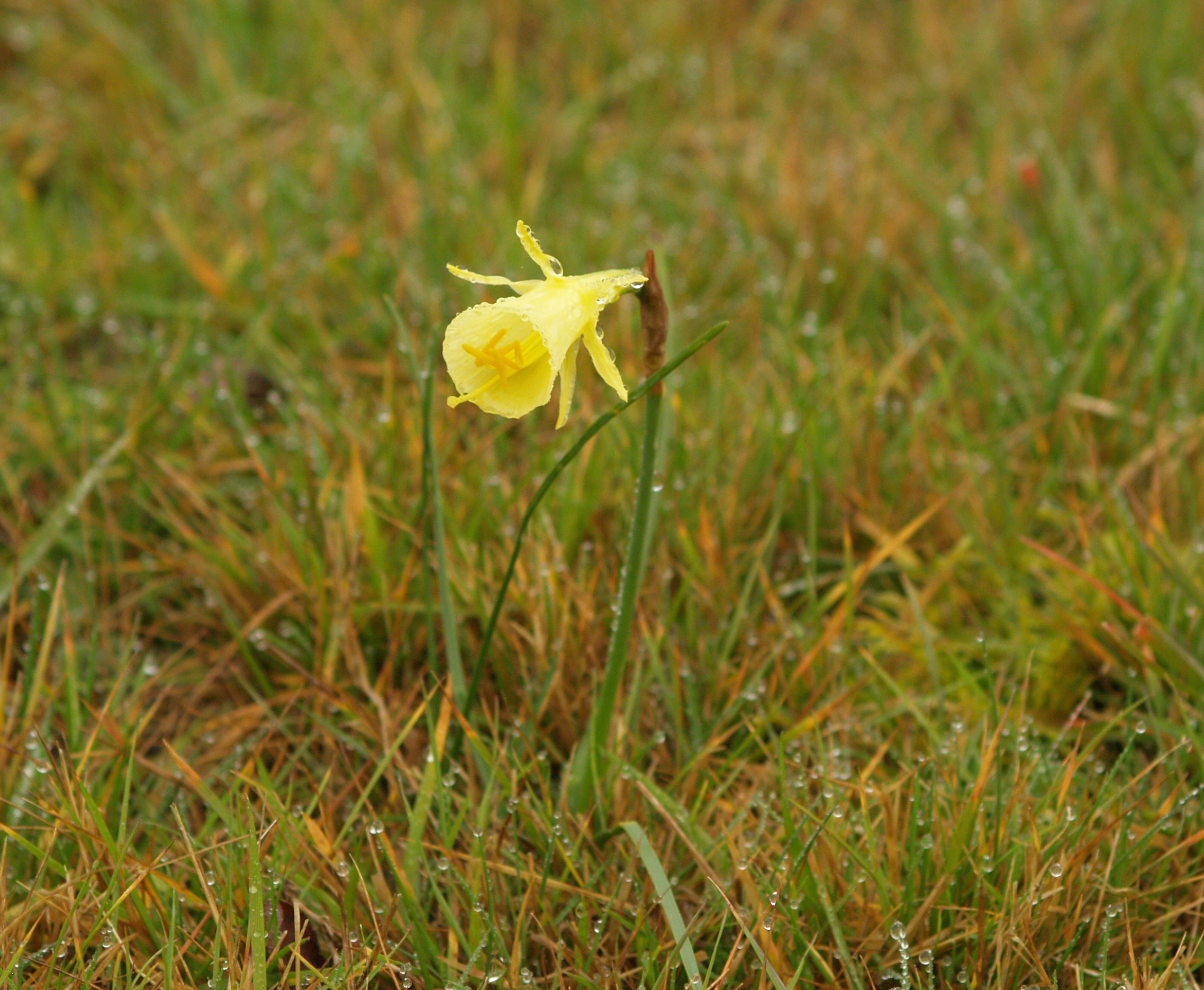
In N. bulbocodium the corona (trumpet, as it where) extends out quite a bit and the tepals are thin and spiky. One cannot really mistake the ID of this flower (though I did).

Hoop-petticoat Daffodil (Narcissus bulbocodium) in Cantabria, Spain.
Flower detail of Hoop-petticoat Daffodil (Narcissus bulbocodium) in Cantabria, Spain.

Further Reading
– A link to the Royal Horticultural Society’s page on this plant. More info and how to grow it in your garden.
– A PDF detailing the different Narcissus species in Spain (there are quite a few!). From the Flora Iberica publication, in Spanish, see page 26 for more info.
– A list of my sightings of this flower on Observation.org.

Flowery Fields Forever – Hoop-petticoat Daffodil – Narcissus bulbocodium (L.)

Book Club – The Butterfly Isles by Patrick Barkham

My primary hobby is reading, always has been and always will be. Any non-fiction is often associated with other interests and hence I’ve been reading books on various natural history topics recently to help build up a knowledge base that can aid me when I can go out into the field. The books I’ve been reading are not only the essential field guides that will help me identify what I see, but I’ve also been reading some that fall into the, currently hip, category of nature writing.

Introduction
In recent years there has been an explosion in books with nature seen from the personal perspective of the writer. Of course this type of book has been around at least since Henry Thoreau’s Walden, so is nothing new, but the sheer number since around 2003 has been astonishing. Usually the author goes on a journey of self discovery while at the same time offering the reader insights into the complex nature of the natural world. This can be done through a literal journey (think A Walk in the Woods by Bill Bryson (1998)) to focusing on one animal (for example the award-winning H is for Hawk by Helen Macdonald (2014)).

The Butterfly Isles is Patrick Barkham’s first novel. He has since gone on to write Badgerlands (2013) and Coastlines (2015), all of which fit nicely into the category of nature writing. I should say, I’ve not read any of his other work, but am keen to read Badgerlands.

The Butterfly Isles covers Barkham’s attempt to see all 59 butterfly species in Great Britain during the spring and summer of 2009. The book is written in a reasonably chronological order. It focuses on various species as he spots them flying in their habitats and also covers Barkham’s own fascination with butterflies that he developed through his father’s keen interest in them.

Comments
My main reason for reading this book is that I wanted to get a feel for butterfly behaviour. I’ve only been looking for butterflies since this past April and I just record what I come across on my walks through the fields here, not really making much of an effort to find out where there might be some special areas to see rare species. I wanted to know how a butterfly aficionado goes about doing such things.

Well, Barkham had not really been active with regards to butterflies when he wrote the book. His knowledge was mostly based on his past forays with his father. Hence he calls in the help of Butterfly Conservation members across the UK (something I cannot quite do, nothing much in the vein of butterfly conservation here in Cantabria). Barkham should count himself lucky in that respect.

Anyway, some great things about the book is that for many species Barkham does cover quite a few interesting details, about how the name came about, how the species has managed to survive in the UK through the butterfly hunting ages etc. There’s also a map showing locations, an extensive appendix that includes directions to specific sites, web sites, a bibliography, a good index etc. I would say this is critical in this type of book so you can go back for specific information at later stages after your read the book and want to go spot some of the species covered.

Barkham’s manner of writing is also quite engaging. It is clear he is passionate and that pulls you through the book, though it probably does help that I’m interested in butterflies.

There are 3 little nitpicky negative points to the book:
– The stuff about the relationship with his girlfriend (Lisa) does not really add much at all, if anything. Sure butterfly watchers are geeks and it can become an obsession to go out searching for new species, but Barkham gives ample evidence of this without the need to drag us into his personal life … I actually started to get irritated at his (in my opinion) selfish girlfriend … obviously you don’t get the whole story and it cannot have been that bad as they get together, marry and have kids (this last is a deduction and not specifically in the book).
– At one point he’s writing away mentioning the Large Skipper (Ochlodes sylvanus) and I think … hold on a sec., he hasn’t given any type of intro etc. to that species and here he’s glossing over it like it is nothing and he’s seen millions. About 100 pages later he has a couple of paragraphs that go back in time and then you realise that he then describes seeing this butterfly for the first time in 2009 and thus checking it off his list. The rest of the book is in reasonable chronological order, why not here? The passage later does not fit in the story well at that point so why not leave it in previously? Dramatic effect?
– The Ringlet (Aphantopus hyperantus) hardly gets two lines when Barkham first spots one and never gets a good introduction … they may be common in the UK but it is one of the species that I’m aching to see here! There are tantalising hints about what I might look for, how it flies, the habitat you can find one in etc. but I was hoping for more.

Anyway, apart from the 3 (personal nitpicky) points this book is pretty good and quite a fun read. As I said before, I’m keen to read Badgerlands now and his other books (Coasts and the upcoming Islands) would be a good read at some point in the future.
I can recommend The Butterfly Isles to anyone living in the UK (learn something about your countryside and what lives in it) or someone who may be interested in learning about the natural world around them, and not only about butterflies but how the views of that natural world have evolved over time.

The Edition
Title: The Butterfly Isles: A Summer in Search of Our Emperors and Admirals
Author: Patrick Barkham
Publisher: Granata Books
Year: 2010, paperback 2011
Edition: Paperback, first edition, 3rd printing, 372 pages
Additional Info: Line drawings by Helen Macdonald.

Further Reading
– Patrick Barkham is a journalist for The Guardian newspaper (UK) and is a regular contributor with pieces on natural history. An overview of his articles.
– Patrick Barkham’s Twitter page.
– Patrick Barkham’s page at Granata Books. Not the most up to date, as the Coasts book is out and he’s working on one called Islands.
Book Club – The Butterfly Isles by Patrick Barkham

Flowery Fields Forever – Autumn Crocus – Crocus nudiflorus (Sm.)

I do not know much about flowers or plants, but I started taking an interest when I started taking pictures of bumblebees, butterflies and such. Certain bumblebees may only visit certain flowers and such information may help in determining the species of bumblebee. The same is for butterflies, where they will lay eggs on certain plants which will be food for the caterpillars when those hatch.
Secondly, the database where I record my observations has the option of adding the plant species from which an insect was eating, taking pollen or taking nectar. Therefore, knowing the genus (in this case Crocus) or family (in this case Iridaceae) adds extra information to the observation. If you then also know the correct species, great.

Introduction
So I started taking pictures of flowers in April of this year (2015). Mostly of those on which I saw bumblebees, but also of ones that I thought were pretty or strange. These last two categories meant that I took pictures of orchids (see future posts) and of this flower, the Crocus nudiflorus.

Autumn Crocus
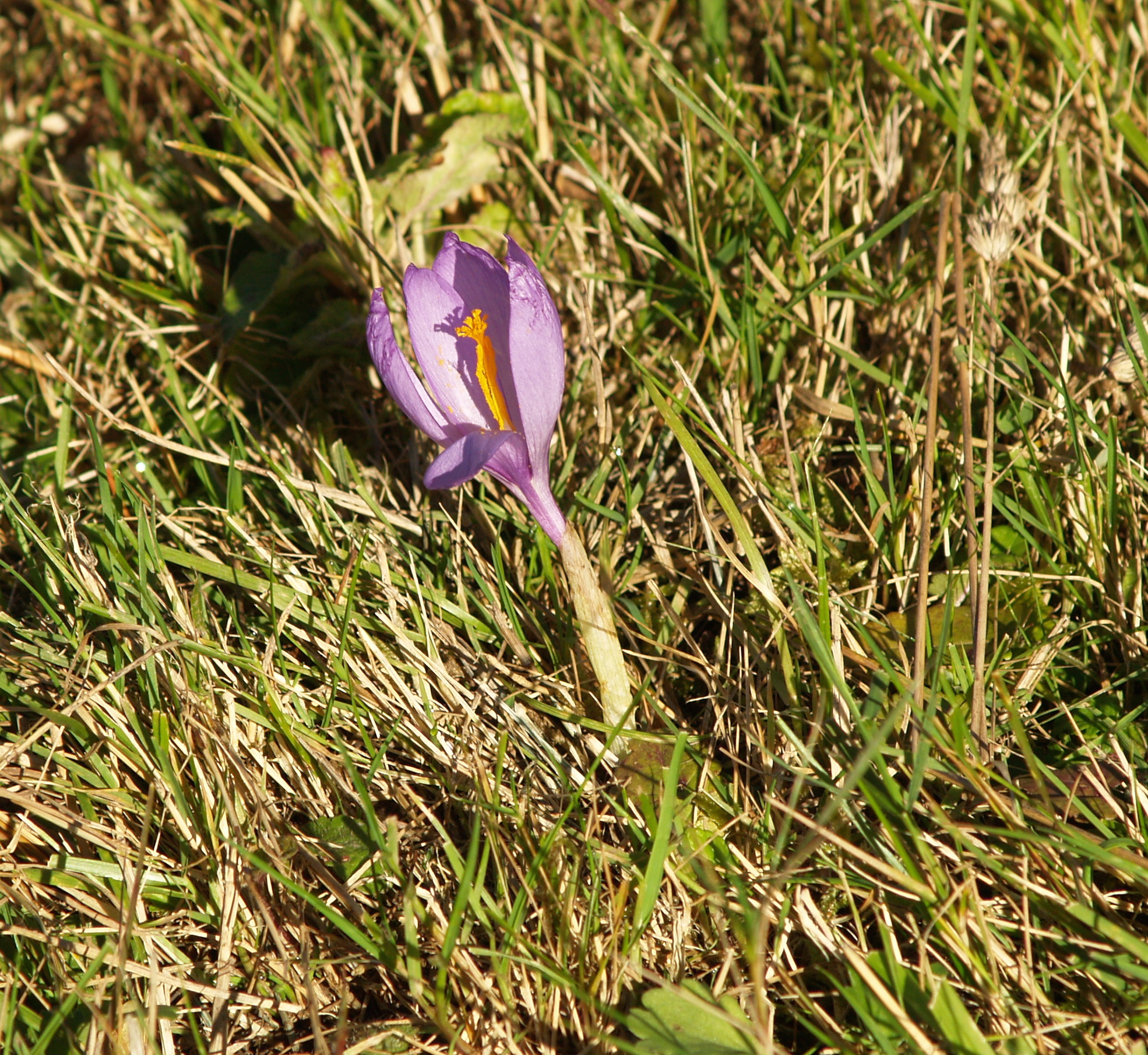
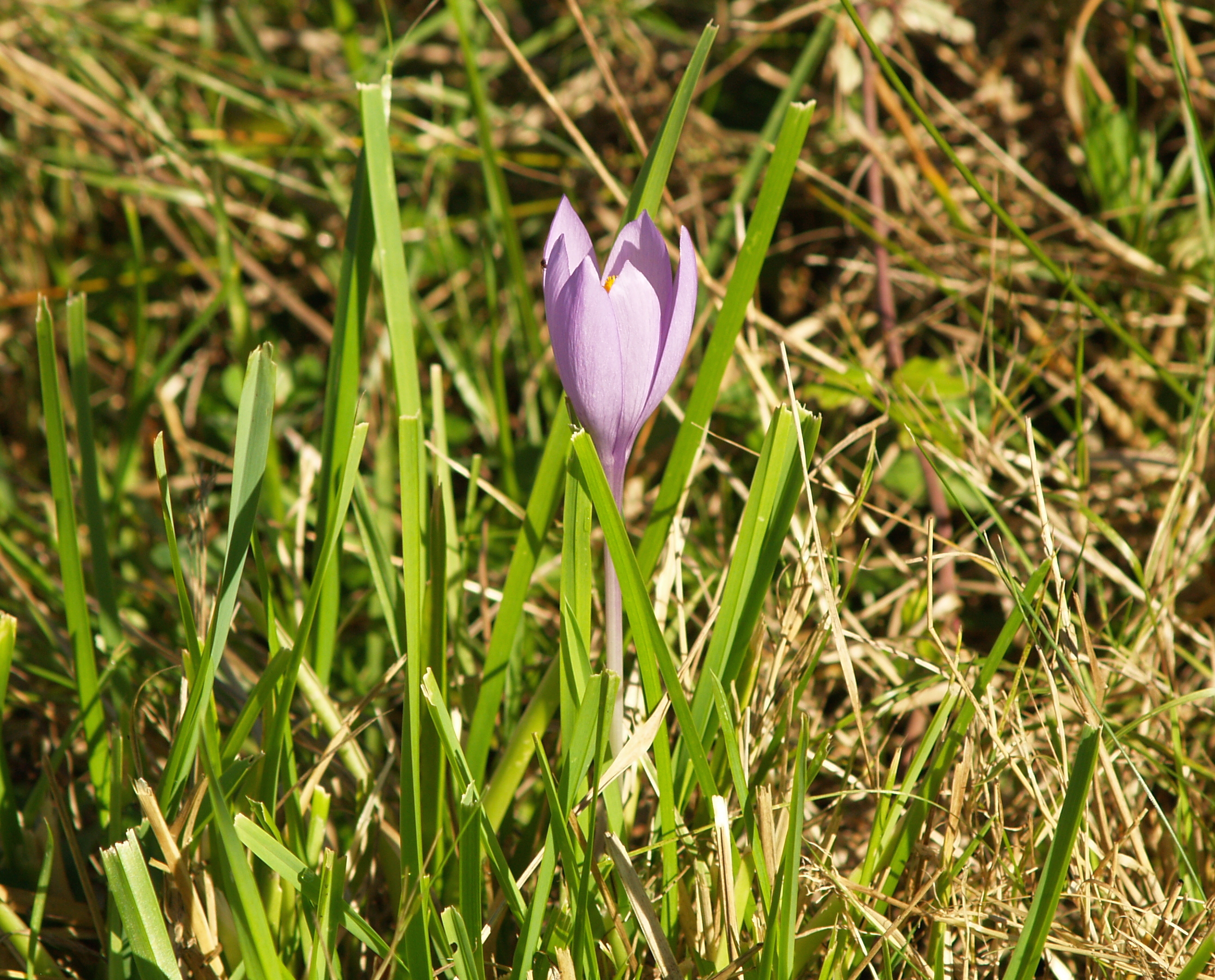
The Autumn Crocus is a bit of a weird one in the Crocus genus, as it is one of the species that flowers in the autumn (hence the name) and it grows on humid soils, whereas many other Crocus species prefer well-drained soils (I assume this has to do with the possibility of the corms rotting). This plant spreads through both seeds and corms (the underground bulbs, which produce stolons). The flowers emerge from late September onward and at first there are no leaves visible. The patches of flowers can become quite dense, I saw them this past weekend in a park in Colombres, Asturias and whole areas of grass under the trees was covered in these flowers. The observation from which the photos below are had a lot less flowers, around 15. Crocus nudiflorus is found in southwestern France and along northern Spain, especially in upland areas.

I noticed these flowers in one of the fields nearby that are used for hay and grazing of horses/donkeys. In this area the ground is generally very humid and during the winter months can become quite boggy with all the rain. I think the flowers are poisonous to animals. Anyway, it was great to see this new injection of colour into the landscape, especially as I never expected it and had no idea Crocuses also flowered in the autumn.

When IDing this species here in northern Spain one has to take care not to confuse it with Late Crocus (Crocus serotinus), which looks very similar except for the stamen (both anther and filament) being completely yellow. On Crocus nudiflorus, the anther is yellow and the filament is white/light purple/blue (in the top picture you can see a hint of white filament). There is also the fact about the plant showing leaves or not, but I do not think that is completely reliable in determining the species. Furthermore, I believe that Crocus serotinus likes drier soils.

Autumn Crocus (Crocus nudiflorous) in Cantabria, Spain.
Autumn Crocus (Crocus nudiflorus) in Cantabria, Spain.
Autumn Crocus (Crocus nudiflorous) in Cantabria, Spain.
Autumn Crocus (Crocus nudiflorus) in Cantabria, Spain.

Further Reading
– A link to the Alpine Garden Society page on this flower. Has more in-depth information and also a bit more about growing this plant in your garden.
– A PDF detailing the different Crocus species in Spain. From the Fauna Iberica publication and in Spanish. See page 7 for C. nudiflorus.
– My sightings, to date, on Observation.org of this species.

Flowery Fields Forever – Autumn Crocus – Crocus nudiflorus (Sm.)

Bee-news – Common Carder Bee – Bombus pascuorum (Scopoli, 1763)

I was not sure with which insect/animal I’d start off the blog, but have decided to go with the Common Carder Bee (Bombus pascuorum). Since I’ve been out and about in nature (start of 2015) and recording what I see … well, to the extent that I record what I know about and what interests me … this little bumblebee has been present throughout. I first saw one mid March and have seen them around till now (October). Furthermore, I’ve seen them in all types of environments, from in the city, to near the coast to the farmland around our house. So, without further ado …

Introduction
Bumblebees are social bees that form small hives of 50 to maybe 250 individuals, depending on the species. These bees are usually recognised by their roundish, compact, hairy bodies and can be anywhere from around 10mm to over 20mm in size, the larger forms being some of the larger bees you’ll see around and thus when they land on certain flowers the stalks will bend due to the weight of the bee.

Carder
Carder bees are a group of bumblebees that (subgenus Thoracobombus) usually build their nests in grasses etc. near the ground. The nests are built of mosses and such materials. The name carder comes from the term carding in wool-making, which is the separating and cleaning of the wool fibres. The bees do a similar action with their rear legs in taking moss and such.
Here in Cantabria there are a possible 9 species of carder bee present. I’ve seen 4 of which the Bombus pascuorum is by far the most common. 4 of the species are on IUCN’s Red List with a category of Near Threatened or worse, one of those is also on Spain’s Red List as Vulnerable.

Common Carder
So, yes, the Common Carder is quite common, and here too. It is the one little bumblebee I can rely on seeing when going out. One of the reasons why it might not be as famous as the black and yellow cousins is that the colour is a gingery brown, not something that flashes between all the flowers that it visits … as it visits all types of flowers, both for pollen and nectar.
There are 23 subspecies (ssp.) of B. pascuorum and I’m not quite sure which can be found here, more research to do on my part … I think B. p. dusmeti and/or B. p. maculatus, but don’t quote me on that and I don’t know the differences.
One of the things that makes identification difficult is that these bees look quite similar to Bombus muscorum (Moss Carder) and Bombus humilis (Brown-banded Carder) and I’ve seen both those around here too … therefore, when spotting a fresh Common Carder looking bee it takes a clear photo etc. in order to really ID it properly, the other two bees are quite rare. The Common Carder has more black hairs on both the thorax and abdomen. Also you can approach these bees quite closely and really get down to have a good look as they are rummaging about in a flower. Sometimes they are a bit in a rush, but if you’re lucky it is just slowly moving from flower to flower and there will probably be others around so you can just sit and wait for them to come to you. A good sized bush of Lavender is great as they love it (as do other bees and insects!). There is a park in Santander (Las Llamas) where they have huge stretches of lavender … on sunny days those flowers are covered in bumblebees including some Common Carder (however, Buff-tailed Bumblebees (Bombus terrestris) were more common when I was there this past summer).

I’ll post a couple of pictures of Bombus pascuorum bees from around here, however, for this bee other sites (see below) are better to really get a good idea how to properly ID one.

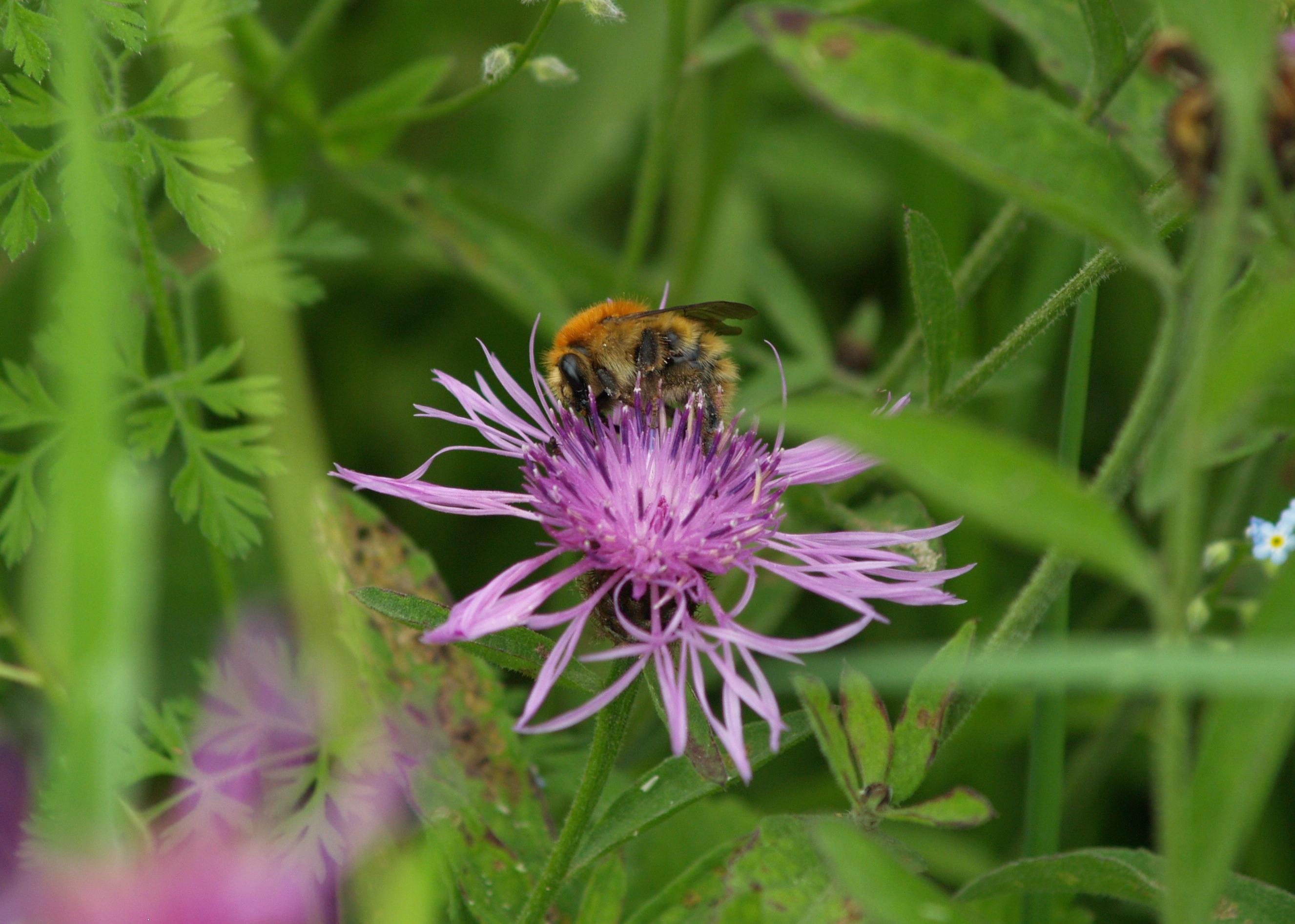
Common Carder on a type of Knapweed (Centaurea spec.) in Cantabria, Spain.
Common Carder on an unknown plant in Cantabria, Spain.
Common Carder on a type of Betany (Stachys spec.) in Cantabria, Spain.

Further Reading
– Here is a link to Steven Falk’s Flickr page, lots of good pictures and basic info. He’s got a book coming out in a week (early November 2015) or so on Bees in GB & Ireland!
– A link to P. Rasmont’s page with a distribution map and some other basic info.
– A link to the Natural History Museum page that gives an overview of the colouration of the Common Carder Bee. I love how they’ve created the images, can at times be better than a drawing. The site can be used to compare different bees’ colourations.
– A link to the IUCN page. Great site.
– The Bumblebee Conservation Trust is a great organisation, especially if you live in the UK, they’ve got a helpful site for the beginner and also a place to upload photos and ID other people’s photos. I’m a member even though I live abroad.
– There’s a cool app for the iPad/iPhone by NatureGuides with great drawings (those will probably be in S. Falk’s book as it is the same artist). I’ve got the Pro version which has been a good resource for info.
– Dave Goulson’s A Sting in the Tail is a fun read about the world of bumblebees.
– My sightings to date on Observation.org of this species in Cantabria.

Bee-news – Common Carder Bee – Bombus pascuorum (Scopoli, 1763)

Background Info.

So … a little background info on the title of the blog:

One of the bugs you catch when going out to look at birds, butterflies and what not is that you start to want to encounter new species. In the beginning it may just be enough to go out and see what’s around your home, in your garden … you’ve probably spent time flipping through field guides studying the small distribution maps that accompany each specie … with the first steps out the door you may recognise that Magpie (Pica pica) and the coming days each time you go out you may notice small groups of magpies (called parliaments) in the fields surrounding your village … at a certain point you’re ready to see something new and not just what you com across on a daily basis. You can do two things:
– look closer at the things around you.
– go further afield to new types of habitat (go to a nearby river, walk up a hill nearby to a large area of pine trees).

Cullum’s Bumblebee (Bombus cullumanus) is one of those species you just really hope to come across one day (usually through luck). Hence the title of the blog. Not only will me finding that bumblebee require me to look closer at the things around me, but it will also require me to go a little further afield that where I’ve been up till now …
Will ever find this species? Who knows. They say it is extinct in this part of Europe but they also say that more research is required into the distribution of the species. Who are they? The bee experts.
I’m stubborn and will try my best. I’ve already found certain species of butterfly and dragonfly that weren’t thought to fly here so who knows …

Cullum’s Bumblebee will probably be one of the most difficult searches, but for many species there will be a similar urge to try to find them in Cantabria.

Cheers,
bart.

Should you want to know more about Cullum’s Bumblebee go to the:
Atlas Hymenoptera run by Pierre Rasmont (a highly rated Belgian scholar on bees).
IUCN Red List page for the species to get more information about habitat and distribution (you’ll note that P. Rasmont is one of the assessors there).
Flickr page created by the excellent Steven Falk, who will be coming out with a book on European bees soon.
– A difficult/academic article (PDF) by Paul Williams et al. (including P. Rasmont), from 2012, on just how extinct this extinct bumblebee is.
– I’ll write a more extensive post in the future on Bombus cullumanus.

Background Info.

The start of a new blog

This is the start of a blog to record and detail observations made of insects, birds, reptiles etc. that I come across in Cantabria, Spain. For the time being I’ll be reflecting on what I’ve seen over the past year, but over time I hope to start adding current observations.

An overview of my observations can be found here … Observation.org … a site dedicated to recording the biodiversity around the world.

That’s all for the time being, cheers,

bart.

The start of a new blog