Data Dwellers – Bombus inexspectatus Tkalcu, 1963

1.0 Introduction

Time to get started on the first real Data Dwellers. The previous two posts were to introduce the series and give short highlights of the methodology behind the series.

In the first post (Introducing the Data Dwellers) I already gave a first glimpse of the species we’ll cover today. What you read here will be the basic outline that each Data Dwellers post will follow. It will include a short introduction to the species and then will highlight the data analysis process. What did I do with the data? Did I find anything interesting? What does the data show us? Can I make improvements in the future and are we missing something in the data?
To round it all off I’ll provide links, and references to the data used.

I have only recently started on my data analysis journey, so part of the process is me learning and documenting my work. You can see this as an extended portfolio, if anyone is interested in my skills they can come here and see what I’ve done and how I have done it.

So, to start, I needed a dataset that was manageable for my current competency level. I needed to find a species of bee or butterfly that would not have millions of data entry points (very common species will have millions of occurrences) so that I could easily review the work that I had done and see where I can improve or simplify my data analysis processes. Two bumblebee species were the first that popped into my mind … the blog’s namesake and a very rare species I have been interested in. Let’s take a closer look in the next section.

Key Takeaways

  • The goal is to learn by doing and you as reader can follow along as we build our data analysis competencies while exploring insect species.
  • Each post will have a similar structure. This spaced repetition learning technique will build up our base skills (continuous learning) and will make any anomalies stand out when we find them in future Data Dwellers posts.

2.0 Species Introduction – Bombus inexspectatus

I actually started on the blog’s namesake (Bombus cullumanus), and I’ve finished the work, but the dataset required quite a lot of cleaning, so I thought I’d leave that for a future post because I have to do more explaining around my data analysis processes. Let’s keep it relatively simple for a first time. This post is going to be a bit longer than usual – grab a coffee and settle in!

Bombus inexspectatus Tkalcu, 1963 is an extremely rare bumblebee species that can be found in the Cantabrian Mountains and the Alps (see the IUCN link below). The reason it is so rare is because it has an incredibly unique lifestyle. I know of one other bumblebee species like it, Bombus hyperboreus Schönherr, 1809, which is found above the Arctic Circle in Norway, Finland, and Russia. What makes this species so special is that the queens cannot make their own nests, but at the same time, they do not parasitize a host’s nest like a cuckoo bumblebee does. Cuckoo bumblebee queens kill or “dominate” the host queen, and the hive then thinks that the usurper is one of their own. Unknowingly, the nest starts rearing the cuckoo bumblebee’s eggs! Think of the Cuckoo bird, where the adult removes a host bird’s eggs (a Robin or Blackbird for example) from the nest and lays her own in it. The host bird then rears the Cuckoo’s egg to adulthood!

Bombus inexspectatus queens cannot make wax (to create the cells into which eggs are lain), so she enters a nest and needs to work with the host (in this case the species she relies upon is Bombus ruderarius (Red-shanked carder bee)). Also, she needs the host’s workers to forage for pollen because she cannot do that (nor any of her offspring). To make things even more difficult, Bombus ruderarius is not a common species in the Cantabrian Mountains, and Bombus inexspectatus bees look very similar to their hosts. This second aspect is why the species was only identified in 1963, and only years later it was confirmed that the two species I’ve mentioned here are connected (Hines & Cameron, 2010 – see below).
I have photos of a bumblebee that fits the coloration of Bombus inexspectatus, but they aren’t good enough for identification. So, I will not post anything until I have something that is certain.

Anyway, all of this means that there are very few observations of this species that we can analyse. The last registered observation is from 2018, with most prior observations coming from entomological collections where the bee was initially misidentified as B. ruderarius. Needless to say, this means that there could still be mislabelled specimens in some of the smaller entomological collections, or private collections, which would help bolster historical data. Given how elusive Bombus inexspectatus is, every data point matters. So, let’s dig into what’s available and see what patterns—if any—we can uncover through analysis.

Key Takeaways

  • Bombus inexspectatus has an unusual lifestyle, where it must cooperate with the host.
  • It is a very rare bumblebee species, both because it is difficult to identify and because its range is very limited.
  • Most observations are historical, making citizen science and scientific fieldwork key to uncovering new data on the species.

3.0 Analysing the Data

3.1 First Steps

Bumblebee data for Europe can come from two main sources.

  • Atlas Hymenoptera – you can download a .csv file per species. The main issue is that the data has not been updated since around 2013, and the type of data per observation is very limited, with only really the basics (location and date(sometimes)). The data comes from old scientific articles and from old collections.
  • GBIF – a massive data repository. You can download a data package with lots of information per observation (if the people uploading the observation have decided to include it). GBIF includes all verified data from the website I use, Observation.org.

So, the first step is to remove most of the data columns (each row in a dataset is an observation), because many of the columns are empty (e.g. life stage), or have information that is not interesting to us (e.g., some of the taxonomy elements are too detailed).

The next step is to integrate both the Atlas Hymenoptera and GBIF data sets together. I add the AH data to the cleaned GBIF file and make sure to tag the imported data as coming from the AH so I can split it out later for visualisation.

Step three is to remove all data that falls outside of Spain, in this case all the observations in the Alps. Not that those aren’t interesting … but the blog is focused on Cantabria and the surrounding regions, and adding the Alps data might distract the reader. In future posts, I’ll need to decide if I keep the focus on this region of Spain or show the data for all of Spain.

3.2 Assumptions Made & Manipulation of Data

These are basic initial steps I do each time, I won’t highlight them in detail for each Data Dwellers post, but you can always ask below if you want to know more. The most important element are the assumptions I apply when I go to visualise the data.

For example, in this case, a number of observations in the dataset came with a NULL (this means nothing is entered in a cell in the database) or N/A in the column of counts of individuals observed. To resolve the issue around counts I decided to replace those NULLs with a “1”, so that it indicated that at least 1 individual was observed at that location. Reasoning being, why would you record an observation if you didn’t see anything? Keeping the count to “1” (and not “2” or “10”) meant that the data doesn’t skew towards those NULL observations and weights each equally, compared to the overall dataset.

Another decision I had to make was around data duplication. Combining both datasets meant that some observations could be counted twice because they are recorded in both the GBIF and Atlas Hymenoptera datasets.
For example, if you look at 1988, there are 4 observations in both datasets. However, on the map they aren’t in exactly the same spot. Keeping both in, allows the viewer to see any trend in each dataset (hence the different colours used to visualise them). The larger the datasets the less impact this will have.

Data counts is also the reason for not adding totals to each bar in the bar chart. For example, for 2015 the bar could have a number 10 above or in it. However, we aren’t really interested in totals per se, we’re more interested in trends (i.e., how does the height of each bar in the bar chart relate to the others?). I should not that with such low numbers of observations, any trends are quite speculative. Most people won’t be able to identify Bombus inexspectatus out in the field considering it looks so similar to other species. So, any large upticks are probably due to a focused effort to record bumblebee species by scientists.

I did not find any mistakes (yet) therefore we’ve reached the end of this section. Below is a picture of the dashboard and you can click it to link to the Tableau page where you can check it out.
For those of you who are new to dashboards, you can hover over things and additional information will pop up. For example, each dot on the map has some information about the observation (if anything was available). You can also zoom in on the map, move it around or uncheck observations from a certain source.

Now that we’ve visualised the data and explored some initial patterns, it’s time to think about what comes next—both in terms of improving the analysis and expanding the scope of future posts.
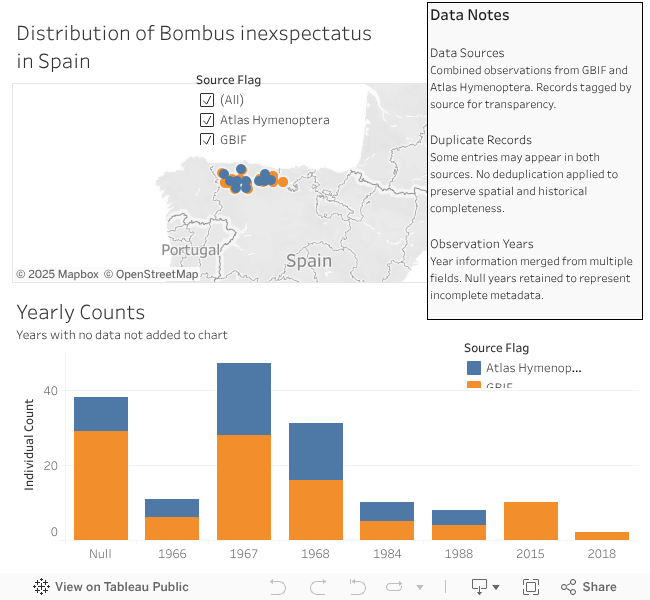
Bombus_inexspectatus Dashboard

Fig 1. – Link to a Tableau Dashboard of Bombus inexspectatus observations. Data from Atlas Hymenoptera and GBIF. Click on the image to visit the dashboard in a new tab.

Key Takeaways

  • Assumptions are key when analysing data. So, we have to be very clear about the assumptions that we are making.
  • Two main sources of data were used. The focus has been on data showing the species’ presence in Spain.
  • The goal here has been to visualise the data and to look for patterns over time and space. The result is the dashboard.

4.0 Next Steps …

As this project evolves, there are several exciting directions I’m planning to explore:

•  Standardising the Dataset. The current Tableau dashboard works well, but the underlying dataset still has inconsistencies due to merging multiple sources. I’ll be refining the structure to ensure smoother integration and more reliable visualisations.

•  Sharing My Workflow in R Markdown. I’m working on creating R Markdown documents to publish on my GitHub. These will walk through my analysis step-by-step, making it easier for others to follow, replicate, or even critique the process. It’s a way to open the door to collaboration and feedback.

•  Learning from the GBIF Data Use Club. I’ll be attending the upcoming webinar on Mapping Occurrences hosted by the GBIF Data Use Club. Their previous sessions have already taught me valuable tricks—like using the taxonKey instead of the scientific name for more consistent searches. I’m excited to apply these insights to future posts, especially when I start diving into butterfly data.

•  Exploring Alternative Mapping Tools. While Tableau has served me well so far, I’m curious about other platforms for species mapping. Depending on what I learn through GBIF and other sources, I may experiment with new tools to enhance the visual storytelling.

•  Tapping into Cleaned Spanish Bee Data. I recently discovered a GitHub repository where someone has already cleaned and organised Spanish bee data from GBIF. I’ll be reviewing their work to see how it might complement or improve my own dataset. More updates on this soon.

If you’re following along and have thoughts, questions, or ideas—drop them in the comments. I’d love to hear from you and keep this conversation going.

5.0 Links

Hines & Cameron, 2010 – Research article on Bombus inexspectatus https://www.life.illinois.edu/scameron/publications/pdfs/HinesCameron2010.pdf

Atlas Hymenoptera data link http://www.atlashymenoptera.net/pagetaxon.aspx?tx_id=3016

GBIF downloaded dataset https://www.gbif.org/occurrence/download/0010366-250711103210423

GBIF Data Use Club https://www.gbif.org/data-use-club

IUCN Red List https://www.iucnredlist.org/species/13340462/57349805

Bumblebee Conservation blog post https://www.bumblebeeconservation.org/bumblebees-of-the-world-blog-series-7-bombus-inexspectatus/

Spanish Ministry for the Environment https://www.miteco.gob.es/content/dam/miteco/es/biodiversidad/temas/inventarios-nacionales/Bombus_inexspectatus_tcm30-198244.pdf

Data Dwellers – Bombus inexspectatus Tkalcu, 1963

Introducing the Data Dwellers

Small Observations, Big Possibilities

Sometimes a bumblebee lands on a flower. Sometimes it lands on a map.

Over the past year there have been a number of significant changes in my life, which include a move and diving into a new area of knowledge; Data Analytics. However, one constant has been nature observation. If you decide to take the plunge with me, I’d like to slowly start incorporating these aspects into a new series —one part data, one part nature observation. This series, Data Dwellers, is about the quiet footprints organisms leave across landscapes, and how every recorded sighting builds the bigger picture. Whether it’s a beetle in a field, a dragonfly over a pond, or a butterfly zigzagging through nettles—these aren’t just wildlife moments. They’re coordinates, timestamps, and opportunities.

I’ll be keeping this first entry light, but here’s what you can expect from future posts:

  • Mini-Profiles: Exploring species you might stumble upon, grounded in data and ecology.
    • Data Deep Dives: Looking at patterns, gaps, and what citizen-collected data can reveal about regional biodiversity.
    • Behind the Numbers: Explaining how digital ecosystems (like Observation.org or GBIF) track nature—with all its quirks and blind spots.

Each entry will be tailored to the species I’ll cover, some might benefit with a deep dive into the data available, whereas others will explore issues found within the data available. Furthermore, each entry will compliment posts in the other regular series such as Fly Facts, Butterfly Bulletin, Odonata Update, and more.

1.0 First Glimpse: Bombus inexspectatus in Spain

Here’s a simple visual example of what I mean. I’ve built a dashboard that combines observations of Bombus inexspectatus—a rare bumblebee—from two public datasets. It’s not flashy, but it starts to tell a story and it provides us a basis for excursions and goals we have to see if we can observe the species ourselves out in the wild.

I‘ve not yet been able to embed the dashboard here (yet), but below is an image with a link to that dashboard. The dashboard is interactive and will update by itself if I make any changes to it in the future. Feel free to zoom in on anything that might interest you, check or uncheck boxes, hover over observations or bars in the bar chart for more information.

Bombus_inexspectatus Dashboard

Fig 1. – Link to a Tableau Dashboard of Bombus inexspectatus observations. Data from Atlas Hymenoptera and GBIF. Click on the image to visit the dashboard in a new tab.

Dashboard Notes

  • Mapped Observations: You’ll see locations pulled from GBIF and Atlas Hymenoptera—both great resources with different strengths. I’ll post links below.
  • Yearly Counts: Even sparse data can show patterns (or silences). Why the jump in 2015? Why nothing recent? Questions like these guide deeper research.
  • Data Gaps: Some records are missing timestamps or counts. I’ve kept these in to reflect the reality of citizen science—messy, imperfect, but meaningful.

I’ll cover these questions in future Data Dwellers posts on specific species, as well as in a Data Dwellers post where I’ll cover my work methodology.

2.0 Why This Matters

In a way, species like Bombus inexspectatus are digital ghosts. We know they exist—or existed—but they flicker in and out of view depending on where people look, what they record, and how they choose to share it. This is where Data Dwellers finds its pulse: in the tension between the known, the visible, and the speculative.

As I mentioend above, I’ll be posting new entries under this series—sometimes short snapshots, other times deeper dives. And if something sparks curiosity along the way, feel free to reach out or leave a comment. Nature isn’t just for scientists, and neither is data.

3.0 Links

Each time I create a new dashboard for a species, I’ll be using various sources. One will usually be GBIF, which requires that you provide a link to the data used.

Atlas Hymenoptera – Great source on bees in Europe. The link it to the species-specific page.

GBIF – An open access database with biodiversity information. See here the citation you are required to add:

Creuwels J (2017). Naturalis Biodiversity Center (NL) – Museum collection digitized at storage unit level. Naturalis Biodiversity Center. Occurrence dataset https://doi.org/10.15468/17e8en accessed via GBIF.org on 2025-07-14.

Praz C, Müller A, Hermann M, Neumeyer-Funk R, Bénon D, Amiet F (2025). Swiss National Apoidea Databank. Version 1.7. Swiss National Biodiversity Data and Information Centres – infospecies.ch. Occurrence dataset https://doi.org/10.15468/ksfmzj accessed via GBIF.org on 2025-07-14.

Bakker F, Creuwels J (2025). Naturalis Biodiversity Center (NL) – Hymenoptera. Naturalis Biodiversity Center. Occurrence dataset https://doi.org/10.15468/jgywgc accessed via GBIF.org on 2025-07-14.

Inventaire National du Patrimoine Naturel (2020). ATBI Parc national du Mercantour / Parco naturale Alpi Marittime-Jeux de données provenant de l’ATBI dans le Parco Naturale Alpi Marittime (Italie). UMS PatriNat (OFB-CNRS-MNHN), Paris. Occurrence dataset https://doi.org/10.15468/wzwus6 accessed via GBIF.org on 2025-07-14.

Orrell T, Informatics and Data Science Center – Digital Stewardship (2025). NMNH Extant Specimen Records (USNM, US). Version 1.96. National Museum of Natural History, Smithsonian Institution. Occurrence dataset https://doi.org/10.15468/hnhrg3 accessed via GBIF.org on 2025-07-14.

Mañas-Jordá S, Acosta Rivas C R, Ariño Plana A, Baquero Martín E, Bartomeus I, Bonada N, García-Barros E, García-Meseguer A J, García Roselló E, Lobo J M, López Mungira M, López Rodríguez M J, Martínez Menéndez J, Millán Sánchez A, Monserrat V J, Prieto C E, Romo H, Sánchez-Campaña C, Tierno de Figueroa J M, Yela J L, Sánchez-Fernández D, González M, Bonada N (2025). IberArthro: A database compiling taxonomic and distributional data on Ibero-Balearic arthropods. Version 2.4. Department of Ecology and Hydrology. University of Murcia. Occurrence dataset https://doi.org/10.15470/pqq9oc accessed via GBIF.org on 2025-07-14.

Villares J M (2023). Inventario Español de Especies Terrestres (MAGRAMA). Version 1.5. Spanish Ministry for Ecological Transition and Demographic Challenge.

Occurrence dataset https://doi.org/10.15468/f0qd41 accessed via GBIF.org on 2025-07-14.

Introducing the Data Dwellers

Butterfly Bulletin – Alcon Blue – Phengaris alcon (Denis & Schiffermüller, 1775)

Introduction

The last post was centred around a chance encounter with a butterfly. I’d not even realised I’d seen it until I got back home and looked at my photos in more detail. Today’s post is about a focused excursion in the hope to see a specific species.

It all starts with setting out a general overview of butterfly species I might come across in Cantabria and listing those all in an Excel. Considering the Alcon Blue is quite a rare species, I then look for scientific articles (PDF format) on the species, which range from a pan-European overview to specific Spanish articles. These documents sit in a neat little folder on my HD and wait for a dreary winter day when I might be inspired to plan some excursions for the warm summer months later in the year …

On that deary day I’ll go through the articles and see if there is more detailed information regarding potential locations where I might find the Alcon Blue. The scarcity of the species means some articles are from the 1960s and 70s (when the province was called Santander, not Cantabria) and come with a short sentence where it was seen. For example, the 1968 source (Agenjo) states “near Herrera de Ibio at 40m”, the problem being that all land around Herrera de Ibio is at least 80m above sea level. We have friends who live in that village, so have made plenty of walks in the country lanes near there and I’ve always kept my eye out for boggy (turbera) areas. There are plenty of those, but I’ve never seen the LHP (larval host plant) at all … I ran into that issue in most other locations I found in documentation. Regarding citizen science web sites, nothing.

So, I had to turn my attention to the LHP (more on that unique relationship below), which I looked up on the citizen science websites (e.g., Observation.org) and I had more luck. From there I turned to Google Maps and scoured potential locations comparing it with what I’ve read in literature, to see how easy it is to get there, some street-view images and so forth.

Then it all came down to waiting for a day, during the butterfly’s flight period, with nice weather (and no other priorities … kids, work, etc.) to head on out, with fingers crossed, to search for the impossible.
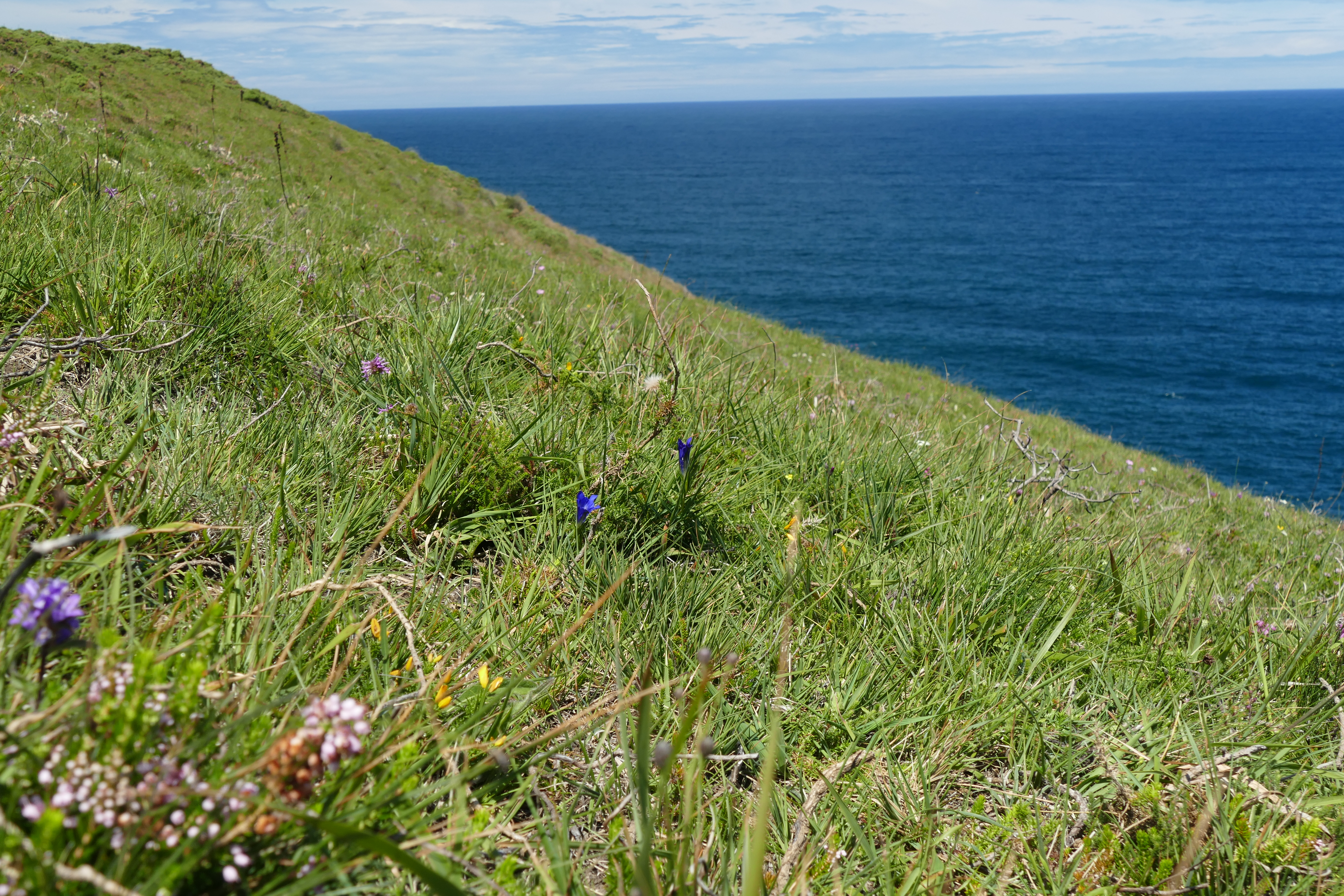
All the above led me to the following location (Fig. 1, yes, Cantabria can be stunning).

Cantabrian Coast near San Vicente de la Barquera.
Fig. 1 – The Cantabrian coast, near San Vicente de la Barquera (30TUP80), looking westwards towards Asturias. Notice the traditionally grazed pastures (there is a small group of cows mid left) right up to the cliff edge. Has potential spots to find more small populations of the Alcon Blue. The butterflies discussed below were found in the field behind me. Photo taken 28.vii.23.

The result: moist costal pasture that had continued under traditional grazing methods (cows) and that was assessable via walking path. Phew.

Alcon Blue

The Alcon Blue (Phengaris alcon) is part of a group of butterflies that have an intricate and complicated life cycle. Not only does it need a very specific plant (Gentiana sp.) on which it lays its eggs on or near the flower. It also needs a specific species of ant (Myrmica sp.)!

After the egg hatches, the tiny caterpillar will feed on the plant for a bit, but then it drops to the ground where it starts emitting pheromones (and I think even emits a sound) to attract that specific species of ant. Hopefully, there is an ant wandering around, and when it comes across the caterpillar it thinks that it is an ant larva. Gathering some mates from the ant nest, they drag the caterpillar down into the nest and put it in the nursery with the other larva. There it gets fed by worker ants (via regurgitation) and then goes into the chrysalis stage. When the time comes to emerge, the butterfly high tails it out of the ant nest because as a butterfly it does not emit a pheromone anymore, which means that the ants see it as a hostile entity within the nest. Finally, when the butterfly makes it out, it crawls up a blade of vegetation and pumps its wings full of “blood” to fly off and try to find a mate in the vicinity (it can’t go far because it is so closely linked with the plant and ant).

Male Alcon Blue.
Fig. 2 – Male Alcon Blue (Phengaris alcon). San Vicente de la Barquera, 30TUP80, 38.vii.23. This was just after release, the blue upper sides of his wings are not visible here.

Holy smokes … even with all the above going perfect, there is still so much more that can go wrong, such as the weather, parasites … there is one wasp that exclusively lays its eggs in the chrysalis of the Phengaris alcon, so if the butterfly disappears from a location so will the wasp(!), another link in the chain of super exclusive dependence … anyway, you can see why I just had to find this marvellous little insect …

But it does not stop there … Firstly, Phengaris alcon is often listed as Maculinea alcon in older literature. Nothing too drastic, but it can make searching the internet a bit more complicated.
Then there is debate in scientific circles if Phengaris alcon and Phengaris rebeli are separate species or if P. rebeli is a subspecies of P. alcon. In general, P. rebeli is found at high mountain altitudes (Picos de Europa in Spain) and P. alcon elsewhere. There are many more details around why they should, or should not, be listed as one species but the most important aspect is centred around the IUCN Red List, where P. rebeli is listed as Vulnerable (Vu) and P. alcon as Least Concern (LC), but that is because the latter takes both possible species into account. It is absolutely clear that both should be seen as Vulnerable because it is very easy to wipe out the small colonies of butterfly due to coastal development, or landscape management changes and more. For example, if you see the field where I saw the female and LHP (Fig. 3 and Fig. 1) it needs human intervention through traditional grazing methods at certain times of the year that keeps shrubs at bay, grasses not too long, but the soil quality poor in general (i.e., don’t spray it with fertilizer or manure). This is one of those cases where conservation regulations are not moving fast enough for a species and the only thing that I can do is to publish my findings publicly so that someone can use it to further their conservation cause.

Granted, you could ask yourself why such a demanding species requires conservation effort, but that’s for another blog debate.

This is turning into a long post, and I’ve not even mentioned the day itself … I went to visit the site I’d identified as a good candidate for a population. When I sat down for lunch in a dip in the landscape, sheltered from the wind and in a lovely sun, I noticed a couple of larger than standard blue butterflies flying about. I managed to net one and when I took pictures of it while I had it in a glass container I quickly saw that it might be an Alcon Blue. Double checking my field guide I was overjoyed to find I was correct. I released it, finished lunch and walked a few meters on to an open field where I saw a couple Marsh Gentian (Gentiana pneumonanthe) emerging from the grass (Fig. 3).

Marsh Gentian in field.
Fig 3. – Two Marsh Gentian (Gentiana pneumonanthe) in a steep meadow right near the cliff’s edge. They are the two blueish flowers in the middle. The humid meadow has been grazed by cows. San Vicente de la Barquera, 30TUP80, 28.vii.23.

I walked the field. It was quite steep and ended in a cliff with a 15-20m drop straight into the sea. With the breeze coming in from the sea I was slowly tiring. I was going at a measured pace and spotted a butterfly perched on a blade of grass, a female (Fig. 4)! The difference between male and female is that the male is bright blue on the upper parts of its wings, where the female is dark grey/brown with tiny specks of blue. I checked a couple more flowers for eggs (no luck) and then headed up to the top of the steep field, where I had a snack and rest before heading back to the car.

Since then, I’ve identified a couple of other sites I think could be contenders and come July this year (work and a move of house permitting) I’ll certainly try for more success. The two butterflies I saw last year are the first that have been recorded in Cantabria for over more than 20 years.

Fremale Alcon Blue.
Fig. 4 – Female Alcon Blue (Phengaris alcon). San Vicente de la Barquera, 30TUP80, 38.vii.23. A stunning fairly fresh emerged individual (wings are in excellent condition). You can see the dark upper sides of her wings, the blue flecks are more towards the base and not visible here.

Conclusion

When I released the male that I’d caught, I helped it onto a blade of grass (see Fig. 2), and then sat there for about 5 minutes watching it gather itself. A million thoughts flashed through my head from the mundane to introspective to existential. Even if I was the best poet on the planet, I don’t think I could put into words what went through me looking at a little Alcon Blue. A half hour later, when I saw a female, I was jumping for joy along the cliff edge.

This will be one of those days of my life that I’ll never forget, I just wish others would have been there to share it with me.

Further Reading

  • The Proyecto Lepides Observation.org page is down … nooooo … will ask to see if it can be reinstated.
  • The list of the butterfly books I own.
  • The Dutch Vlinderstichting has a good page on it. The butterfly does not fly in the UK, hence no English-text link to the Butterfly Conservation page.
  • The species is not listed on the IUCN’s Red List, sigh. This needs to be addressed asap.

Butterfly Bulletin – Alcon Blue – Phengaris alcon (Denis & Schiffermüller, 1775)

Butterfly Bulletin – Duke of Burgundy – Hamearis lucina (Linnaeus, 1758)

Introduction

Now is the time so see them fly. The Duke of Burgundy is a species I’ve been looking for over the past 5-6 years and have struggled to find it. Going back to 2010, there are only 1-2 annual sightings of this species in the region. When I say region, I mean the area we had identified for Proyecto Lepides, which included all of Cantabria, parts of Asturias and País Vasco, as well as a thin strip of northern León, Palencia and Burgos.

In Cantabria I’ve not had any success, even though it is possible. So low and behold my surprise when out on a hike last weekend (June 1st) with the boys and some friends, I snap a rushed photo of a butterfly and only realise when I return home that the photo was of the all elusive Duke of Burgundy … reflecting on the day I’m sure I saw more flying about, but I thought it was some species of fritillary, a little faded. I was mainly rushing between calls from the kids to come help identify a snake (Vipera seoanei), an orchid (Neotinea ustulata) or any multitude of flowers, butterflies and insects out and about. There was little time to crouch in a sunny spot and watch the butterflies bob and weave about, waiting on little blues to land and show me the underside of their wings, or big brown ones to flatten against the warm rocks … ah well, there will be more opportunities to document the Duke. The key thing was that it was a great day out with friends and family … “best hike ever, thanks for taking me on it” was a comment from one of the friends, I could not have asked for more.

Duke of Burgundy

The Duke of Burgundy (Hamearis lucina) is unique within European butterflies, as it is the only one in the Riodinidae (metalmark) family here. Most species in the family live in tropical America and in the tropics of Africa and Asia, not quite the landscape you think of when you see the picture below (Fig. 1).

Fig. 1 – Looking down (in a southeast direction) the gorge made by the Río de Covalagua. In the clearings between the trees is where we spotted the Duke of Burgundy. Pomar de Valdivia, Palencia, 30TVN03. 01.xi.24.

Technically, I was not in Cantabria that weekend, but in Palencia, a kilometre or two from the border with Cantabria … which is actually quite a spectacular area, but I’ll feature it as a future Local Hotspot post on the Páramo de Covalagua (you can translate páramo as moor in English).

Anyway, Hamearis lucina feeds on Primula sp. (such as primrose, Primula vulgaris), which is quite abundant in the area where we live. However, as always, it comes down to the ecosystem, environment and microclimate of an area. So, here in northern Spain the Duke of Burgundy can be found in the hilly, mountainous areas with native, scrubby woodland.

Fig. 2 Hamearis lucina / Duke of Burgundy. Pomar de Valdivia, Palencia, 30TVN03. 01.xi.24.

The butterfly flies quite early in the season in May and June, which might be a reason for the very low numbers of observations because the influx of tourists (nature enthusiasts from abroad who would be recording their nature sightings) has not yet begun … well, the area where Hamearis lucina flies is not that touristic anyway. I spotted the butterfly around 12.30 in the afternoon and, outside of our little group, there was no one there. We did come across some people walking their dogs later, but numbers remained low.
I guess this highlights a limitation of citizen science observation sites like Observation.org … the numbers of observations of a species are related to the number of users recording their observations in a certain location at a certain time. Only through the likes of butterfly monitoring schemes do you really get good insight into how abundant a species is.
All that said, Hamearis lucina remains a rare sighting in the region, even where the butterfly is more common (central Europe) it flies in low numbers.

Conclusion

I’ve not gone into detail covering the actual insect and meandered along talking about nature observations etc. but I think that is because I didn’t spend much time observing the Duke of Burgundy as it flew around. Does it fly in a determined manner like a Boloria dia (I thought that might be the species I’d taken a picture of) or flop around like a Wood White (Leptidea sp.)? Does it fiercely defend its territory, or does it stay calm, soaking in the sun? I can hazard a guess based on what I thought it was, but I’m not certain. And so, I’ve rambled a bit on what is actually a really exciting discovery for me.

Which brings me to my Species Schedule Excel that I first mentioned in 2023’s March/April review. This was one of the highlight species on it. Up next Lycaena helle (Violet Copper), another one I’ve been looking for the past 5-8 years, and which I feel is probably/unfortunately not around anymore in this region … this coming Sunday, I’ll give it a shot.

Further Reading

  • As always, the Proyecto Lepides Observation.org page to keep up to date on current sightings.
  • The list of the butterfly books I own.
  • The UK’s Butterfly Conservation has a good page on it.
  • The species is listed on the IUCN’s Red List, where for all of Europe it falls under Least Concern (LC), but the assessment for Europe dates from 2009 with the population trend decreasing at that time. I cannot imagine it has gotten any better.

Butterfly Bulletin – Duke of Burgundy – Hamearis lucina (Linnaeus, 1758)

Orthoptera Quarterly – Burr’s Wide-winged Bush-cricket – Zeuneriana burriana (Uvarov, 1935)

Introduction

The previous Tuesday post’s common species found across large parts of Europe; we go to one found only in the Cantabrian Mountains region. The goal today is to set us up for the upcoming Nature 101 Biogeography post. Well, and to show you an interesting species you can find here.

Orthoptera, in regular language grasshoppers and crickets, have not been a part of any extensive scientific studies in the region, so any distribution maps have massive gaps in them. This makes it a difficult order to study here without having in-depth knowledge yourself … where can I best find suitable habitats for specific, maybe rare, species? To give a bit of an indication, a new species was found in 1992 in Cantabria, which has a very restricted distribution, it is called Metrioptera maritima and is closely related to today’s species …

Burr’s Wide-winged Bush-cricket – Zeuneriana burriana

Before we go any further, lets quickly cover the naming aspects.

Order – Suborder – Family – Genus

Orthoptera – Ensifera (crickets only) – Tettigoniidae (katydids/bush crickets) – Zeuneriana

Zeuneriana burriana is also part of a genus group of crickets that all have fairly similar characteristics called Metripotera (to which Metripotera maritima also belongs). Now, I’m not going to go any deeper into this because it gets quite complicated how the taxonomy came about, but if you are interested there are plenty of scientific papers and web sites that can help you learn more. I’ll put some links below.

Picture of male Zeuneriana burriana.
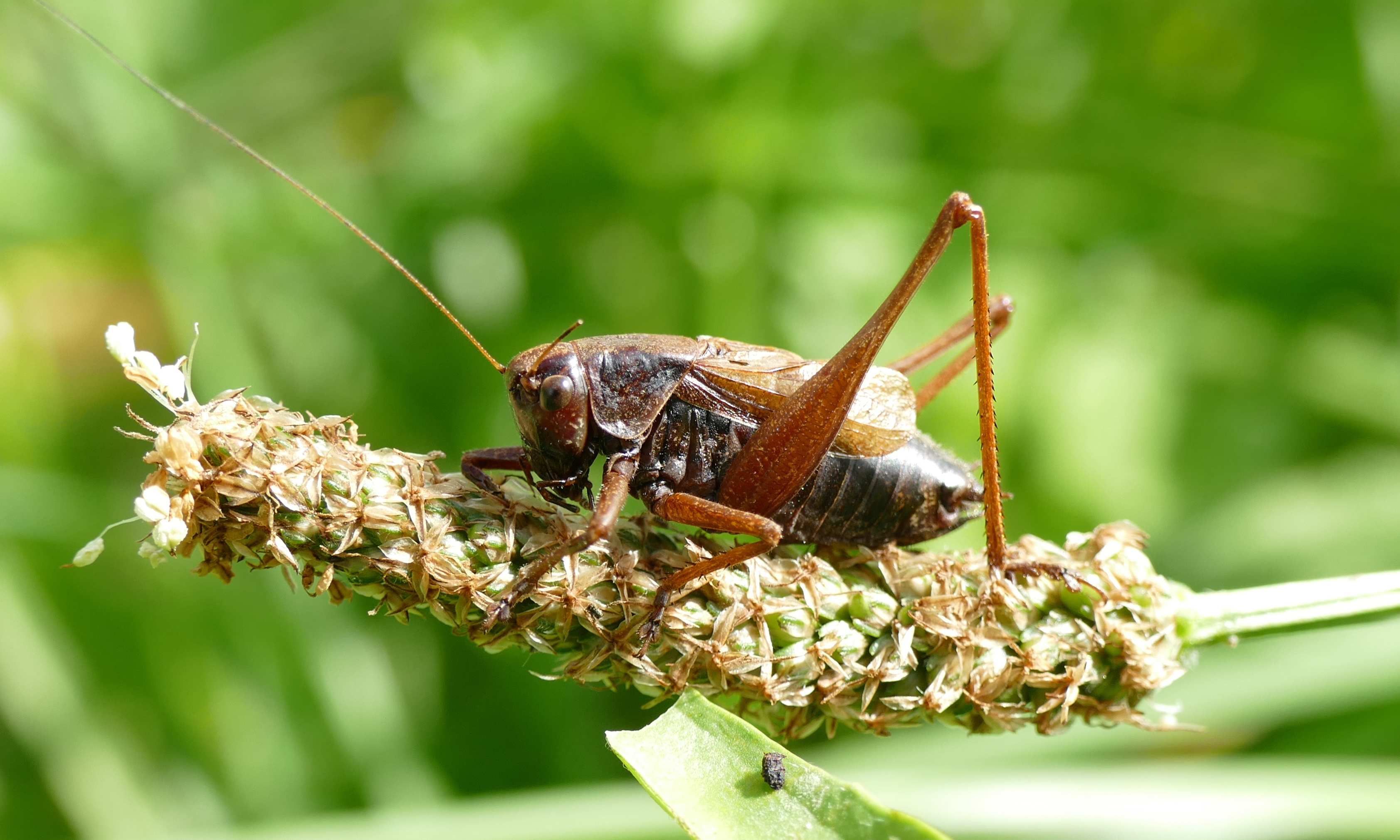
Fig. 1Zeuneriana burriana, male. Mazcuerras, Cantabria, 30TVN09. Normally, the long antenna mean that it is a cricket and not a grasshapper.

Most of the species within the Metrioptera genus group have an extremely limited range. Within Zeurneriana there are only 4 species, of which today’s focus species has the largest range. For example, Zeuneriana marmorata (Adriatic Wide-winged Bush-cricket) is only found in a tiny region in northern Italy and Slovenia and is listed as Endangered (EN) on the IUCN Red List.

Zeuneriana burriana is rare, though found in Cantabria, Asturias, the Basque County, Leon, Galicia, and a tiny bit of France. It is found in humid, uncultivated grasslands. I’ve seen it in El Minchón (here is a link to the Local Hotspots post) and “rough” areas around flower-rich fields used for hay. The taller the grasses the better, as normally I’ll be wading through grass that easily reaches my hips.

Cerci of male Zeuneriana burriana.
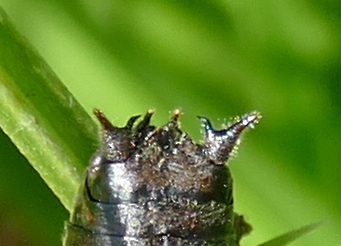
Fig. 2Zeuneriana burriana. Detail of male cerci.

I am not good at identifying grasshoppers and crickets, so usually ask for help from experts on the various forums. What makes the Metrioptera genus group so difficult is that when the insects are not yet adults, so in their nymph stage and the wings have not yet fully formed, they are very small and have very similar characteristics. The best way to ID species is to get good pictures of the male appendages (called cerci) at the end of the abdomen (Fig. 2). The females have a dagger-shaped ovipositor at the end of their abdomen (not used for stinging! Egg-laying only), however, I am not sure how to tell the difference between species when it comes to females. It probably has to do with the curve/shape of the ovipositor.

Conclusion

Orthoptera are difficult, but that should not hold you back from getting interested and informed about them. They are stunningly beautiful when you really get into the details, not just brown or green insects, but with flashy yellows, blues, and oranges. As mentioned, many are only found in very specific habitats (e.g., dune landscapes) so it is also a great way to be introduced to this style of nature observation, where you plan a day out to visit one or two specific areas and take your time investigating them (e.g., learning where to look etc.). You really start to learn a lot doing this, building up your knowledge base for when you go visit more generalised areas where you can spot a wider variety of species.

Another post where I’ve tried to keep it short and to the point.

Further Reading

I mentioned previously that there can be difficulties identifying Orthoptera, especially in the nymph life stage, where even there I think you’ll struggle to get definitive answers. Here are some sites:

Orthoptera Quarterly – Burr’s Wide-winged Bush-cricket – Zeuneriana burriana (Uvarov, 1935)

Book Club – Other Reference Books

Amphibians & Reptiles

  • Arnold, E. Nicholas & Denys W. Ovenden – A Field Guide to the Reptiles & Amphibians of Britain & Europe – second edition reprint with corrections – 2004 (1978 first edition) – William Collins – 288 pp. A pretty decent overview but it shows its age. The book by Speybroeck et al has just surpassed this in most aspects. The information is good, but I found it slightly difficult to use because all illustrations are in the middle and so you are flipping back and forth all the time. Have the hardcover version.
  • Speybroeck, Jeroen, Wouter Beukema, Bobby Bok, Jan Van Der Voort & Ilian Velikov – Field Guide to the Amphibians & Reptiles of Britain and Europe – 2016 – Bloomsbury – 432 pp. Another entry in the British Wildlife Field Guise series and another great one. A must buy.

Note

Although not a book, you can get a decent pamphlet for amphibians in Cantabria from Red Cambera in PDF format here. I was able to get a physical copy when I did some volunteer work with them, they might still have some so try and contact them if you are interested.

Birds

  • Svensson, Lars, Killian Mullarney & Dan Zetterström – Birds of Europe – second edition – 2009 (1999 first edition) – Princeton University Press – 447 pp. My copy is absolutely beat up, which should indicate just how good this book is, as I take it with me everywhere I go. This summer (2023) a third edition will be released, it will be a must-buy for me. Everything is goof about this book, I’ve seen books on European birds by others, but they all pale in comparison. I cannot recommend this book highly enough.

Note
Birding is probably the #1 hobby for those who enjoy nature observation … and while I love it and it was the gateway for me into the world of butterflies, dragonflies, and other insects, I feel hopelessly inadequate when it comes to IDing birds. Not in the first part because I’m terrible at bird calls. However, I continue to get enjoyment from it even though I have my deficiencies … but if I ever did nature tours etc. in Cantabria, this is the area I’d need help in. It is also the main reason why I do not write much about birds, too many other people know much, much more than I do so I do not feel like I’m adding to the conversation at all.

Hymenoptera (Bees, Wasps, & Ants)

  • Falk, Steven & Richard Lewington – Field Guide to the Bees of Great Britain and Ireland – 2015 – Bloomsbury – 432 pp. Lewington illustrates this excellent introduction and overview of bees. The main issue is that here in Spain there are many more species, especially in the difficult families. However, a valuable learning tool that is even better when coupled with Mr Falk’s Flickr page. An excellent entry in the British Wildlife Field Guide series.

Note
Bees, and then especially bumblebees, are a passion. I love them, but … they are so difficult to ID without catching and collecting them so that you can take detailed pictures. That is not something I’m ready to get into now. My goal is to one day write a big article on the bumblebees of Cantabria. I live with the realisation that I’ll continue taking pictures of bees I spot in the wild but will probably not get further in IDing them than a family and a handful of possible species it might be. Still …
As far as ants and wasps are concerned … they are even more difficult.

Orthoptera (Crickets & Grasshoppers)

  • Bellmann, Heiko, Florin Rutschmann, Christian Roesti & Axel Hochkirch – Veldgids Sprinkhanen en Krekels van Europa – 2020 – KNNV Publishing – 432 pp. Another great publication by the KNNV … but in Dutch. There is a German version available too. It does not cover all Orthoptera in Europe in detail with mainly very specific species in southern Europe only briefly covered. However, several of the authors also volunteer their services IDing photos that users upload to Observation.org so with their input there you can get far. A must buy for those interested in these insects.

Other

  • Fitter, Richard, Alastair Firrer & Ann Farrer (illus.) – Collins Pocket Guide: Grasses, Sedges, Rushes & Ferns of Britain and Northern Europe – reprint 1992 (1984 first edition) – Collins – 256 pp. A really excellent introduction. I do not know much about grasses etc. but this has been a great source of information. The maps don’t show Cantabria, but many of the species discussed occur here as well.
  • Jahns, Hans Martin – Collins Guide to the Ferns, Mosses & Lichens of Britain and Northern and Central Europe – 1983 – Collins – 272 pp. Another topic I know nothing about, but the book has helped out greatly. Both this and the grass book have been excellent to figure out what some of the larval host plants are of butterflies and moths.

Comments

More will be added if I pick up other books … am still looking for one on European mammals and maybe some other interesting insect groups, like beetles.

Book Club – Other Reference Books

Odonata Update – Western Willow Spreadwing – Chalcolestes viridis (Vander Linden, 1825)

Introduction

Just a short one on this Tuesday that covers a common damselfly found across much of Europe. Even though it is common, there are a few interesting aspects to this species, some of which were covered in the recent Nature 101 post on Odonata.

A quick refresh in case you do not want to re-read that post …

The Western willow spreadwing is part of the order Odonata (dragonflies and damselflies) and falls under the suborder Zygoptera (only damselflies). It belongs to the Lestidae family, which in turn has three genera (in Europe); Sympecma, Lestes and Chalcolestes. Today we are most interested in the third of those two genera (I’ve put in bold the taxonomy line we need to follow to get to the species. For an introduction to taxonomy see Nature 101 Naming).

The goal for today is to link what we learnt in a recent Nature 101 post with a specific species. How does it relate to other species, but probably more importantly, where does it differ? By choosing a common species found across large parts of Europe, even a frequent garden pond visitor, it means we have a good chance of spotting it in the field and allowing us to experience the insect first-hand.

Chalcolestes viridis, male, in Cantabria.
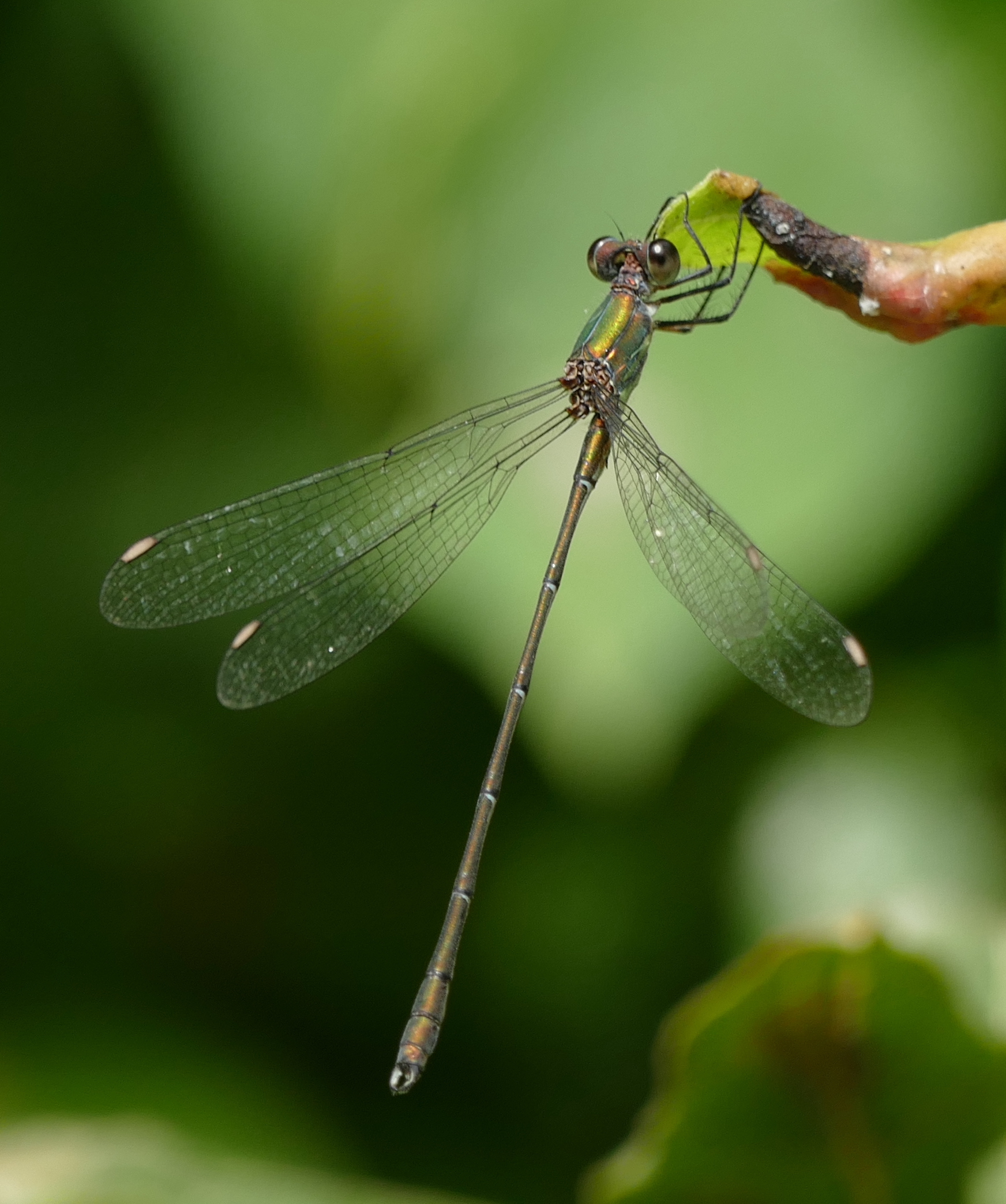
Fig. 1 – Chalcolestes viridis, male. Santander, Cantabria, 30TVP31. 04.ix.16. Notice the spread wings and tip of abdomen.

Western Willow Spreadwing – Chalcolestes viridis

If we look at the name, Western willow spreadwing, we can assume that there is an Eastern variant too … and yes there is, Chalcolesets parvidens. Almost indistinguishable in the field, with the eastern species (previously thought to be a subspecies), found from Italy to the Balkans and further eastwards.
These are the only two species worldwide, that we know of, found in the genus of Chalcolestes.

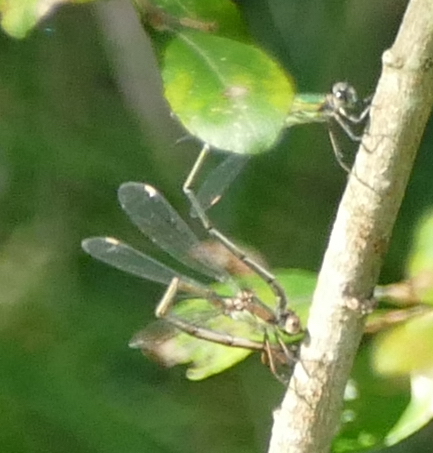
Tandem of Chalcolestes viridis ovipisiting.
Fig. 2 – Tandem ovipositing. See note 1 below.

What makes them different form Lestes and Sympecma species is that they lay their eggs in living, woody material such as reed stems or under tree bark, see Fig. 2 (sorry for the photo quality). For Odonata, and many other insects, egg laying is done through an ovipositor, which is a tube-like organ, and so is called ovipositing. The two Chalcolestes species are the only species in Europe that do not oviposit directly in water.

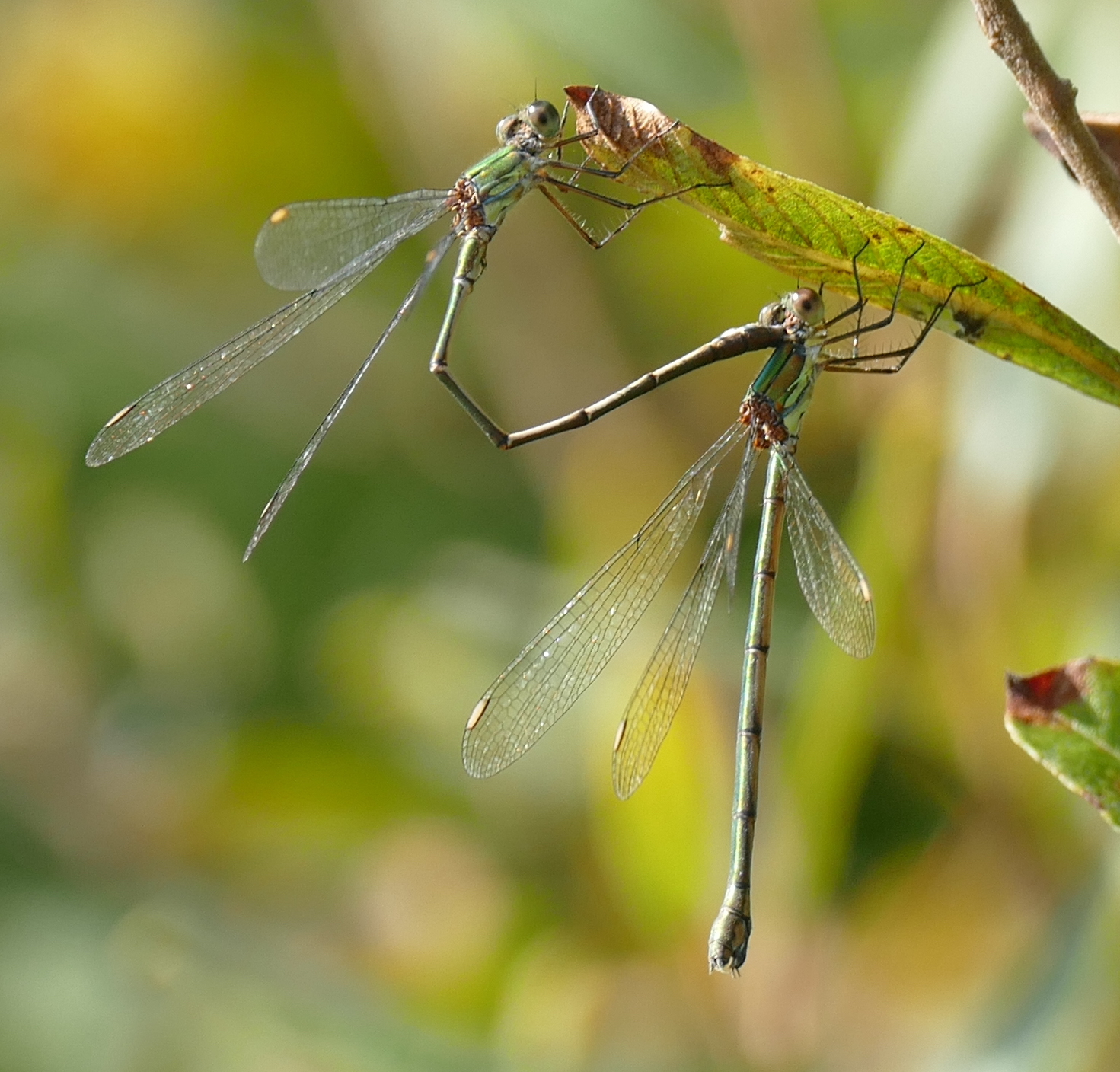
When in tandem (Fig. 3), they fly to an appropriate location and the female creates scratches into the bark of a twig with the rough teeth at the tip of her abdomen. In the photo of the tandem we can see the male has the female in his prong-like appendages located at the tip of his abdomen (see Fig. 1) and he is holding her by the back of her neck.

The damselfly requires slow moving to still waters with plenty of bushy vegetation around. The ponds and bodies of water cannot be ephemeral (i.e., drying up during the summer). The flight period is generally late summer and on into November. The species is common and can be found throughout Cantabria wherever there is suitable habitat.
Even though they are large compared to other damselflies, they can be a bit tricky to spot, often dangling from the underside of leaves. As with Lestes species (not Sympecma), Chalcolestes viridis holds its wings spread open when at rest (Fig. 1). In the Nature 101 post we saw that normally damselflies hold then wings along their bodies when at rest.

Tandem of Chalcolestes viridis.
Fig. 3 – Chalcolestes viridis in tandem. Miengo, Cantabria, 30TVP10. 25.ix.21. The male is holding the female, by the back of her neck, with the “claw-like” appendage at the tip of his abdomen. Also notice the tip of the female abdomen to help scratch and oviposit under bark.

Conclusion

As I mentioned, wanted to keep it short to be able to provide an easy case study for some of the things we have picked up in pervious posts, especially in the Nature 101 series. Because it is a common species it is easy to spot it in your own garden, or while you are out for a walk. This will allow you to pick up experience spotting specific insects out in nature and hone your observation skills.

Probably no post on Friday this week, am a bit busy. Thanks for reading and see you in the next one!

Further Reading

  • The list of Odonata books I own.
  • The British Dragonfly Society has a nice page.
  • The Vlinderstichting also has a good page, in Dutch. Odonata are part of De Vlinderstichting’s remit.

Notes

1 – Fig. 2Chalcolestes viridis tandem ovipositing. Mazcuerras, Cantabria, 30TVN09. 29.ix.21.

Odonata Update – Western Willow Spreadwing – Chalcolestes viridis (Vander Linden, 1825)

Nature 101 – Base Knowledge – Odonata

Introduction

As with the previous Nature 101 on Lepidoptera, today we will cover a specific order within insects. Just to remind you, the taxonomic term “order” deals with a group of insects (in this case) that have similar characteristics.

As was the case with Lepidoptera (butterflies and moths), Odonata can be split into two groups … actually, in this case it already gets a bit more complicated than Lepidoptera because there have been several taxonomical developments in the last few years …:

  • Zygoptera – this is the suborder that contains all damselflies.
  • Epiprocta – this suborder contains both Anisozigoptera and Anisoptera as infraorders. The first of which (in the past a separate suborder of Odonata) does not have any representatives in Europe (only Asia), and the second of which used to be a separate suborder too and contains all true dragonflies.

Phew, okay that was the first step. So, basically, we know that here in Europe (or the Americas) we’re trying to identify the differences between damselflies and dragonflies.

Again, I’ll refer you to the Nature 101 Naming post that gives a better/basic overview view of how the taxonomy system fits together.

1.0 Common Aspects

There are no strong characteristics that set Odonata apart from other insects (like scaly wings), but it is usually pretty clear that the insect you are looking at (in the imago stage) is a dragonfly or damselfly. They have long, slender abdomens with 4 large wings (compared to body size), very short antenna, and big eyes. In both larval and imago life stages they devour other insects (and even small fish and tadpoles) like there’s no tomorrow.
When they are still in the larval stage most people wouldn’t have a clue that they are looking at a dragonfly. How can those strange, drab (they are usually brown and covered in mud) alien creatures turn into vibrant metallic-coloured dragonflies?

With regards to life stages there are:

Egglarva (naiad/nymph) – imago (dragonfly or damselfly)

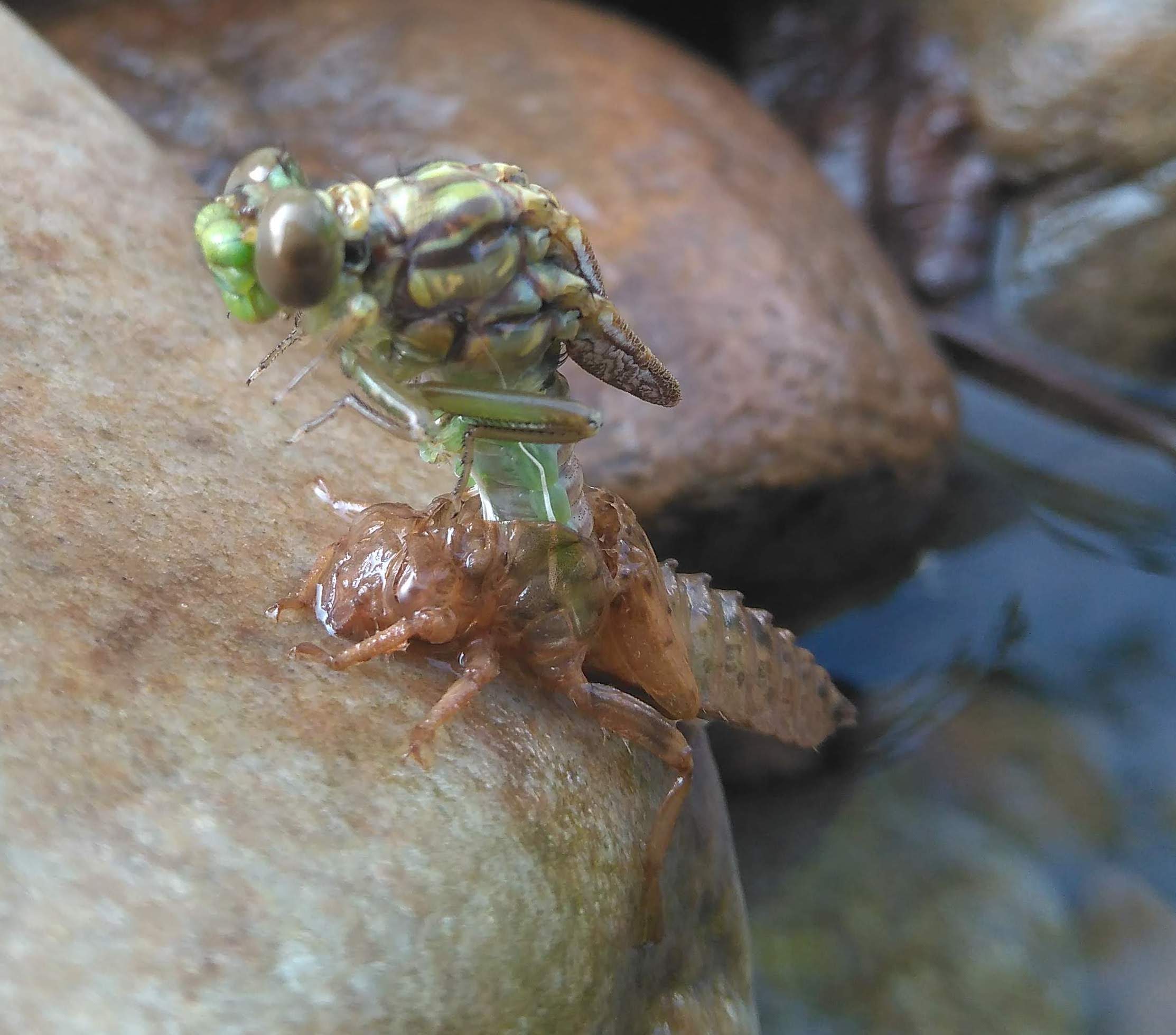
So, there’s no pupa stage. Larvae crawl out of the water up onto rocks or vegetation, break open the back of the larval shell and emerge as an imago, slowly pumping insect blood (haemolymph) around their bodies and wings (Fig. 1). It is quite stunning to see. They leave behind the shell of the larval body, called an exuvia, and that is absolutely critical (see below) when considering that Odonata can live up to 5 years in the larval stage! We notice them as imagoes, and most will only fly for a few weeks.

Metamorphoses of a Large pincertail.
Fig. 1Large pincertail (Onychogomphus uncatus), male, emerging from larval form. Cabezón de la Sal (Río Saja), Cantabria, 30TVN09. 12.vii.18. Notice that the eyes do not touch at the top of the head (see exceptions below).

Odonata life is strongly associated with water, but each species usually has quite some restrictions to the preferred habitat … running water or stagnant (e.g., a pond), no fish presence (or doesn’t matter), sandy or rocky bottom of the body of water, lots of vegetation or very little, and so forth. Most lay their eggs in the water, stuck to clumps of vegetation, and all larvae develop in water (or mud). Anisoptera imagoes are great fliers and can be found far from bodies of water, where Zygoptera are generally “weaker” fliers.

There are insects that could be mistaken for Odonata, which include owlflies and antlions. Owlflies strange-looking insects that are not directly associated with water and have long antenna with a bulb ending (similar to butterflies). Antlions are also not associated with water, have longish antenna and hunt ants (what’s in a name, eh?). Both owlflies and antlions are more common in drier, warm climates and fly towards the end of the day into the night. Both are part of the order Neuroptera, which is just filled with wonderful weirdness … but that is for a future post (with pictures).

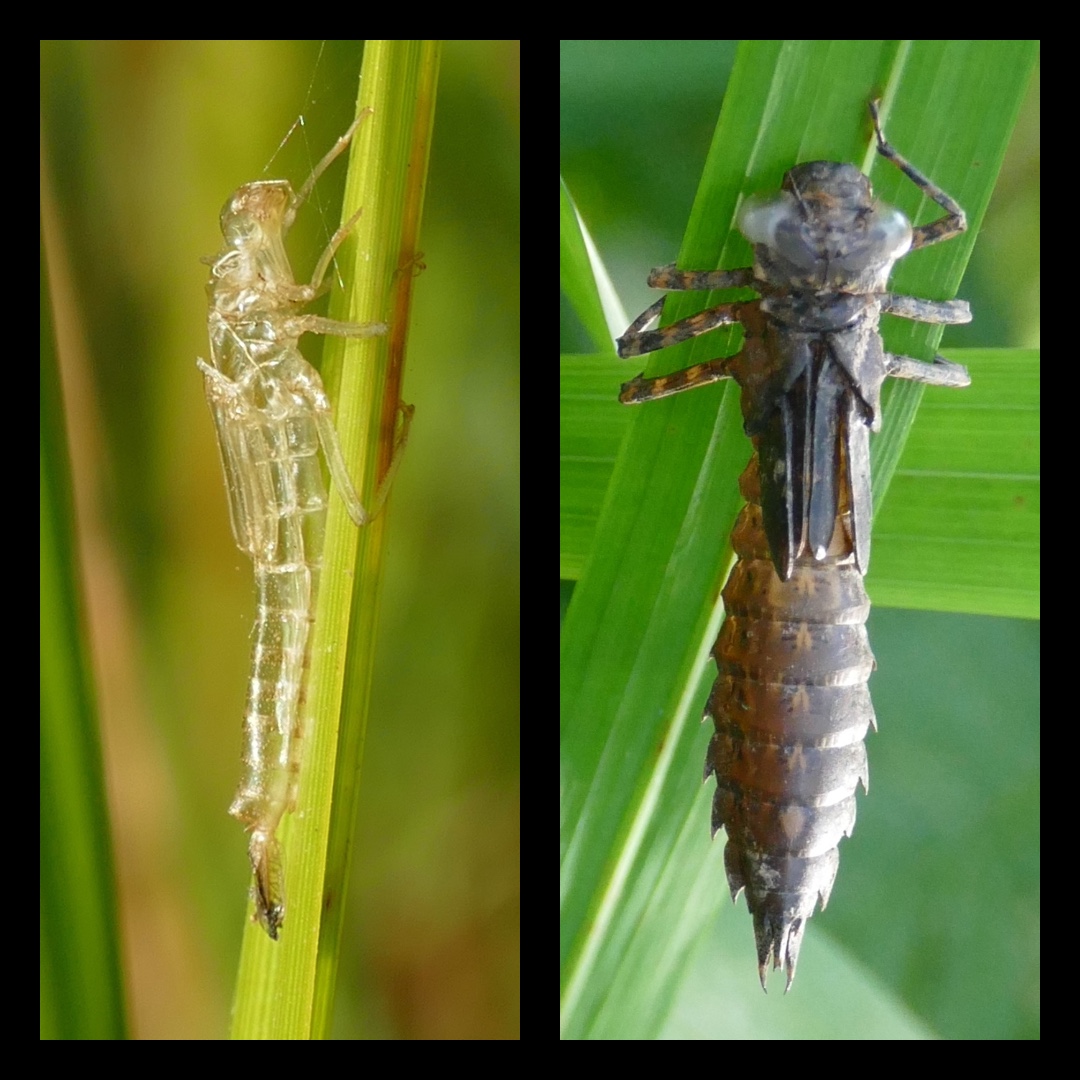
Exuvie of two different Odonata.
Fig. 2 – Evuvie. Common bluet (Enallagma cyathigerum), Miengo, Cantabria, 30TVP10. 20.vii.20. The proct has the dark “vein” running through it at towards the bottom of the exuvie.; Western spectre (Boyeria irene), Mazcuerras, Cantabria, 30TVN09. 10.ix.16. The bottom ends in three sharp points.

2.0 Differentiating Aspects

There are three fairly clear ways to tell damselflies and dragonflies apart, although one is during the larval stage only:

  1. Larval stage only – damselfly larvae have 3 “feather-like” appendages (called procts), which are actually their breathing apparatus, sticking out of the tip of their abdomen (see Fig. 2).
  2. Eye placement – during the imago stage, the eyes are placed differently on the head, with dragonflies having eyes that are placed close together on the head, often touching, and damselflies having each eye quite distant and separate from the other (Fig. 3).
  3. Wings at rest – when at rest, dragonflies hold their wings spread out from their body, whereas most damselflies fold their wings in along their abdomen. This can make damselflies very difficult to spot when at rest (Fig. 4).
Eye position of Odonata.
Fig. 3 – Eye placement. Vagrant emporer (Anax ephippiger) (left), Miengo, Cantabria, 30TVP10. 30.iii.23. A dragondly with large eyes clearly connected at the top of the head.; Migrant spreadwing (Lestes barbarus) (top right), Miengo, Cantabria, 30TVP10. 06.v.22. A damselfly with the eyes at opposite ends of an elongated head.; Green-eyed hawker (Aeshna isoceles) (bottom right), Miengo, Cantabria, 30TVP10. 20.vii.20. Another dragonfly with eyes joined along the middle of the head.

There are of course exceptions, as was also the case in the Lepidotera post, to the statements above.

  • Dragonflies in the Gomphidae family (clubtails, pincertails and hooktails) do have a noticeable space between their eyes, see Fig. 1. But their wings are always held open at rest.
  • Damselflies in the Lestidae family (spreadwings) hold their wings … spread out … at rest. The nameplate states it. Though their eyes are clearly far apart. One interesting characteristic about Lestidae is that some place their eggs in plant tissue (e.g., under tree bark), well out of the water.
Different wing positions of Odonata.
Fig. 4 – Wing position at rest. Red-veined darter (Sympetrum fonscolombii) (left), Cabezón de la Sal, Cantabria, 30TVN09. 00.ix.15. Dragonfly with wings spread wide.; Keeled skimmer (Orthetrum coerulescens) (top right), Cabezón de la Sal, Cantabria, 30TVN09. 25.viii.21. Another dragonfly with wings spread wide.; Small redeye (Erythromma viridulum) (bottom right), Miengo, Cantabria, 30TVP10. 25.ix.21. Damselfly with wings held close to the abdomen.

Conclusion

Damselflies and dragonflies are not that difficult to differentiate, but maybe reading the above has shown you that there are many subtle variations that you can take into account when observing nature.

Finally, it is often stated that dragonflies are good bioindicators of the health of an ecosystem. I was going to write a paragraph on just what makes them so useful, but as I was writing it I felt I was adding too much extra to an already information-loaded post. I will copy/paste that piece into a future Nature 101 post on Citizen Science or Ecosystem Monitoring … stay tuned.

Again, feel free to ask any questions. Up next in the series will be something on Biogeography or Phenology (cycles in nature), not sure which yet.

Nature 101 – Base Knowledge – Odonata

Fly Facts – Milesia crabroniformis (Fabricius, 1775)

Introduction

I’ve mentioned a few times in the other posts of the blog that one of my goals is to provide an opportunity for others to learn, with me, about that natural world around them. Because it is through a blog there will be some repetition, but that repetition will hopefully help the reader become aware of some of the details that make a difference when trying to identify or categorise what we see around us.

The Nature 101 series provides some of those building blocks that support our knowledge growth. These species highlights can be taken as a type of case study where we can not only apply that knowledge but also become aware of our limitations through questions that come up that we cannot immediately answer. This we can use as sustenance for our quest to gain more knowledge (a never-ending cycle if we’ve found something that interests us). So, without further ado … today a fly …

Image of Milesia crabroniformis.
Fig. 1 – Left, Milesia crabroniformis (female), 28.viii.22, Cabezón de la Sal, Cantabria, Spain; top right, Milesia crabroniformis (male) 09.viii.22, Cabezón de la Sal, Cantabria, Spain; bottom right, Vespa crabro (female), 21.iv.15, Cabezón de la Sal, Cantabria, Spain. All photos by Bart van Hoof.

Milesia crabroniformis

When we look at the images above, we notice that the fly looks a bit like a bee or wasp. They are active at the height of summer, especially in August and when you see them flying around you might have some concern if you’re not sure what you’re looking at because they are big, as they can be up to 25 mm in body length, as big as a European hornet (Vespa crabro), and one of the largest flies in Europe.

Here is where Nature 101 Naming comes in … crabroniformis (Latin) means “shaped like crabro”, the European hornet. Here’s another reason why I started learning the scientific names, so I could start seeing links between species “behind the scenes,“ as it were. This hoverfly (more on that later) mimics a hornet. So, there are two paths forward that we might be able to find an answer to with our current knowledge:

  • How can we tell it is not a wasp or bee?
  • What exactly is mimicry?

The latter I’ll leave for a Nature 101 post … I mean I have to create content for the blog. But it might first calm the mind a bit if we can figure out which details show us that this hornet-looking fly is actually a fly and not a hornet.

Milesia crabroniformis is part of the hoverfly family. The order name for flies is Diptera … from our Nature 101 Lepidoptera post we know that “ptera” means wing … “di”, well that means two … flies have two wings, compared to bees and wasps (Hymenoptera) who have 4. One of the tricky things is that Hymenoptera have little hooks that connect the two wings on each side making it look like they only have two wings in total, but if you look closely on a photo, you’ll actually be able to make out 4.

A second clue, and one that should jump out straight away … is the size and shape of the antennae. They are like two nibs that stick out from the middle of the face, whereas Hymenoptera have long, segmented antenna.

The third clue, but one that can be more difficult to determine, is the eyes. This does bring me to another interesting observation. If we go back up to the images above and look at the two Milesia crabroniformis there, have a look at the eyes … they are different. One has them touching ever so slightly in the middle, where the other has them clearly separated along the whole central section. What is going on here? In many hoverflies, males have eyes that touch whereas female’s eyes do not touch. We can therefore not only ID the species but also the sex.

Just before I round off the post, a few more details about this fly. It is mainly found in Europe from about mid-France southwards, as well as in Northern Africa. It is not very common, one of the reasons being that it needs mature woodland, oak trees, and beech trees, where it lays its eggs in rotting wood. You often find them feeding on the nectar of umbellifers (as seen in both photos), which have big “flower heads” made up of many tiny little flowers, so they do not need to have a long tongue to get down into the flower (like a bee or butterfly) but can hoover it up with their mouthparts.

Conclusion

I hope I’ve been able to show how just a little bit of knowledge and information can point us in a direction that can help us identify or understand and insect or animal better. We don’t have to know everything about it straight away, we can look up more in-depth information at a later date. However, we can start seeing connections to it and things we already know.

It is easier to bring this information across in the field … this is one of the basics of adult learning, where we learn best by doing and use all our sense to process information … but as I’ve said before, I am still trying to find a good way to package this information so that a large chuck will stick till the next blog post, and then we can go from there.

See you in the next one (hopefully on Odonata).

Fly Facts – Milesia crabroniformis (Fabricius, 1775)

March / April Review

Introduction

Back in late February this blog was kickstarted back into action … this being post lucky 13, I thought I’d provide a short overview of both the blog and what has happened these past 2 months.

Discussion

Firstly, a bit about what is coming up … as always, lots of plans … I have been enjoying writing the Nature 101 series, so I have some topics lined up for that including:

  • Odonata – to continue with the “order” series as started by Lepidoptera.
  • Biogeography – another one of these general knowledge ones that popped into my head when writing the recent species posts, as well as the Local Hotspots ones. This should provide some insight into why Cantabria and the Cantabrian Mountains are so unique and interesting.
  • Phenology – a topic I wanted to touch in the Lepidoptera post but skipped because I felt that post to be quite dense and this topic to be more broadly applicable. What does that word mean? Stay tuned (if you don’t feel like Googling it)!

The Book Club posts were also fun to write. Going forward the focus will be on individual books, and I’ll also write one on other reference books I have. I’m very happy that my book reading has picked up again since around the start of 2023. It had been down in the doldrums for ages due to family life with young kids. I just started Silent Earth (Dave Goulson) and that has given my inspiration and some ideas for topics.

Starting up the Local Hotspot series has been immensely fun. It will be a bit before I get going on future instalments because I need to do some pre-work. Still, this will turn out to be a great series for any visitors to the region.

Here is where you can find an overview of the above-mentioend posts.

The individual species posts have been both difficult and easy at the same time. I’ve focused on a number of species that have been emblematic for me personally, so the enthusiasm has been there … but I’ve struggled to find the right voice and tone for those posts. All the types of posts above require improvement through learning and experience, but it seems that this series really needs that added attention.

Outside of writing the blog, going out into nature has had its ups and downs. I am very pleased with how my “dragonfly”-goals have gone for 2023. It has surpassed even my high expectations and I’m only 2 months in. Three new species with great photos to ID them.

Fig. 1 – Updated year list of species keen to see. Those in blue have been seen in 2023.

On the flip side, I’ve not gone out for walks as much as I would have liked. Also, moth trapping has been abysmal, with no luck at all on nights I’ve set out a trap. Maybe this weekend …

The Species Schedule I’d set up at the start of the year is looking good, with May being the month where things really pick up. Some exciting times should be just around the corner.

Conclusion

So, I am pleased with how the blog is going, but I do feel I need to inject a smidge of professionalism into it (improve my blog design, “Photoshop” skills etc.). The writing itself feels like it is getting to where I want it to be and to be honest, it is something I’d read on a weekly basis if a link etc. dropped into my mailbox (in the style of treat people how you’d like to be treated – write stuff that you’d like to read).

As far as nature goes … it is the classic overpromise/underdeliver … in my case that’s – plan in too much and do not get around to doing it all … but that is okay, as I also realise that there’s a lot which is out of my direct control (weather, having the second car in the garage for coming up to 5 weeks when they said 2!, etc.). Furthermore, I do have a paid job requiring my attention … so, there’s that.

Glad you made it down this far! Take care.

March / April Review