Odonata Update – Western Willow Spreadwing – Chalcolestes viridis (Vander Linden, 1825)

Introduction

Just a short one on this Tuesday that covers a common damselfly found across much of Europe. Even though it is common, there are a few interesting aspects to this species, some of which were covered in the recent Nature 101 post on Odonata.

A quick refresh in case you do not want to re-read that post …

The Western willow spreadwing is part of the order Odonata (dragonflies and damselflies) and falls under the suborder Zygoptera (only damselflies). It belongs to the Lestidae family, which in turn has three genera (in Europe); Sympecma, Lestes and Chalcolestes. Today we are most interested in the third of those two genera (I’ve put in bold the taxonomy line we need to follow to get to the species. For an introduction to taxonomy see Nature 101 Naming).

The goal for today is to link what we learnt in a recent Nature 101 post with a specific species. How does it relate to other species, but probably more importantly, where does it differ? By choosing a common species found across large parts of Europe, even a frequent garden pond visitor, it means we have a good chance of spotting it in the field and allowing us to experience the insect first-hand.
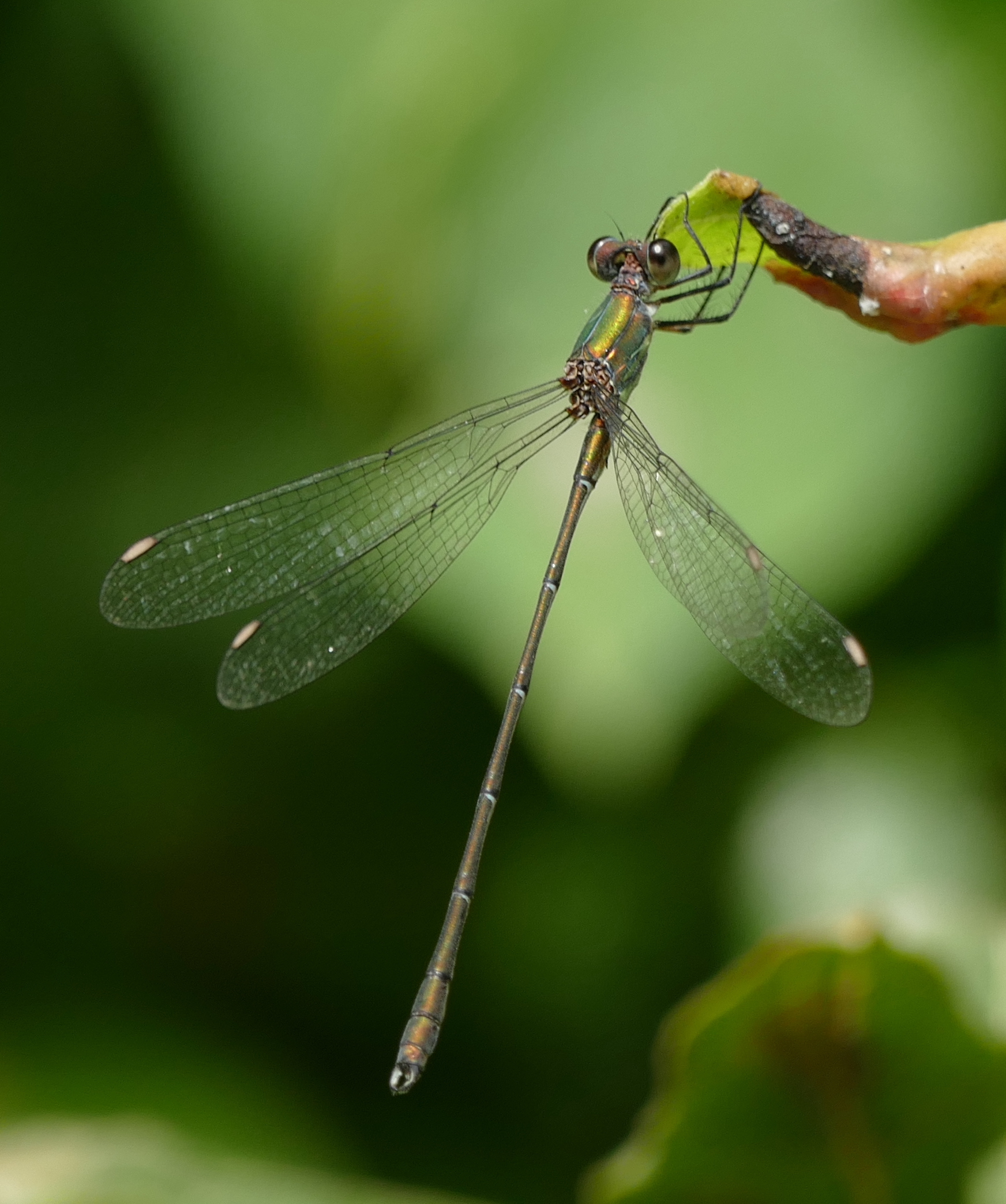
Chalcolestes viridis, male, in Cantabria.
Fig. 1 – Chalcolestes viridis, male. Santander, Cantabria, 30TVP31. 04.ix.16. Notice the spread wings and tip of abdomen.

Western Willow Spreadwing – Chalcolestes viridis

If we look at the name, Western willow spreadwing, we can assume that there is an Eastern variant too … and yes there is, Chalcolesets parvidens. Almost indistinguishable in the field, with the eastern species (previously thought to be a subspecies), found from Italy to the Balkans and further eastwards.
These are the only two species worldwide, that we know of, found in the genus of Chalcolestes.
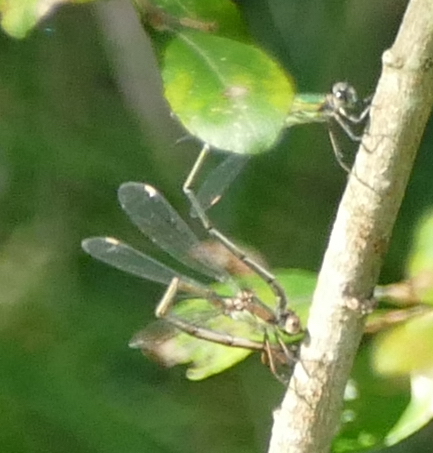
Tandem of Chalcolestes viridis ovipisiting.
Fig. 2 – Tandem ovipositing. See note 1 below.

What makes them different form Lestes and Sympecma species is that they lay their eggs in living, woody material such as reed stems or under tree bark, see Fig. 2 (sorry for the photo quality). For Odonata, and many other insects, egg laying is done through an ovipositor, which is a tube-like organ, and so is called ovipositing. The two Chalcolestes species are the only species in Europe that do not oviposit directly in water.

When in tandem (Fig. 3), they fly to an appropriate location and the female creates scratches into the bark of a twig with the rough teeth at the tip of her abdomen. In the photo of the tandem we can see the male has the female in his prong-like appendages located at the tip of his abdomen (see Fig. 1) and he is holding her by the back of her neck.

The damselfly requires slow moving to still waters with plenty of bushy vegetation around. The ponds and bodies of water cannot be ephemeral (i.e., drying up during the summer). The flight period is generally late summer and on into November. The species is common and can be found throughout Cantabria wherever there is suitable habitat.
Even though they are large compared to other damselflies, they can be a bit tricky to spot, often dangling from the underside of leaves. As with Lestes species (not Sympecma), Chalcolestes viridis holds its wings spread open when at rest (Fig. 1). In the Nature 101 post we saw that normally damselflies hold then wings along their bodies when at rest.
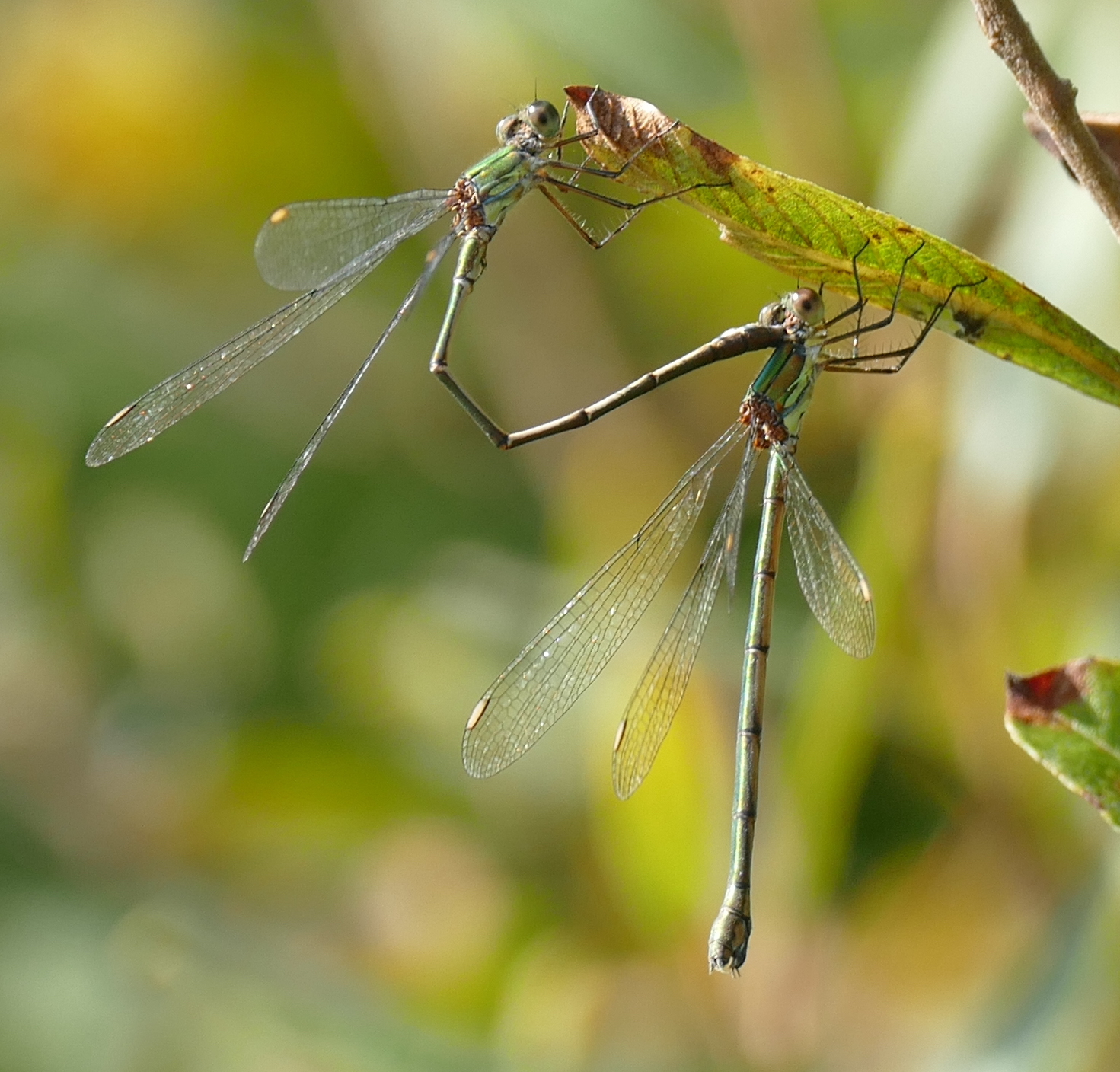
Tandem of Chalcolestes viridis.
Fig. 3 – Chalcolestes viridis in tandem. Miengo, Cantabria, 30TVP10. 25.ix.21. The male is holding the female, by the back of her neck, with the “claw-like” appendage at the tip of his abdomen. Also notice the tip of the female abdomen to help scratch and oviposit under bark.

Conclusion

As I mentioned, wanted to keep it short to be able to provide an easy case study for some of the things we have picked up in pervious posts, especially in the Nature 101 series. Because it is a common species it is easy to spot it in your own garden, or while you are out for a walk. This will allow you to pick up experience spotting specific insects out in nature and hone your observation skills.

Probably no post on Friday this week, am a bit busy. Thanks for reading and see you in the next one!

Further Reading

  • The list of Odonata books I own.
  • The British Dragonfly Society has a nice page.
  • The Vlinderstichting also has a good page, in Dutch. Odonata are part of De Vlinderstichting’s remit.

Notes

1 – Fig. 2Chalcolestes viridis tandem ovipositing. Mazcuerras, Cantabria, 30TVN09. 29.ix.21.
Odonata Update – Western Willow Spreadwing – Chalcolestes viridis (Vander Linden, 1825)

Nature 101 – Base Knowledge – Odonata

Introduction

As with the previous Nature 101 on Lepidoptera, today we will cover a specific order within insects. Just to remind you, the taxonomic term “order” deals with a group of insects (in this case) that have similar characteristics.

As was the case with Lepidoptera (butterflies and moths), Odonata can be split into two groups … actually, in this case it already gets a bit more complicated than Lepidoptera because there have been several taxonomical developments in the last few years …:

  • Zygoptera – this is the suborder that contains all damselflies.
  • Epiprocta – this suborder contains both Anisozigoptera and Anisoptera as infraorders. The first of which (in the past a separate suborder of Odonata) does not have any representatives in Europe (only Asia), and the second of which used to be a separate suborder too and contains all true dragonflies.

Phew, okay that was the first step. So, basically, we know that here in Europe (or the Americas) we’re trying to identify the differences between damselflies and dragonflies.

Again, I’ll refer you to the Nature 101 Naming post that gives a better/basic overview view of how the taxonomy system fits together.

1.0 Common Aspects

There are no strong characteristics that set Odonata apart from other insects (like scaly wings), but it is usually pretty clear that the insect you are looking at (in the imago stage) is a dragonfly or damselfly. They have long, slender abdomens with 4 large wings (compared to body size), very short antenna, and big eyes. In both larval and imago life stages they devour other insects (and even small fish and tadpoles) like there’s no tomorrow.
When they are still in the larval stage most people wouldn’t have a clue that they are looking at a dragonfly. How can those strange, drab (they are usually brown and covered in mud) alien creatures turn into vibrant metallic-coloured dragonflies?

With regards to life stages there are:

Egglarva (naiad/nymph) – imago (dragonfly or damselfly)

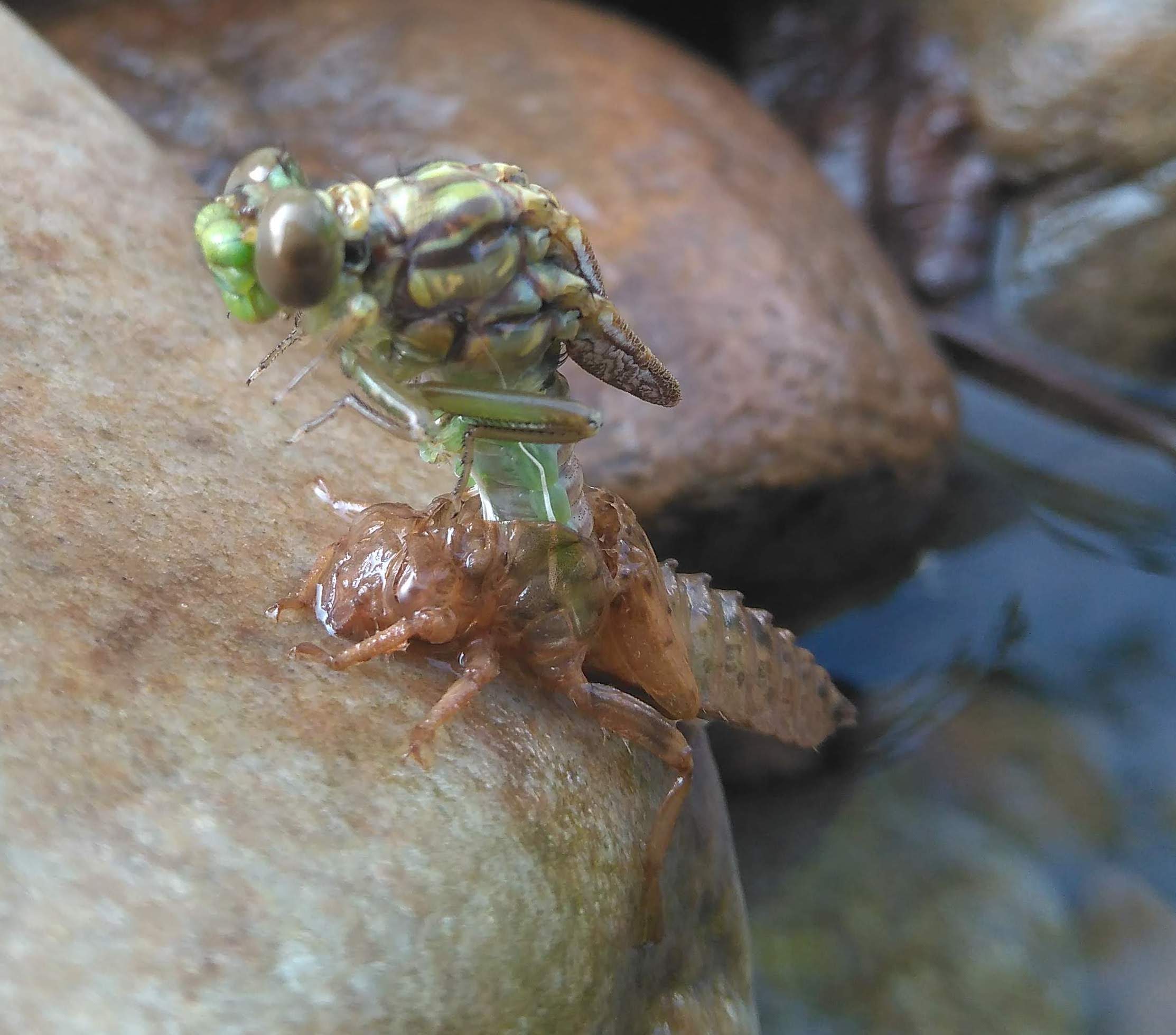
So, there’s no pupa stage. Larvae crawl out of the water up onto rocks or vegetation, break open the back of the larval shell and emerge as an imago, slowly pumping insect blood (haemolymph) around their bodies and wings (Fig. 1). It is quite stunning to see. They leave behind the shell of the larval body, called an exuvia, and that is absolutely critical (see below) when considering that Odonata can live up to 5 years in the larval stage! We notice them as imagoes, and most will only fly for a few weeks.

Metamorphoses of a Large pincertail.
Fig. 1Large pincertail (Onychogomphus uncatus), male, emerging from larval form. Cabezón de la Sal (Río Saja), Cantabria, 30TVN09. 12.vii.18. Notice that the eyes do not touch at the top of the head (see exceptions below).

Odonata life is strongly associated with water, but each species usually has quite some restrictions to the preferred habitat … running water or stagnant (e.g., a pond), no fish presence (or doesn’t matter), sandy or rocky bottom of the body of water, lots of vegetation or very little, and so forth. Most lay their eggs in the water, stuck to clumps of vegetation, and all larvae develop in water (or mud). Anisoptera imagoes are great fliers and can be found far from bodies of water, where Zygoptera are generally “weaker” fliers.

There are insects that could be mistaken for Odonata, which include owlflies and antlions. Owlflies strange-looking insects that are not directly associated with water and have long antenna with a bulb ending (similar to butterflies). Antlions are also not associated with water, have longish antenna and hunt ants (what’s in a name, eh?). Both owlflies and antlions are more common in drier, warm climates and fly towards the end of the day into the night. Both are part of the order Neuroptera, which is just filled with wonderful weirdness … but that is for a future post (with pictures).

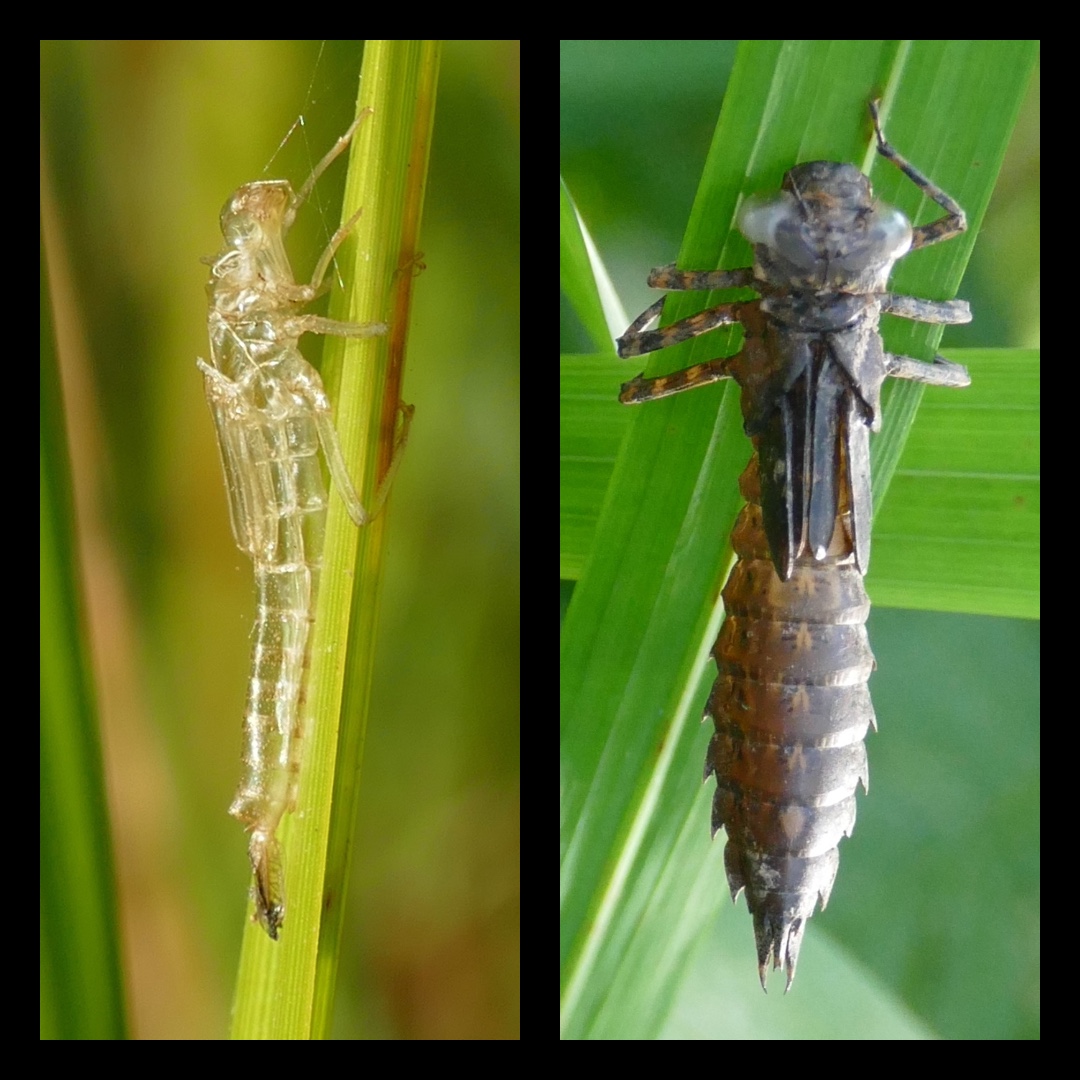
Exuvie of two different Odonata.
Fig. 2 – Evuvie. Common bluet (Enallagma cyathigerum), Miengo, Cantabria, 30TVP10. 20.vii.20. The proct has the dark “vein” running through it at towards the bottom of the exuvie.; Western spectre (Boyeria irene), Mazcuerras, Cantabria, 30TVN09. 10.ix.16. The bottom ends in three sharp points.

2.0 Differentiating Aspects

There are three fairly clear ways to tell damselflies and dragonflies apart, although one is during the larval stage only:

  1. Larval stage only – damselfly larvae have 3 “feather-like” appendages (called procts), which are actually their breathing apparatus, sticking out of the tip of their abdomen (see Fig. 2).
  2. Eye placement – during the imago stage, the eyes are placed differently on the head, with dragonflies having eyes that are placed close together on the head, often touching, and damselflies having each eye quite distant and separate from the other (Fig. 3).
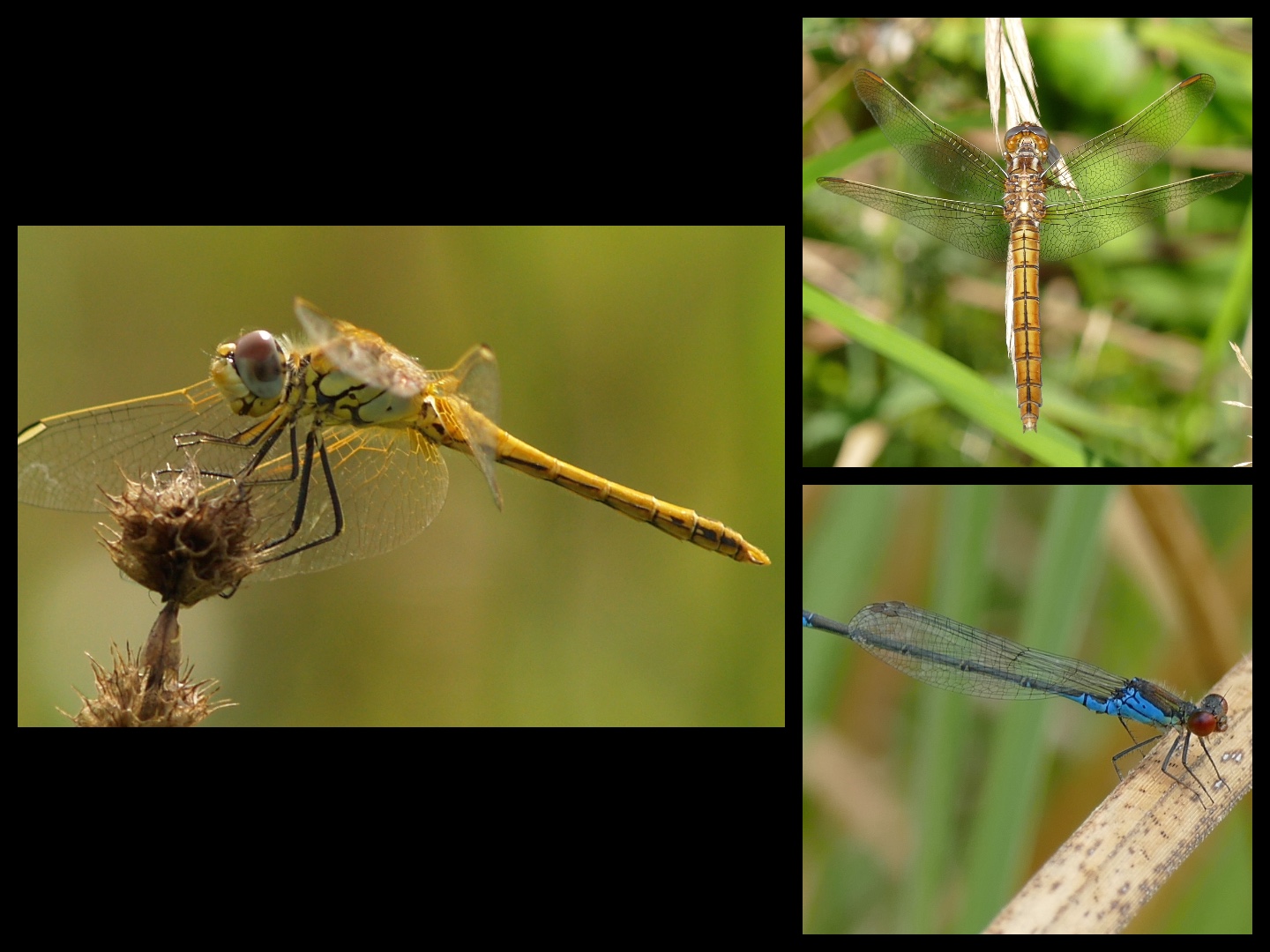
  3. Wings at rest – when at rest, dragonflies hold their wings spread out from their body, whereas most damselflies fold their wings in along their abdomen. This can make damselflies very difficult to spot when at rest (Fig. 4).
Eye position of Odonata.
Fig. 3 – Eye placement. Vagrant emporer (Anax ephippiger) (left), Miengo, Cantabria, 30TVP10. 30.iii.23. A dragondly with large eyes clearly connected at the top of the head.; Migrant spreadwing (Lestes barbarus) (top right), Miengo, Cantabria, 30TVP10. 06.v.22. A damselfly with the eyes at opposite ends of an elongated head.; Green-eyed hawker (Aeshna isoceles) (bottom right), Miengo, Cantabria, 30TVP10. 20.vii.20. Another dragonfly with eyes joined along the middle of the head.

There are of course exceptions, as was also the case in the Lepidotera post, to the statements above.

  • Dragonflies in the Gomphidae family (clubtails, pincertails and hooktails) do have a noticeable space between their eyes, see Fig. 1. But their wings are always held open at rest.
  • Damselflies in the Lestidae family (spreadwings) hold their wings … spread out … at rest. The nameplate states it. Though their eyes are clearly far apart. One interesting characteristic about Lestidae is that some place their eggs in plant tissue (e.g., under tree bark), well out of the water.
Different wing positions of Odonata.
Fig. 4 – Wing position at rest. Red-veined darter (Sympetrum fonscolombii) (left), Cabezón de la Sal, Cantabria, 30TVN09. 00.ix.15. Dragonfly with wings spread wide.; Keeled skimmer (Orthetrum coerulescens) (top right), Cabezón de la Sal, Cantabria, 30TVN09. 25.viii.21. Another dragonfly with wings spread wide.; Small redeye (Erythromma viridulum) (bottom right), Miengo, Cantabria, 30TVP10. 25.ix.21. Damselfly with wings held close to the abdomen.

Conclusion

Damselflies and dragonflies are not that difficult to differentiate, but maybe reading the above has shown you that there are many subtle variations that you can take into account when observing nature.

Finally, it is often stated that dragonflies are good bioindicators of the health of an ecosystem. I was going to write a paragraph on just what makes them so useful, but as I was writing it I felt I was adding too much extra to an already information-loaded post. I will copy/paste that piece into a future Nature 101 post on Citizen Science or Ecosystem Monitoring … stay tuned.

Again, feel free to ask any questions. Up next in the series will be something on Biogeography or Phenology (cycles in nature), not sure which yet.

Nature 101 – Base Knowledge – Odonata

Book Club – Books on Dragonflies & Damselflies

Another post in the same veis as the previous Book Club posts, which focussed on the books I use to help me ID species or general reference books I use. This time on Odonata … although each book states dragonflies, they all include damselflies too.

General

  • Askew, R.R. – The Dragonflies of Europe – revised edition – 2004 – Harley Books – 308 pp. – Although older than the Dijkstra books (and you can tell – it was first publised in 1987(?)) it is often used as a reference citing in scientific papers because it is a touch more in-depth in the information given. Richly illustrated (not as good as Lewington – see below – though) some of the detailed illustrations are excellent. Out of print.
  • Bos, Frank, Marcel Wasscher & Weia Reinboud – Veldgids Libellen – herzine editie, 10e druk – 2022 (1st edition 1997) – KNNV Publishing – 290 pp. – Really nice field guide. In Dutch with a focus on the Benelux (Belgium, the Netherlands. and Luxembourg) region it does cover some southern European species. A recent addition to by “library”. I still prefer Dijkstra for IDing because the illustrations are just so good. However, there’s a lot of excellent information (maps, bibliography etc.) in this book, which includes Red List data. A great addition for anyone who lives in the Benelux and those who can read Dutch.
  • Boudot, Jean-Pierre & Vincent J. Kalkman (eds.) – Atlas of the European dragonflies and damselflies – 2015 – KNNV Publishing – 382 pp. – A bit more of a scientific overview where there is a large list of scientists who describe specific individual species, including notes on conservation. Has a massive bibliography at the end to really help you dig deeper into specific countries/regions etc. if you’d like. Some photos (by Fons Peels) of each species, but not really meant to help you ID. While intersting and in-depth, I’d say more for the completionist. Out of print. Hardcover, in English.
  • Dijkstra, Klaas-Douwe B. & Richard Lewington – Field Guide to the Dragonflies of Britain and Europe – 2014 reprint (2006) – British Wildlife Publishing – 320 pp. – The modern reference work on Odonata … now available in a second edition (see below) … the copy I own of this book is all beat up and heavily used. Stunning, with Lewington illustrations of all species and some photos.
  • Dijkstra, Klaas-Douwe B., Asmus Schröter & Richard Lewington – Field Guide to the Dragonflies of Britain and Europe – second edition – 2020 – Bloomsbury – 336 pp. – An updated version of the above. I havn’t really checked what the updates are. A must buy for any dragonfly enthusiast, as it is absolutely amazing. In my opinion, hands down the best book available to help ID species.
  • Brochard, Christophe, Dick Groenendijk, Ewoud van der Ploeg & Tim Termaat – Fotogids van Larvenhuidjes van Libellen – tweede druk – 2016 (1st edition 2014) – KNNV Publishing – 320 pp. – Companion piece to the previous book. Another stunning photo book on the skins that dragonflies leave behind after they’ve emerged from their larval state. Again, does not cover all of southern Europe’s species, but essential for reference and ID if you want to get deep into Odonata. Hey their skins are quite easy to find, and you can take them with you without harming anything. I’d get this book (or something similar in a different language) over the previous one, if you need to choose between the two, because of that. Out of print. Hardcover.
  • Brochard, Christophe & Ewoud van der Ploeg – Fotogids Larven van Libellen – 2014 – KNNV Publishing – 242 pp. – In Dutch … but oh man … a bit specialist, but essential if you want to get a bit deeper into dragonflies. Stunning photos and amazing, in-depth information on dragonflies in their larval stage. Does not include all species in southern Europe. There are English (and French, German and 1 Spanish) books available on the subject, but if you can read Dutch this is excellent. Out of print. Hardcover.

Spain

Specific Regions in the Cantabrian Mountains (my area of interest)

  • Gainzarain, José Antonio – Atlas de las Libélulas de Álava – 2a edición – 2018 – Diputación Foral de Álava – 166 pp. – In Spanish. This on dragonflies in one of the provinces in País Vasco (the Basque country) by one of the Spanish experts on dragonflies. The ecology is slightly different to where I live, many more dry/hot areas in Álava. However, the book is very well written and given a great overview of what you can potentially find here. The great thing about regional books is that you get a better feeling of where on the scale of common to rare a species is. There’s also better information on the types of habitats that you might find the species in. Not really required if you are just visiting the region, as some of the general books (i.e. Dijkstra) do a good job already. So, more for the completionist.

Comments

The other books I’m keen on getting are one (or two) by Corbet …
Again, the out of print books can be costly to get a hold of these days.

So … it should be obvious that for Spain there is no book easily available that is not a translation of one of the above. Also, the above are all so good that I’ve not seen the benefit of picking up anything related to Spain in general. There are PDFs for specific regions (e.g. Pais Vasco, Extremadura, Andalucía) you can find on the internet. I do think these regional reports hold value due to the specific requirements habitats need to have for certain species and so a regional overview can really zoom in on suitable locations.

Again, I’ll try and keep this list evergreen …

Final Note

My list of non-reference works includes: Dragonflight and The Dragonfly Diaries … but they are not that great (spoiler if I get around to discussing them).

Book Club – Books on Dragonflies & Damselflies

Odonata Update – Orange-spotted Emerald – Oxygastra curtisii (Dale, 1834)

Introduction

The year was 2015 and it was one of those chance meetings. Something flew by, landed on a desiccated bracken leaf for a few seconds and then flew off. In those split seconds I was able to wrestle with a camera I was not familiar with (my partner’s) aim it where I thought that something had landed and take one, single, photo. I didn’t really know how to use the camera, so it was not until I’d uploaded the picture to my computer that I could see I’d taken a reasonable picture of a dragonfly … back in 2015 I was new to all of this so had no idea which species it might be and with no books on the subject searched internet … with little success. I posted the picture to Observation.org and then went to the Dutch forum the site has to ask is anyone might know what I’d taken a picture of. They quickly helped me out there, as it was quite easy to identify … if you know what to look for … but it still did not dawn on me just what it meant.

Oxygastra curtisii (male), 27.vi,15 – Río Saja, Cantabria.

I had slowly been scouring the internet on PDFs, articles, etc. for species on insect and animal that were present in either Cantabria or the general region of northern Spain. I’d also check the IUCN Red List to see if I could find anything there.

A little over a year later, during a visit to one of my favourite parks to spot wildlife, I was walking back to the car with my partner and our kids, and something zipped by us and landed in front of us on the path. I took my (new) camera and we all stood very still while I took a few pictures, as we inched closer it flew off. Again, I had a hunch it was something interesting … back at home I saw that it was a female of the same species I’d seen a year earlier …

Orange-spotted Emerald

The family affiliation of Oxygastra curtisii (Dale, 1834) – Orange-Spotted Emerald in English – is uncertain but it does fall under Anisoptera, which is a suborder of Odonata that includes all true dragonflies (as opposed to damselflies – Zygoptera). So, it is a bit of a unique species, although it does look a bit like Somatochlora (Striped Emeralds) and Cordulia (Downy Emeralds) – both of which do not really occur here on the Iberian Peninsula. On top of that, the Orange-Spotted Emerald is only found in south-western Europe and small populations in Morocco (Northern Africa).

Oxygastra curtisii (female), 10.vii,16 – Cuchía, Cantabria.

It needs slow moving rivers to breed in, which does fit this area of Cantabria where the rivers have calmed down a bit on their way to the Cantabrian Sea after having rushed down the mountains nearby. But the waters need to be really, really clean for it to have a chance to survive and until the early 2000s the factories were not always focused on dumping clean water into the rivers here. This has changed and improvements have been monitored by local organisations here, so who knows, we might start seeing an increase in sightings. It still remains incredibly rare here in Cantabria and I have tried to spot another, but to no avail so far …

However, the IUCN Red List classifies the species as Near Threatened NT and that assessment is probably right on the money. It is also listed as a protected species in Spain.

Our Article

So, the observations were so interesting we, when I was still part of Proyecto Lepides (organisation now defunct), decided to send a scientific article to a reputable publication here in Spain, the Boletin Sociedad de Entomologia de Aragon (or SEA). Jorge Garzón wrote it in Spanish after I sent him an English version of the events. He dressed the text up a bit so that it was all a bit more official, as I’d never done something like it before. I’m still super proud of it and I see it as part of the foundation to help justify all the time I’ve spent out in nature, observing, having fun … there’s nothing like a little recognition for your work … now if I could only publish more articles … hmm … (stay tuned).

Further Reading

  • Klass-Douwe B. Dijkstra, Asmus Schröter & Richard Lweington (illus.). Field Guide to the Dragonflies of Britain & Europe – 2nd edition. 2020. Bloomsbury, 336 pp. – Pretty much the go-to guide at the moment. Pretty stunning book.
  • Christophe Brochard, Dick Groenendijk, Ewoud van der Ploeg, Tim Termaat. Fotogids van Larvenhuidjes van Libellen – 2e druk. 2016. KNNV Uitgeverij. 320 pp. – In Dutch but great pictures of the skins (exuvie) Odonata leave behind.
  • Christophe Brochard, Ewoud van der Ploeg. Fotogids Larven van Libellen. 2014. KNNV Uitgeverij. 236 pp. – Same as the above, also in Dutch, but then of living larva of Odonata. Again, stunning photos.
  • My SEA article that I wrote together with Jorge Garzón.
  • A list of sightings in our area on our (now defunct) project page of Proyecto Lepides on Observation.org.

Odonata Update – Orange-spotted Emerald – Oxygastra curtisii (Dale, 1834)