Methodology Behind the Data Dwellers

1.0 Introduction

This will be a bit technical, no biodiversity here, but I want to get this down in print. What is “this”? Well, the story and methodology behind Data Dwellers and my journey into data analytics. I will keep it short, because it will be text-only … let’s get cracking.

2.0 Personal Story

I recently started on this data analytics journey and have picked up, or improved, skills like Excel, SQL, Tableau visualisations and the R programming language using RStudio. These are the basics you need and for future Data Dwellers posts I’ll probably have to use all those tools. For example, I’ll use Tableau to create a dashboard with some nice-looking visuals that might get people more interested in what I have to say.

The data analytics basics were picked up through Google’s Data Analytics course. An awesome online learning experience. Hard work, but highly recommended if you are interested in this topic.
I’ve specialised in Sports Data Analytics through a course at the Johan Cruyff Institute. For those who don’t know, Johan Cruyff was a famous football/soccer player from The Netherlands who played for Ajax and Barcelona (where the JCI is located). It was a great experience, and the course instructor was inspirational, he really helped me out a lot and provided great feedback to the work I handed in. The main benefit was using my general skills and applying them to a specific topic, football in this case.
Then, I also did an online course for Statistics which was given by Stanford University. Hah, not for the faint of heart and I’m super proud of myself for passing this.

I’ve always had an interest in data, statistics, and numbers. So, why not take my new skills and apply them to biodiversity!?! But how do I approach data and what do I do with it to get it ready for you the reader? …

3.0 The Methodology

Having acquired these skills and a passion for data analytics, I embarked on a journey to apply them to biodiversity. The following methodology outlines the steps I take to analyse and present the data effectively. For each species I highlight in this series, the end result will be slightly different.

  • I’ll need to find a good source for data, which include repositories like the GBIF, Atlas Hymenoptera, and others.
  • Then I’ll need to clean up the data. Most data files for species will have 1000s of observations from across the world. However, the focus of this blog is Cantabria, so I’ll at least have to focus the data down to Spain only.
  • After that, the goal is to analyse what is there, are there any issues with the data? What are the limitations? There will be a host of questions to answer, and I’ll make sure to touch on them in the posts.
  • A story will need to be developed … what is the data telling us? Is it the data that is interesting, or is the more interesting aspect the data that is “missing”? “Missing” data can be interesting for rare species because there will be so few observations of them, so can those lead us to possibly go out and look for the species in areas where we currently do not have observations recorded for them?
  • Make some visualisations using Tableau and RStudio.
  • Write up the blog post.

4.0 Next Steps …

So, the next steps are to write up a number of posts. The goal is to link these Data Dwellers posts into a specific species post found in Fly Facts etc. However, some of the more interesting Data Dwellers subjects probably won’t have a species post yet, because they are rare species that I’ve not yet seen.

I have a lot more to say, so if you are interested, then let’s get a conversation going in the comments section of this post.

Methodology Behind the Data Dwellers

Information Overload – Visual Media

Introduction

We’ve had a few posts on butterfly species of late, so I thought I’d mix it up a bit and provide a short overview of some of the YouTube channels I follow that are related to nature. At the end I’ll add some channels that fall under my general interests (i.e. outside of nature).

Will make sure to provide a short comment on all channels and maybe you find something you like as well. Furthermore, there is a theme here for all channels; they usually deliver their message in a relaxed and calm manner, are centred around a learner mindset, and offer a broad range of insights into the topic discussed. So, let’s get started.

New England Forests
Frequency – Very irregular
Average duration – 30-60 minutes.
Comment – A calm voice, interspersed with sounds of nature, provides in-depth knowledge on a multitude of aspects of New England forests. There is a focus on trees and land-use over time, but there are other great series on the life around a pond over the course of a calendar year, amphibians, and more.
I wish this kind of content existed for Cantabria, but hopefully my blog can fill the gap in written format.

Mossy Earth
Frequency – Irregular, used to be bi-weekly.
Average duration – 10-20 minutes.
Comment – An NGO focused on rewildering and restoring natural habitats. They have projects across the globe, from a patch of rainforest in South America to abandoned quarries in Europe. What I enjoy is their documentation and clarity around the work that they do, in depth and thorough. They are not afraid to make mistakes, which makes it all part of a greater learning process. Learning through doing, perfect stuff.
They also have a Field Notes channel that goes into more detail around each project. Not a channel I watch regularly but I have watched the odd video just to get a better idea around how you might structure and set up an organisation/projects that they work on. Interesting insights.

Leave Curious
Frequency – Weekly, fairly regular at the moment.
Average duration – 10-15 minutes.
Comment – I came across this channel through Mossy Earth, as he is part of a number of projects they are doing in the UK and Scotland. Although he details those projects too, he also covers other aspects around rewildering (e.g., his own garden). Even though the channel is UK-centric, you can learn a lot if you want to approach nature in a similar manner around where you live.
Although the opinions given are stronger than the other channels, they are balanced (with a drive to improve our relationship with nature) and provide an opportunity for learning.

Stefano Ianiro
Frequency – Very irregular.
Average duration – 10-20 minutes.
Comment – Canadian wildlife photographer who purchased a piece of land (in Quebec I think) and is restoring it. Stunning images, relaxed atmosphere, and introspective approach create a great platform for the viewer to learn along with him as he rewilders his piece of land.

Other Topics

So here is a quick list of other channels I follow. There are plenty more, but these are the most interesting. Others are gamers (for the kids) like Emongg, and stuff like The Late Show or EV reviews. The following are channels that not everyone might know about but are super interesting.

  • The Late Brake Show – Channel about cars and considering I don’t really like cars/driving this has to be pretty decent for me to watch the regular cadence of videos that drop (around twice a week). Has a great way of informing and teaching viewers about the topics he covers.
  • Wristwatch Revival – More or less biweekly videos of 30+ minutes in length detailing watch restoration. Marshall’s dulcet voice guides the viewer through the whole process. What he does for watch repair is what I hope to do in teaching people about nature.
  • Random Golf Club – Slightly irregular schedule for videos about golf. Not your typical reviews etc. The Breaking 90 series is amazing. Laid back viewing.
  • The Needle Drop – Daily music reviews across all genres. He has various channels. Not that deep into music these days so this helps keep me informed at least a tiny bit. Weekly Track Round-up is a must watch for me, much of the rest I skip.
  • Everything Electric – The “blog” channel linked to the Fully Charged Show (EVs). Can be a bit preachy, but there are often interesting insights into energy. I often listen to the podcast of this show in the car and skip the videos.

Conclusion

Not much to add really. Maybe I’ll add an entry on sites I visit or podcasts I listen too, but those aren’t really nature specific. I’m more into listening to stuff like Freaknomics or The Daily because I want to learn about other things too, such as statistics etc. But for the time being we’re back to nature next week, not sure which one yet, we’ll see how the hike around Bejes goes on Saturday. This past Sunday it was 9C up in the mountains, lots of mist and cloudy, so no butterflies. Still a good day out, hoping to see a bear or wolf (no luck) but I just switch focus to other animals and plants. For the afternoon hike I went a bit down the mountain to walk a trail I’d never been on, yeah that was amazing. Will take the kids on it this summer and then I will see if I can do one of those day reports I did way back …

Information Overload – Visual Media

Summer/Early Autumn 2023 Review

Introduction

Summer was hectic on personal, work-related, and nature related fronts. As is often the case, I had too many things on my plate and so some stuff had to be put on hold, including the blog.

But I’m back and next week regular service will continue, all be it in a slightly different format. I used to post on specific topics on Tuesdays and Fridays, where going forward I’ve decided to remove that rigidity for the time being. For example, the first change will be that I’ll be posting a Local Hotspot report on Tuesday, rather than waiting for a Friday.

Discussion

The work and personal fronts are not so interesting for this blog (ask away in the comments if you want to know more) but regarding nature related stuff, now there’s some cool stuff …

  • Although I did not have many opportunities to really go out for day trips, those that I did go on were focussed and delivered stunning results. I was able to find new locations in Cantabria for incredibly rare butterfly and moth species. I cannot wait to highlight those here on the blog. Not quite sure how yet, I think one will be through a multi-part trip report.
  • We were able to get our article (my second scientific article) published in the Boletín (journal) of the Sociedad Entomológica Aragonesa (SEA), it concerns the dragonfly Brachytron pratense (Hairy Hawker). I am quite proud of this … on to the next one! Will cover this in a future post.
  • Family members gave me an annual subscription to the British Dragonfly Society (BDS). At last, something I’ve been keen to be support, but have been too lazy etc. to do so myself (granted I was a member of the Bumblebee Conservation Trust and am of SEO BirdLife in Spain). The BDS has two regular publications, and I just received the copy of the Autumn journal and magazine. I had been sent the spring publications early this summer. The result of it all has been an increased drive concerning reading of articles and related publications and I’ve updated my PDF repository.
  • Speaking of the PDF repository … I must find a way to share these documents with all of you, I have tonnes of documents related to Lepidoptera, Hymenoptera and Odonata in Cantabria. Those provide a base for many of the things I write/know.
  • I recently received an email from the Iberian Group of Odonatology (GIO) that stated they will be holding a congress in Sevilla from June 25th till the 28th 2024. I’m mulling it over with respect to attending it this time around (I think they hold it every 2 years). In a future post I will make sure to highlight this congress in case there is interest in attending and provide more information about previous congresses held.

So, much of the above will be covered in upcoming posts and those will continue dropping at 1 or 2 times a week.

Conclusion
This was a bit of an overview and start to the next chapter of posts for the blog. Stay tuned for the next post this coming Tuesday! Take care all.

Summer/Early Autumn 2023 Review

Personal & Blog Background

Introduction

So, I have been asked to give a little background on both the blog/site and myself. It seemed an opportune time to do this, because as you read this I’m on a 2-week business trip and I’ve written this piece during the late hours while the others are asleep and during various short breaks from some urgent work that needs to be completed (yes I know, I should be walking around stretching and not behind a screen for 5 minutes … but I do not want to accidentally wake anyone up).
Anyway, feel free to skip this post if you’re here for nature …

Personal Background

I studied Architecture at the Delft University of Technology and finally did get a BSc in Architecture, Urbanism and Building Sciences. I am super proud of that because Delft is very highly rated both in Europe and in the world for engineering and architecture (top 3 in the world since 2012 right up there with MIT and UCLondon). But I realised fairly soon that I did not want to be an Architect per se, though I really loved the theory and architectural history aspects of the degree. Hence, I did English Language & Literature at the University of Leiden at the same time. So much fun (outside of Old English, oef).

After going through a difficult personal period, where I actually worked as a house painter and went through a 6-year vocational study in 2 years (I am officially one step below a Master Painter in The Netherlands – I have the skills (I can do fake marbling etc.) but not enough experience time-wise). I ended up moving to Spain, in 2010, with a lovely woman I met while living in Brussels (we met at the Institute Supérieur de Peinture Van der Kelen-Logelain where my partner and I got the highest grades of our year).

In Spain I again switched focus and started working for an oil & gas major in the Knowledge Management department. I’ve worked my way up (slightly) to be the Lead Technical Writer heading up a very small team. It has been an immense learning period for me, and it is super interesting as the company heads into the energy transition, lots of stuff on electric mobility and such (I daily drive a fully electric car and love that technology!). A great part of the work is that I’ve been able to work from home since I started there. The team I work in is based in The Netherlands.

We have two kids, aged 9 and 7. I’m not the greatest dad, but I’m as good as I can be and always trying to be better … the learning curve has been far steeper in how to be a good parent than the curve for learning about nature that’s for sure.

Blog Background

Everything I know about nature has been gained through self-study. I have done a lot of reading and trying to put that knowledge into practice in the field. At times I’ve had help from experts and knowledgeable friends. I sometimes wish I’d followed my kid dreams while living in New Zealand of being a Marine Biologist or followed through on a visit I made as a teenager to the University of Wageningen, but hey.

Even without the correct education I’ve been able to publish some pieces in reputable scientific publications, so I’m happy.

I set up the blog because I had the urge to “speak” to someone about the stuff I was learning. Yes, I have friends in Spain, and I’ve picked up Spanish quite well, but I wanted more … to have conversations with people who are interested in the same stuff as I am and to be able to learn from them. So basically, the blog is there to speak to the reader, and indirectly myself, and help me process my thoughts and knowledge about certain aspects and topics dealing with the natural world around us. I guess I needed a way to validate what I know.

The name of the blog/site is Searching for Cullum’s Bee, here is some background to it:

  • Cullum’s Bee is a bumblebee, Bombus callumanus, it used to be present in Cantabria, in high mountainous areas, but is probably extinct in the region (though not the world, where it is still a very rare bee).
  • Waiting for Godot is an inspiration. A play by Samuel Beckett about two guys waiting by a tree for another person, Godot, to meet them there … but Godot never comes.
  • Waiting for Guffman is another inspiration. A mockumentary by Christopher Guest about a bunch of unique people in a small town and performing in a talent show, all waiting for Guffman to review their skills, but he never shows up.

I think you can see where I’m going with this. The change I made was to switch out waiting for searching because I wanted a more active verb … I, the blog writer, am not just sitting around, I’m actually doing something until I sit here in my chair writing the blog posts. Anyway, all these unique characters are the insects, reptiles etc. that I write about and I’m taking you on a journey where I chat to you (the reader) about this and that (like Valdimir) in our search to gain knowledge about nature … and there is that one elusive species, which we will probably never end up seeing … that empty chair in the audience with a special guest ribbon on it … Cullum’s Bee.

Remember to take it all with a bit of humour and not get too serious.

Conclusion

So that about covers the basics. If you want to know more, just ask, I’m very open about everything. I won’t be posting next week, too busy with work. Back in July!

I do want to mention one last thing that I am proud of … I’m dyslectic … couple that with studying English, all the writing I do (I’m a Technical Writer in my job! And I’m good at it), learning languages and all the reading I do to make sure I continually learn and gain knowledge … I never take the easy route … and so I write a blog about a topic that I know I do not really know a lot about, and push myself to know more with each post.

Personal & Blog Background

March / April Review

Introduction

Back in late February this blog was kickstarted back into action … this being post lucky 13, I thought I’d provide a short overview of both the blog and what has happened these past 2 months.

Discussion

Firstly, a bit about what is coming up … as always, lots of plans … I have been enjoying writing the Nature 101 series, so I have some topics lined up for that including:

  • Odonata – to continue with the “order” series as started by Lepidoptera.
  • Biogeography – another one of these general knowledge ones that popped into my head when writing the recent species posts, as well as the Local Hotspots ones. This should provide some insight into why Cantabria and the Cantabrian Mountains are so unique and interesting.
  • Phenology – a topic I wanted to touch in the Lepidoptera post but skipped because I felt that post to be quite dense and this topic to be more broadly applicable. What does that word mean? Stay tuned (if you don’t feel like Googling it)!

The Book Club posts were also fun to write. Going forward the focus will be on individual books, and I’ll also write one on other reference books I have. I’m very happy that my book reading has picked up again since around the start of 2023. It had been down in the doldrums for ages due to family life with young kids. I just started Silent Earth (Dave Goulson) and that has given my inspiration and some ideas for topics.

Starting up the Local Hotspot series has been immensely fun. It will be a bit before I get going on future instalments because I need to do some pre-work. Still, this will turn out to be a great series for any visitors to the region.

Here is where you can find an overview of the above-mentioend posts.

The individual species posts have been both difficult and easy at the same time. I’ve focused on a number of species that have been emblematic for me personally, so the enthusiasm has been there … but I’ve struggled to find the right voice and tone for those posts. All the types of posts above require improvement through learning and experience, but it seems that this series really needs that added attention.

Outside of writing the blog, going out into nature has had its ups and downs. I am very pleased with how my “dragonfly”-goals have gone for 2023. It has surpassed even my high expectations and I’m only 2 months in. Three new species with great photos to ID them.

Fig. 1 – Updated year list of species keen to see. Those in blue have been seen in 2023.

On the flip side, I’ve not gone out for walks as much as I would have liked. Also, moth trapping has been abysmal, with no luck at all on nights I’ve set out a trap. Maybe this weekend …

The Species Schedule I’d set up at the start of the year is looking good, with May being the month where things really pick up. Some exciting times should be just around the corner.

Conclusion

So, I am pleased with how the blog is going, but I do feel I need to inject a smidge of professionalism into it (improve my blog design, “Photoshop” skills etc.). The writing itself feels like it is getting to where I want it to be and to be honest, it is something I’d read on a weekly basis if a link etc. dropped into my mailbox (in the style of treat people how you’d like to be treated – write stuff that you’d like to read).

As far as nature goes … it is the classic overpromise/underdeliver … in my case that’s – plan in too much and do not get around to doing it all … but that is okay, as I also realise that there’s a lot which is out of my direct control (weather, having the second car in the garage for coming up to 5 weeks when they said 2!, etc.). Furthermore, I do have a paid job requiring my attention … so, there’s that.

Glad you made it down this far! Take care.

March / April Review

Local Hotspots – El Minchón

I thought I’d write up another Local Hotspot post, mainly to see how I could improve them and develop them so that they are useful for any nature enthusiasts who travel through the region. Again, I’m trying to highlight some locations that might not be known or evident for the traveller from outside of Cantabria. They might not be worth visiting if you are just passing through, but if you are here for a week or two then they are something to consider.

Introduction

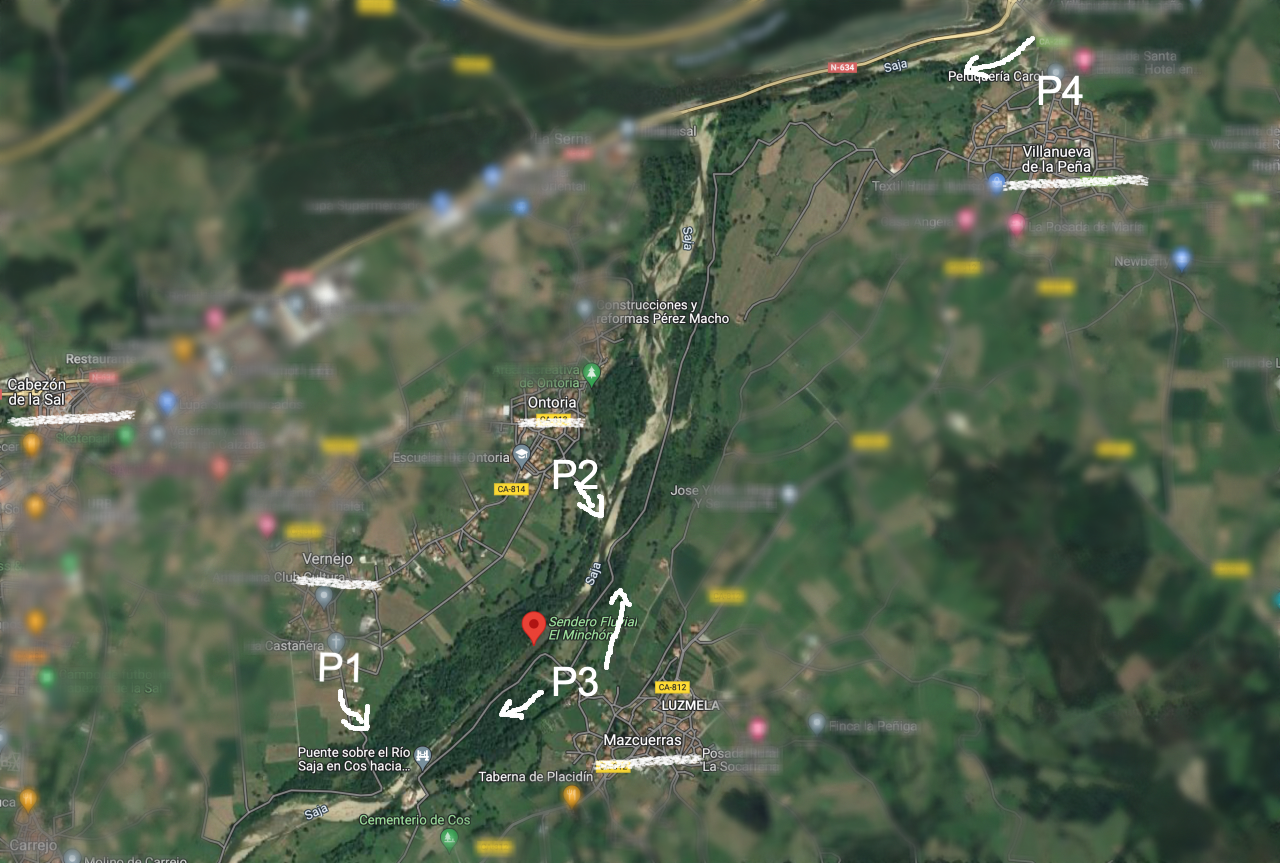
So, without further ado … El Minchón … along this stretch, the Saja River (which also runs along the other Hotspot, Canteras de Cuchía) forms the boundary between the municipalities of Cabezón de la Sal and Mazcuerras. On the Cabezón side there are the villages of Vernejo and Ontoria that have access to the area. In the case of Mazcuerras, it is the main village itself and Villanueva de la Peña.

Below (Fig. 1) is a a Google Maps screenshot of the area. Not sure it works, but I’ve blurred most of the area around the location just to try and accent it more. I’m thinking I should maybe remove the colour from the image in areas that are not part of the location … will look into it and make a change in the future (and for all Local Hotspot posts).

Fig. 1 – Google Maps screen capture of the area. El Minchón (Cabezón de la Sal, Cantabria – 30TVN09)

El Minchón is a wooded area around the Saja River, it covers both banks and for the most part is surrounded by farmland. The trees are mainly poplar (Populus sp.), birch (Betula sp.) and willow (Salix sp.) with lots of areas of low growth shrubs, ferns, or open grassy patches. There’s a great mix of areas that are a bit drier and ones that are quite wet … and then there’s the river itself with all the little streams that flow around and into it.

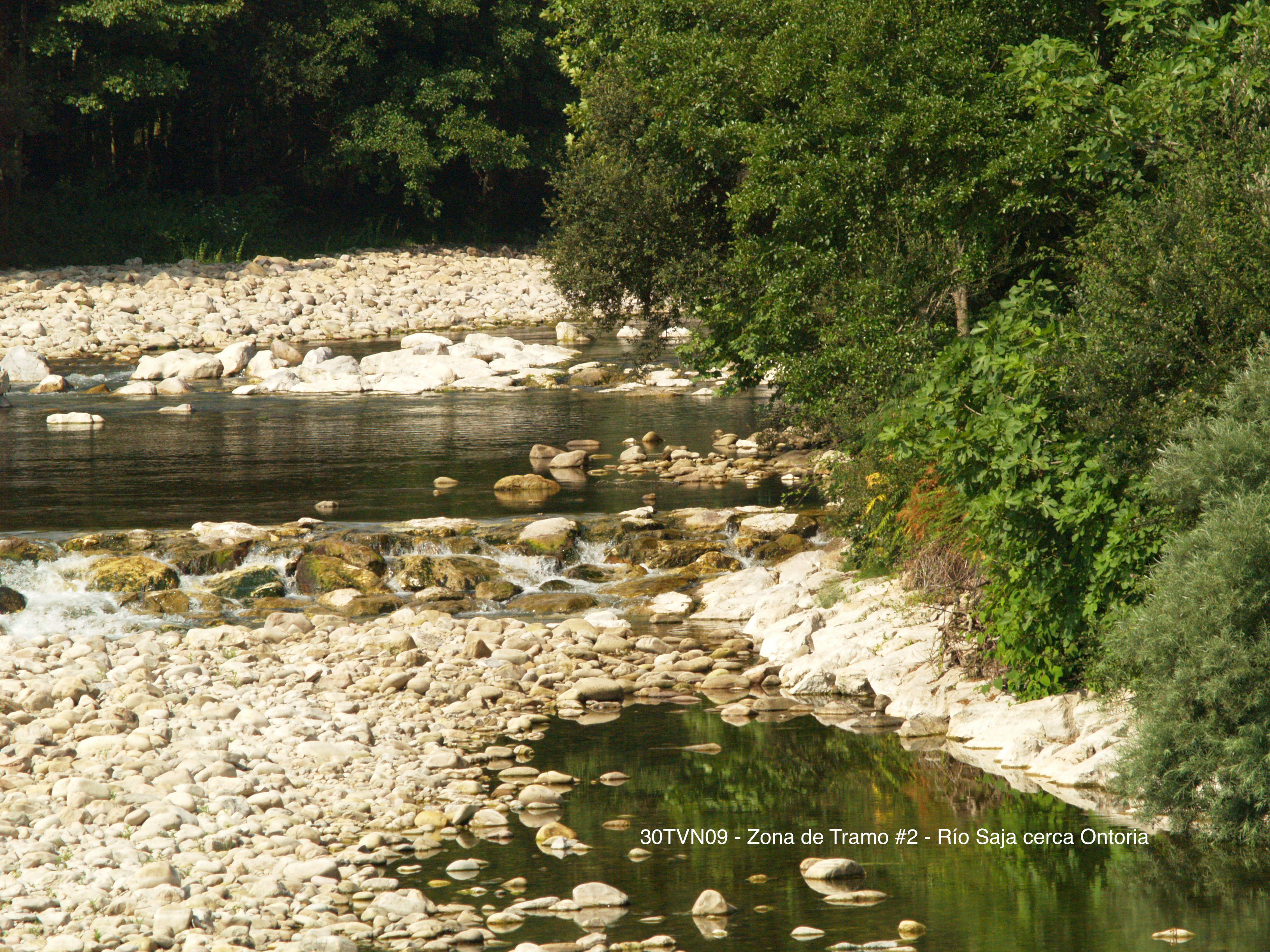
On the side of Cabezón de la Sal (the section between Vernejo (P1) and Ontoria (P2)) some farmers have been allowed to let their livestock (sheep and horses) roam around freely in areas that they set off with temporary fences. This helps create little microclimates, open areas etc. … great for all sorts of wildlife (more on that below). There are little paths that make their way through the area, almost always coming back to the main gravel path that runs parallel to the river. The only area to cross the river (without getting your feet wet) is near P1 where a prominent footbridge provides great views up and down the river.

On the Mazcuerras side there is a large field and picnic area (P3). The path that leads back upriver takes you to the only bridge crossing in the area (near P1). The path down river is a bit hidden at the back of the football field, it is not well maintained, can be slightly overgrown in parts, and can be a muddy, narrow dirt path at times, but it eventually leads to you Villanueva de la Peña (P4) where you end at a small church hugging a cliff face, some picnic tables and the new bridge (you can’t miss it).

Getting Around

The 4 areas where you can park a car all have different benefits:

  • P1 – This is where I usually go in, as I prefer the area between P1 and P2 for wildlife spotting. I usually park near a small church, but parking is limited, and roads are narrow so beware. Once you enter the area through a wooden gate there are tracks leading off left and right, great to explore the area. The river near P1 has been altered quite a bit by man, but recent heavy floods have smashed some of the barriers to bits (see Dam Removal Europe on why removal of these types of barriers (non-essential) is critical), creating some swimming areas etc.
  • P2 – There is a dirt parking area near the river, but not maintained, so it can be rough on your car. You can’t really walk downriver from here but have to go up towards P1. However, this is a fairly natural stretch, so easy to get to the river and see if you can spot trout or salmon (or emerging dragonflies).
  • P3 – An adventure to get there because you go through very narrow streets (keep your fingers crossed you don’t meet someone coming the other way!) of Mazcuerras and just before you get to the parking area you have to drive through a stream. P3 is great if you are with family and friends. They can relax and play while you explore the area. Also, the path to the main bridge is well maintained and easy to walk with little kids, lots to see. Going from P3 to P4 is slightly more adventurous though, but an excellent area for birds.
  • P4 – More for if you want to go for a walk. Because the route is not circular it is basically towards P1 and back, hence I never really go there. Also, they just finished the new bridge (April 2023) in Villanueva and the path starts just where they were doing a lot of groundwork for that side, it has been a messy construction site for years, it used to be a nice playground for kids, so maybe they will set that up again.

So, it depends on what you want to do. For Proyecto Lepides I used to walk a transect from P1. I can easily spend a couple of hours exploring the area. Hence, starting at any of the other locations means I just have to walk more to get to the area that is most interesting from my viewpoint. But for a relaxing morning/afternoon out then P3 and P4 can be great options. We go to P2 when we want to take the kids to the river to explore and swim.

Fig 2. – Looking upriver from the bridge (puente), near P1, crossing the Saja River. This photo was used to illustrate an area of my Transect #2 for Proyecto Lepides. This part of the river has had the banks reinforces with boulders and there are small barriers crossing the river.

Wildlife Highlights

I haven’t even really touched on what you can see there … I don’t know much about plants, but there are orchids in the area (between April and June). My focus is insects and animals … well, the area is known for its snakes (mostly the non-poisonous ones), and I’ve seen a fair amount, including Seonne’s Viper (Vipera seoanei) which is endemic to the Cantabria mountains! Plenty of other reptiles and amphibians to see too.

Birds are great too, with plenty of dead trees left standing there are lots of woodpeckers, and small passerines. From April onwards you can hear Golden Orioles (Oriolus oriolus), and throughout the year there are plenty of birds of prey to spot. Along the river there are Dippers (Cinculus cinculus) and kingfishers.

I’ve seen a wild boar once but I’m certain there are all sorts of other mammals you can come across.

On the insect front, where to start? Flies, beetles (Stag beetles – Lucanus cervus) a plenty … for butterflies and moths it is amazing, such as the Lesser Purple Emperor (Apatura ilia – rare here), Weaver’s Fritillary (Boloria dia) and many, many more … in some of the clearings there are so many butterflies you don’t know where to point your camera first. For Odonata one of the highlights for many will be the Mercury Bluet (Coenagrion mercuriale (a European protected species!)), which is present in very large numbers here from April to October. The rocky bedding in the river also provides a great breeding ground for pincertails and a multitude of other dragonflies (e.g., Oxygastra curtisii – Orange-spotted Emerald).

Conclusion

This is the kind of spot that is great to have near your home. It is small enough to be able to follow the changes during the year, while at the same time being diverse enough in habitat to have an abundance of species within that small area. It also makes it a decent place to visit if you are keen to see a whole list of species.
Furthermore, most of the locals keep to the main path, walking their dogs, riding bikes or jogging, which means the small paths are a quiet domain giving you plenty of time to take great pictures.

Local Hotspots – El Minchón

Nature 101 – Base Knowledge – Naming

Introduction

I should have posted something like this earlier because it will cover the basics in all past and future posts. So, what am I talking about? There are some Nature 101 subjects that might not be known by readers, but if you know the basics, a whole world can suddenly materialise in front of you. For example, the naming conventions I use in my posts, which includes common names, scientific names, families, etc.

Not all readers will have a background or interest in what I cover in my posts but might stumble upon it through a link or a random internet search. This means that those readers might think; “Huh, why is he writing this?” or “What does that mean?”. By providing a little bit of background information it might entice the reader to want to look deeper into certain aspects I cover or into things they come across in their daily lives. For example, they might be out on their daily walk and come across an interesting flower … maybe something they’ve picked up in the Nature 101 series will help them find out more about that flower.

As a side benefit, this will be a longish post and will therefore help me build up my writing style again. I’m a Technical Writer by profession and so my daily work has meant I’ve had to strip some of the creative/random flourishes from my writing to be able to meet my client’s demands. I used to write a lot in my free time but now, after a day of work I don’t always feel like sitting down and doing more writing, I might choose to go out and go for a walk, or do something with me kids etc. Anyway, without further rambling, let’s get into it …

1.0 Naming

I’ll start with a very broad statement … all plants and animals have a scientific name, but not all plants and animals have a common name. Broad because, well, there are of course plants and animals that have yet to be discovered by science and so have not yet been given a scientific name, but you get the general idea.

1.1 Common Names

When I first started out, I was talking with Spanish and Dutch friends about what we’d come across in the field. I was also reading English books to help build up my knowledge. This means that for a specific bird I might have to know the Spanish, Dutch and English common name so that I could talk and have a decent conversation with all my friends … I quickly realised that I would go nuts if I have to learn all those names for everything that I had an interest in … solution, learn the scientific names because those are the same no matter what language I’m talking in. For example … know what a Gyps fulvus is instead of a vale gier (Dutch), Eurasian griffon vulture (English) or buitre leonado (Spanish) (writing convention – the Spanish and Dutch names are in italics because I’m writing this article in English).

That is why I’ve moved away from common names … I still do use them but prefer scientific names because I have noticed that there has sometimes been confusion when using a common name in a conversation where I realised that we weren’t talking about the same species of butterfly. However, I realise my situation might not be a regular case and I might be a bit nerdy in this regard.

There is a case for common names because they stimulate the imagination and so can be a great entry point in building an interest in nature. For example, Spotted redshank sounds great compared to Tringa erythropus.

However, sometimes you are forced to learn the scientific name, because not all plants and animals have been given a common name in a certain language. The English language is pretty good at slapping a name onto everything though.

1.2 Scientific Names

Scientific names can be daunting because they are in Latin and often you might not even understand what it means. I’m not going to explain what the names mean but I will provide an insight into what they are based on.

1.2.1 Taxonomy

The first thing to understand is that the names are based on taxonomy systems first set out by Linnaeus in 1735. However, this system has been continually updated as we have built on our understanding of nature, our planet etc.  This is also one of the main reasons that scientific names can change over time (more on that below).

Here is an overview for a certain species on the taxonomy behind the name:

  • Order – Family – Genus – Species
  • Odonata (dragonflies and damselflies) – Aeshnidae (hawkers/darners) – BrachytronBrachytron pratense (Hairy hawker)

Now a family might have numerous genera (plural for genus) within it … in this case, in Europe the genera of Anax, Aeshna, and Boyeria also fall under the family of Aeshnidae. Some of these genera have more than one species within them … e.g., Anax imperator and Anax ephippiger (among others). The genus of Brachytron only has one species within it (in the whole world).

The stuff about orders is well set out, however, the changes occur in the three levels below that (so a species might shift into a different genus based on DNA analysis). To complicate things a bit more … there are also classifications that fall between the four general levels above, such as Subgenera, Infraorders (under orders … in this case Anisoptera, to distinguish dragonflies from damselflies (Zygoptera)), and Superfamilies (below infraorders but above families).
Okay … the main thing that needs to stick in the beginning is the order and species. The order because you want to at least have a basic understanding of what you are looking at and to be able to differentiate between a dragonfly and a butterfly (order – Lepidoptera). Species because that is probably what you are interested in finding out … only later will you realise that a species is not always possible to get to through photos made out and about and so the best you’ll be able to do is genus. But hey … first things first.

1.2.2 Scientific Naming

So, what do various styles of scientific names mean?

  • Brachytron pratense (Müller, 1764) – This is the binomial name. So, we know that the species is Brachytron pratense and that we have to put that in italics. But the rest? Müller is the name of the person who first described the species, and they did that in 1764. You can Google the name, it is Otto Friedrich Müller, a Danish naturalist. His name and date are in brackets because when he described it, he named the dragonfly Libellula pratense. Over time it has become clear that the genus Libellula has different characteristics and Brachytron was described by another scientist (William Frederick Evans) in 1845. So, the brackets mean that there has been a change in the original name.
    Why do they add the person’s name? So that the reader is 100% certain they know the correct species being discussed in a paper.
  • Anax sp. or Anax spec. – Sometimes when we’re out in the field taking photos, we can’t quite ID an insect/plant/etc. down to a species level, but we can identify the genus … then we add either sp. or spec. after then genus … it basically means “I know I’ve seen an Anax dragonfly, but I’ve not been able to identify the exact species.”
  • B. pratense – Sometimes the genus is shortened to the first letter (and a period) … basically the writer is writing about that species and does not feel like writing the whole name out each time. Care must be taken when writing about multiple species that have a genus that starts with the same letter … e.g., A. imperator and A. isoceles, where the first is Anax imperator and the second is Aeshna isoceles. Does the reader know they both aren’t Anax?

Conclusion

Okay, this has been one long post even though I’ve tried to keep it basic and brief … but hopefully you’ve picked up one of two things to take with you when you read a future blog post of mine. I’ll try to see if there are other Nature 101 subjects I can cover in future posts (maybe some about specific orders). Also, I think I’ll post these on Fridays from now on because the topics fit well with the Book Club stuff. I’m still figuring this out a bit. Finally, I’ll make sure that there is a list for all Nature 101 and Book Club posts on a general page.

Thanks for making it down this far!

Nature 101 – Base Knowledge – Naming

Local Hotspots – Canteras de Cuchía

No post last Tuesday because I ended up quite a few days in bed with fever. I had expected to head off to a small village in the north of Palencia to put out a moth trap for the night and then, upon returning home I’d write up a piece on how it had gone. Friday I already felt terrible shambling about the place and by the next day I couldn’t move … last Wednesday I ended up running some errands but still in a groggy state … ah well.

Introduction

So, no moth report, but I did end up going to the Canteras de Cuchía on the Thursday, and again the past Sunday. This is one of my favourite local spots to go check out wildlife. It is an old quarry (cantera) site for a local chemical plant (Solvay) near Torrelavega. I think they used the carbonate rocks. The site is situated across the river from Suances, and it is where the Saja River meets the Cantabrian Sea. Basically, a whole hill was quarried away and what is left is a dip in the landscape. The site was granted to SEO BirdLife, and they’ve been custodians for quite some time. One of the biggest issues has been invasive species that have come to completely dominate the site, or until recently. The main culprit has been pampas grass, which was just everywhere, and it grew to massive proportions. An organisation was set up … http://stopcortaderia.org/language/en/news/ … and slowly the site is starting to win the struggle against the pampas grass. Below is a Google Maps screen capture of the area, with the large lake in the middle of the site.

Fig. 1 – Google Maps screen capture of the area. The main dark rectangle in the middle is the large lake. Cuchia (Miengo, Cantabria – 30TVP10)

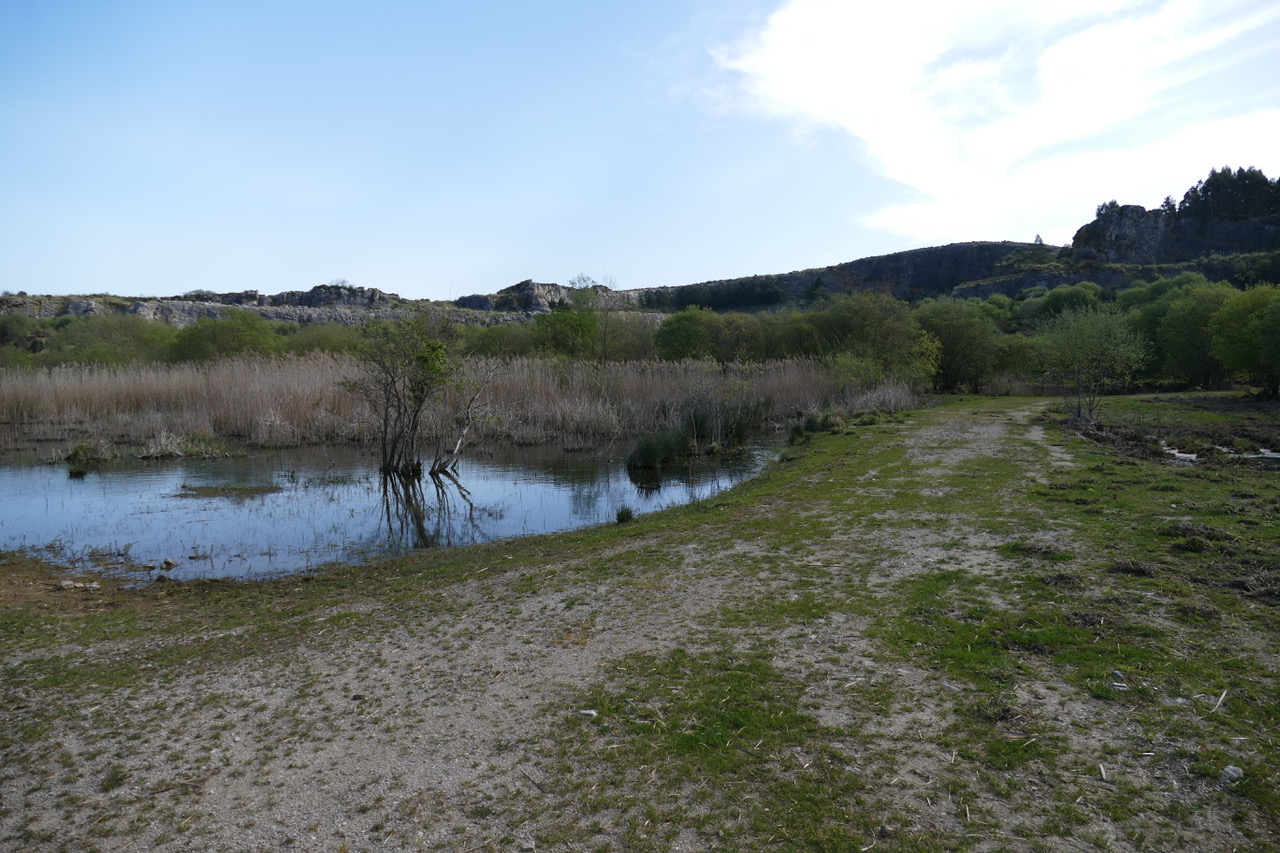
The site is characterised by the cliff faces that surround a fairly unique habitat here in Cantabria, lots of wet, marshy areas (temporary lakes – critical for amphibians and insects) and many little microclimate zones that can be really warm compared with the surrounding area. They are using livestock to keep the areas clear of pampas grass, with horses and donkeys being key to keep it at bay (see Fig. 2). I always figured that this area would be great for Mossy Earth (https://www.mossy.earth – see the quarry project in northern Portugal) to be a part of the project here and really take it to the next level where the whole area is fenced off to let the livestock really roam about the area. I know that in The Netherlands there have been similar projects that have had great success (the ENCI groeve near Maastricht is stunning – https://www.amazingplaces.com/netherlands/enci-groeve-nature-park/).

These wet zones are a haven for bird and insect life, and you can even spot larger mammals like badgers (Meles meles), otters (Lutra lutra), foxes and others from the weasel family. Hares have also recently taken a spot in some of the cleared areas.

Fig. 2 – Some of the area to the right (southeast) of the main lake that has been cleared and is maintained by horses.

Getting Around

The best spot for parking is on the north side (centre top of Fig. 1). Towards the beach there’s a wet/reedy area that has a couple of board walks running through it, the dune area is quite nice, but it does need better management. However, it gets a lot better once you make your way up and over the hill in a southward direction and head down into the quarry. Most of the area to the west of the main lake is closed off and you must stick to the paths. However, everything to the east of the lake is open, although you might have to pass over some makeshift fences that are there to keep the horses in, that leads you to the likes of Fig. 2. You are surrounded by cliff faces and on a sunny day with little wind it can get really hot down there. It is a bit wild there, no real set paths to follow, or signpost to help navigate you around the area. You have to just go for a small adventure.

If you want, beforehand you can walk from the car park to the lookout point and get an overview of where you’ll be walking later, but that area around the car park is not the nicest spot. But when you are down there between the willows and reeds you might lose your orientation, so it might help you set some bearings for when you go down.

I should also note that there’s a parking near the small port in the southern area, but I never go there. Lots of pampas grass and not the best spot (garbage about etc.).

Conclusion

Take a hat for the sun, some snacks and some water and you’re set for 3-4 hours at least. I like getting there around 9 AM at the latest. Highlights are birds and insects (dragonflies!). Visits are interesting all year round, with lots of migratory birds passing through.

There is still a lot of work to do to keep invasive species in check, but if they keep it up this will be amazing in 5-10 years’ time. I personally hope they get rid of some of the eucalyptus and plant birch instead.

Local Hotspots – Canteras de Cuchía

Intermezzo part 2 – The Second … or Third … Coming

So, there I was, back in late 2017 with ambition to get back on track and thinking I’d have plenty of time over the winter to write some pieces for this blog … and here we are, over 5 years later with not a single (published) post to show for it.

Will it be any different this time around? Who knows, but I’m going to give it another go. A lot has happened, not only in my life, but in general. There are some excellent new methods to get content out to those interested, such as Substack, and there is even development around AI writing with tools like ChatGPT. However, the goal is to restart the blog simple … not fill my plate up with too much, I can add more content as it comes. This means I’ll stick with the following:

  • Bee-News – all things related to Hymenoptera, so also wasps and ants. Posts in this category will probably be fairly regular, maybe once a month or so.
  • Book Club – books on nature or related topics. Infrequent, but I’ve read some great books since the last one and so will be a bit more common at first. One of the books I’m considering is The Collector by John Fowles. I have half a draft ready but was never sure it fit … we’ll see.
  • Butterfly Bulletin – the name describes it fairly well. Again, expect to see regular posts on this.
  • Flower Fields Forever – plants of all types really. This category will be irregular because I’m least knowledgeable about this topic, though I do have some interesting orchids etc. I want to highlight.
  • Odonata Update – all things dragonfly and damselfly. A regular that covers an area I’m really interested in.
  • RAm Report – reptiles and amphibians will be covered here. I do not expect to be posting on a regular basis in this category, but I do have some great observations I want to highlight.

Will I be leaving anything behind? Well, yes:

  • Proyecto Lepides – I was part of an organisation here that tracked butterfly, moth, dragonfly, and damselfly populations in Cantabria but unfortunately it has ceased to exist. It was actually one of the reasons I stopped posting here. A job, family & young kids, and then learning something new in such an in-depth manner (reading, taking time to walk set routes or investigate new areas, sifting and IDing 1000s of photos, carefully recording each observation etc. etc. etc.) was exhausting and did not always align well. I did not want to disappoint the organisation, to which I feel I was one of the key contributors … I am still 4th on the ranking list for number of species of butterflies (92, #1 has 129) seen, 1st for moths (264, #2 has 221) and 1st for dragonflies (34, #2 has 32) all within our defined area (https://proyectolepides.observation.org/) even after little activity on my part over the past 2 years … so I did as much as I could until the founder wrapped it up.
    I am happy to have been a part of it all and if there is ever another similar organisation in the area I’ll be one of the first to join. Thanks to all who I met through this organisation … I’ve kept in touch with a couple, more on that in the future.

Is there anything I might consider adding going forward? (i.e., stuff to add to my plate.)

  • Routes/Excursions – this would basically take over the stuff covered under Proyecto Lepides where I give an overview of any (day) trips I make in the area. I usually set out to go see butterflies or dragonflies in certain locations so this would be an account of those occasions. We’ll see, these take a ton of time and effort to write up. Maybe only the memorable ones with the others being a footnote in a post in one of the 6 topics above.
  • Moth Matters – I own a moth trap these days and a frequent activity I’ve done over the past few years is just to put it out on our balcony and see what comes by. I’ve also IDed a few other locations where I’ve placed the trap with great results. One of the problems has been that in 2022 they replaced the street lighting from old bulbs to LED lights (great for energy efficiency but …) and man are those new LED lights ever bright! Since they’ve been in place then number of moths on our balcony has been next to none, so I’ve had to go out now, where in the past a trap on the balcony was so little effort. I’ll probably start with this topic once I get trapping again …
  • Various other topics – then there are Diptera (flies – Horde of the Flies), Orthoptera (grasshoppers and crickets – ??) and Coleoptera (beetles – Beetlemania) that all really deserve their own topic … and I’ve seen some great species that would make excellent subjects for a post. We’ll see …

Where do we go from here?

I plan to post once a week (oh boy, hopefully I don’t shoot myself in the foot here) on a Tuesday with the first post being in March (on the 7th), which gives me time to finalise some of the draft posts I have planned. My goal is to keep the posts short and to the point. I’ll continue to include some links at the bottom of the post, and I might add a heading for Random Comments at the end of posts so I can jot down some things I’ve been busy with outside of stuff to do with nature etc.

Random Comment of the Post – We now drive a fully electric vehicle (BEV) … I have to say, life-changing really. Hopefully you have the chance/opportunity to switch too, it’s great.

Intermezzo part 2 – The Second … or Third … Coming