Introduction
The end of March gave hope for a good April and also April 2015 had been quite excellent with 17 species seen (although 2 of those were not in the area here) even though I was just starting out in the world of butterflies. A year on I’m a bit wiser, but with still so much ahead of me to learn …
Anyway, back to the start of this month. Work was a bit on the slow side, so in that sense I had time off … but illness hit the kids hard so they were home and needed close attention. The month started of with reasonable weather but a little gusty in the wind department … as the month went on the rains came when I had little to do and the sun was out when work was staring at me in the face … very frustrating! The 2016 butterfly-bug was starting to hit hard.
I was able to do a few truncated rounds of Recorrido A in the first days of April … pushing the least ill kid around in the pram so he could get some rest outside of the stuffy house where his brother was busy vomiting every time a spoon came close to his mouth … anyway, the usual suspects were out: Pieris napi, Pararge aegeria, Aglias io, Colias croceus to name but a few.
It was on the 1st of April when totally unexpectedly two new species popped infront of my camera lens … Boloria dia (Violet/Weavers Fritillary) and Erynnis tages (Dingy Skipper) … both within a couple of meters from each other. I spotted the one when I’d spotted the other. I was drawn to the fritillary due to colouring and patterns on the wings and only got a couple of poor shots off of the skipper, luckily one was good enough for a positive ID. I got quite a few decent photos of the fritillary and knew I needed some underside pictures for a proper ID, with with some patience I managed to get (though poor lighting! still just enough for an ID). This fritillary is not very common and a great find. Where these the butterflies I’d seen a few days earlier in the same spot but without being able to find out what they were? It sure seemed that way and I was well pleased even though some initial complaints had started coming from the pram telling me it was time to head home.
Both were a first for me and thus also a first for the area/transect, even though I was not officially walking the transect.


On the 3rd of April I again went for a walk (with same kid) but this time around grandma’s house (very nearby here and also in 30TVN09). The wind was blowing so hard I almost decided not to go out, but the sun was out in full force, so who knew …
I went to a favourite spot, a sheltered field on the side of a sunny hill. A little dirt trail runs along the bottom of the hill accompanied by a shrub-lined brook. The wind was whipping high around the trees with the occasional gust through my hair … but I slowly walked the track with the sun as my guide … and there it was, amongst many other larger whites a relatively smaller white flying just that little bit different. The first Leptidea sinapis (Wood White) of the year. Only male genital analysis will tell us if it is this species or in fact Real’s Wood White that flies here, so until that day I’ll keep it to the more common of the two species.

As the track started to climb I decided to turn around and while walking back my next new species … Polygonia c-album (Comma Butterfly). For me this has always been an elusive species so I was again elated to see it. It sat on a sand bank and flew around a bit, happy for me to take pictures. Again a first for the year.
After this came two frustrating weeks of bad weather or no time. In the weekend I marked a day that looked to be good for the following week …
Recorrido A – 19.04.16 – 30TVN09, Casar de Periedo
… but it ended up being poor … continually overcast (after a sunny morning – no time, argh!) and with strong gusts of wind. The temperature was the only thing going for the day, just above 20C, when I headed out.
Even with the poor weather I saw the first butterflies instantly, flying up and down along the scrub. Dutifully checking the first few I came across it was clear they were probably all Pieris napi (Green-veined White). This white butterfly will be so plentiful in the coming months that it will drive me crazy.
It was a while before I saw something else fly by, this time it was a disturbed Pararge aegeria (Speckled Wood), again common stuff, though again this time around not as plentiful as in earlier months of this year.
A little later I spotted the first Leptidea sinapis (Wood White) for the transect this year, bouncing around in a field before it got swept away by a strong gust of wind.
I was feeling a bit hopeless, the poor weather was getting me down. Even a decent number of Colias croceus (15-20) (Clouded Yellow) zipping around just above the various Plantago spec. flowers at great speeds (wind no deterring factor for those excellent fliers) could not cheer me up. With a sigh I looked down and scratched my beard, what to do? It was staring right back at me … A colourful caterpillar, a blazing warning signal amidst the green grasses. This caterpillar (Zygaena spec.) looked about ready to start building a case. In a month+ the field I was standing at would be filled with the day flying moths that this caterpillar would turn in to. I’d have to wait until then to find out the exact species of vivid black and red moth that it will become. If I saw one I might see other caterpillars out …
Within 30cm was the next, this time a rich green with some light striping. I’d need to search internet for this difficult ID (turned out to be probably be the common Maniola jurtina – Meadow Brown – that will also be ever-present in a month or two).
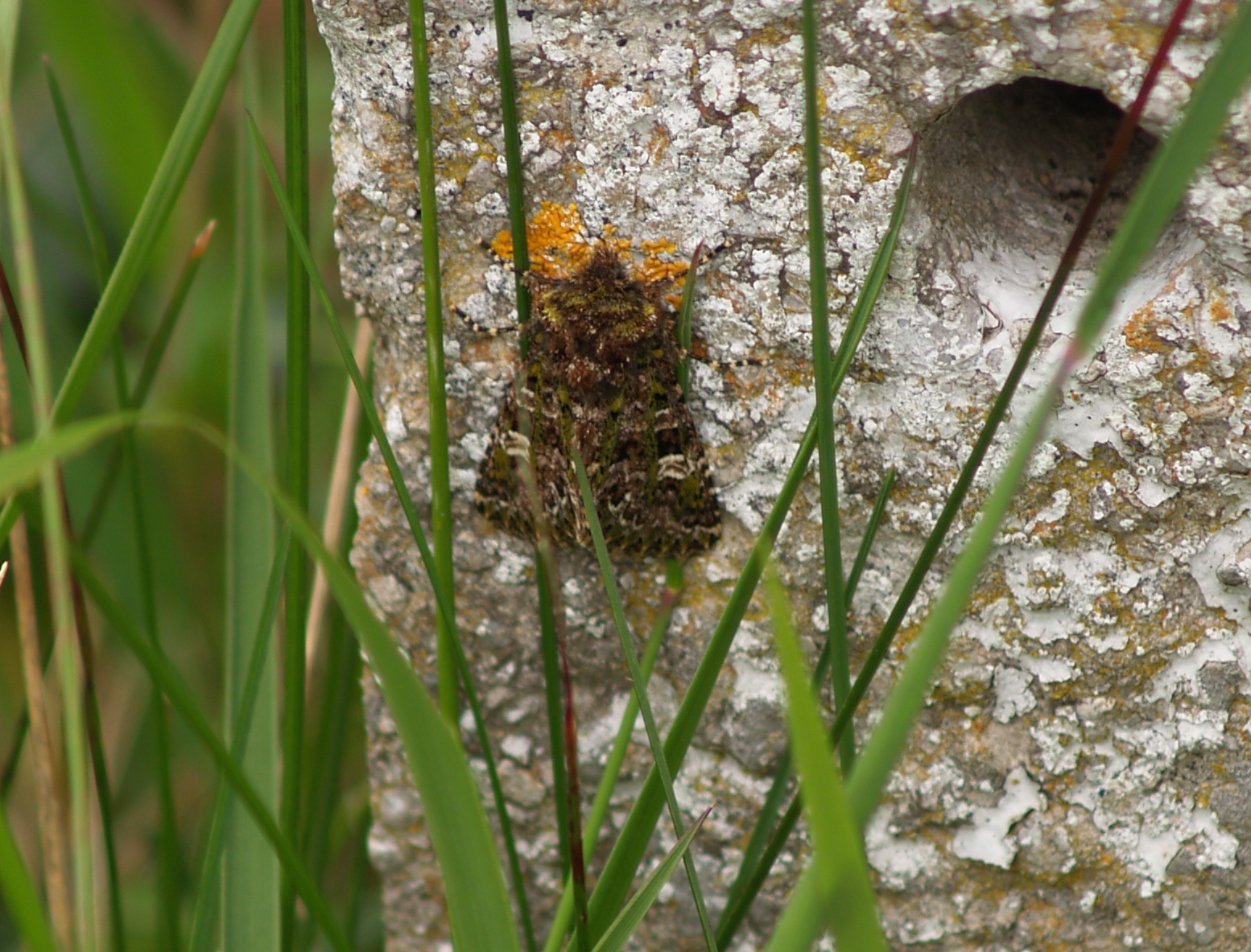
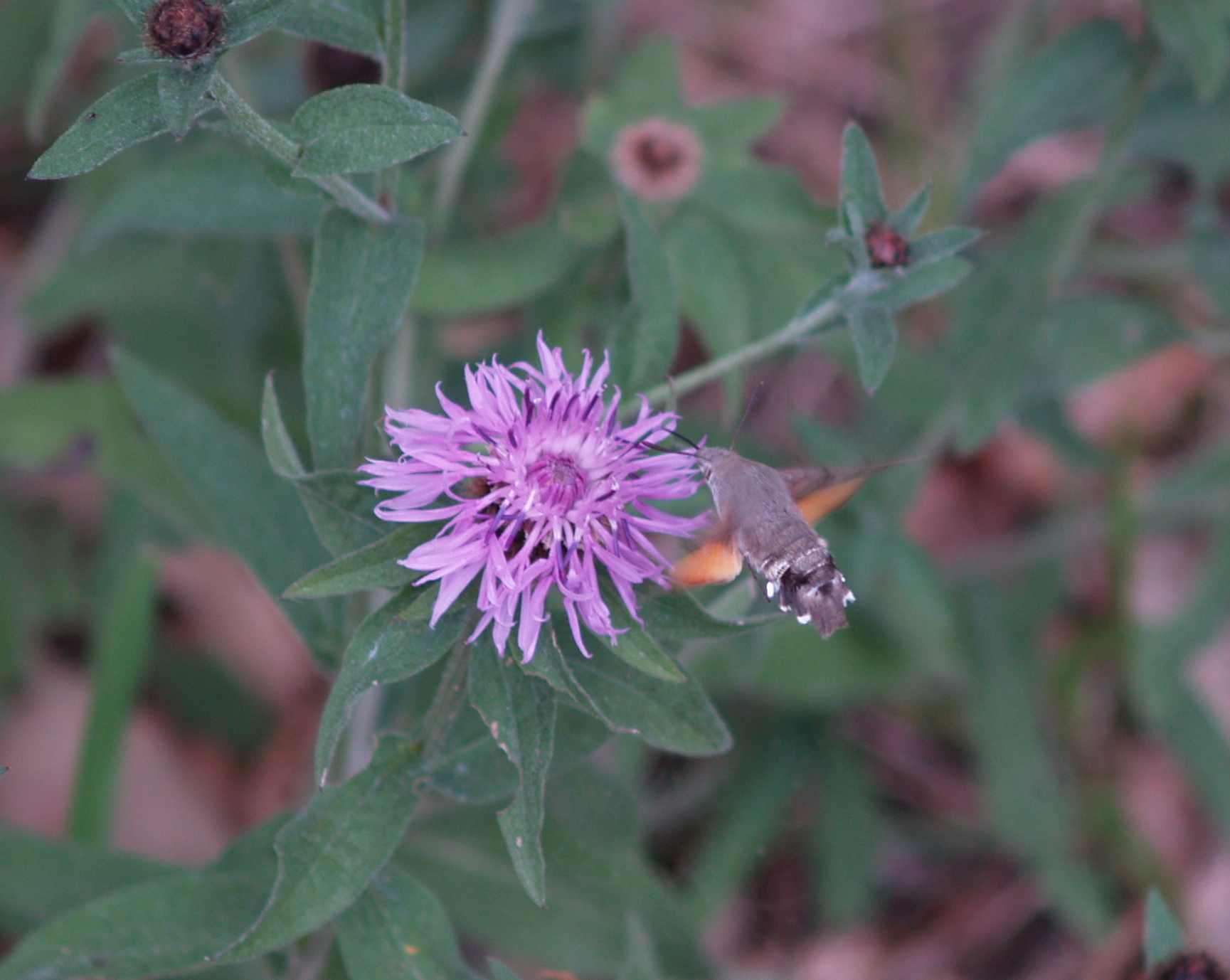
I walked on, keeping my eyes peeled to the ground. This helped me spot a beautiful moth, Valeria jaspidea, on a small concrete post in the field. Incredibly subtly coloured, what a beauty. A bit further I spotted more Zygaena spec. caterpillars (3) and the weird but wonderful Macroglossum stellatarum (Humming-bird Hawk Moth) hovering and taking nectar from a knapweed.
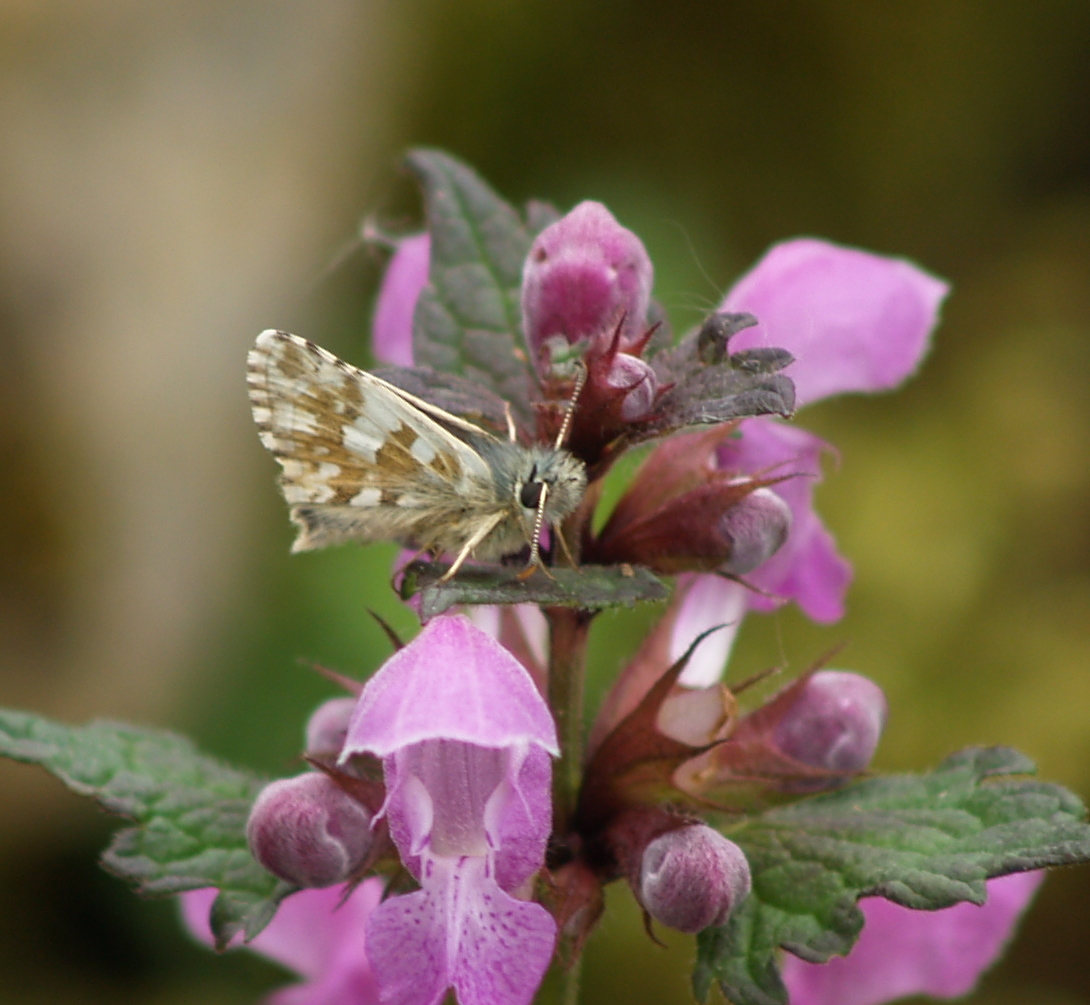
Not at all bad after all … and then came the highlight of the day … I’d stopped at a favourite spot of mine to look at 4-5 different species of bumblebee when I spotted an incredibly small whitish fluffy thing zip by, at a crazy speed. By pure luck I had been able to track it with sight, I quickly whipped up my binoculars to get a closer look … what was that!? I took some quick pictures, as it was clear I’d never seen something of the sort before. Slowly I circled around inching forward and getting a better look from the other side. I almost lost sight of it as I made sure I had proper footing.
A Pyrgus spec., a tiny butterfly that at times resembles a moth. I was able to get quite close, but it refused to open its wings (or move for that matter). Without further scientific examination it is impossible to say whether it was a Pyrgus onopordi (Rosy Grizzled Skipper) or a Pyrgus armoricanus (Oberthür’s Grizzled Skipper). The second is slightly more probable, but either way, both are rare in Spain and especially here.
Due to the stubbornness to not open its wings I decided to call it a day and left. I do not see many butterflies of this family here so I was keen to get home and see what I’d seen (at that time I didn’t know an exact determination was impossible).
Summary
– Pieris napi.
– Pararge aegeria.
– Leptidea sinapis.
– Maniola jurtina (caterpillar).
– Zygaena spec. (a moth – caterpillar).
– Colias croceus.
– Valeria jaspidea (a moth) – a first for me.
– Celastrina argiolus.
– Macroglossum stellatarum (a moth) – first of the year.
– Pyrgus spec. – first on all accounts; me, year and transect!
Species year total — 17 (2015 – 45). 11 species over March 2016.
Notes:
– Not counting caterpillar species, as there is uncertainty around the ID and did not add those to the 2015 results. There will be plenty of Maniola jurtina imagos in a short while.
– Pyrgus spec. has been counted as one species.
– Only species of butterflies are counted, I really have no knowledge of moths, but they are part of Proyecto Lepides goals and results so … I will mention them in write-ups.
Further Reading
– My sightings (butterflies only) for the month of April so far on Observation.org.

 Searching for Cullum's Bee