Bee-news – Early Bumblebee – Bombus pratorum (Linnaeus, 1761)

Introduction
I was going to write about one of my favourite bumblebees next, but due to the season (early spring) I thought I’d write about a species that starts showing up at this time of year and is actually not all that common in this area (Cabezón de la Sal, Cantabria, Spain).

Early Bumblebee
Bombus pratorum belongs to the subgenus Pyrobombus. The queens are relatively small and one of the earliest to appear each year (as the name might suggest). Queens pop out with regards to colours as the orangey tail makes them look a bit darker and more drab when compared to the whitish tailed bumblebees that are also out. The yellow bands are a crisper colour yellow.
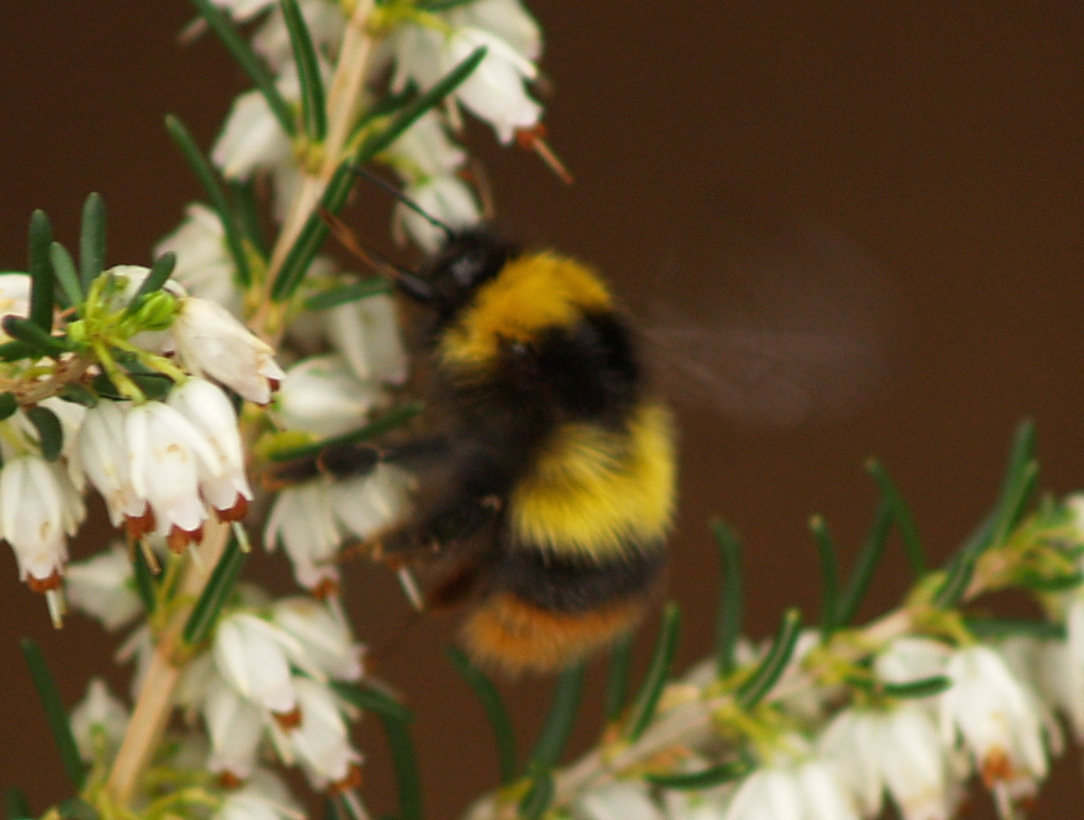
Early Bumblebee (queen) on an unknown plant in Cantabria, Spain.

Males are fuzzy balls of yellow, with yellow hairs on their heads and with an orangey tail.
I have yet to see a worker.
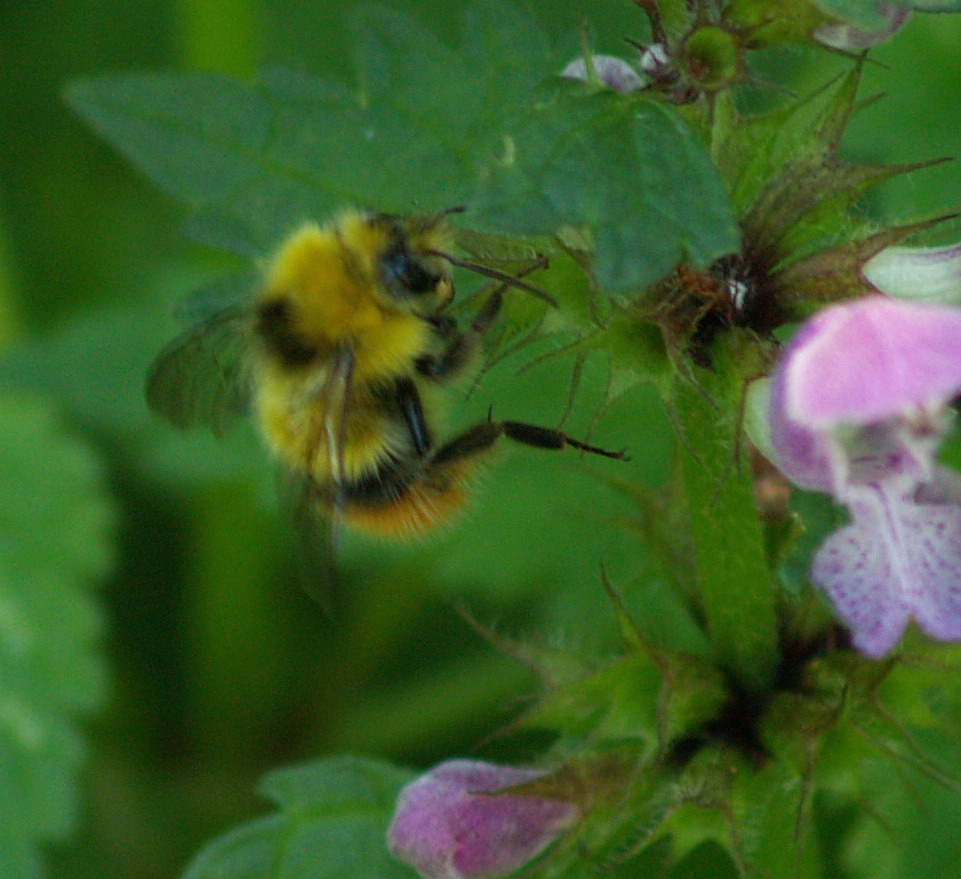
Early Bumblebee (male) on a dead nettle (Lamium sp.) in Cantabria, Spain.

The subspecies B. p. santonae can be found on the Iberian peninsula, but I have no idea what the differences are, but it is the only subspecies found here. If I compare my pictures with those found in the Falk link (see below) then here the bees have more extensive yellow bands.
There is conflicting information on this subspecies and I do not really know which is correct. Some sources state that this is a higher altitude species (500m+ above sea level), but I’m at around 100m. However, I do not know which other species it could be (see Complicating Factors below). Furthermore, there are very few pictures on the internet.

The one thing that could help me out it a book called Fauna iberíca. Vol. 23. Hymenpotera: Apoidea 1 by Ortíz-Sánchez and Ornosa, but it is costly and in Spanish.

Sigh, bees are not that well detailed in Spain as butterflies are and information is difficult to obtain. Once I find out more I’ll post a follow-up article, as this one’s pretty poor with regards to actual information! haha

Complicating Factors
So, not only is it difficult to find out what B. p. santonae actually looks like, but apparently the subspecies of the Red-tailed Bumblebee (B. lapidarius), which is called B. l. decipiens, has the same colouration in queens! However, they are also normally found at higher altitudes (apparently) here and queens emerge much later (May). Furthermore, they are bigger, but this is something you can only really pick up once you have gained quite some experience out in the field. After only one summer season, I am still far from that required level.

So, I guess the bumblebees I’m seeing are Bombus pratorum santonae, but at the moment I cannot be 100% certain. All I know is that the UK situation is a lot simpler.

Further Reading
– Here is a link to Steven Falk’s Flickr page, lots of good pictures and basic info. He has a good book out on Bees in GB & Ireland!
– A link to P. Rasmont’s page with a distribution map and some other basic info.
– A link to the Natural History Museum page that gives an overview of the colouration of the Early Bumblebee.
– A link to the IUCN page. Great site.
– The Bumblebee Conservation Trust is a great organisation, especially if you live in the UK, they’ve got a helpful site for the beginner and also a place to upload photos and ID other people’s photos. I’m a member even though I live abroad.
– There’s a cool app for the iPad/iPhone by NatureGuides with great drawings. I’ve got the Pro version which has been a good resource for info.
– Dave Goulson’s A Sting in the Tail is a fun read about the world of bumblebees.
– My sightings to date on Observation.org of this species in Cantabria.
Bee-news – Early Bumblebee – Bombus pratorum (Linnaeus, 1761)

Bee-news – Common Carder Bee – Bombus pascuorum (Scopoli, 1763)

I was not sure with which insect/animal I’d start off the blog, but have decided to go with the Common Carder Bee (Bombus pascuorum). Since I’ve been out and about in nature (start of 2015) and recording what I see … well, to the extent that I record what I know about and what interests me … this little bumblebee has been present throughout. I first saw one mid March and have seen them around till now (October). Furthermore, I’ve seen them in all types of environments, from in the city, to near the coast to the farmland around our house. So, without further ado …

Introduction
Bumblebees are social bees that form small hives of 50 to maybe 250 individuals, depending on the species. These bees are usually recognised by their roundish, compact, hairy bodies and can be anywhere from around 10mm to over 20mm in size, the larger forms being some of the larger bees you’ll see around and thus when they land on certain flowers the stalks will bend due to the weight of the bee.

Carder
Carder bees are a group of bumblebees that (subgenus Thoracobombus) usually build their nests in grasses etc. near the ground. The nests are built of mosses and such materials. The name carder comes from the term carding in wool-making, which is the separating and cleaning of the wool fibres. The bees do a similar action with their rear legs in taking moss and such.
Here in Cantabria there are a possible 9 species of carder bee present. I’ve seen 4 of which the Bombus pascuorum is by far the most common. 4 of the species are on IUCN’s Red List with a category of Near Threatened or worse, one of those is also on Spain’s Red List as Vulnerable.

Common Carder
So, yes, the Common Carder is quite common, and here too. It is the one little bumblebee I can rely on seeing when going out. One of the reasons why it might not be as famous as the black and yellow cousins is that the colour is a gingery brown, not something that flashes between all the flowers that it visits … as it visits all types of flowers, both for pollen and nectar.
There are 23 subspecies (ssp.) of B. pascuorum and I’m not quite sure which can be found here, more research to do on my part … I think B. p. dusmeti and/or B. p. maculatus, but don’t quote me on that and I don’t know the differences.
One of the things that makes identification difficult is that these bees look quite similar to Bombus muscorum (Moss Carder) and Bombus humilis (Brown-banded Carder) and I’ve seen both those around here too … therefore, when spotting a fresh Common Carder looking bee it takes a clear photo etc. in order to really ID it properly, the other two bees are quite rare. The Common Carder has more black hairs on both the thorax and abdomen. Also you can approach these bees quite closely and really get down to have a good look as they are rummaging about in a flower. Sometimes they are a bit in a rush, but if you’re lucky it is just slowly moving from flower to flower and there will probably be others around so you can just sit and wait for them to come to you. A good sized bush of Lavender is great as they love it (as do other bees and insects!). There is a park in Santander (Las Llamas) where they have huge stretches of lavender … on sunny days those flowers are covered in bumblebees including some Common Carder (however, Buff-tailed Bumblebees (Bombus terrestris) were more common when I was there this past summer).

I’ll post a couple of pictures of Bombus pascuorum bees from around here, however, for this bee other sites (see below) are better to really get a good idea how to properly ID one.

Common Carder on a type of Knapweed (Centaurea spec.) in Cantabria, Spain.
Common Carder on an unknown plant in Cantabria, Spain.
Common Carder on a type of Betany (Stachys spec.) in Cantabria, Spain.

Further Reading
– Here is a link to Steven Falk’s Flickr page, lots of good pictures and basic info. He’s got a book coming out in a week (early November 2015) or so on Bees in GB & Ireland!
– A link to P. Rasmont’s page with a distribution map and some other basic info.
– A link to the Natural History Museum page that gives an overview of the colouration of the Common Carder Bee. I love how they’ve created the images, can at times be better than a drawing. The site can be used to compare different bees’ colourations.
– A link to the IUCN page. Great site.
– The Bumblebee Conservation Trust is a great organisation, especially if you live in the UK, they’ve got a helpful site for the beginner and also a place to upload photos and ID other people’s photos. I’m a member even though I live abroad.
– There’s a cool app for the iPad/iPhone by NatureGuides with great drawings (those will probably be in S. Falk’s book as it is the same artist). I’ve got the Pro version which has been a good resource for info.
– Dave Goulson’s A Sting in the Tail is a fun read about the world of bumblebees.
– My sightings to date on Observation.org of this species in Cantabria.

Bee-news – Common Carder Bee – Bombus pascuorum (Scopoli, 1763)