Introduction
Hymenoptera (or wasps, bees, and ants as some might call them) can be really difficult to identify. Not only due to their small size but also due to the similarities between the species. Bumblebees (which fall under bees) are no different. Add to that fact that documentation of bumblebee species in Spain, and as always in this area of Spain, is spotty at best. As well as the fact that bumblebee species look differently here, as they do in other parts of Europe (differences in band colouration can be striking due to the multitude of subspecies present). Ugh, why did I start looking into this group of insects then if they only bring headache when trying to identify them? Long story for another day, but this site is named after a species of bumblebee (Bombus cullumanus) …
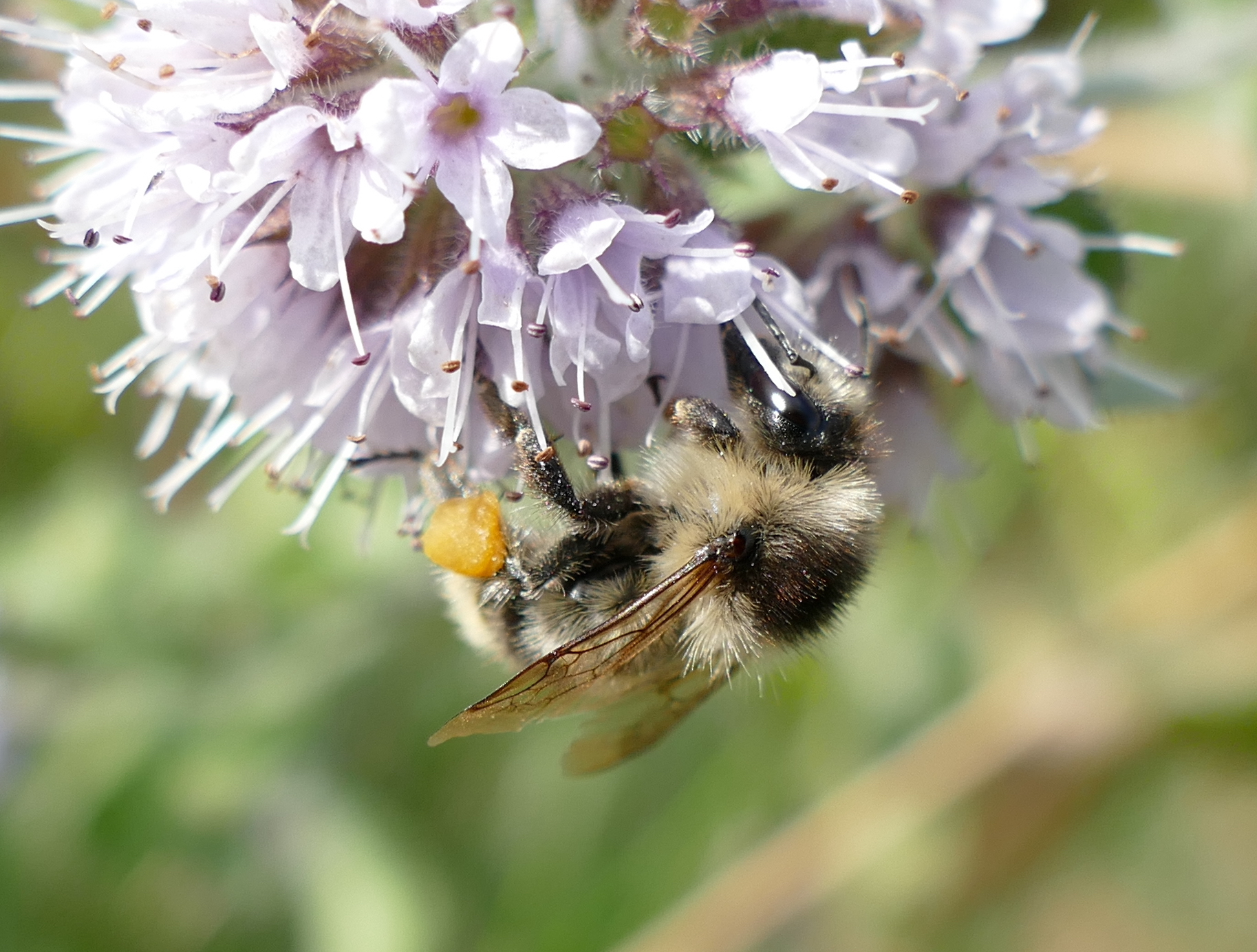
Shrill Carder Bee
So its English name comes down to the high-pitched sound it makes while flying around flowers, it really is distinctive. The species usually flies a bit later in the year/season than other bumblebees, I usually see them in August to October, but have seen them flying earlier.
They are quite common around the village where I live, as they need “rough” farmland with lots of different types of flowers … therefore, due to agricultural changes, across most of Europe Bombus sylvarum is struggling a bit. In Spain, the occur in the northern stretch along the Cantabrian Mountains and in some higher altitude areas along the east coast and towards Madrid. Apart from near my village I’ve also seen them along the coast (Cuchía), in the mountains (Alto Campoo ski resort) and in Palencia.
There aren’t any big differences between males and females. The most distinguishing characteristic is the black band between where the wings attach to the thorax. However, as previously stated, depending on where you live IDing the species can be difficult. For example, it gets more complicated here at higher altitudes, as there are other bumblebee species that might look similar. At lower altitudes it is reasonably certain, especially if you can hear the bee flying around too.

Very Rare Form
Sometimes you can spot an unusual variation of a species (called forma – abbreviated as f.), which will have a specific name. Some variations can be fairly common, as they might occur due to climactic variation, but others can be very rare. I’ve been lucky to spot a Bombus sylvarum f. nigrescens. Initially I had no idea what it was because the coloration did not fit with anything that I might find in this area. The only reason I found out the species was because I got into contact with Leopoldo Castro, the bumblebee expert in Spain, and he was able to ID it for me, not 100% certain but highly probable.
In the picture below you can see the thin light-yellowish bands that it has (running along the edges of the tergites) within the mass of black hairs on the abdomen, with a bit more around the connection between thorax and abdomen.

Further Reading
- The IUCN Red List page – general information about the status of the species in Europe.
- Atlas Hymenoptera – the best site on information and distribution of Hymenoptera species in Europe. Run by Pierre Rasmont, Belgian expert.
- Bumblebee Conservation Trust – page on the trust’s site dedicated to the species in the United Kingdom, where it is a rare bee.
- Steven Falk’s Flickr page – he wrote the field guide for bees in the UK. Awesome photos, great resource.
- Observation.org – citizen science website that would benefit from your contributions. You can find all my observations there.
 Searching for Cullum's Bee