RAm Report – Seoane’s Viper – Vipera seoanei Lataste, 1879

Introduction

It has been a minute since I’ve posted a RAm Report … a what?! … a report on Reptiles & Amphibians. Just a side track first, RAm is a little play on words, as in my daily work I often come across a risk assessment matrix (RAM) reference when it concerns projects. When people think about reptiles, snakes are often first to their mind, the poisonous ones, so you might need to do a little personal risk assessment if you come across one in the field.

Anyway, silliness aside, snakes can be split into various families, with vipers (Viperidae) being one. I will not be going into the others now, too much there for this post. In our region (Cantabrian Mountains more or less) there are three species of viper:

  • Asp viper (Vipera aspis) – found from about a north/south line through Santander to the east. Also found in large parts of Europe. A protected species under the Berne Convention.
  • Lataste’s viper (Vipera latastei) – found from around the southern border of Cantabria southwards, likes a warmer/drier climate. I’ve seen this species near Burgos. A rare species and listed as Vulnerable (VU) by the IUCN in 2008 (needs updating!) and is a strictly protected species under the Berne Convention.
  • Seoane’s viper (Vipera seoanei) – Almost endemic to the Iberian peninsula, with just a tiny corner in SW France. The range is basically the Cantabrian mountains and Galicia. Listed as Least Concern (LC) by the IUCN (also here, update required!) and is a protected species under the Berne Convention.

All three vipers are poisonous and so require medical attention if you are bitten. The only other poisonous snake in the region is the Western Montpellier snake (Malpolon monspessulanus – similar range to Lataste’s viper). When you spot a snake in the wild, you’ll know it is a viper (and so more or less if it is poisonous) by looking at the eyes, where non-vipers (for the most part) have round, black pupils and vipers have black vertical slits as pupils (like those of a cat), see Fig. 1. Something to take into consideration when doing your risk assessment …

An image of a female Vipera seoanei.
Fig. 1Vipera seoanei (female), Cabezón de la Sal, Cantabria, Spain. 24.ix.17. 30TVN09. Notice the verticle black slit shape of the pupil and also the size of the leaves and grasses around her to get a reasonale size estimate.

Seoane’s Viper

So, I’ve seen Seoane’s viper several times, one of them being in El Minchón, one of the Local Hotspots I recently highlighted. When you see one, if you remain fairly quiet, you can watch it for quite a long time. You can often spot them, curled up, just along the edges of brambles or gorse, in sunny spots at the edges of fields or openings in the woods. There is quite some variety in the colours of the pattern they have with some, even being quite monotone in colour (blackish brown). The was the case for the one I saw in El Minchón, which was a bit strange, as I was told by a reptile expert, because those colour variants are usually found at higher altitudes in the mountains.

They mainly feed on small mammals, and probably also lizards and larger grasshoppers. So usually, if I spot a few larger lizards in the undergrowth (like Lacerta bilineata), I’ll walk on a bit, as I’m sure they wouldn’t be out and about with a viper lying around.

Before I round off … they are not big, maybe around 50 cm (20 inches) in length. They can be bigger (up to 75 cm – 30 inches), but when you go looking for them do not expect to see a massive snake. What also makes them look smaller is when they are curled up, they are quite compact. You can compare the size of the snake in the picture (Fig. 1) with the size of the leaves around her (yes, I was told this is a female). The big snakes in this region are the non-poisonous ones like Natrix astreptophora (Iberian grass snake), which can grow up to 2 meters.

Conclusion

For a nature enthusiast, these kinds of species are always interesting, and that is because you can only really find it in a limited area in Europe. It is this kind of species that will provide a tingling sensation to someone who’s keen on snakes/nature and it will be a cornerstone for a spring/summer vacation trip planned during the cold winter months. There is a whole segment of the tourism industry built on birding or nature trips and I’m sure the guide will be over the moon when they can show their clients a species like this … something unique and which they probably cannot see at home.

Further Reading & A Comment

  • Speybroeck, Jeroen, Wouter Beukema, Bobby Bok, Jan van der Voort – Field Guide to the Amphibians & Reptiles of Britain and Europe – 2016 – Bloomsbury – 432 pp. – part of the British Wildlife Field Guides by this publisher, as always stunning. Great illustrations (by Ilian Velikov), excellent text. A must own if you are into reptiles and amphibians, or nature in general for that matter.

Remember that small rant I went on in the Book Club post Books on Moths about Biodiversidad Virtual (hit that link if not)? Well, what I was hoping for has happened, the site will combine with Observation.org! Hot off the press (22.v.23), see their blog post here. Excellent news and congratulations to all involved. All be best migrating data and consolidating the databases etc. I do hope the publications are kept going.

RAm Report – Seoane’s Viper – Vipera seoanei Lataste, 1879

Fly Facts – Milesia crabroniformis (Fabricius, 1775)

Introduction

I’ve mentioned a few times in the other posts of the blog that one of my goals is to provide an opportunity for others to learn, with me, about that natural world around them. Because it is through a blog there will be some repetition, but that repetition will hopefully help the reader become aware of some of the details that make a difference when trying to identify or categorise what we see around us.

The Nature 101 series provides some of those building blocks that support our knowledge growth. These species highlights can be taken as a type of case study where we can not only apply that knowledge but also become aware of our limitations through questions that come up that we cannot immediately answer. This we can use as sustenance for our quest to gain more knowledge (a never-ending cycle if we’ve found something that interests us). So, without further ado … today a fly …

Image of Milesia crabroniformis.
Fig. 1 – Left, Milesia crabroniformis (female), 28.viii.22, Cabezón de la Sal, Cantabria, Spain; top right, Milesia crabroniformis (male) 09.viii.22, Cabezón de la Sal, Cantabria, Spain; bottom right, Vespa crabro (female), 21.iv.15, Cabezón de la Sal, Cantabria, Spain. All photos by Bart van Hoof.

Milesia crabroniformis

When we look at the images above, we notice that the fly looks a bit like a bee or wasp. They are active at the height of summer, especially in August and when you see them flying around you might have some concern if you’re not sure what you’re looking at because they are big, as they can be up to 25 mm in body length, as big as a European hornet (Vespa crabro), and one of the largest flies in Europe.

Here is where Nature 101 Naming comes in … crabroniformis (Latin) means “shaped like crabro”, the European hornet. Here’s another reason why I started learning the scientific names, so I could start seeing links between species “behind the scenes,“ as it were. This hoverfly (more on that later) mimics a hornet. So, there are two paths forward that we might be able to find an answer to with our current knowledge:

  • How can we tell it is not a wasp or bee?
  • What exactly is mimicry?

The latter I’ll leave for a Nature 101 post … I mean I have to create content for the blog. But it might first calm the mind a bit if we can figure out which details show us that this hornet-looking fly is actually a fly and not a hornet.

Milesia crabroniformis is part of the hoverfly family. The order name for flies is Diptera … from our Nature 101 Lepidoptera post we know that “ptera” means wing … “di”, well that means two … flies have two wings, compared to bees and wasps (Hymenoptera) who have 4. One of the tricky things is that Hymenoptera have little hooks that connect the two wings on each side making it look like they only have two wings in total, but if you look closely on a photo, you’ll actually be able to make out 4.

A second clue, and one that should jump out straight away … is the size and shape of the antennae. They are like two nibs that stick out from the middle of the face, whereas Hymenoptera have long, segmented antenna.

The third clue, but one that can be more difficult to determine, is the eyes. This does bring me to another interesting observation. If we go back up to the images above and look at the two Milesia crabroniformis there, have a look at the eyes … they are different. One has them touching ever so slightly in the middle, where the other has them clearly separated along the whole central section. What is going on here? In many hoverflies, males have eyes that touch whereas female’s eyes do not touch. We can therefore not only ID the species but also the sex.

Just before I round off the post, a few more details about this fly. It is mainly found in Europe from about mid-France southwards, as well as in Northern Africa. It is not very common, one of the reasons being that it needs mature woodland, oak trees, and beech trees, where it lays its eggs in rotting wood. You often find them feeding on the nectar of umbellifers (as seen in both photos), which have big “flower heads” made up of many tiny little flowers, so they do not need to have a long tongue to get down into the flower (like a bee or butterfly) but can hoover it up with their mouthparts.

Conclusion

I hope I’ve been able to show how just a little bit of knowledge and information can point us in a direction that can help us identify or understand and insect or animal better. We don’t have to know everything about it straight away, we can look up more in-depth information at a later date. However, we can start seeing connections to it and things we already know.

It is easier to bring this information across in the field … this is one of the basics of adult learning, where we learn best by doing and use all our sense to process information … but as I’ve said before, I am still trying to find a good way to package this information so that a large chuck will stick till the next blog post, and then we can go from there.

See you in the next one (hopefully on Odonata).

Fly Facts – Milesia crabroniformis (Fabricius, 1775)

Local Hotspots – El Minchón

I thought I’d write up another Local Hotspot post, mainly to see how I could improve them and develop them so that they are useful for any nature enthusiasts who travel through the region. Again, I’m trying to highlight some locations that might not be known or evident for the traveller from outside of Cantabria. They might not be worth visiting if you are just passing through, but if you are here for a week or two then they are something to consider.

Introduction

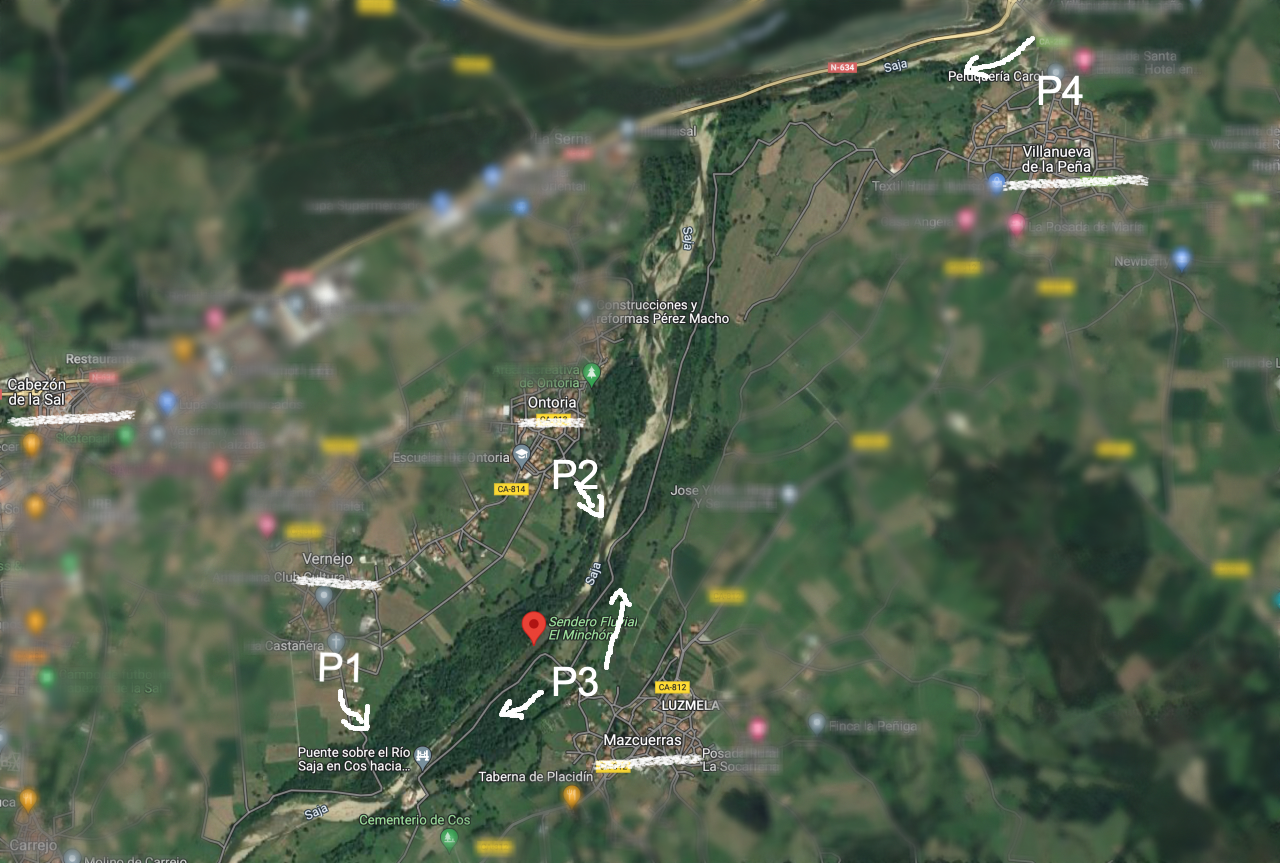
So, without further ado … El Minchón … along this stretch, the Saja River (which also runs along the other Hotspot, Canteras de Cuchía) forms the boundary between the municipalities of Cabezón de la Sal and Mazcuerras. On the Cabezón side there are the villages of Vernejo and Ontoria that have access to the area. In the case of Mazcuerras, it is the main village itself and Villanueva de la Peña.

Below (Fig. 1) is a a Google Maps screenshot of the area. Not sure it works, but I’ve blurred most of the area around the location just to try and accent it more. I’m thinking I should maybe remove the colour from the image in areas that are not part of the location … will look into it and make a change in the future (and for all Local Hotspot posts).

Fig. 1 – Google Maps screen capture of the area. El Minchón (Cabezón de la Sal, Cantabria – 30TVN09)

El Minchón is a wooded area around the Saja River, it covers both banks and for the most part is surrounded by farmland. The trees are mainly poplar (Populus sp.), birch (Betula sp.) and willow (Salix sp.) with lots of areas of low growth shrubs, ferns, or open grassy patches. There’s a great mix of areas that are a bit drier and ones that are quite wet … and then there’s the river itself with all the little streams that flow around and into it.

On the side of Cabezón de la Sal (the section between Vernejo (P1) and Ontoria (P2)) some farmers have been allowed to let their livestock (sheep and horses) roam around freely in areas that they set off with temporary fences. This helps create little microclimates, open areas etc. … great for all sorts of wildlife (more on that below). There are little paths that make their way through the area, almost always coming back to the main gravel path that runs parallel to the river. The only area to cross the river (without getting your feet wet) is near P1 where a prominent footbridge provides great views up and down the river.

On the Mazcuerras side there is a large field and picnic area (P3). The path that leads back upriver takes you to the only bridge crossing in the area (near P1). The path down river is a bit hidden at the back of the football field, it is not well maintained, can be slightly overgrown in parts, and can be a muddy, narrow dirt path at times, but it eventually leads to you Villanueva de la Peña (P4) where you end at a small church hugging a cliff face, some picnic tables and the new bridge (you can’t miss it).

Getting Around

The 4 areas where you can park a car all have different benefits:

  • P1 – This is where I usually go in, as I prefer the area between P1 and P2 for wildlife spotting. I usually park near a small church, but parking is limited, and roads are narrow so beware. Once you enter the area through a wooden gate there are tracks leading off left and right, great to explore the area. The river near P1 has been altered quite a bit by man, but recent heavy floods have smashed some of the barriers to bits (see Dam Removal Europe on why removal of these types of barriers (non-essential) is critical), creating some swimming areas etc.
  • P2 – There is a dirt parking area near the river, but not maintained, so it can be rough on your car. You can’t really walk downriver from here but have to go up towards P1. However, this is a fairly natural stretch, so easy to get to the river and see if you can spot trout or salmon (or emerging dragonflies).
  • P3 – An adventure to get there because you go through very narrow streets (keep your fingers crossed you don’t meet someone coming the other way!) of Mazcuerras and just before you get to the parking area you have to drive through a stream. P3 is great if you are with family and friends. They can relax and play while you explore the area. Also, the path to the main bridge is well maintained and easy to walk with little kids, lots to see. Going from P3 to P4 is slightly more adventurous though, but an excellent area for birds.
  • P4 – More for if you want to go for a walk. Because the route is not circular it is basically towards P1 and back, hence I never really go there. Also, they just finished the new bridge (April 2023) in Villanueva and the path starts just where they were doing a lot of groundwork for that side, it has been a messy construction site for years, it used to be a nice playground for kids, so maybe they will set that up again.

So, it depends on what you want to do. For Proyecto Lepides I used to walk a transect from P1. I can easily spend a couple of hours exploring the area. Hence, starting at any of the other locations means I just have to walk more to get to the area that is most interesting from my viewpoint. But for a relaxing morning/afternoon out then P3 and P4 can be great options. We go to P2 when we want to take the kids to the river to explore and swim.

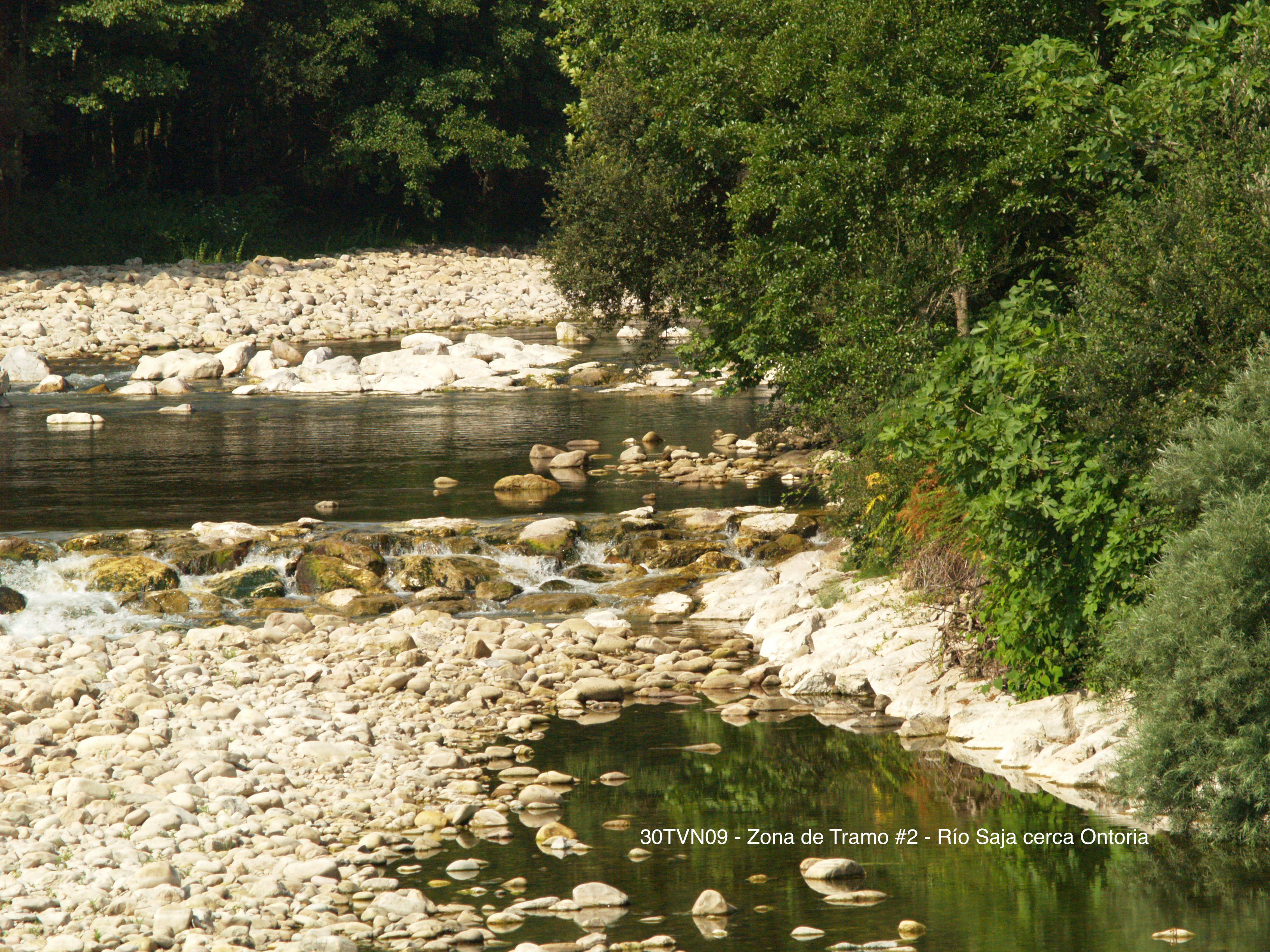
Fig 2. – Looking upriver from the bridge (puente), near P1, crossing the Saja River. This photo was used to illustrate an area of my Transect #2 for Proyecto Lepides. This part of the river has had the banks reinforces with boulders and there are small barriers crossing the river.

Wildlife Highlights

I haven’t even really touched on what you can see there … I don’t know much about plants, but there are orchids in the area (between April and June). My focus is insects and animals … well, the area is known for its snakes (mostly the non-poisonous ones), and I’ve seen a fair amount, including Seonne’s Viper (Vipera seoanei) which is endemic to the Cantabria mountains! Plenty of other reptiles and amphibians to see too.

Birds are great too, with plenty of dead trees left standing there are lots of woodpeckers, and small passerines. From April onwards you can hear Golden Orioles (Oriolus oriolus), and throughout the year there are plenty of birds of prey to spot. Along the river there are Dippers (Cinculus cinculus) and kingfishers.

I’ve seen a wild boar once but I’m certain there are all sorts of other mammals you can come across.

On the insect front, where to start? Flies, beetles (Stag beetles – Lucanus cervus) a plenty … for butterflies and moths it is amazing, such as the Lesser Purple Emperor (Apatura ilia – rare here), Weaver’s Fritillary (Boloria dia) and many, many more … in some of the clearings there are so many butterflies you don’t know where to point your camera first. For Odonata one of the highlights for many will be the Mercury Bluet (Coenagrion mercuriale (a European protected species!)), which is present in very large numbers here from April to October. The rocky bedding in the river also provides a great breeding ground for pincertails and a multitude of other dragonflies (e.g., Oxygastra curtisii – Orange-spotted Emerald).

Conclusion

This is the kind of spot that is great to have near your home. It is small enough to be able to follow the changes during the year, while at the same time being diverse enough in habitat to have an abundance of species within that small area. It also makes it a decent place to visit if you are keen to see a whole list of species.
Furthermore, most of the locals keep to the main path, walking their dogs, riding bikes or jogging, which means the small paths are a quiet domain giving you plenty of time to take great pictures.

Local Hotspots – El Minchón