Introduction
With one day of good weather suddenly upon me I decided to head out. There was the occasional gust of wind, but the sun was fully out and the temperature was around 15C. The forecast said rainy periods over the days after. So … out I went …
Recorrido A – 25.04.16 – 30TVN09, Casar de Periedo
There was not much going on at the start of the walk until I noticed a little white butterfly flittering along the edge of the field and road. It was clear that it was a Wood White (Leptidea sinapis) but it was acting strange and it was in a spot where I’d not seen many before … quite far from any woods! 🙂 Anyway, I looked closely and it seemed to be laying eggs individually in a plant that hung over a small dirt edge along the dirt track. In my quest to see if I can find out which Wood White it is I took some pictures, but, as I’m very poor with plants I’ve not made much headway in that department. Furthermore, the plant does not look like any that are listed in the books I have … Will go into it in a post specific on Wood Whites in the (hopefully near) future …
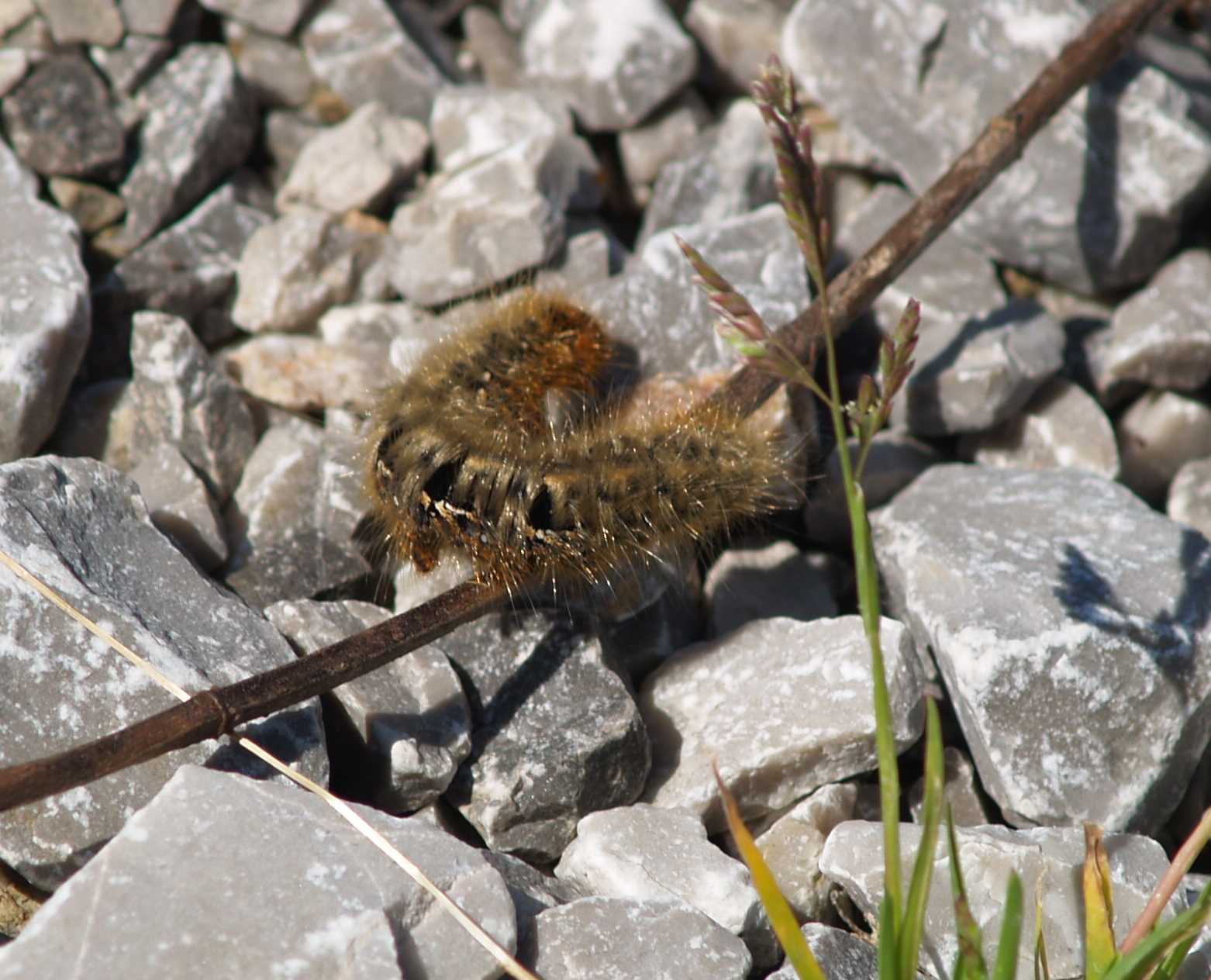
As I was marveling at this funny lone white, I looked down and at my feet was a hairy caterpillar … Lasiocampa quercus (Oak Egger), a moth … have read that you shouldn’t really handle hairy caterpillars due to skin irritation, so lifted the stick onto the dirt track to get a better angle for a picture. Noticed that it seemed to just have shed its skin, had not seen this before.
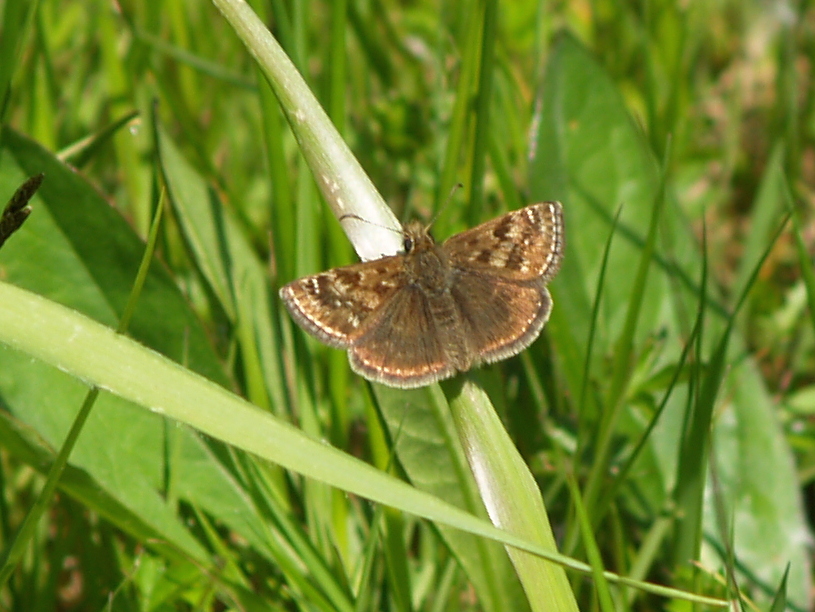
On I went … in the first really interesting field that I like to take a closer look in I spotted quite a number of Small Heaths (Coenonympha pamphilus), they were starting to come out in large numbers! I also spotted a dark little thing … this time I was able to get it on camera in a decent manner … a Dingy Skipper (Erynnis tages). Later in the walk I’d spot a second. This was starting well, it isn’t every day I see a Dingy Skipper. I thought I saw another close by, but the Burnet Companion (Euclidia glyphica), a day-flying moth, that it turned out to be was a bit of a let-down. This species and other day-flying moths will become a feature in the months to come. An inexperienced eye will think “hey butterfly” and that’s what I did … but through endless frustration last year I was slowly learning. However, now for Proyecto Lepides we also record moths we see … so, hey, this is an easy one (i.e. don’t have to go out at night to see it)!
For most of the rest of the walk there was more standard stuff, always good to see, but after a while those species become a touch boring.

I did see my first Sooty Copper (Lycaena tityrus) of the year, a male. I quite like this butterfly, and it is reasonably common around here during the summer months. The females have a spectacular mix of orange and brown. The males are more “drab” dark blackish brown (sooty is a fitting name for the males). But when they thus fly you see flashed from their white underside wings … so for males you get a neat black/white strobe-action going. They aren’t the greatest of flyers, so do not go far if you disturb them and hence are easy to follow. One of my goals this year is to see as many Copper species as possible. There are 6 species in this area of Spain, but three are rare and one of those is really extremely rare … and apparently the most common I cannot seem to come across here (just once last year)!

Towards the end of my walk I saw another year-first … an Orange-tip (Anthocharis cardamines). Again apparently a common sort that I do not come across much here … I’d actually seen a female earlier in April during a stroll, and those are difficult to spot … but males should be easy with their flashy orange wing-tips. Usually, I just seen them flying up and down a path, relentlessly, never seeming to stop for a drink of nectar. I was thus very happy to see one drinking away, and quickly took a picture before it zipped off again.
During the walk I’d also seen three butterflies I had not been able to ID, one was probably a moth and the other two were darkish-looking in flight (one a Small Tortoiseshell?!). Still again, even though I was a touch disappointed with my daily haul, I had some hope for if the weather should turn good for a more extended period.
(I wrote the above but did not finish the post … it is now just into May and we’ve got a couple of excellent days of sun ahead … will go out this Wednesday for my monthly walk, it is looking to be amazing weather … keeping my fingers crossed for some real dazzle!)
Jan. to April Summary
The month of April is almost at a close and it has been a mixed bag … both of butterflies, and of hopes and expectations … for the year.
With regards to 2015, I’m at the exact same numbers, for the year till the end of April I had seen 19 species, of which I’d seen 17 in April. I should also note that of the April species, 3 (of the 17) were not in 30TVN09 (I was not a volunteer yet either), and for the year that number was at 4 (of the 19).
The species I’d seen in 2015 but not so far this year are; Carcharodus alceae, Papilio machaon*, Pieris brassicae, Callophrys rubi*, Cupido argriades, Vanessa cardui* and Aglais urticae. The ones with a * are non-30TVN09.
I realise that some of these are pure luck due to the migratory nature of the species (Pm, Vc, and Au) and the others will surely be seen in May – the one exception to all being Callophyrs rubi, I cannot understand why I have not seen this species in 30TVN09 yet. It is apparently very common but I’ve only seen this butterfly once – however, I cannot but feel slight disappointment with how the sightings have gone this year. Especially seeing as the first months (Jan. and Feb.) looked to be building up quite well. I thought that with a bit more knowledge and experience I’d be able to ID more butterflies, but that has not been the case. Most I’ve seen I’ve been able to ID this year, but I’ve not seen many new species. I assume this has to do with:
– Habitat.
– Weather.
– Luck.
And it is with the last two categories that frustration comes in …
But it is thus also with a bit of luck that I’ve seen two new excellent species so far this year … Boloria dia and the Pyrgus spec. … both not the most common of butterflies in these parts.
I guess what I should take from this is that I should focus more on the positives of 2016 so far … there’s still a lot to go in the year and May looks to be exciting with a friend coming over and the possibility to explore some new areas!
Summary
– Lasiocampa quercus (a moth – caterpillar).
– Leptidea sinapis – a few, around 5-8.
– Pararge aegeria – reasonable amount 10-15.
– Gonepteryx rhamni – a small number, around 5 in total.
– Coenonympha pamphilus – around 20.
– Colias croceus – quite a few, maybe 10.
– Erynnis tages – 2 in total.
– Euclidia glyphica (a moth) – 2 in total.
– Pieris napi.
– Lycaena tityrus – first of the year, 2 in total.
– Anthocharis cardamines – first of the year.
Species year total — 19 (2015 – 45). 16 species seen in April.
Notes:
– Only species of butterflies are counted, I really have no knowledge of moths, but they are part of Proyecto Lepides goals and results so, I mention them in write-ups.
Further Reading
– My sightings for the walk on Observation.org.
– Overview of what has been happening with Proyecto Lepides and butterfly sightings all over Spain. Note the lack of “action” in the north.


 Searching for Cullum's Bee