Introduction
Just a short one on this Tuesday that covers a common damselfly found across much of Europe. Even though it is common, there are a few interesting aspects to this species, some of which were covered in the recent Nature 101 post on Odonata.
A quick refresh in case you do not want to re-read that post …
The Western willow spreadwing is part of the order Odonata (dragonflies and damselflies) and falls under the suborder Zygoptera (only damselflies). It belongs to the Lestidae family, which in turn has three genera (in Europe); Sympecma, Lestes and Chalcolestes. Today we are most interested in the third of those two genera (I’ve put in bold the taxonomy line we need to follow to get to the species. For an introduction to taxonomy see Nature 101 Naming).
The goal for today is to link what we learnt in a recent Nature 101 post with a specific species. How does it relate to other species, but probably more importantly, where does it differ? By choosing a common species found across large parts of Europe, even a frequent garden pond visitor, it means we have a good chance of spotting it in the field and allowing us to experience the insect first-hand.
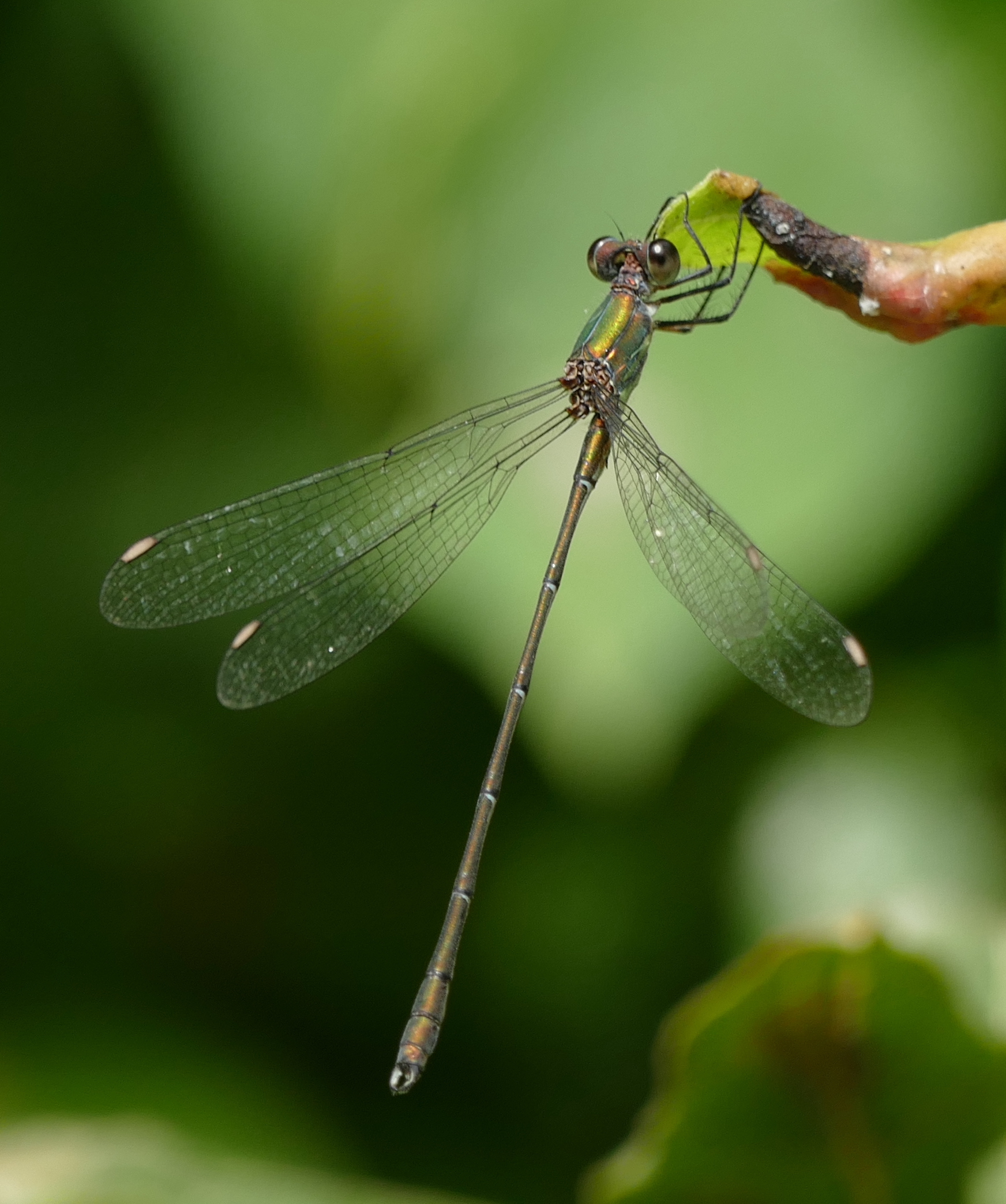
Western Willow Spreadwing – Chalcolestes viridis
If we look at the name, Western willow spreadwing, we can assume that there is an Eastern variant too … and yes there is, Chalcolesets parvidens. Almost indistinguishable in the field, with the eastern species (previously thought to be a subspecies), found from Italy to the Balkans and further eastwards.
These are the only two species worldwide, that we know of, found in the genus of Chalcolestes.
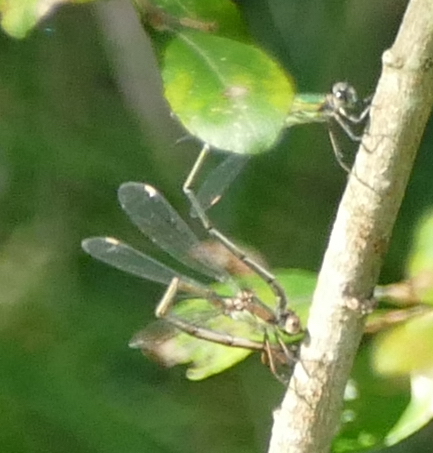
What makes them different form Lestes and Sympecma species is that they lay their eggs in living, woody material such as reed stems or under tree bark, see Fig. 2 (sorry for the photo quality). For Odonata, and many other insects, egg laying is done through an ovipositor, which is a tube-like organ, and so is called ovipositing. The two Chalcolestes species are the only species in Europe that do not oviposit directly in water.
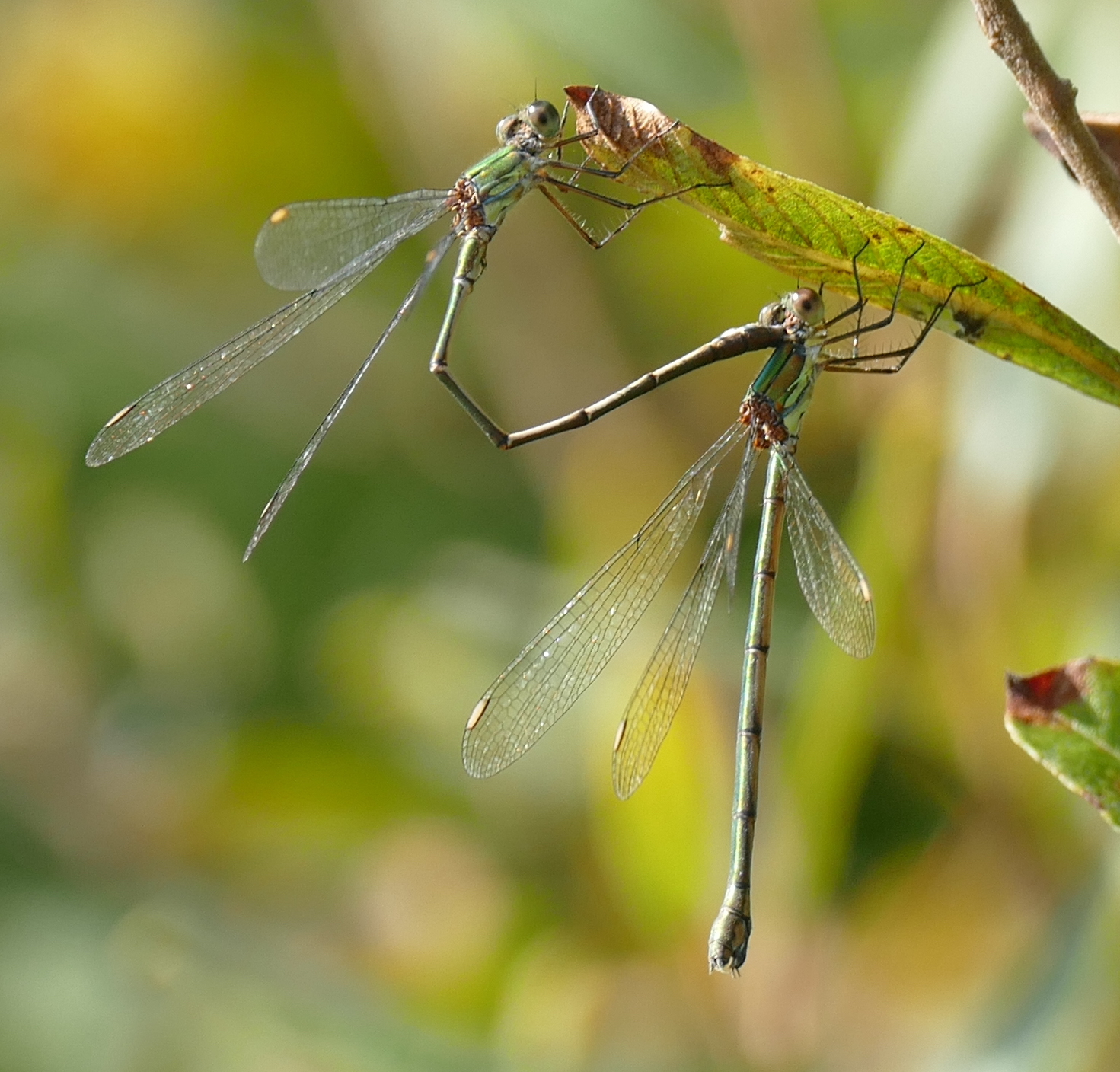
When in tandem (Fig. 3), they fly to an appropriate location and the female creates scratches into the bark of a twig with the rough teeth at the tip of her abdomen. In the photo of the tandem we can see the male has the female in his prong-like appendages located at the tip of his abdomen (see Fig. 1) and he is holding her by the back of her neck.
The damselfly requires slow moving to still waters with plenty of bushy vegetation around. The ponds and bodies of water cannot be ephemeral (i.e., drying up during the summer). The flight period is generally late summer and on into November. The species is common and can be found throughout Cantabria wherever there is suitable habitat.
Even though they are large compared to other damselflies, they can be a bit tricky to spot, often dangling from the underside of leaves. As with Lestes species (not Sympecma), Chalcolestes viridis holds its wings spread open when at rest (Fig. 1). In the Nature 101 post we saw that normally damselflies hold then wings along their bodies when at rest.
Conclusion
As I mentioned, wanted to keep it short to be able to provide an easy case study for some of the things we have picked up in pervious posts, especially in the Nature 101 series. Because it is a common species it is easy to spot it in your own garden, or while you are out for a walk. This will allow you to pick up experience spotting specific insects out in nature and hone your observation skills.
Probably no post on Friday this week, am a bit busy. Thanks for reading and see you in the next one!
Further Reading
- The list of Odonata books I own.
- The British Dragonfly Society has a nice page.
- The Vlinderstichting also has a good page, in Dutch. Odonata are part of De Vlinderstichting’s remit.
Notes
1 – Fig. 2 – Chalcolestes viridis tandem ovipositing. Mazcuerras, Cantabria, 30TVN09. 29.ix.21.

 Searching for Cullum's Bee