Introduction
As with the previous Nature 101 on Lepidoptera, today we will cover a specific order within insects. Just to remind you, the taxonomic term “order” deals with a group of insects (in this case) that have similar characteristics.
As was the case with Lepidoptera (butterflies and moths), Odonata can be split into two groups … actually, in this case it already gets a bit more complicated than Lepidoptera because there have been several taxonomical developments in the last few years …:
- Zygoptera – this is the suborder that contains all damselflies.
- Epiprocta – this suborder contains both Anisozigoptera and Anisoptera as infraorders. The first of which (in the past a separate suborder of Odonata) does not have any representatives in Europe (only Asia), and the second of which used to be a separate suborder too and contains all true dragonflies.
Phew, okay that was the first step. So, basically, we know that here in Europe (or the Americas) we’re trying to identify the differences between damselflies and dragonflies.
Again, I’ll refer you to the Nature 101 Naming post that gives a better/basic overview view of how the taxonomy system fits together.
1.0 Common Aspects
There are no strong characteristics that set Odonata apart from other insects (like scaly wings), but it is usually pretty clear that the insect you are looking at (in the imago stage) is a dragonfly or damselfly. They have long, slender abdomens with 4 large wings (compared to body size), very short antenna, and big eyes. In both larval and imago life stages they devour other insects (and even small fish and tadpoles) like there’s no tomorrow.
When they are still in the larval stage most people wouldn’t have a clue that they are looking at a dragonfly. How can those strange, drab (they are usually brown and covered in mud) alien creatures turn into vibrant metallic-coloured dragonflies?
With regards to life stages there are:
Egg – larva (naiad/nymph) – imago (dragonfly or damselfly)
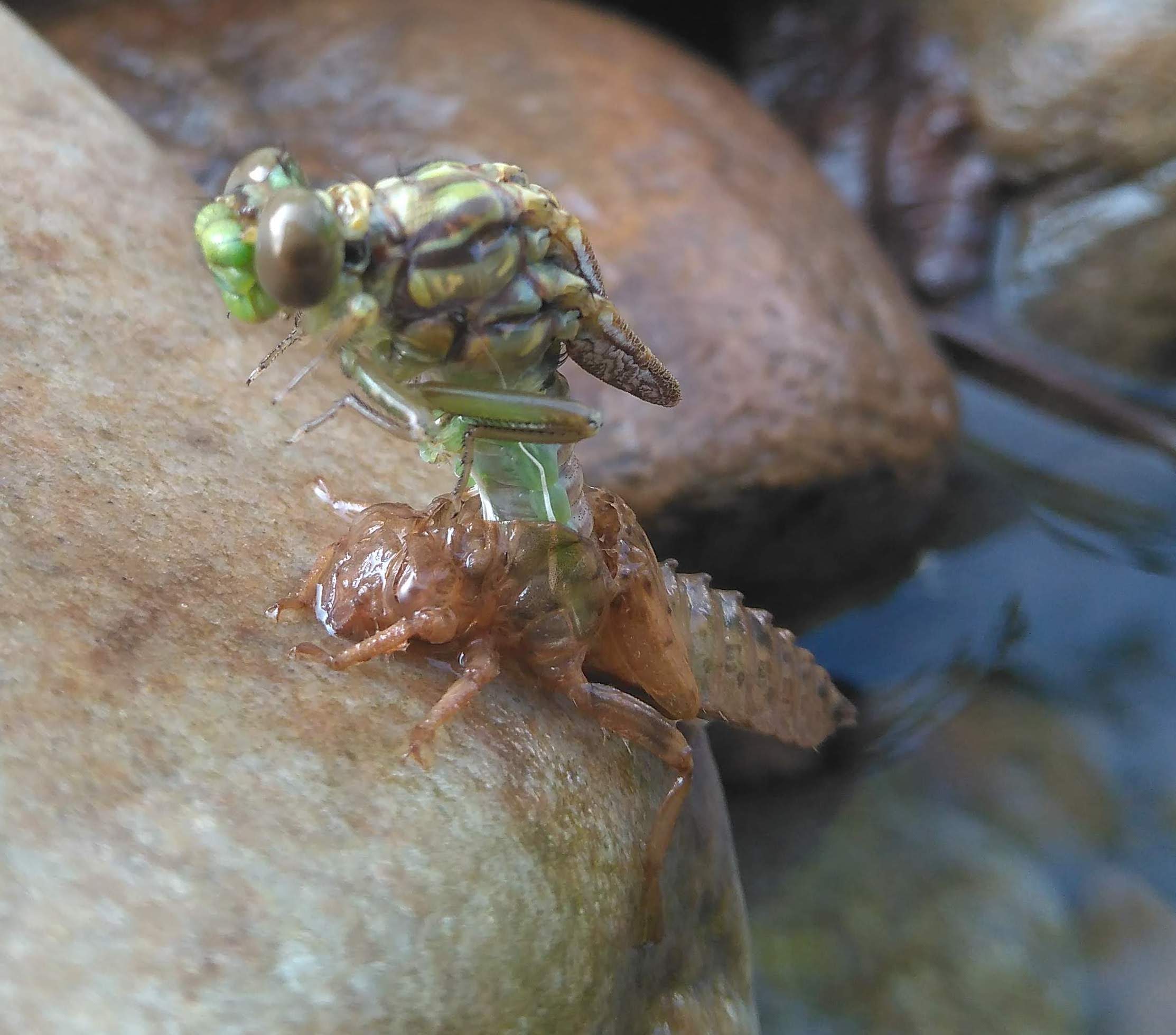
So, there’s no pupa stage. Larvae crawl out of the water up onto rocks or vegetation, break open the back of the larval shell and emerge as an imago, slowly pumping insect blood (haemolymph) around their bodies and wings (Fig. 1). It is quite stunning to see. They leave behind the shell of the larval body, called an exuvia, and that is absolutely critical (see below) when considering that Odonata can live up to 5 years in the larval stage! We notice them as imagoes, and most will only fly for a few weeks.
Odonata life is strongly associated with water, but each species usually has quite some restrictions to the preferred habitat … running water or stagnant (e.g., a pond), no fish presence (or doesn’t matter), sandy or rocky bottom of the body of water, lots of vegetation or very little, and so forth. Most lay their eggs in the water, stuck to clumps of vegetation, and all larvae develop in water (or mud). Anisoptera imagoes are great fliers and can be found far from bodies of water, where Zygoptera are generally “weaker” fliers.
There are insects that could be mistaken for Odonata, which include owlflies and antlions. Owlflies strange-looking insects that are not directly associated with water and have long antenna with a bulb ending (similar to butterflies). Antlions are also not associated with water, have longish antenna and hunt ants (what’s in a name, eh?). Both owlflies and antlions are more common in drier, warm climates and fly towards the end of the day into the night. Both are part of the order Neuroptera, which is just filled with wonderful weirdness … but that is for a future post (with pictures).
2.0 Differentiating Aspects
There are three fairly clear ways to tell damselflies and dragonflies apart, although one is during the larval stage only:
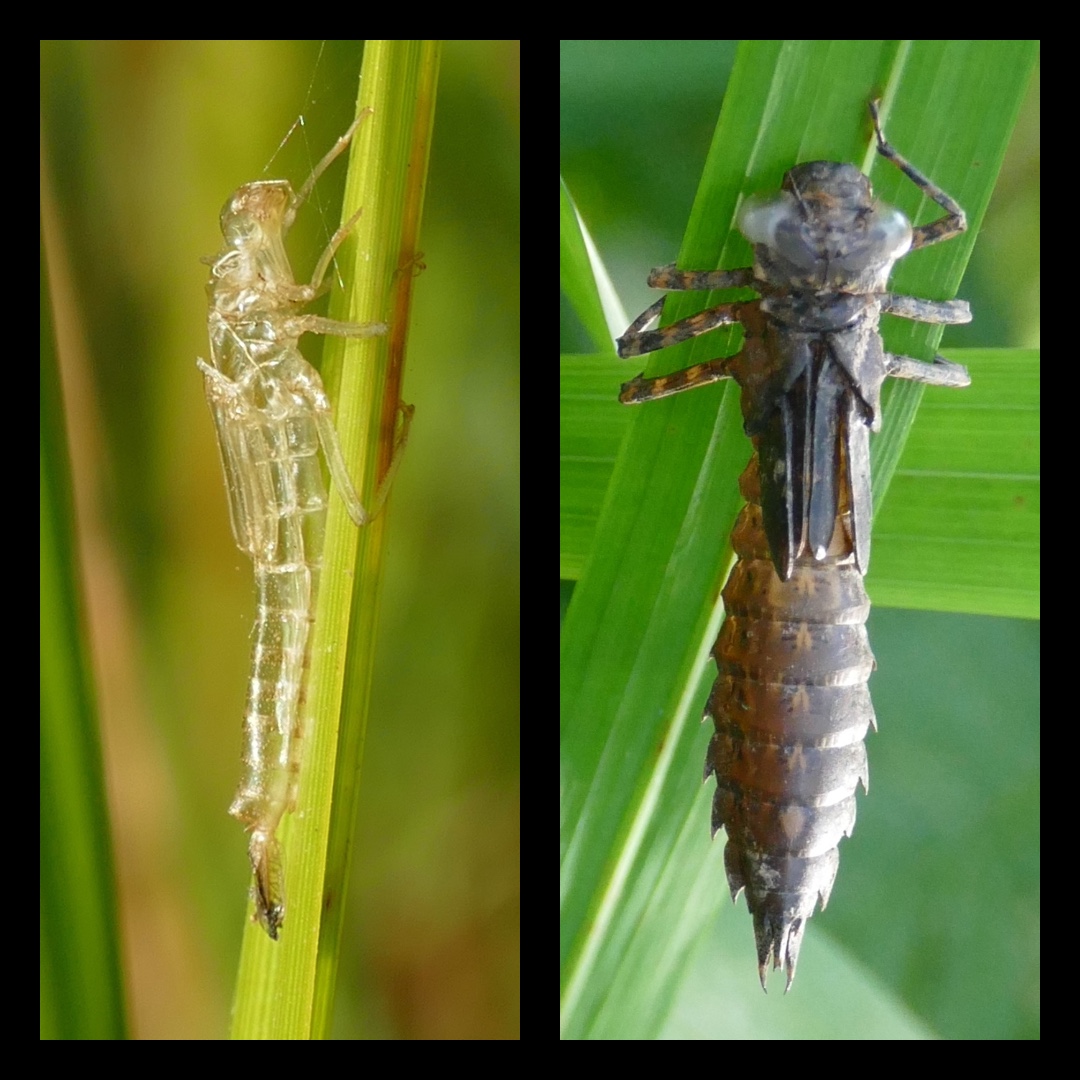
- Larval stage only – damselfly larvae have 3 “feather-like” appendages (called procts), which are actually their breathing apparatus, sticking out of the tip of their abdomen (see Fig. 2).
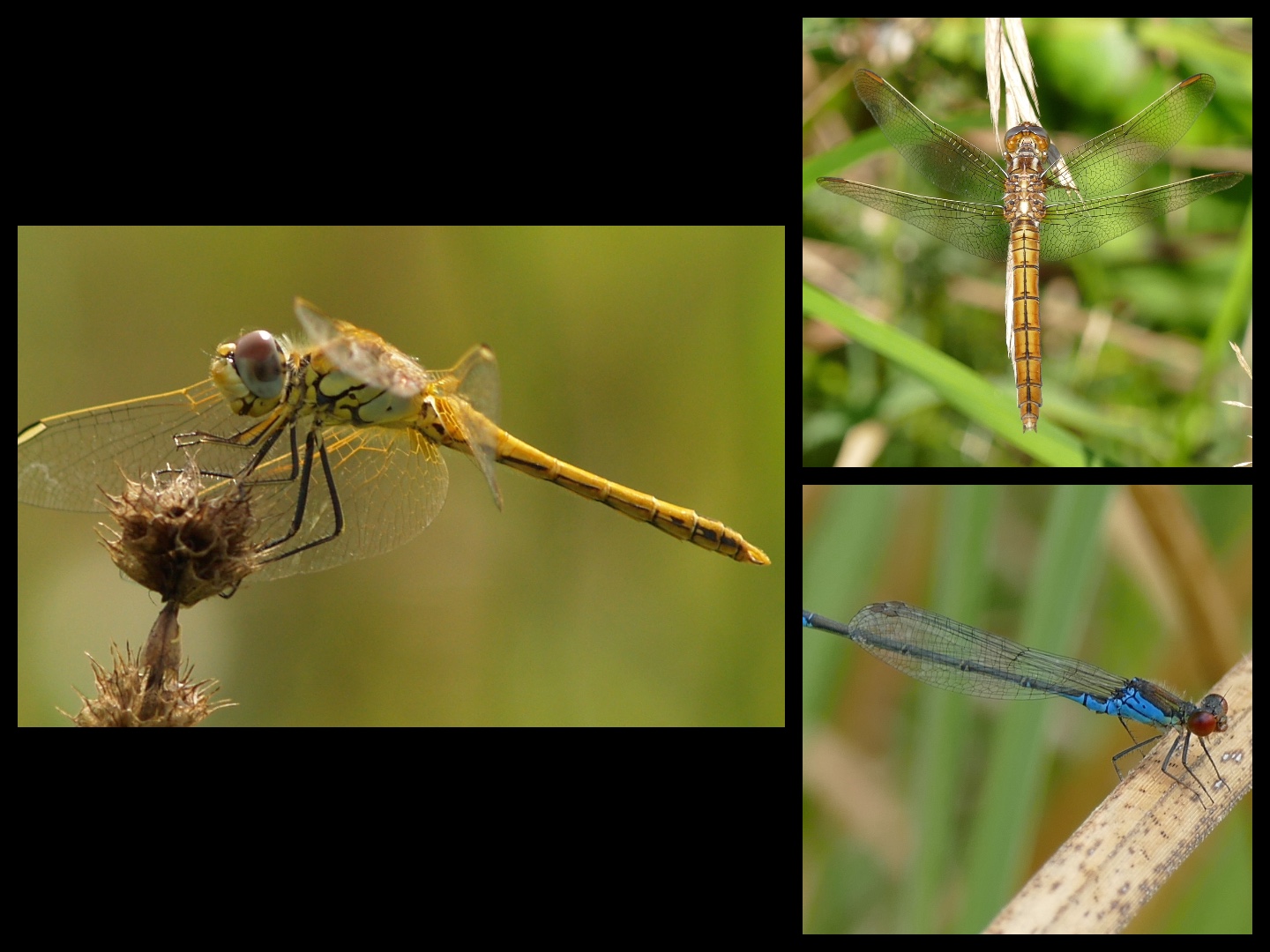
- Eye placement – during the imago stage, the eyes are placed differently on the head, with dragonflies having eyes that are placed close together on the head, often touching, and damselflies having each eye quite distant and separate from the other (Fig. 3).
- Wings at rest – when at rest, dragonflies hold their wings spread out from their body, whereas most damselflies fold their wings in along their abdomen. This can make damselflies very difficult to spot when at rest (Fig. 4).

There are of course exceptions, as was also the case in the Lepidotera post, to the statements above.
- Dragonflies in the Gomphidae family (clubtails, pincertails and hooktails) do have a noticeable space between their eyes, see Fig. 1. But their wings are always held open at rest.
- Damselflies in the Lestidae family (spreadwings) hold their wings … spread out … at rest. The nameplate states it. Though their eyes are clearly far apart. One interesting characteristic about Lestidae is that some place their eggs in plant tissue (e.g., under tree bark), well out of the water.
Conclusion
Damselflies and dragonflies are not that difficult to differentiate, but maybe reading the above has shown you that there are many subtle variations that you can take into account when observing nature.
Finally, it is often stated that dragonflies are good bioindicators of the health of an ecosystem. I was going to write a paragraph on just what makes them so useful, but as I was writing it I felt I was adding too much extra to an already information-loaded post. I will copy/paste that piece into a future Nature 101 post on Citizen Science or Ecosystem Monitoring … stay tuned.
Again, feel free to ask any questions. Up next in the series will be something on Biogeography or Phenology (cycles in nature), not sure which yet.
 Searching for Cullum's Bee