Introduction
The year was 2015 and it was one of those chance meetings. Something flew by, landed on a desiccated bracken leaf for a few seconds and then flew off. In those split seconds I was able to wrestle with a camera I was not familiar with (my partner’s) aim it where I thought that something had landed and take one, single, photo. I didn’t really know how to use the camera, so it was not until I’d uploaded the picture to my computer that I could see I’d taken a reasonable picture of a dragonfly … back in 2015 I was new to all of this so had no idea which species it might be and with no books on the subject searched internet … with little success. I posted the picture to Observation.org and then went to the Dutch forum the site has to ask is anyone might know what I’d taken a picture of. They quickly helped me out there, as it was quite easy to identify … if you know what to look for … but it still did not dawn on me just what it meant.

I had slowly been scouring the internet on PDFs, articles, etc. for species on insect and animal that were present in either Cantabria or the general region of northern Spain. I’d also check the IUCN Red List to see if I could find anything there.
A little over a year later, during a visit to one of my favourite parks to spot wildlife, I was walking back to the car with my partner and our kids, and something zipped by us and landed in front of us on the path. I took my (new) camera and we all stood very still while I took a few pictures, as we inched closer it flew off. Again, I had a hunch it was something interesting … back at home I saw that it was a female of the same species I’d seen a year earlier …
Orange-spotted Emerald
The family affiliation of Oxygastra curtisii (Dale, 1834) – Orange-Spotted Emerald in English – is uncertain but it does fall under Anisoptera, which is a suborder of Odonata that includes all true dragonflies (as opposed to damselflies – Zygoptera). So, it is a bit of a unique species, although it does look a bit like Somatochlora (Striped Emeralds) and Cordulia (Downy Emeralds) – both of which do not really occur here on the Iberian Peninsula. On top of that, the Orange-Spotted Emerald is only found in south-western Europe and small populations in Morocco (Northern Africa).
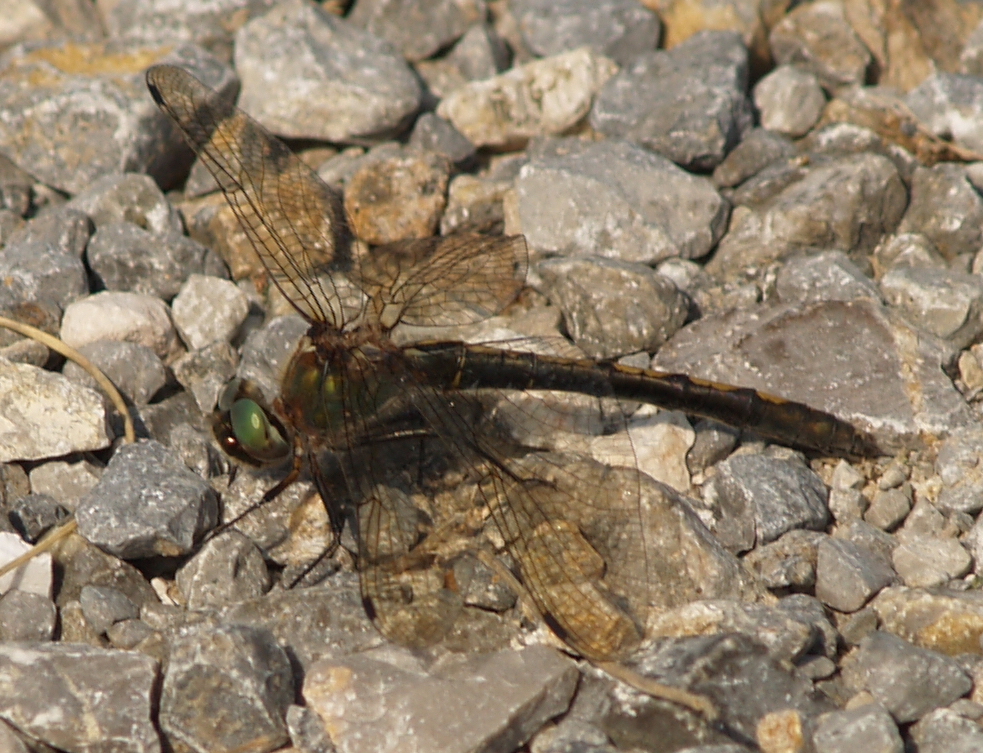
It needs slow moving rivers to breed in, which does fit this area of Cantabria where the rivers have calmed down a bit on their way to the Cantabrian Sea after having rushed down the mountains nearby. But the waters need to be really, really clean for it to have a chance to survive and until the early 2000s the factories were not always focused on dumping clean water into the rivers here. This has changed and improvements have been monitored by local organisations here, so who knows, we might start seeing an increase in sightings. It still remains incredibly rare here in Cantabria and I have tried to spot another, but to no avail so far …
However, the IUCN Red List classifies the species as Near Threatened NT and that assessment is probably right on the money. It is also listed as a protected species in Spain.
Our Article
So, the observations were so interesting we, when I was still part of Proyecto Lepides (organisation now defunct), decided to send a scientific article to a reputable publication here in Spain, the Boletin Sociedad de Entomologia de Aragon (or SEA). Jorge Garzón wrote it in Spanish after I sent him an English version of the events. He dressed the text up a bit so that it was all a bit more official, as I’d never done something like it before. I’m still super proud of it and I see it as part of the foundation to help justify all the time I’ve spent out in nature, observing, having fun … there’s nothing like a little recognition for your work … now if I could only publish more articles … hmm … (stay tuned).
Further Reading
- Klass-Douwe B. Dijkstra, Asmus Schröter & Richard Lweington (illus.). Field Guide to the Dragonflies of Britain & Europe – 2nd edition. 2020. Bloomsbury, 336 pp. – Pretty much the go-to guide at the moment. Pretty stunning book.
- Christophe Brochard, Dick Groenendijk, Ewoud van der Ploeg, Tim Termaat. Fotogids van Larvenhuidjes van Libellen – 2e druk. 2016. KNNV Uitgeverij. 320 pp. – In Dutch but great pictures of the skins (exuvie) Odonata leave behind.
- Christophe Brochard, Ewoud van der Ploeg. Fotogids Larven van Libellen. 2014. KNNV Uitgeverij. 236 pp. – Same as the above, also in Dutch, but then of living larva of Odonata. Again, stunning photos.
- My SEA article that I wrote together with Jorge Garzón.
- A list of sightings in our area on our (now defunct) project page of Proyecto Lepides on Observation.org.
 Searching for Cullum's Bee