Butterfly Bulletin – Duke of Burgundy – Hamearis lucina (Linnaeus, 1758)

Introduction

Now is the time so see them fly. The Duke of Burgundy is a species I’ve been looking for over the past 5-6 years and have struggled to find it. Going back to 2010, there are only 1-2 annual sightings of this species in the region. When I say region, I mean the area we had identified for Proyecto Lepides, which included all of Cantabria, parts of Asturias and País Vasco, as well as a thin strip of northern León, Palencia and Burgos.

In Cantabria I’ve not had any success, even though it is possible. So low and behold my surprise when out on a hike last weekend (June 1st) with the boys and some friends, I snap a rushed photo of a butterfly and only realise when I return home that the photo was of the all elusive Duke of Burgundy … reflecting on the day I’m sure I saw more flying about, but I thought it was some species of fritillary, a little faded. I was mainly rushing between calls from the kids to come help identify a snake (Vipera seoanei), an orchid (Neotinea ustulata) or any multitude of flowers, butterflies and insects out and about. There was little time to crouch in a sunny spot and watch the butterflies bob and weave about, waiting on little blues to land and show me the underside of their wings, or big brown ones to flatten against the warm rocks … ah well, there will be more opportunities to document the Duke. The key thing was that it was a great day out with friends and family … “best hike ever, thanks for taking me on it” was a comment from one of the friends, I could not have asked for more.

Duke of Burgundy

The Duke of Burgundy (Hamearis lucina) is unique within European butterflies, as it is the only one in the Riodinidae (metalmark) family here. Most species in the family live in tropical America and in the tropics of Africa and Asia, not quite the landscape you think of when you see the picture below (Fig. 1).

Fig. 1 – Looking down (in a southeast direction) the gorge made by the Río de Covalagua. In the clearings between the trees is where we spotted the Duke of Burgundy. Pomar de Valdivia, Palencia, 30TVN03. 01.xi.24.

Technically, I was not in Cantabria that weekend, but in Palencia, a kilometre or two from the border with Cantabria … which is actually quite a spectacular area, but I’ll feature it as a future Local Hotspot post on the Páramo de Covalagua (you can translate páramo as moor in English).

Anyway, Hamearis lucina feeds on Primula sp. (such as primrose, Primula vulgaris), which is quite abundant in the area where we live. However, as always, it comes down to the ecosystem, environment and microclimate of an area. So, here in northern Spain the Duke of Burgundy can be found in the hilly, mountainous areas with native, scrubby woodland.

Fig. 2 Hamearis lucina / Duke of Burgundy. Pomar de Valdivia, Palencia, 30TVN03. 01.xi.24.

The butterfly flies quite early in the season in May and June, which might be a reason for the very low numbers of observations because the influx of tourists (nature enthusiasts from abroad who would be recording their nature sightings) has not yet begun … well, the area where Hamearis lucina flies is not that touristic anyway. I spotted the butterfly around 12.30 in the afternoon and, outside of our little group, there was no one there. We did come across some people walking their dogs later, but numbers remained low.
I guess this highlights a limitation of citizen science observation sites like Observation.org … the numbers of observations of a species are related to the number of users recording their observations in a certain location at a certain time. Only through the likes of butterfly monitoring schemes do you really get good insight into how abundant a species is.
All that said, Hamearis lucina remains a rare sighting in the region, even where the butterfly is more common (central Europe) it flies in low numbers.

Conclusion

I’ve not gone into detail covering the actual insect and meandered along talking about nature observations etc. but I think that is because I didn’t spend much time observing the Duke of Burgundy as it flew around. Does it fly in a determined manner like a Boloria dia (I thought that might be the species I’d taken a picture of) or flop around like a Wood White (Leptidea sp.)? Does it fiercely defend its territory, or does it stay calm, soaking in the sun? I can hazard a guess based on what I thought it was, but I’m not certain. And so, I’ve rambled a bit on what is actually a really exciting discovery for me.

Which brings me to my Species Schedule Excel that I first mentioned in 2023’s March/April review. This was one of the highlight species on it. Up next Lycaena helle (Violet Copper), another one I’ve been looking for the past 5-8 years, and which I feel is probably/unfortunately not around anymore in this region … this coming Sunday, I’ll give it a shot.

Further Reading

  • As always, the Proyecto Lepides Observation.org page to keep up to date on current sightings.
  • The list of the butterfly books I own.
  • The UK’s Butterfly Conservation has a good page on it.
  • The species is listed on the IUCN’s Red List, where for all of Europe it falls under Least Concern (LC), but the assessment for Europe dates from 2009 with the population trend decreasing at that time. I cannot imagine it has gotten any better.
Butterfly Bulletin – Duke of Burgundy – Hamearis lucina (Linnaeus, 1758)

Nature 101 – Base Knowledge – Lepidoptera

Introduction

Today we’ll cover the order of Lepidoptera … In the Nature 101 Naming post we discussed a little bit about where order fits into the taxonomy picture. Basically, order covers a whole group of animals/insects/plants/etc. that have fairly similar characteristics.

Within the order of Lepidoptera we have both butterflies (Rhopalocera – a clade, or natural group) and moths (Heterocera) … what are common characteristics and what makes them different? Is it the time of day at which they fly or is that more an over-generalisation?

1.0 Common Aspects

There are two key common elements within Lepidoptera:

  1. Scaly wings – Lepidoptera is a term that is derived from Greek … “lepis” meaning scale and “ptera” meaning wing.
  2. The life cycle – this can be split into:

Egglarva (caterpillar) – pupa (cocoon/chrysalis) – imago (butterfly or moth)

1.1 Scales

The closest insects to butterflies and moths are caddisflies, which are part of the order Trichoptera. The main difference is that their wings are covered in hairs (“trich”) and not scales! It can be really tricky to spot the difference. One of the ways to tell is that if you catch a moth in your hand and close it into a fist (don’t crush it!), when you release it you can notice that the palm of your hand is covered in a light dust, those are the scales that have fallen off (been knocked off) the wings while it was fluttering and trying to escape. A caddisfly won’t leave anything behind. But I’d suggest you take good macro photos and then you can sort of see the scales (or not).

1.2 Lifecycle

When it comes to life cycle, most of us only really notice the last stage, that of imago. It is during that stage when we see them fluttering (or zipping, some are amazing fliers) around, looking for a mate or food (nectar from flowers or minerals from mud, or rotting fruit or dog poo). They can have brilliant colours, but even the drab ones can catch our eye as they spring up to defend their sunny patch of woodland.

Eggs are tiny and you must know what you are looking for or spot them in big bunches for some species. So, they generally go unnoticed.

Larvae are either easy to spot or super difficult. Some are bunched by the hundreds is silky nests that look like giant spider webs. Other are brightly coloured. Then there are caterpillars that look like twigs or are within parts of a plant.

Then there are pupae … again something that is less common to see … most tend to be well camouflaged and hidden; some are even underground. But I guess that should be self-evident … the two life stages at which they are most vulnerable (egg and pupa – cannot do much against attackers) they are hidden and least noticeable.

There’s one area I want to touch upon but not really go into too deep because buy can it get detailed … but basically each moth or butterfly is associated with a plant or group of plants. This is because the imago will lay an egg on a specific plant so that when it hatches the larva has plenty of food that it can eat straight away. No use laying an egg on a blade of grass if the caterpillar is only interested in eating cabbage leaves. This plant is called a larval host plant (LHP), and this is super critical in the life of a moth or butterfly … either it can be labelled a pest if the LHP happens to be a plant us humans rely on for food (or really like). Or the moth/butterfly can get itself into a really tricky situation (nature conservation-wise) if that LHP happens to become scarce (think climate change or humans changing the landscape (e.g., drying out marshy areas)).

What this means is that the average moth or butterfly you see is probably a generalist regarding LHP (so can lay eggs on lots of different types of plants) or feeds on plants we do not value much (e.g., nettles). Therefore, if you really want to see different types of Lepidoptera it often means going to very specific ecosystems … which can be used as the basis for an adventure …

2.0 Differentiating Aspect

Before I go into the one key differentiating factor, first the following:

  • Not all Lepidoptera can fly in the imago stage. There are several moth species (in Europe) where the female is basically wingless (she has little stubs). Males find her (from quite far away) through a pheromone she emits. She just nestles tightly against the tree’s bark waiting for the males to figure out how to find her.
  • Butterflies fly by day but not all moths fly at night. Or in other words … there are day-flying moths. Quite a few actually, so no, the time of day is not always accurate. That said, a moth trap (a light trap emitting UV light) set out during the night is still the best way to see large numbers of moths.

So, what is that key differentiating factor? … if you know Greek you might have guessed by the name of their clades …

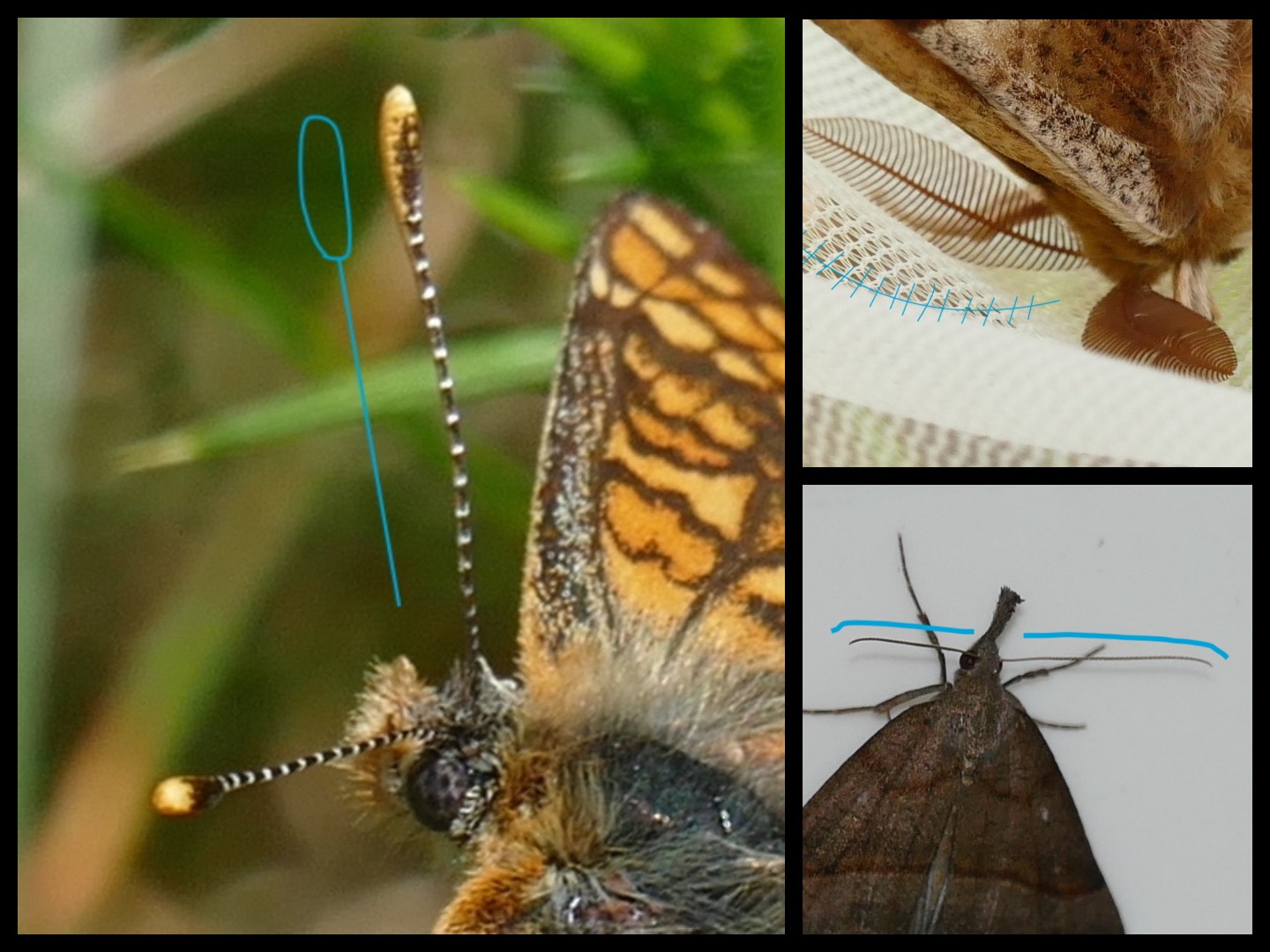
Butterflies have little clubs at the end of their antenna, whereas moths have straight or feathery antenna (see Fig. 1).

Three types of antenna for Lepidoptera.
Fig. 1Euphydryas aurinia (left), Rionansa, 17.vi.18 (butterfly with a club antenna); Aglia tau (top right), Valdáliga, 05.iv.19 (moth with a feathery antenna – males fly around during the day); Hypena proboscidalis (bottom right), Cabezón de la Sal, 15.x.21 (moth with a straight antenna – it came to my light trap at night).

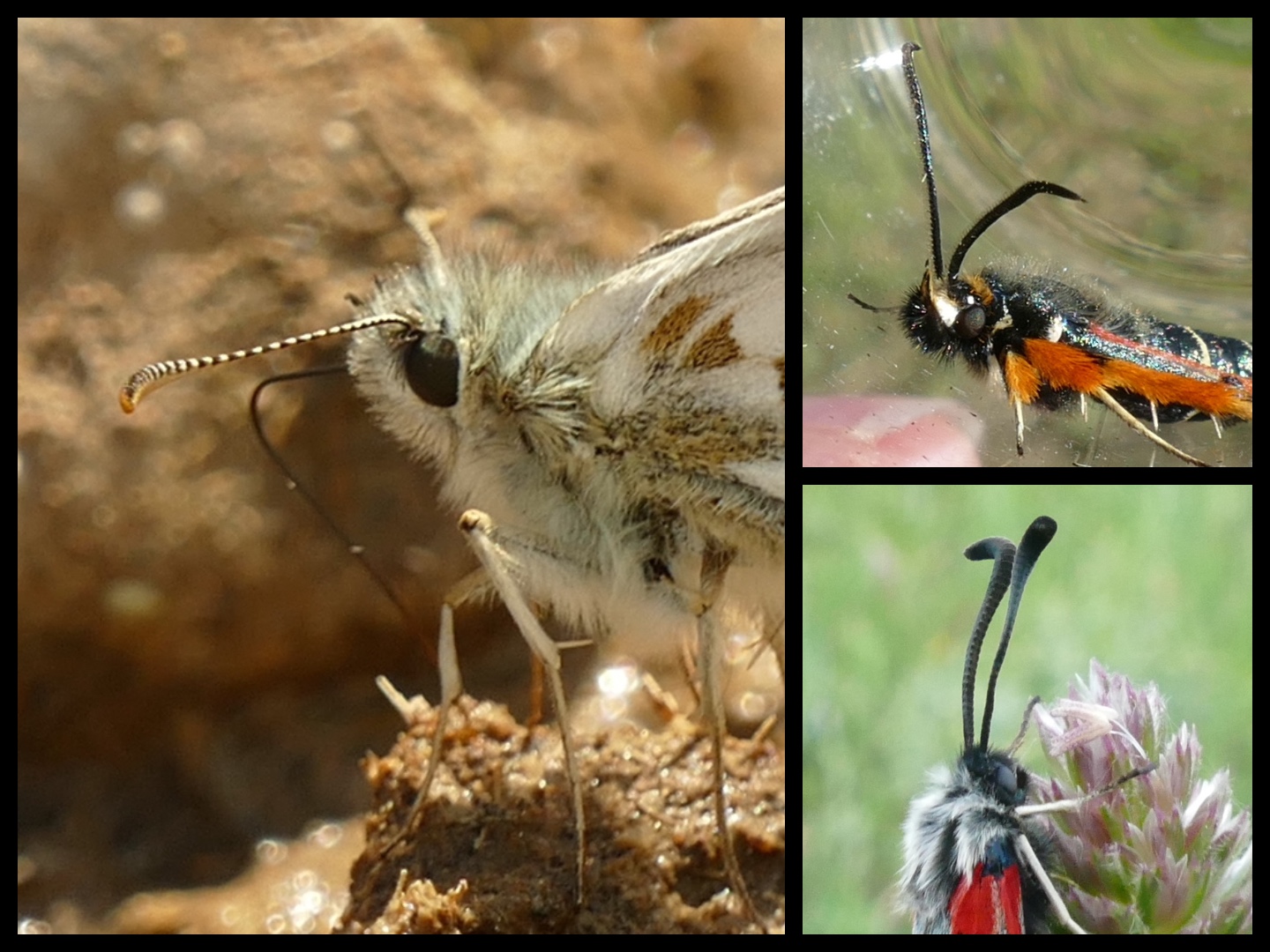
Now, as you might expect, it is not all as crystal clear as that (when is it ever?) … there are moths whose antenna look “clubby” in shape … examples are clearwing moths (Sesiidae) and burnet moths (Zygaenidae), both of which fly by day. There are also butterflies that have antenna that look less “clubby” in shape, such as skippers (Hesperiidae). (Fig. 2)

Fig. 2Pyrgus armoricanus (left), Valdeprado del Río, 08.v.21 (a butterfly with fairly flat antenna); Pyropteron chrysidiformis (top right), Camargo, 07.vi.17 (a beautiful dayflying moth from the Sesiidae family); Zygaena rhadamanthus (bottom right), Valdeprado del Río, 06.vi.18 (another stunning dayflying moth with chunky antenna).

Conclusion

Well, I hope this has been informative. Butterflies have been the insect that help draw me into nature observation. There is so much more I could cover, like flight generations etc. but that would make this post too long. I wanted to keep the post relatively short and not overwhelm the reader with too much (new) information in one go.

The next Nature 101 will probably cover Odonata, another favourite of mine.

If you have any questions, please feel free to ask I can either answer them below or decide to dedicate another Nature 101 to it if the topic is extensive (e.g., migration, lifecycles etc.).

Nature 101 – Base Knowledge – Lepidoptera

Book Club – Books on Moths

I’ve decided to move the Book Club posts to Fridays … they might not drop each week, as there is only so much I can read. This will allow me to highlight species and excursions etc. on Tuesdays each week, there is a lot more I want to cover there.

Just like the other Book Club entry where I discuss reference books on butterflies, this one is on moths (Lepidoptera). Now, I have nowhere near the same number of books on moths as I do on butterflies, but still I think it might be interesting none-the-less … so without further ado …

General

  • Sterling, Phil, Mark Parsons & Richard Lewington (illus.) – Field Guide to the Micro Moths of Great Britain and Ireland – 2012 (reprint 2015) – Bloomsbury – 416 pp. – Great companion piece to the above below, they go together really. Again, this will cover a lot of what you can find in Cantabria, but because these moths are so much more difficult/complex to ID, care does need to be taken when doing so. A must-buy for those interested in moths. Just excellent.
  • Waring, Paul, Martin Townsend & Richard Lewington (illus.) – Field Guide to the Moths of Great Britain and Ireland – 2nd edition – 2009 (reprint 2015) – Bloomsbury – 444 pp. – An excellent guide for macro moths (the “larger” species) and even in Cantabria it covers most of what you’ll find here (we have a similar climate to the UK). The more south you go and the higher the altitude (e.g., Picos de Europa) is where you’ll find the most gaps. Still, great to have and a must-buy if you want to start an interest in moths. Stunning book.

Spain

  • Redondo, Víctor, Javier Gastón & Juan Carlos Vicente – Las Mariposas de España Peninsular: Manual ilustrado de la especies diurnas y nocturnas – 3a edición – 2019 – Prames – 464 pp. – In Spanish and it includes butterflies, but it does not include micro moths. All pictures are of collection specimens with their wings spread, which makes it a bit weird because that is not how living specimens usually rest (wings open etc.), although some families do. Very basic distribution information. However, it does a decent job of covering most, if not all, the species present in peninsular Spain. This means that it has some of the warmer climate species that my other books do not mention. Okay I guess but only really needed if you are going south of the area I live (Cantabrian mountains).
  • Sesma, José Manuel, Juan Ramón Córdoba, Luis Carlos Herrero, Óscar Ventura & Diego Gil Tapetado – Guía de indentificación de las gitanillas (Zygaena) ibéricas – 2019 – Asociación Fotografía y Biodiversidad – 84 pp. – This thin book covers the distribution etc. of the 22 Burnet species found in Spain. Pretty informative with lots of photos, but still makes identification of some species difficult without dissection etc. Much of the distribution data is based on citizen science websites. I’d classify this book under nice-to-have for the completionist.
    However, it is also a bit (understatement) frustrating because the book is labelled as “Volume 1” on the cover … so you’d think there would be more publications on other families etc. by the publisher … but so far no. Also, the publisher’s website is not good, or up-to-date and the main source of observations (biodiversidadvirtual.org – the publisher runs this site) is massively frustrating to use … so were this the business world this would fail spectacularly … If I owned a citizen science website/company (or was a millionaire with a passion for nature), I’d buy up the site, and everything associated with it, and consolidate all the data into a decent repository (e.g., Observation.org), a merger as it were … not to detract from the amazing work done by the publisher/site (volunteers, experts, etc. etc.) but it basically ticks all the boxes of what you can do wrong … if you want the general public to care, and be interested in nature, it needs to be a lot, and I mean a lot, more accessible (modern phone app etc.) … in 2023 it has to be much better and it should be with all the innovative technology at hand (using AI to help with IDing species, detailed mapping of species in Spain (i.e., where spieces have been recorded and where they might be found if we take ecosystem requirements into consideration) etc. etc.) … rant over.

Specific Regions in the Cantabrian Mountains (my area of interest)

  • Sanz Román, Pablo & Juan Manuel Marcos Gómez – Mariposas y Ecosistemas Cántabros – 2004 – Cantabria Tradicional S.L. – 196 pp. – I’ve not had this book too long, but I’ve read parts of it many times. It is in Spanish, has photos and maps of some moth (and most butterfly) species in Cantabria. Long since out of print (the publisher went bankrupt years ago) and hard to get. The selection of moths is strange, some are day-flying but not all are covered in the book. Then there are some night-flying moths, but only a select few. There is also extensive information on larval host plants (LHP) for the species in the book, Yes, interesting species (some mistakes there), but all quite random. Not really useful for moths, a bit of an oddity. Only for completionists.

Comments

Now … the moth book publishing world is massive … you can get huge, expensive tomes in multiple volumes on one moth family of in Europe (Palearctic region). I do not have the space or money for these at present, but boy can you go down the rabbit hole in this area. I’ve also noticed that people interested in moths are a bit special/weird but in a good way. Once you start with this hobby it can get quite carried away, you need a special light trap etc. etc. With the above list I’ve only just grazed the surface.

For information on specific regions in Spain you’ll have to consult scientific publications. There are extensive lists of moths for Palencia and other regions in the north.

However, the best source to help ID your moth pictures is through Facebook groups. There is a specific one for Spanish moths (in english) that is great and really helpful … sorta (some people there can be a bit … scientific, lets say).

Book Club – Books on Moths

Moth Matters – Valeria jaspidea (Villers, 1789)

Introduction

So, I’ve set out the moth trap on the balcony a couple of nights so far in 2023 … zero, zilch, no luck. As I stated in a previous post, the street lighting has been changed to LED … great for the environment when it concerns energy usage but poor when it comes to light polution. Unfortunately, I’ve not had to time to set the trap in a friend’s garden, so the best thing I can do, for the moment, is to write up on some interesting species I’ve managed to see.

However, if all goes well I will set up the trap this evening at a friend’s house and then this weekend I will do it again in Salinas de Pisuerga, Palencia, where another friend lives. I’ve identified a number of species (moths, butterflies and dragonflies) I’d like to see this year, which includes Valeria jaspidea, and put all related data into an Excel sheet. Below is a screenshot of the moth section to give you an indication of what I’ve done. Will add to it as I come across other interesting species.

Overview of interesting moth species to try and see during 2023.
Fig. 1 – Overview of moth species in the Cantabrian mountains that I’d like to see over 2023.

Valeria jaspidea

Valeria jaspidea falls under the Noctuidae family of moths and is quite similar to Valeria oleagina ([Denis & Schiffermüller], 1775). I cannot find the paper that details the difference and if it is widely accepted or not, but Lepiforum (see links below) has them as different, so I’ll keep it at that too. Apparently,Valeria jaspidea occurs in the western part of southern Europe, whereas Valeria oleagina in the eastern part. I also cannot find a map of where the split would be, and if they overlap.

(Ugh … getting used to using this tool again and lost half of the post in trying to update it … oops) The moth can be found throughout the Iberian peninsula, but it is rare. To be honest, with the continual growth of eucalyptus plantations in Cantabria (which dry out suitable habitats) this species looks to need to be ready for a struggle to continue surviving in the region. Also, with the changes in landscape management (farming techniques) this will only add to the struggle they already face.

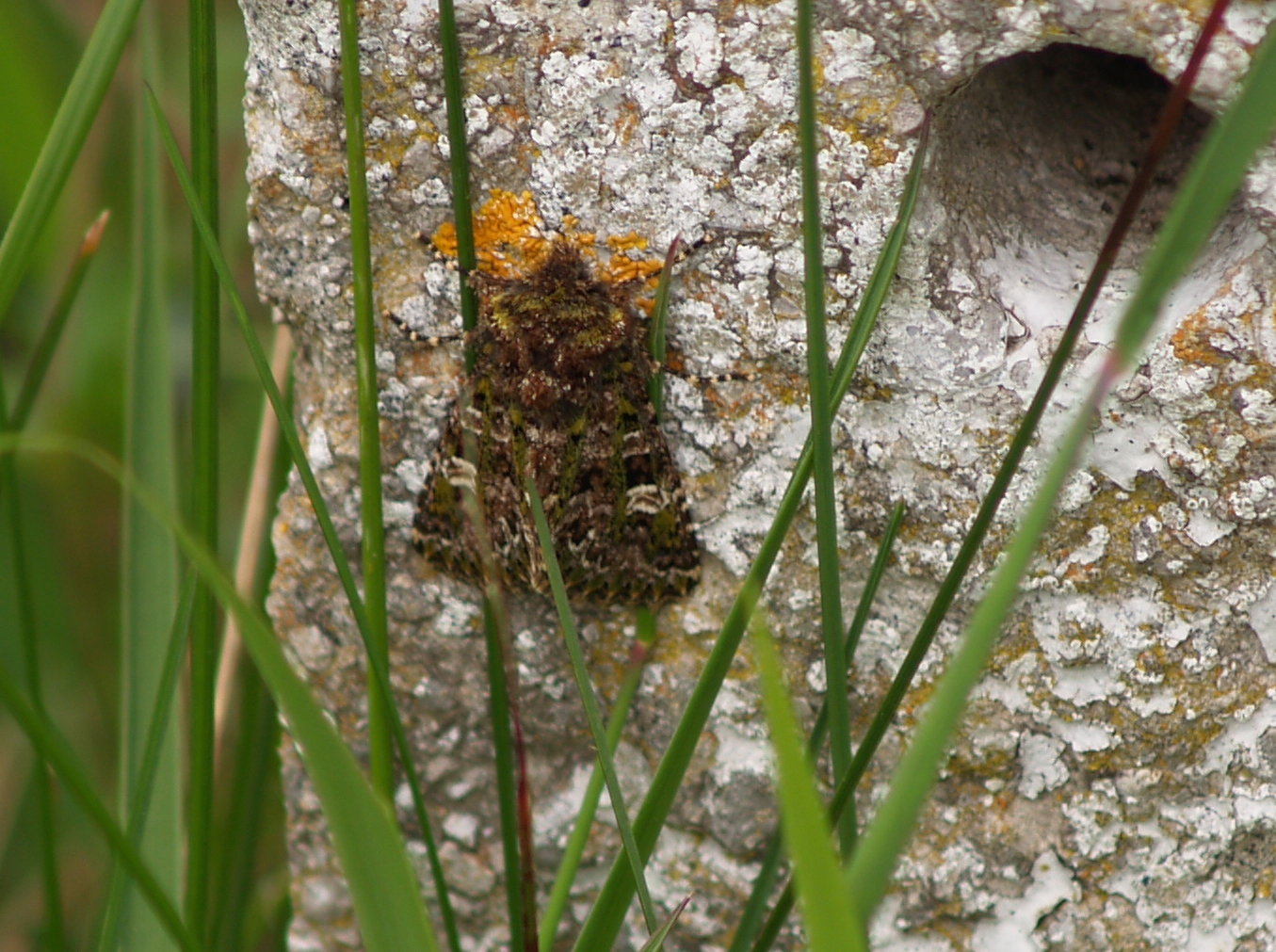
The caterpillars of Valeria jaspidea feed on Prunus spinosa (blackthorn) and also Crataegus sp. (hawthorns). The moths fly from March to May and can often be found at rest at the bottoms of walls and stones. They have these stunning streaks of green that make them look like a moss that might grow on a blackthorn.

A photo of Valeria jaspidea.
Fig. 2Valeria jaspidea, 19.iv.16 – Casar de Periedo (Cabezón de la Sal), Cantabria, 30TVN09.

Further Reading

  • I have written a blog post about the moth resource books I use. It will be published on Friday (30.iii.23) after which you can find it here(will add link).
  • This is a link to a great site called Pyrgus.de that I reference a lot. Excellent information and photos. He hasn’t updated or added Valeria jaspidea yet (not sure why) but the info can be found here under Valeria oleagina.
  • No moth reference list is complete without a link to Lepiforum, an incredibly in-depth site. Here is a link to the moth’s page.
  • All sightings in my region of Spain as recorded through Proyecto Lepides.
  • I actually wrote a blog about walking the transect when I saw this species, see here.
Moth Matters – Valeria jaspidea (Villers, 1789)