Introduction
As I stated in a previous post, butterflies are one of the drivers behind this blog. So, I thought I’d start my Butterfly Bulletin posts off with one of the most spectacular species I managed to see in 2015 … and that I hope to see many more times.
Mid-August I was out with my oldest son, we had gone for a walk (him in the stroller) around his siesta time so that he could have a bit of a rest, the new addition to the family (at that time around 1 month old) was tiring us all out a bit (i.e. lack of sleep) … so I decided to walk Recorrido A of my volunteer walks for Proyecto Lepides.
With my son snoring away we’d reached the back part of the route, with a south facing hill covered with trees on one side of the road and fields on the other. I was just rounding onto that stretch of paved road when out of the corner of my eye I noticed something dark and big flopping around in the field to my right. I pushed the stroller to the bank-side (son facing the field in case he woke up), put on the brakes and dived into the field, camera at the ready …
Dryad
A few quick shots of the camera and I knew I was onto something interesting … while going through my Tolman/Lewington guide (Collins, 2009) during the previous winter months, Minois dryas had been one of the species that I’d marked as hoping to see. I had no idea that this was a fairly rare species (not that clear in the field guide) in this part of its range. In general, the Dryad can be found across a band stretching across the central area of Europe and further on to Japan even. There is a slight sliver of its range that hugs the northern coast of Spain from País Vasco to Asturias (the Cantabrian Mountains). The Dryad can be found between 100-1600m in grassy and bushy margins of mixed deciduous woodland, often in damp places … the field I found her in (turned out to be a female) was thus the perfect habitat, all be it slightly below the altitude range (by about 10m).
When I spotted the butterfly, it was flying just above the grass, not in any determined fashion, but more floppily. As I entered the field it settled down in the grass (my first photos were from a side angle, see below), I slowly circled around a bit so that I could get a picture of the fully open wings. She just sat there, relaxed. I was able to creep a bit closer, but I almost always remain at a distance so no to disturb the butterfly, I did so here too. When I was satisfied I’d taken enough photos I headed back to the stroller. As I walked off I glanced back several times and she remained where she was.
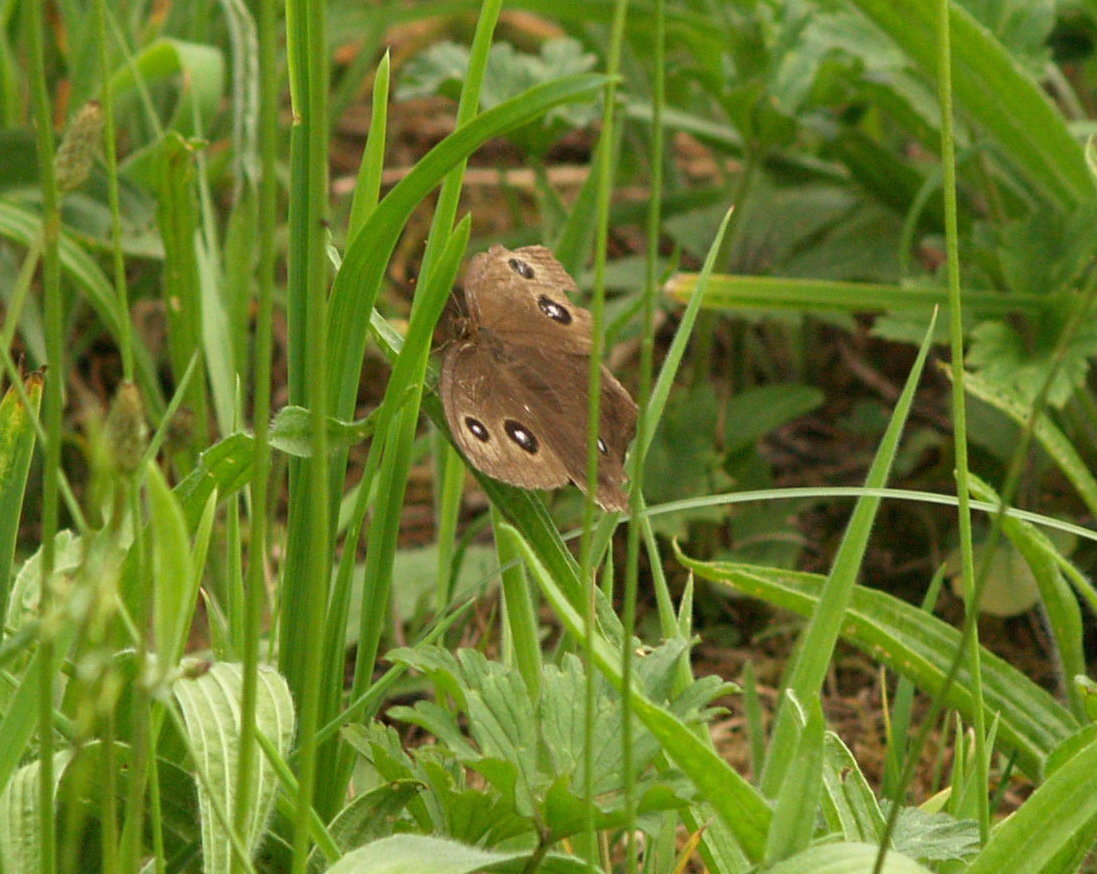
Minois dryas has big oceli on the fore and hind wings that have a beautiful tings of blue to them. The one I saw was a bit “beaten up” with arts of her wings missing etc. and so the blue was not as vibrant anymore, still a great sighting and one that will stay with me for quite a while. The female is larger than the male and also has colours that are not as vibrant in general.
It was only when I was uploading the photos and data at home that I realised how special the sighting had been in a general sense.
A few months later, I went to a small exhibition, in a nearby village, on butterfly photography. The museum in which it was held also has some cabinets filled with pinned butterflies. These have been donated by a local lepidopterist. There are many tropical species but also regional species. There were around 4-5 examples of Dryad pinned, each with a tag noting year and region … they were all from the early 2000s (maybe a couple from the 1990s or earlier, cannot remember exactly). The location for all was Novales, a village/area on the other side of the large hill (extended hilly area) to the north …
Will I see this species again in the future? There’s a reasonable chance … maybe she laid eggs somewhere nearby … but, I probably won’t be as lucky as this anymore and will have to put in a lot more effort …

Oh, this butterfly is not on any red list in Spain, but it should be, as it seems to be fast disappearing due to changes in agricultural techniques.
Further Reading
– A PDF with specific distributions of various Satyrinae in Spain, Minois dryas is in that family. In Spanish but easy to understand for non-Spanish speakers.
– A list of my sightings of this butterfly on Observation.org.
– All butterfly sightings in Spain as recorded through Proyecto Lepides.
 Searching for Cullum's Bee