Introducing the Data Dwellers

Small Observations, Big Possibilities

Sometimes a bumblebee lands on a flower. Sometimes it lands on a map.

Over the past year there have been a number of significant changes in my life, which include a move and diving into a new area of knowledge; Data Analytics. However, one constant has been nature observation. If you decide to take the plunge with me, I’d like to slowly start incorporating these aspects into a new series —one part data, one part nature observation. This series, Data Dwellers, is about the quiet footprints organisms leave across landscapes, and how every recorded sighting builds the bigger picture. Whether it’s a beetle in a field, a dragonfly over a pond, or a butterfly zigzagging through nettles—these aren’t just wildlife moments. They’re coordinates, timestamps, and opportunities.

I’ll be keeping this first entry light, but here’s what you can expect from future posts:

  • Mini-Profiles: Exploring species you might stumble upon, grounded in data and ecology.
    • Data Deep Dives: Looking at patterns, gaps, and what citizen-collected data can reveal about regional biodiversity.
    • Behind the Numbers: Explaining how digital ecosystems (like Observation.org or GBIF) track nature—with all its quirks and blind spots.

Each entry will be tailored to the species I’ll cover, some might benefit with a deep dive into the data available, whereas others will explore issues found within the data available. Furthermore, each entry will compliment posts in the other regular series such as Fly Facts, Butterfly Bulletin, Odonata Update, and more.

1.0 First Glimpse: Bombus inexspectatus in Spain

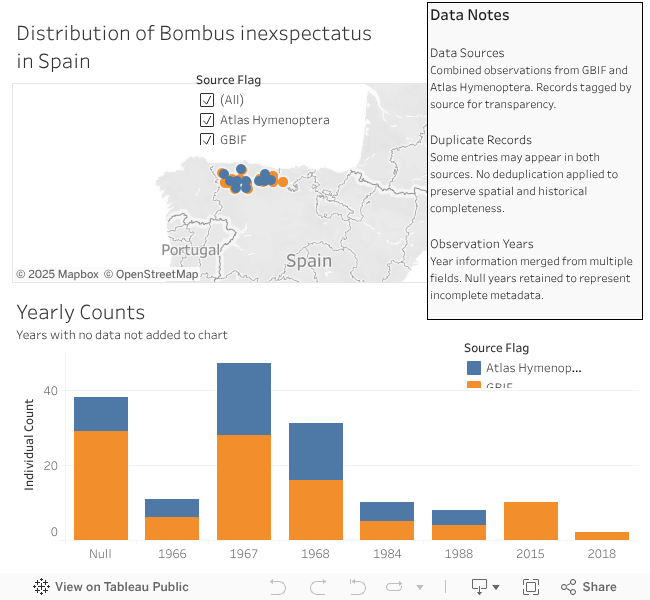
Here’s a simple visual example of what I mean. I’ve built a dashboard that combines observations of Bombus inexspectatus—a rare bumblebee—from two public datasets. It’s not flashy, but it starts to tell a story and it provides us a basis for excursions and goals we have to see if we can observe the species ourselves out in the wild.

I‘ve not yet been able to embed the dashboard here (yet), but below is an image with a link to that dashboard. The dashboard is interactive and will update by itself if I make any changes to it in the future. Feel free to zoom in on anything that might interest you, check or uncheck boxes, hover over observations or bars in the bar chart for more information.
Bombus_inexspectatus Dashboard

Fig 1. – Link to a Tableau Dashboard of Bombus inexspectatus observations. Data from Atlas Hymenoptera and GBIF. Click on the image to visit the dashboard in a new tab.

Dashboard Notes

  • Mapped Observations: You’ll see locations pulled from GBIF and Atlas Hymenoptera—both great resources with different strengths. I’ll post links below.
  • Yearly Counts: Even sparse data can show patterns (or silences). Why the jump in 2015? Why nothing recent? Questions like these guide deeper research.
  • Data Gaps: Some records are missing timestamps or counts. I’ve kept these in to reflect the reality of citizen science—messy, imperfect, but meaningful.

I’ll cover these questions in future Data Dwellers posts on specific species, as well as in a Data Dwellers post where I’ll cover my work methodology.

2.0 Why This Matters

In a way, species like Bombus inexspectatus are digital ghosts. We know they exist—or existed—but they flicker in and out of view depending on where people look, what they record, and how they choose to share it. This is where Data Dwellers finds its pulse: in the tension between the known, the visible, and the speculative.

As I mentioend above, I’ll be posting new entries under this series—sometimes short snapshots, other times deeper dives. And if something sparks curiosity along the way, feel free to reach out or leave a comment. Nature isn’t just for scientists, and neither is data.

3.0 Links

Each time I create a new dashboard for a species, I’ll be using various sources. One will usually be GBIF, which requires that you provide a link to the data used.

Atlas Hymenoptera – Great source on bees in Europe. The link it to the species-specific page.

GBIF – An open access database with biodiversity information. See here the citation you are required to add:

Creuwels J (2017). Naturalis Biodiversity Center (NL) – Museum collection digitized at storage unit level. Naturalis Biodiversity Center. Occurrence dataset https://doi.org/10.15468/17e8en accessed via GBIF.org on 2025-07-14.

Praz C, Müller A, Hermann M, Neumeyer-Funk R, Bénon D, Amiet F (2025). Swiss National Apoidea Databank. Version 1.7. Swiss National Biodiversity Data and Information Centres – infospecies.ch. Occurrence dataset https://doi.org/10.15468/ksfmzj accessed via GBIF.org on 2025-07-14.

Bakker F, Creuwels J (2025). Naturalis Biodiversity Center (NL) – Hymenoptera. Naturalis Biodiversity Center. Occurrence dataset https://doi.org/10.15468/jgywgc accessed via GBIF.org on 2025-07-14.

Inventaire National du Patrimoine Naturel (2020). ATBI Parc national du Mercantour / Parco naturale Alpi Marittime-Jeux de données provenant de l’ATBI dans le Parco Naturale Alpi Marittime (Italie). UMS PatriNat (OFB-CNRS-MNHN), Paris. Occurrence dataset https://doi.org/10.15468/wzwus6 accessed via GBIF.org on 2025-07-14.

Orrell T, Informatics and Data Science Center – Digital Stewardship (2025). NMNH Extant Specimen Records (USNM, US). Version 1.96. National Museum of Natural History, Smithsonian Institution. Occurrence dataset https://doi.org/10.15468/hnhrg3 accessed via GBIF.org on 2025-07-14.

Mañas-Jordá S, Acosta Rivas C R, Ariño Plana A, Baquero Martín E, Bartomeus I, Bonada N, García-Barros E, García-Meseguer A J, García Roselló E, Lobo J M, López Mungira M, López Rodríguez M J, Martínez Menéndez J, Millán Sánchez A, Monserrat V J, Prieto C E, Romo H, Sánchez-Campaña C, Tierno de Figueroa J M, Yela J L, Sánchez-Fernández D, González M, Bonada N (2025). IberArthro: A database compiling taxonomic and distributional data on Ibero-Balearic arthropods. Version 2.4. Department of Ecology and Hydrology. University of Murcia. Occurrence dataset https://doi.org/10.15470/pqq9oc accessed via GBIF.org on 2025-07-14.

Villares J M (2023). Inventario Español de Especies Terrestres (MAGRAMA). Version 1.5. Spanish Ministry for Ecological Transition and Demographic Challenge.

Occurrence dataset https://doi.org/10.15468/f0qd41 accessed via GBIF.org on 2025-07-14.

Introducing the Data Dwellers

Information Overload – Visual Media

Introduction

We’ve had a few posts on butterfly species of late, so I thought I’d mix it up a bit and provide a short overview of some of the YouTube channels I follow that are related to nature. At the end I’ll add some channels that fall under my general interests (i.e. outside of nature).

Will make sure to provide a short comment on all channels and maybe you find something you like as well. Furthermore, there is a theme here for all channels; they usually deliver their message in a relaxed and calm manner, are centred around a learner mindset, and offer a broad range of insights into the topic discussed. So, let’s get started.

New England Forests
Frequency – Very irregular
Average duration – 30-60 minutes.
Comment – A calm voice, interspersed with sounds of nature, provides in-depth knowledge on a multitude of aspects of New England forests. There is a focus on trees and land-use over time, but there are other great series on the life around a pond over the course of a calendar year, amphibians, and more.
I wish this kind of content existed for Cantabria, but hopefully my blog can fill the gap in written format.

Mossy Earth
Frequency – Irregular, used to be bi-weekly.
Average duration – 10-20 minutes.
Comment – An NGO focused on rewildering and restoring natural habitats. They have projects across the globe, from a patch of rainforest in South America to abandoned quarries in Europe. What I enjoy is their documentation and clarity around the work that they do, in depth and thorough. They are not afraid to make mistakes, which makes it all part of a greater learning process. Learning through doing, perfect stuff.
They also have a Field Notes channel that goes into more detail around each project. Not a channel I watch regularly but I have watched the odd video just to get a better idea around how you might structure and set up an organisation/projects that they work on. Interesting insights.

Leave Curious
Frequency – Weekly, fairly regular at the moment.
Average duration – 10-15 minutes.
Comment – I came across this channel through Mossy Earth, as he is part of a number of projects they are doing in the UK and Scotland. Although he details those projects too, he also covers other aspects around rewildering (e.g., his own garden). Even though the channel is UK-centric, you can learn a lot if you want to approach nature in a similar manner around where you live.
Although the opinions given are stronger than the other channels, they are balanced (with a drive to improve our relationship with nature) and provide an opportunity for learning.

Stefano Ianiro
Frequency – Very irregular.
Average duration – 10-20 minutes.
Comment – Canadian wildlife photographer who purchased a piece of land (in Quebec I think) and is restoring it. Stunning images, relaxed atmosphere, and introspective approach create a great platform for the viewer to learn along with him as he rewilders his piece of land.

Other Topics

So here is a quick list of other channels I follow. There are plenty more, but these are the most interesting. Others are gamers (for the kids) like Emongg, and stuff like The Late Show or EV reviews. The following are channels that not everyone might know about but are super interesting.

  • The Late Brake Show – Channel about cars and considering I don’t really like cars/driving this has to be pretty decent for me to watch the regular cadence of videos that drop (around twice a week). Has a great way of informing and teaching viewers about the topics he covers.
  • Wristwatch Revival – More or less biweekly videos of 30+ minutes in length detailing watch restoration. Marshall’s dulcet voice guides the viewer through the whole process. What he does for watch repair is what I hope to do in teaching people about nature.
  • Random Golf Club – Slightly irregular schedule for videos about golf. Not your typical reviews etc. The Breaking 90 series is amazing. Laid back viewing.
  • The Needle Drop – Daily music reviews across all genres. He has various channels. Not that deep into music these days so this helps keep me informed at least a tiny bit. Weekly Track Round-up is a must watch for me, much of the rest I skip.
  • Everything Electric – The “blog” channel linked to the Fully Charged Show (EVs). Can be a bit preachy, but there are often interesting insights into energy. I often listen to the podcast of this show in the car and skip the videos.

Conclusion

Not much to add really. Maybe I’ll add an entry on sites I visit or podcasts I listen too, but those aren’t really nature specific. I’m more into listening to stuff like Freaknomics or The Daily because I want to learn about other things too, such as statistics etc. But for the time being we’re back to nature next week, not sure which one yet, we’ll see how the hike around Bejes goes on Saturday. This past Sunday it was 9C up in the mountains, lots of mist and cloudy, so no butterflies. Still a good day out, hoping to see a bear or wolf (no luck) but I just switch focus to other animals and plants. For the afternoon hike I went a bit down the mountain to walk a trail I’d never been on, yeah that was amazing. Will take the kids on it this summer and then I will see if I can do one of those day reports I did way back …

Information Overload – Visual Media

Butterfly Bulletin – Alcon Blue – Phengaris alcon (Denis & Schiffermüller, 1775)

Introduction

The last post was centred around a chance encounter with a butterfly. I’d not even realised I’d seen it until I got back home and looked at my photos in more detail. Today’s post is about a focused excursion in the hope to see a specific species.

It all starts with setting out a general overview of butterfly species I might come across in Cantabria and listing those all in an Excel. Considering the Alcon Blue is quite a rare species, I then look for scientific articles (PDF format) on the species, which range from a pan-European overview to specific Spanish articles. These documents sit in a neat little folder on my HD and wait for a dreary winter day when I might be inspired to plan some excursions for the warm summer months later in the year …

On that deary day I’ll go through the articles and see if there is more detailed information regarding potential locations where I might find the Alcon Blue. The scarcity of the species means some articles are from the 1960s and 70s (when the province was called Santander, not Cantabria) and come with a short sentence where it was seen. For example, the 1968 source (Agenjo) states “near Herrera de Ibio at 40m”, the problem being that all land around Herrera de Ibio is at least 80m above sea level. We have friends who live in that village, so have made plenty of walks in the country lanes near there and I’ve always kept my eye out for boggy (turbera) areas. There are plenty of those, but I’ve never seen the LHP (larval host plant) at all … I ran into that issue in most other locations I found in documentation. Regarding citizen science web sites, nothing.

So, I had to turn my attention to the LHP (more on that unique relationship below), which I looked up on the citizen science websites (e.g., Observation.org) and I had more luck. From there I turned to Google Maps and scoured potential locations comparing it with what I’ve read in literature, to see how easy it is to get there, some street-view images and so forth.

Then it all came down to waiting for a day, during the butterfly’s flight period, with nice weather (and no other priorities … kids, work, etc.) to head on out, with fingers crossed, to search for the impossible.
All the above led me to the following location (Fig. 1, yes, Cantabria can be stunning).

Cantabrian Coast near San Vicente de la Barquera.
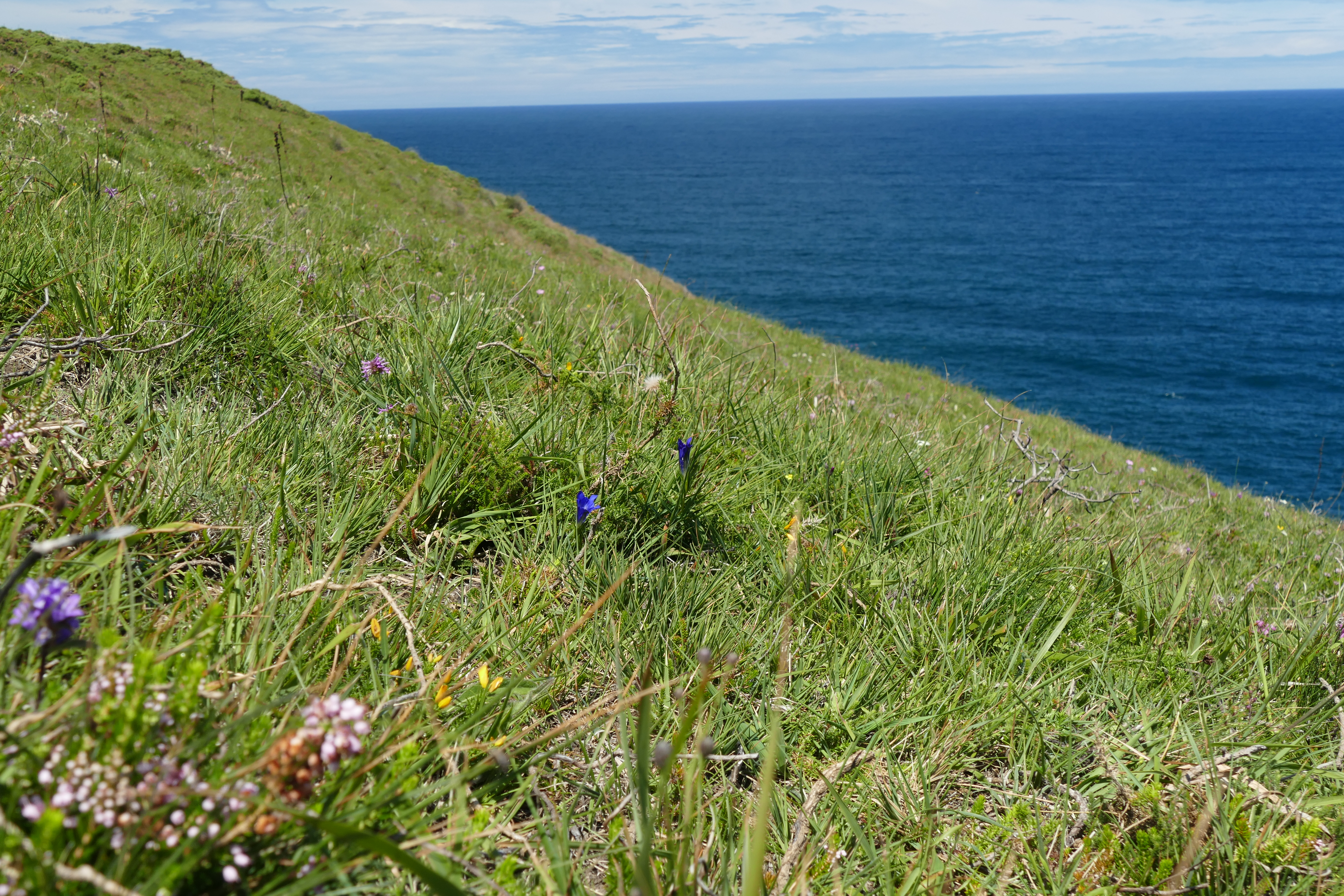
Fig. 1 – The Cantabrian coast, near San Vicente de la Barquera (30TUP80), looking westwards towards Asturias. Notice the traditionally grazed pastures (there is a small group of cows mid left) right up to the cliff edge. Has potential spots to find more small populations of the Alcon Blue. The butterflies discussed below were found in the field behind me. Photo taken 28.vii.23.

The result: moist costal pasture that had continued under traditional grazing methods (cows) and that was assessable via walking path. Phew.

Alcon Blue

The Alcon Blue (Phengaris alcon) is part of a group of butterflies that have an intricate and complicated life cycle. Not only does it need a very specific plant (Gentiana sp.) on which it lays its eggs on or near the flower. It also needs a specific species of ant (Myrmica sp.)!

After the egg hatches, the tiny caterpillar will feed on the plant for a bit, but then it drops to the ground where it starts emitting pheromones (and I think even emits a sound) to attract that specific species of ant. Hopefully, there is an ant wandering around, and when it comes across the caterpillar it thinks that it is an ant larva. Gathering some mates from the ant nest, they drag the caterpillar down into the nest and put it in the nursery with the other larva. There it gets fed by worker ants (via regurgitation) and then goes into the chrysalis stage. When the time comes to emerge, the butterfly high tails it out of the ant nest because as a butterfly it does not emit a pheromone anymore, which means that the ants see it as a hostile entity within the nest. Finally, when the butterfly makes it out, it crawls up a blade of vegetation and pumps its wings full of “blood” to fly off and try to find a mate in the vicinity (it can’t go far because it is so closely linked with the plant and ant).

Male Alcon Blue.
Fig. 2 – Male Alcon Blue (Phengaris alcon). San Vicente de la Barquera, 30TUP80, 38.vii.23. This was just after release, the blue upper sides of his wings are not visible here.

Holy smokes … even with all the above going perfect, there is still so much more that can go wrong, such as the weather, parasites … there is one wasp that exclusively lays its eggs in the chrysalis of the Phengaris alcon, so if the butterfly disappears from a location so will the wasp(!), another link in the chain of super exclusive dependence … anyway, you can see why I just had to find this marvellous little insect …

But it does not stop there … Firstly, Phengaris alcon is often listed as Maculinea alcon in older literature. Nothing too drastic, but it can make searching the internet a bit more complicated.
Then there is debate in scientific circles if Phengaris alcon and Phengaris rebeli are separate species or if P. rebeli is a subspecies of P. alcon. In general, P. rebeli is found at high mountain altitudes (Picos de Europa in Spain) and P. alcon elsewhere. There are many more details around why they should, or should not, be listed as one species but the most important aspect is centred around the IUCN Red List, where P. rebeli is listed as Vulnerable (Vu) and P. alcon as Least Concern (LC), but that is because the latter takes both possible species into account. It is absolutely clear that both should be seen as Vulnerable because it is very easy to wipe out the small colonies of butterfly due to coastal development, or landscape management changes and more. For example, if you see the field where I saw the female and LHP (Fig. 3 and Fig. 1) it needs human intervention through traditional grazing methods at certain times of the year that keeps shrubs at bay, grasses not too long, but the soil quality poor in general (i.e., don’t spray it with fertilizer or manure). This is one of those cases where conservation regulations are not moving fast enough for a species and the only thing that I can do is to publish my findings publicly so that someone can use it to further their conservation cause.

Granted, you could ask yourself why such a demanding species requires conservation effort, but that’s for another blog debate.

This is turning into a long post, and I’ve not even mentioned the day itself … I went to visit the site I’d identified as a good candidate for a population. When I sat down for lunch in a dip in the landscape, sheltered from the wind and in a lovely sun, I noticed a couple of larger than standard blue butterflies flying about. I managed to net one and when I took pictures of it while I had it in a glass container I quickly saw that it might be an Alcon Blue. Double checking my field guide I was overjoyed to find I was correct. I released it, finished lunch and walked a few meters on to an open field where I saw a couple Marsh Gentian (Gentiana pneumonanthe) emerging from the grass (Fig. 3).

Marsh Gentian in field.
Fig 3. – Two Marsh Gentian (Gentiana pneumonanthe) in a steep meadow right near the cliff’s edge. They are the two blueish flowers in the middle. The humid meadow has been grazed by cows. San Vicente de la Barquera, 30TUP80, 28.vii.23.

I walked the field. It was quite steep and ended in a cliff with a 15-20m drop straight into the sea. With the breeze coming in from the sea I was slowly tiring. I was going at a measured pace and spotted a butterfly perched on a blade of grass, a female (Fig. 4)! The difference between male and female is that the male is bright blue on the upper parts of its wings, where the female is dark grey/brown with tiny specks of blue. I checked a couple more flowers for eggs (no luck) and then headed up to the top of the steep field, where I had a snack and rest before heading back to the car.

Since then, I’ve identified a couple of other sites I think could be contenders and come July this year (work and a move of house permitting) I’ll certainly try for more success. The two butterflies I saw last year are the first that have been recorded in Cantabria for over more than 20 years.

Fremale Alcon Blue.
Fig. 4 – Female Alcon Blue (Phengaris alcon). San Vicente de la Barquera, 30TUP80, 38.vii.23. A stunning fairly fresh emerged individual (wings are in excellent condition). You can see the dark upper sides of her wings, the blue flecks are more towards the base and not visible here.

Conclusion

When I released the male that I’d caught, I helped it onto a blade of grass (see Fig. 2), and then sat there for about 5 minutes watching it gather itself. A million thoughts flashed through my head from the mundane to introspective to existential. Even if I was the best poet on the planet, I don’t think I could put into words what went through me looking at a little Alcon Blue. A half hour later, when I saw a female, I was jumping for joy along the cliff edge.

This will be one of those days of my life that I’ll never forget, I just wish others would have been there to share it with me.

Further Reading

  • The Proyecto Lepides Observation.org page is down … nooooo … will ask to see if it can be reinstated.
  • The list of the butterfly books I own.
  • The Dutch Vlinderstichting has a good page on it. The butterfly does not fly in the UK, hence no English-text link to the Butterfly Conservation page.
  • The species is not listed on the IUCN’s Red List, sigh. This needs to be addressed asap.

Butterfly Bulletin – Alcon Blue – Phengaris alcon (Denis & Schiffermüller, 1775)

Butterfly Bulletin – Duke of Burgundy – Hamearis lucina (Linnaeus, 1758)

Introduction

Now is the time so see them fly. The Duke of Burgundy is a species I’ve been looking for over the past 5-6 years and have struggled to find it. Going back to 2010, there are only 1-2 annual sightings of this species in the region. When I say region, I mean the area we had identified for Proyecto Lepides, which included all of Cantabria, parts of Asturias and País Vasco, as well as a thin strip of northern León, Palencia and Burgos.

In Cantabria I’ve not had any success, even though it is possible. So low and behold my surprise when out on a hike last weekend (June 1st) with the boys and some friends, I snap a rushed photo of a butterfly and only realise when I return home that the photo was of the all elusive Duke of Burgundy … reflecting on the day I’m sure I saw more flying about, but I thought it was some species of fritillary, a little faded. I was mainly rushing between calls from the kids to come help identify a snake (Vipera seoanei), an orchid (Neotinea ustulata) or any multitude of flowers, butterflies and insects out and about. There was little time to crouch in a sunny spot and watch the butterflies bob and weave about, waiting on little blues to land and show me the underside of their wings, or big brown ones to flatten against the warm rocks … ah well, there will be more opportunities to document the Duke. The key thing was that it was a great day out with friends and family … “best hike ever, thanks for taking me on it” was a comment from one of the friends, I could not have asked for more.

Duke of Burgundy

The Duke of Burgundy (Hamearis lucina) is unique within European butterflies, as it is the only one in the Riodinidae (metalmark) family here. Most species in the family live in tropical America and in the tropics of Africa and Asia, not quite the landscape you think of when you see the picture below (Fig. 1).

Fig. 1 – Looking down (in a southeast direction) the gorge made by the Río de Covalagua. In the clearings between the trees is where we spotted the Duke of Burgundy. Pomar de Valdivia, Palencia, 30TVN03. 01.xi.24.

Technically, I was not in Cantabria that weekend, but in Palencia, a kilometre or two from the border with Cantabria … which is actually quite a spectacular area, but I’ll feature it as a future Local Hotspot post on the Páramo de Covalagua (you can translate páramo as moor in English).

Anyway, Hamearis lucina feeds on Primula sp. (such as primrose, Primula vulgaris), which is quite abundant in the area where we live. However, as always, it comes down to the ecosystem, environment and microclimate of an area. So, here in northern Spain the Duke of Burgundy can be found in the hilly, mountainous areas with native, scrubby woodland.

Fig. 2 Hamearis lucina / Duke of Burgundy. Pomar de Valdivia, Palencia, 30TVN03. 01.xi.24.

The butterfly flies quite early in the season in May and June, which might be a reason for the very low numbers of observations because the influx of tourists (nature enthusiasts from abroad who would be recording their nature sightings) has not yet begun … well, the area where Hamearis lucina flies is not that touristic anyway. I spotted the butterfly around 12.30 in the afternoon and, outside of our little group, there was no one there. We did come across some people walking their dogs later, but numbers remained low.
I guess this highlights a limitation of citizen science observation sites like Observation.org … the numbers of observations of a species are related to the number of users recording their observations in a certain location at a certain time. Only through the likes of butterfly monitoring schemes do you really get good insight into how abundant a species is.
All that said, Hamearis lucina remains a rare sighting in the region, even where the butterfly is more common (central Europe) it flies in low numbers.

Conclusion

I’ve not gone into detail covering the actual insect and meandered along talking about nature observations etc. but I think that is because I didn’t spend much time observing the Duke of Burgundy as it flew around. Does it fly in a determined manner like a Boloria dia (I thought that might be the species I’d taken a picture of) or flop around like a Wood White (Leptidea sp.)? Does it fiercely defend its territory, or does it stay calm, soaking in the sun? I can hazard a guess based on what I thought it was, but I’m not certain. And so, I’ve rambled a bit on what is actually a really exciting discovery for me.

Which brings me to my Species Schedule Excel that I first mentioned in 2023’s March/April review. This was one of the highlight species on it. Up next Lycaena helle (Violet Copper), another one I’ve been looking for the past 5-8 years, and which I feel is probably/unfortunately not around anymore in this region … this coming Sunday, I’ll give it a shot.

Further Reading

  • As always, the Proyecto Lepides Observation.org page to keep up to date on current sightings.
  • The list of the butterfly books I own.
  • The UK’s Butterfly Conservation has a good page on it.
  • The species is listed on the IUCN’s Red List, where for all of Europe it falls under Least Concern (LC), but the assessment for Europe dates from 2009 with the population trend decreasing at that time. I cannot imagine it has gotten any better.

Butterfly Bulletin – Duke of Burgundy – Hamearis lucina (Linnaeus, 1758)