Orthoptera Quarterly – Burr’s Wide-winged Bush-cricket – Zeuneriana burriana (Uvarov, 1935)

Introduction

The previous Tuesday post’s common species found across large parts of Europe; we go to one found only in the Cantabrian Mountains region. The goal today is to set us up for the upcoming Nature 101 Biogeography post. Well, and to show you an interesting species you can find here.

Orthoptera, in regular language grasshoppers and crickets, have not been a part of any extensive scientific studies in the region, so any distribution maps have massive gaps in them. This makes it a difficult order to study here without having in-depth knowledge yourself … where can I best find suitable habitats for specific, maybe rare, species? To give a bit of an indication, a new species was found in 1992 in Cantabria, which has a very restricted distribution, it is called Metrioptera maritima and is closely related to today’s species …

Burr’s Wide-winged Bush-cricket – Zeuneriana burriana

Before we go any further, lets quickly cover the naming aspects.

Order – Suborder – Family – Genus

Orthoptera – Ensifera (crickets only) – Tettigoniidae (katydids/bush crickets) – Zeuneriana

Zeuneriana burriana is also part of a genus group of crickets that all have fairly similar characteristics called Metripotera (to which Metripotera maritima also belongs). Now, I’m not going to go any deeper into this because it gets quite complicated how the taxonomy came about, but if you are interested there are plenty of scientific papers and web sites that can help you learn more. I’ll put some links below.
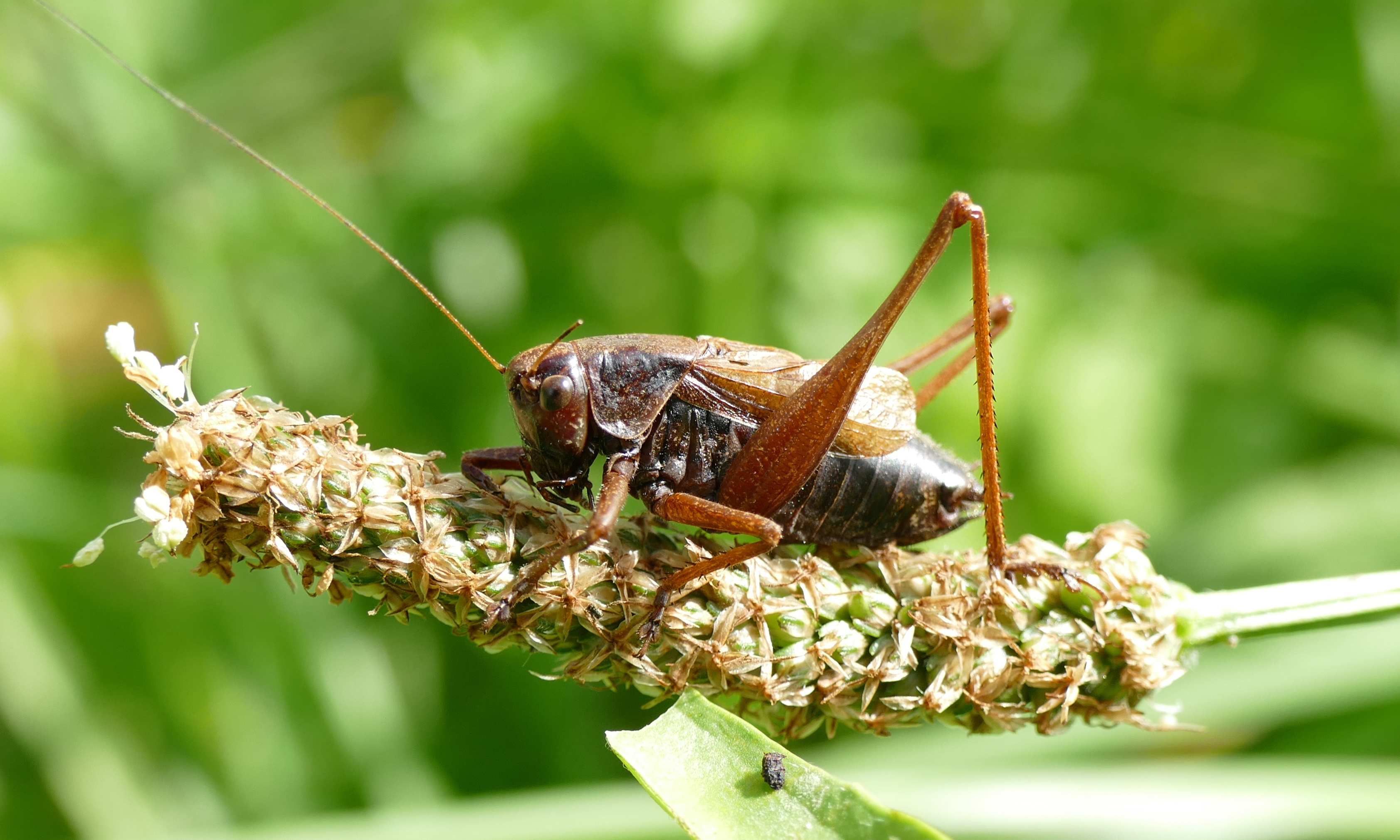
Picture of male Zeuneriana burriana.
Fig. 1Zeuneriana burriana, male. Mazcuerras, Cantabria, 30TVN09. Normally, the long antenna mean that it is a cricket and not a grasshapper.

Most of the species within the Metrioptera genus group have an extremely limited range. Within Zeurneriana there are only 4 species, of which today’s focus species has the largest range. For example, Zeuneriana marmorata (Adriatic Wide-winged Bush-cricket) is only found in a tiny region in northern Italy and Slovenia and is listed as Endangered (EN) on the IUCN Red List.

Zeuneriana burriana is rare, though found in Cantabria, Asturias, the Basque County, Leon, Galicia, and a tiny bit of France. It is found in humid, uncultivated grasslands. I’ve seen it in El Minchón (here is a link to the Local Hotspots post) and “rough” areas around flower-rich fields used for hay. The taller the grasses the better, as normally I’ll be wading through grass that easily reaches my hips.
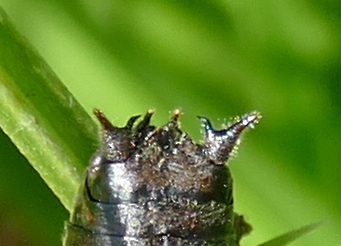
Cerci of male Zeuneriana burriana.
Fig. 2Zeuneriana burriana. Detail of male cerci.

I am not good at identifying grasshoppers and crickets, so usually ask for help from experts on the various forums. What makes the Metrioptera genus group so difficult is that when the insects are not yet adults, so in their nymph stage and the wings have not yet fully formed, they are very small and have very similar characteristics. The best way to ID species is to get good pictures of the male appendages (called cerci) at the end of the abdomen (Fig. 2). The females have a dagger-shaped ovipositor at the end of their abdomen (not used for stinging! Egg-laying only), however, I am not sure how to tell the difference between species when it comes to females. It probably has to do with the curve/shape of the ovipositor.

Conclusion

Orthoptera are difficult, but that should not hold you back from getting interested and informed about them. They are stunningly beautiful when you really get into the details, not just brown or green insects, but with flashy yellows, blues, and oranges. As mentioned, many are only found in very specific habitats (e.g., dune landscapes) so it is also a great way to be introduced to this style of nature observation, where you plan a day out to visit one or two specific areas and take your time investigating them (e.g., learning where to look etc.). You really start to learn a lot doing this, building up your knowledge base for when you go visit more generalised areas where you can spot a wider variety of species.

Another post where I’ve tried to keep it short and to the point.

Further Reading

I mentioned previously that there can be difficulties identifying Orthoptera, especially in the nymph life stage, where even there I think you’ll struggle to get definitive answers. Here are some sites:

Orthoptera Quarterly – Burr’s Wide-winged Bush-cricket – Zeuneriana burriana (Uvarov, 1935)

Book Club – Other Reference Books

Amphibians & Reptiles

  • Arnold, E. Nicholas & Denys W. Ovenden – A Field Guide to the Reptiles & Amphibians of Britain & Europe – second edition reprint with corrections – 2004 (1978 first edition) – William Collins – 288 pp. A pretty decent overview but it shows its age. The book by Speybroeck et al has just surpassed this in most aspects. The information is good, but I found it slightly difficult to use because all illustrations are in the middle and so you are flipping back and forth all the time. Have the hardcover version.
  • Speybroeck, Jeroen, Wouter Beukema, Bobby Bok, Jan Van Der Voort & Ilian Velikov – Field Guide to the Amphibians & Reptiles of Britain and Europe – 2016 – Bloomsbury – 432 pp. Another entry in the British Wildlife Field Guise series and another great one. A must buy.

Note

Although not a book, you can get a decent pamphlet for amphibians in Cantabria from Red Cambera in PDF format here. I was able to get a physical copy when I did some volunteer work with them, they might still have some so try and contact them if you are interested.

Birds

  • Svensson, Lars, Killian Mullarney & Dan Zetterström – Birds of Europe – second edition – 2009 (1999 first edition) – Princeton University Press – 447 pp. My copy is absolutely beat up, which should indicate just how good this book is, as I take it with me everywhere I go. This summer (2023) a third edition will be released, it will be a must-buy for me. Everything is goof about this book, I’ve seen books on European birds by others, but they all pale in comparison. I cannot recommend this book highly enough.

Note
Birding is probably the #1 hobby for those who enjoy nature observation … and while I love it and it was the gateway for me into the world of butterflies, dragonflies, and other insects, I feel hopelessly inadequate when it comes to IDing birds. Not in the first part because I’m terrible at bird calls. However, I continue to get enjoyment from it even though I have my deficiencies … but if I ever did nature tours etc. in Cantabria, this is the area I’d need help in. It is also the main reason why I do not write much about birds, too many other people know much, much more than I do so I do not feel like I’m adding to the conversation at all.

Hymenoptera (Bees, Wasps, & Ants)

  • Falk, Steven & Richard Lewington – Field Guide to the Bees of Great Britain and Ireland – 2015 – Bloomsbury – 432 pp. Lewington illustrates this excellent introduction and overview of bees. The main issue is that here in Spain there are many more species, especially in the difficult families. However, a valuable learning tool that is even better when coupled with Mr Falk’s Flickr page. An excellent entry in the British Wildlife Field Guide series.

Note
Bees, and then especially bumblebees, are a passion. I love them, but … they are so difficult to ID without catching and collecting them so that you can take detailed pictures. That is not something I’m ready to get into now. My goal is to one day write a big article on the bumblebees of Cantabria. I live with the realisation that I’ll continue taking pictures of bees I spot in the wild but will probably not get further in IDing them than a family and a handful of possible species it might be. Still …
As far as ants and wasps are concerned … they are even more difficult.

Orthoptera (Crickets & Grasshoppers)

  • Bellmann, Heiko, Florin Rutschmann, Christian Roesti & Axel Hochkirch – Veldgids Sprinkhanen en Krekels van Europa – 2020 – KNNV Publishing – 432 pp. Another great publication by the KNNV … but in Dutch. There is a German version available too. It does not cover all Orthoptera in Europe in detail with mainly very specific species in southern Europe only briefly covered. However, several of the authors also volunteer their services IDing photos that users upload to Observation.org so with their input there you can get far. A must buy for those interested in these insects.

Other

  • Fitter, Richard, Alastair Firrer & Ann Farrer (illus.) – Collins Pocket Guide: Grasses, Sedges, Rushes & Ferns of Britain and Northern Europe – reprint 1992 (1984 first edition) – Collins – 256 pp. A really excellent introduction. I do not know much about grasses etc. but this has been a great source of information. The maps don’t show Cantabria, but many of the species discussed occur here as well.
  • Jahns, Hans Martin – Collins Guide to the Ferns, Mosses & Lichens of Britain and Northern and Central Europe – 1983 – Collins – 272 pp. Another topic I know nothing about, but the book has helped out greatly. Both this and the grass book have been excellent to figure out what some of the larval host plants are of butterflies and moths.

Comments

More will be added if I pick up other books … am still looking for one on European mammals and maybe some other interesting insect groups, like beetles.

Book Club – Other Reference Books