Book Club – A Buzz in the Meadow by Dave Goulson

Introduction
This is actually the second book I’ve read by Dave Goulson, however, it is the one I’ve finished most recently and hence will cover the other book (A Sting in the Tail) at a future date.

As for other books to come through the review, over the past couple of months I purchased some field guides and natural history books, and am currently reading John Fowles’ The Collector, which is maybe not directly a “nature” book but is pretty good and about a butterfly collector, sort of …

Comments
As I stated above, this is the second book I’ve read by Mr Goulson. It is also his second book and follows up nicely from the first with many links between the two.

In 2003, Mr Goulson purchased a farm in France that came with 13 hectares (130,000 m2) of land. Since then he’s been working on the buildings and slowly letting the land get back to a more natural state of flowery meadows … although he has created a little brook and pond to attract wildlife that needs water (e.g. dragonflies). The main thing is that he’s letting the land recuperate after being fertilised and treated with pesticides etc. throughout the time that it was “productive” land for the farmstead.

The book is divided into 3 sections. The first (and longest) consists of 9 chapters covering the animal (mainly insect) life to be found around the farm. This includes bees, butterflies, dragonflies, beetles, newts etc. Birds aren’t really covered. The second section (3 chapters) is about plant life and the last section (also three chapters) is how the natural world is interlinked and what man’s effect has been on that natural world.

Each chapter starts on one topic, but often it meanders from there on, going from one related subject to the other. It is like listening to someone extremely knowledgeable on a multitude of topics and that person is excited to tell you something and then he or she just continues talking and you have the feeling they can go on for ever.
Mr Goulson has a pleasant manner of writing, which explains everything quite clearly and thus it becomes quite fun to read the book. So much so that at times I had to stop myself from reading, as there is an overload of information and it becomes impossible to remember all that is told. In other words, I’ll probably re-read chapters on specific topics in the future to remember what was said.

I enjoyed this book and it inspired me, but hey, I was probably going to enjoy the book anyway considering my interests … It was a fluid read, even though some subjects can be quite scientific, but it is never boring. The only thing is that I sometimes longed for more, but I think this is inherent with nature, in that it will take many more years before the farm gets to full potential and Mr Goulson discovers all the interesting things happening in the fields, as everything needs time to adapt, change and grow. For example, he’s doing an experiment over various plots (to do with growth of plants), but it a will take many seasons before the results are finally known and a bit more conclusive. I can easily see a “part two” in 10 years time to give us an update on how the farm’s changed.

The Edition
Title: A Buzz in the Meadow: The Natural History of a French Farm
Author: Dave Goulson
Publisher: Picador
Year: 2014
Edition: Hard cover, first US edition (2015), 1st printing, 265 pages
Additional Info: Includes index.

Further Reading
– Dave Goulson’s Twitter page.
– Mr Goulson’s page at the university where he works.
Book Club – A Buzz in the Meadow by Dave Goulson

Flowery Fields Forever – Hoop-petticoat Daffodil – Narcissus bulbocodium (L.)

Introduction
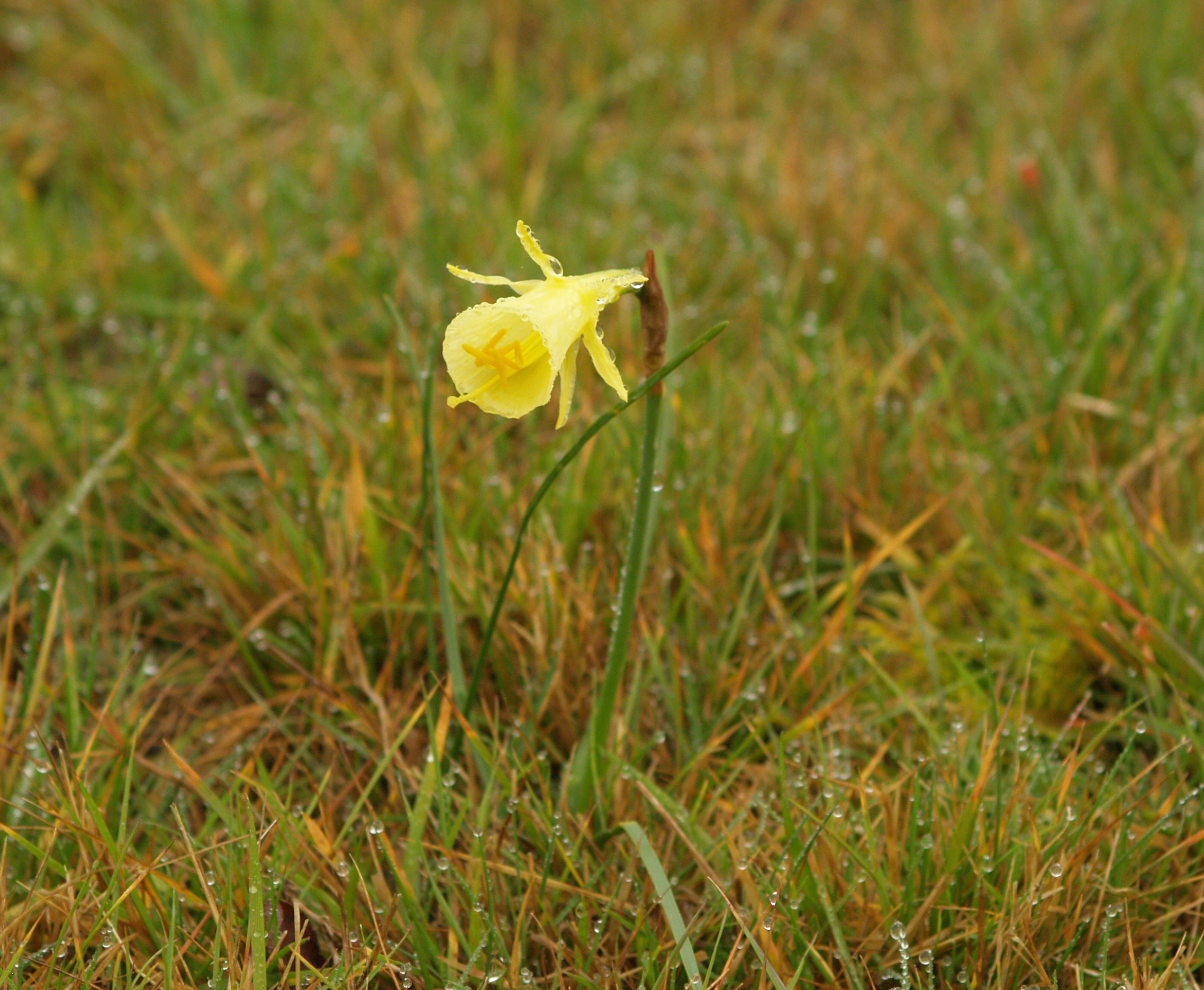
Has been a while since a post, too busy with work. Anyway … I thought I’d start with a surprise flower that I saw at the start of January of 2016. Individual, little yellow flowers were scattered across various fields where I was walking (looking for birds). After some searching on internet it turned out to be Narcissus bulbocodium, or Hoop-petticoat Daffodil as its common name.

Hoop-petticoat Daffodil
The Hoop-petticoal Daffodil sits in the Amaryllidacaea family and the Narcissus genus. Apparently there is a specific subspecies of N. bulbocodium in the area where I saw the flower, it is called ssp. citcirrus, but I am not sure what the exact characteristics of the subspecies are.

The flowers emerge early in the year and last till about March. The plants need wet soils, but well draining. This flower also grows from bulbs, usually not in big patches, but individual flowers here and there. I saw these in exactly the same field as the Crocus nudiflorus (see a previous post).

Spain is a hotbed for Narcissus and this particular species is found from southern France down through the Iberian peninsula. It can cross with N. asturiensis, but that plant is found at higher altitudes in the hills (usually around 800+ metres).
In N. bulbocodium the corona (trumpet, as it where) extends out quite a bit and the tepals are thin and spiky. One cannot really mistake the ID of this flower (though I did).

Hoop-petticoat Daffodil (Narcissus bulbocodium) in Cantabria, Spain.
Flower detail of Hoop-petticoat Daffodil (Narcissus bulbocodium) in Cantabria, Spain.

Further Reading
– A link to the Royal Horticultural Society’s page on this plant. More info and how to grow it in your garden.
– A PDF detailing the different Narcissus species in Spain (there are quite a few!). From the Flora Iberica publication, in Spanish, see page 26 for more info.
– A list of my sightings of this flower on Observation.org.

Flowery Fields Forever – Hoop-petticoat Daffodil – Narcissus bulbocodium (L.)

Flowery Fields Forever – Autumn Crocus – Crocus nudiflorus (Sm.)

I do not know much about flowers or plants, but I started taking an interest when I started taking pictures of bumblebees, butterflies and such. Certain bumblebees may only visit certain flowers and such information may help in determining the species of bumblebee. The same is for butterflies, where they will lay eggs on certain plants which will be food for the caterpillars when those hatch.
Secondly, the database where I record my observations has the option of adding the plant species from which an insect was eating, taking pollen or taking nectar. Therefore, knowing the genus (in this case Crocus) or family (in this case Iridaceae) adds extra information to the observation. If you then also know the correct species, great.

Introduction
So I started taking pictures of flowers in April of this year (2015). Mostly of those on which I saw bumblebees, but also of ones that I thought were pretty or strange. These last two categories meant that I took pictures of orchids (see future posts) and of this flower, the Crocus nudiflorus.

Autumn Crocus
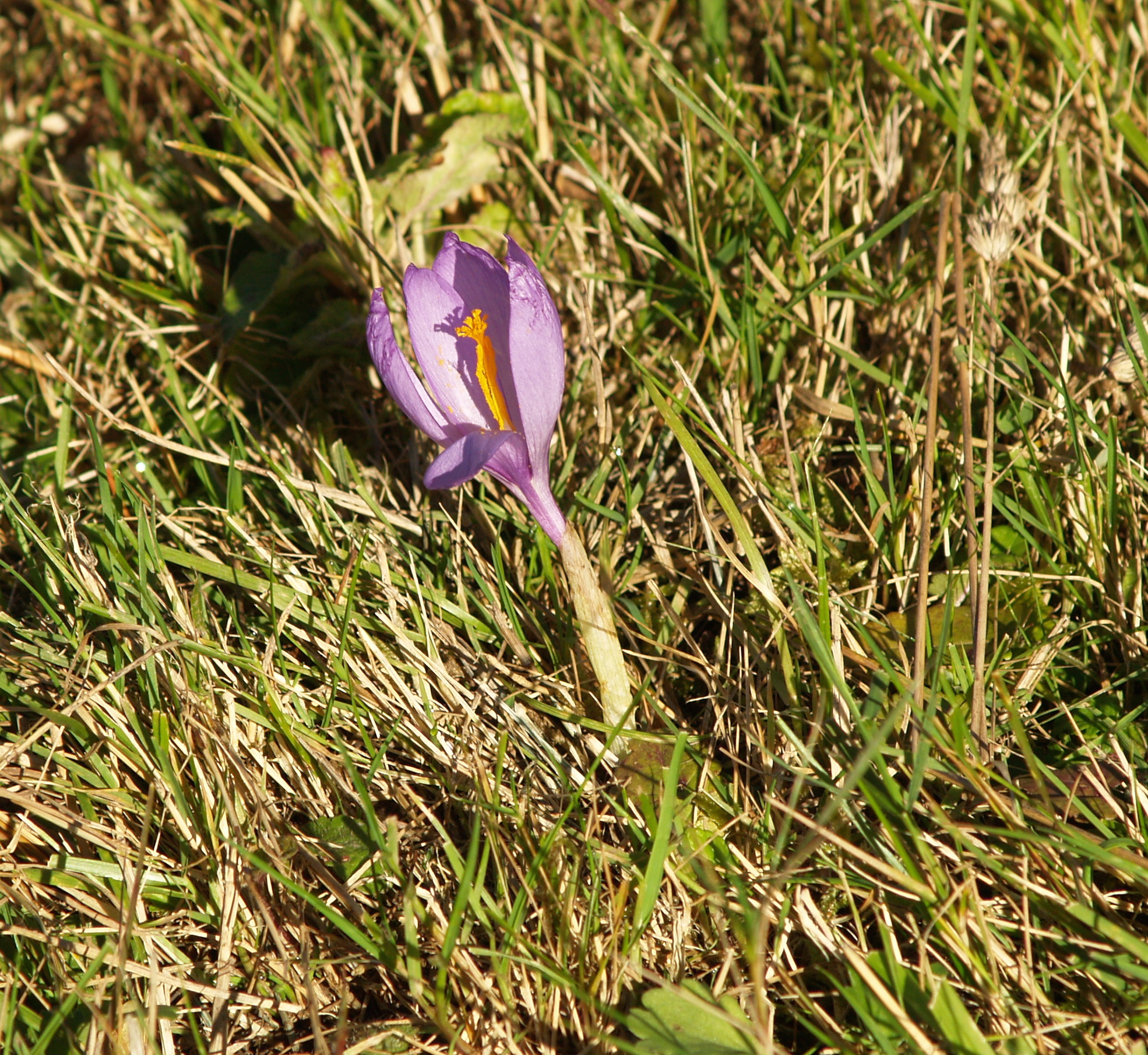
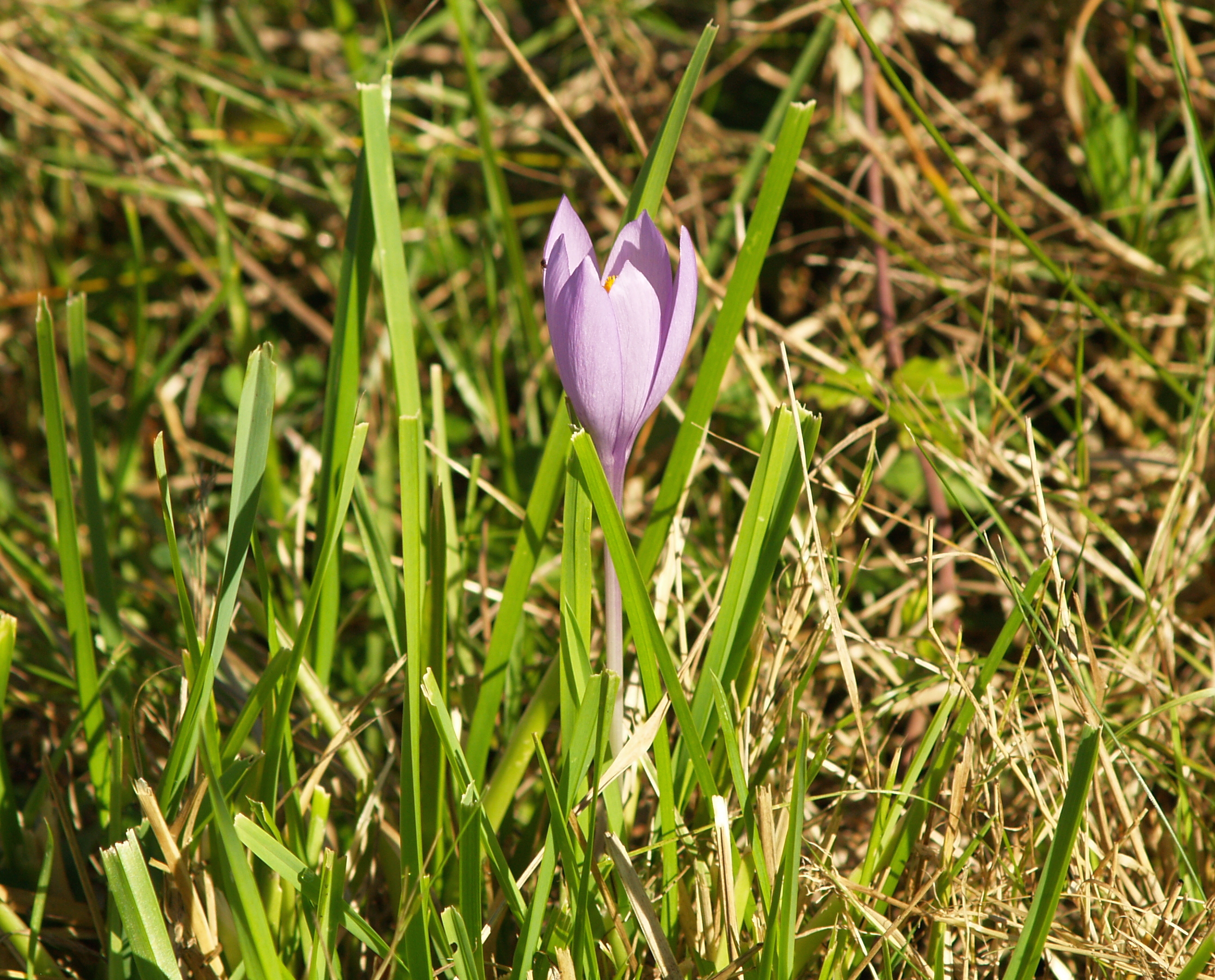
The Autumn Crocus is a bit of a weird one in the Crocus genus, as it is one of the species that flowers in the autumn (hence the name) and it grows on humid soils, whereas many other Crocus species prefer well-drained soils (I assume this has to do with the possibility of the corms rotting). This plant spreads through both seeds and corms (the underground bulbs, which produce stolons). The flowers emerge from late September onward and at first there are no leaves visible. The patches of flowers can become quite dense, I saw them this past weekend in a park in Colombres, Asturias and whole areas of grass under the trees was covered in these flowers. The observation from which the photos below are had a lot less flowers, around 15. Crocus nudiflorus is found in southwestern France and along northern Spain, especially in upland areas.

I noticed these flowers in one of the fields nearby that are used for hay and grazing of horses/donkeys. In this area the ground is generally very humid and during the winter months can become quite boggy with all the rain. I think the flowers are poisonous to animals. Anyway, it was great to see this new injection of colour into the landscape, especially as I never expected it and had no idea Crocuses also flowered in the autumn.

When IDing this species here in northern Spain one has to take care not to confuse it with Late Crocus (Crocus serotinus), which looks very similar except for the stamen (both anther and filament) being completely yellow. On Crocus nudiflorus, the anther is yellow and the filament is white/light purple/blue (in the top picture you can see a hint of white filament). There is also the fact about the plant showing leaves or not, but I do not think that is completely reliable in determining the species. Furthermore, I believe that Crocus serotinus likes drier soils.

Autumn Crocus (Crocus nudiflorous) in Cantabria, Spain.
Autumn Crocus (Crocus nudiflorus) in Cantabria, Spain.
Autumn Crocus (Crocus nudiflorous) in Cantabria, Spain.
Autumn Crocus (Crocus nudiflorus) in Cantabria, Spain.

Further Reading
– A link to the Alpine Garden Society page on this flower. Has more in-depth information and also a bit more about growing this plant in your garden.
– A PDF detailing the different Crocus species in Spain. From the Fauna Iberica publication and in Spanish. See page 7 for C. nudiflorus.
– My sightings, to date, on Observation.org of this species.

Flowery Fields Forever – Autumn Crocus – Crocus nudiflorus (Sm.)