So, I’ve set out the moth trap on the balcony a couple of nights so far in 2023 … zero, zilch, no luck. As I stated in a previous post, the street lighting has been changed to LED … great for the environment when it concerns energy usage but poor when it comes to light polution. Unfortunately, I’ve not had to time to set the trap in a friend’s garden, so the best thing I can do, for the moment, is to write up on some interesting species I’ve managed to see.
However, if all goes well I will set up the trap this evening at a friend’s house and then this weekend I will do it again in Salinas de Pisuerga, Palencia, where another friend lives. I’ve identified a number of species (moths, butterflies and dragonflies) I’d like to see this year, which includes Valeria jaspidea, and put all related data into an Excel sheet. Below is a screenshot of the moth section to give you an indication of what I’ve done. Will add to it as I come across other interesting species.
Fig. 1 – Overview of moth species in the Cantabrian mountains that I’d like to see over 2023.
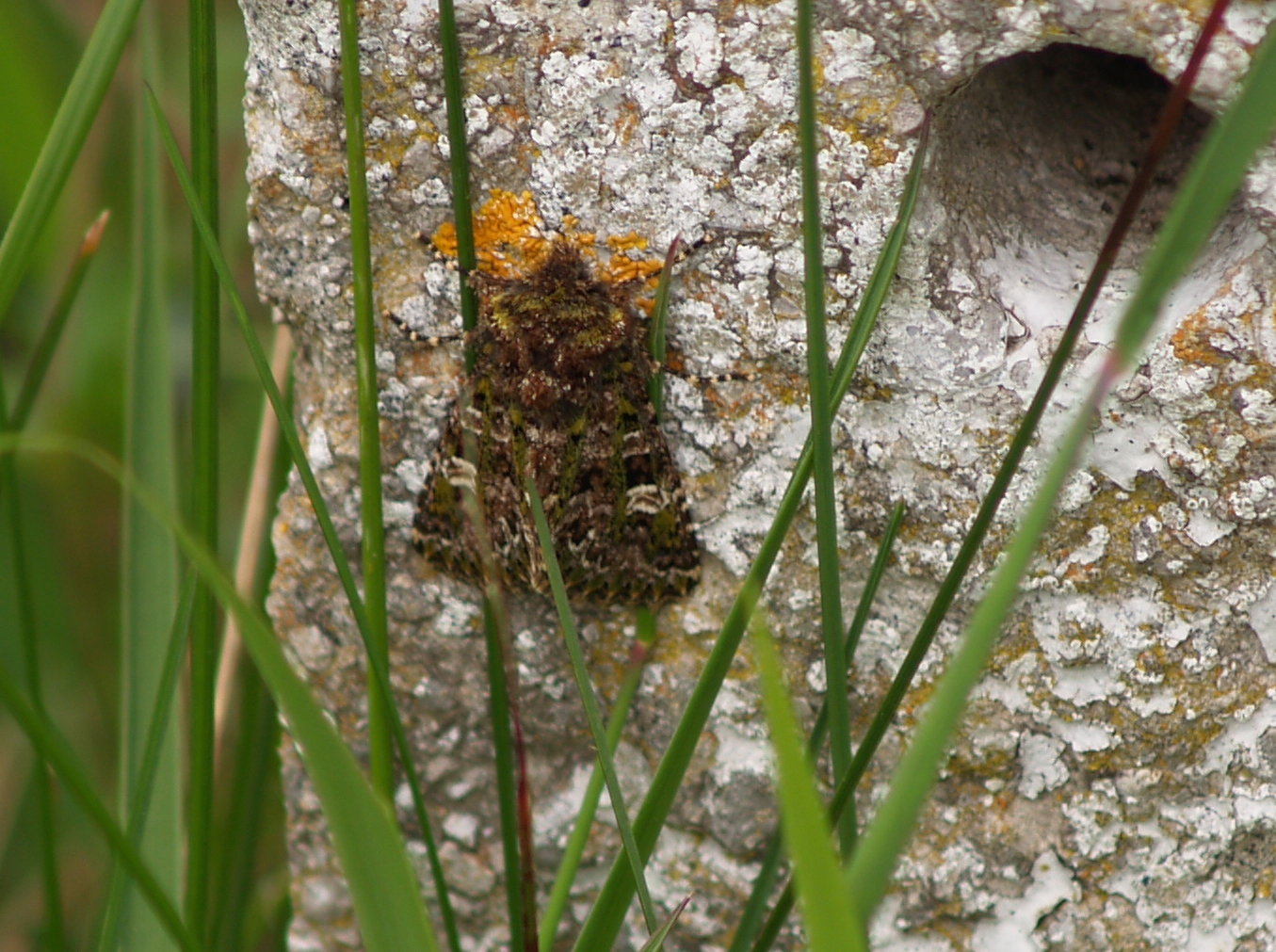
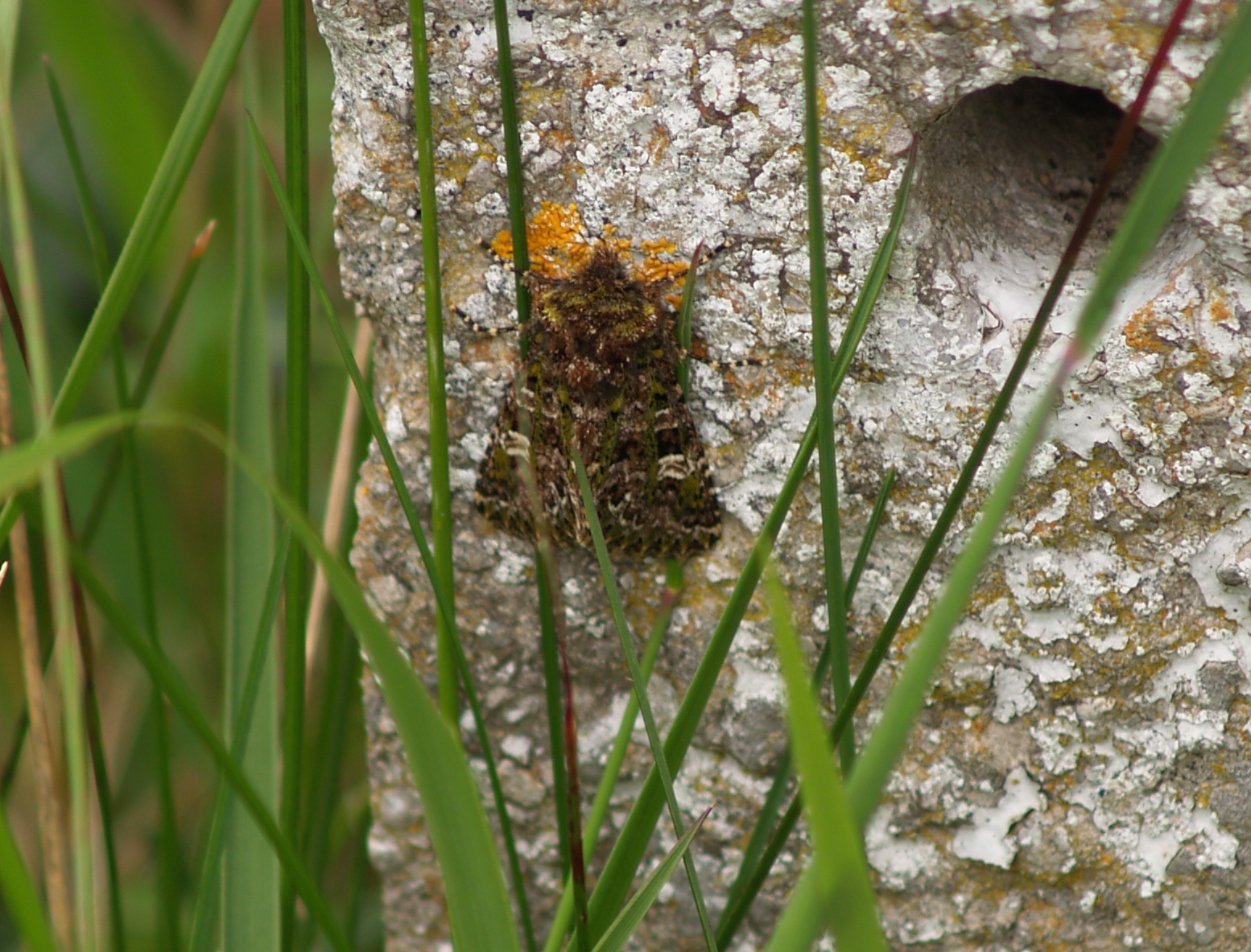
Valeria jaspidea
Valeria jaspidea falls under the Noctuidae family of moths and is quite similar to Valeria oleagina ([Denis & Schiffermüller], 1775). I cannot find the paper that details the difference and if it is widely accepted or not, but Lepiforum (see links below) has them as different, so I’ll keep it at that too. Apparently,Valeria jaspidea occurs in the western part of southern Europe, whereas Valeria oleagina in the eastern part. I also cannot find a map of where the split would be, and if they overlap.
(Ugh … getting used to using this tool again and lost half of the post in trying to update it … oops) The moth can be found throughout the Iberian peninsula, but it is rare. To be honest, with the continual growth of eucalyptus plantations in Cantabria (which dry out suitable habitats) this species looks to need to be ready for a struggle to continue surviving in the region. Also, with the changes in landscape management (farming techniques) this will only add to the struggle they already face.
The caterpillars of Valeria jaspidea feed on Prunus spinosa (blackthorn) and also Crataegus sp. (hawthorns). The moths fly from March to May and can often be found at rest at the bottoms of walls and stones. They have these stunning streaks of green that make them look like a moss that might grow on a blackthorn.
Fig. 2 – Valeria jaspidea, 19.iv.16 – Casar de Periedo (Cabezón de la Sal), Cantabria, 30TVN09.
Further Reading
I have written a blog post about the moth resource books I use. It will be published on Friday (30.iii.23) after which you can find it here(will add link).
This is a link to a great site called Pyrgus.de that I reference a lot. Excellent information and photos. He hasn’t updated or added Valeria jaspidea yet (not sure why) but the info can be found here under Valeria oleagina.
No moth reference list is complete without a link to Lepiforum, an incredibly in-depth site. Here is a link to the moth’s page.
All sightings in my region of Spain as recorded through Proyecto Lepides.
I actually wrote a blog about walking the transect when I saw this species, see here.
Introduction
With one day of good weather suddenly upon me I decided to head out. There was the occasional gust of wind, but the sun was fully out and the temperature was around 15C. The forecast said rainy periods over the days after. So … out I went …
Recorrido A – 25.04.16 – 30TVN09, Casar de Periedo There was not much going on at the start of the walk until I noticed a little white butterfly flittering along the edge of the field and road. It was clear that it was a Wood White (Leptidea sinapis) but it was acting strange and it was in a spot where I’d not seen many before … quite far from any woods! 🙂 Anyway, I looked closely and it seemed to be laying eggs individually in a plant that hung over a small dirt edge along the dirt track. In my quest to see if I can find out which Wood White it is I took some pictures, but, as I’m very poor with plants I’ve not made much headway in that department. Furthermore, the plant does not look like any that are listed in the books I have … Will go into it in a post specific on Wood Whites in the (hopefully near) future …
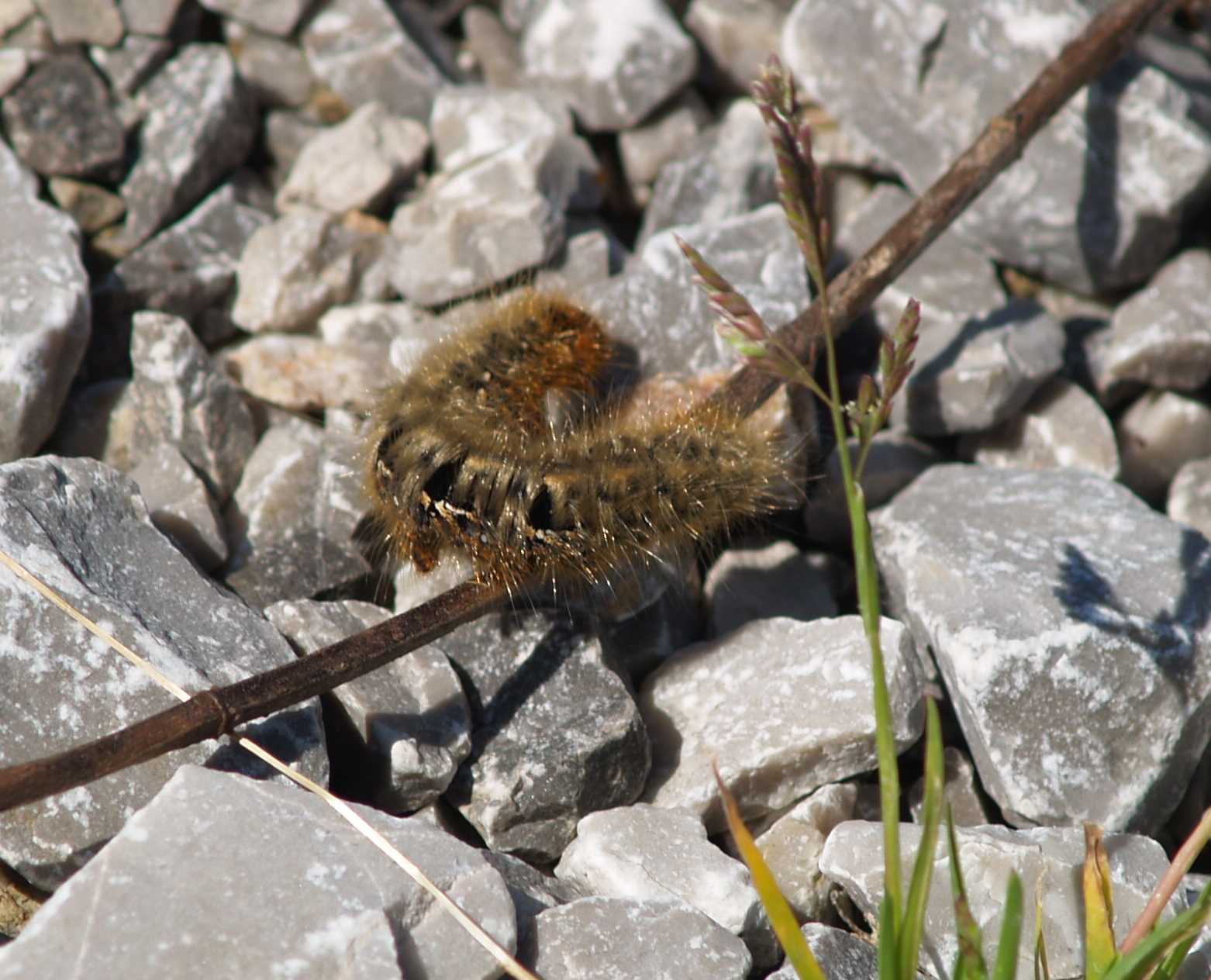
Oak Eggar (caterpillar) in Cantabria, Spain. 25.04.16
As I was marveling at this funny lone white, I looked down and at my feet was a hairy caterpillar … Lasiocampa quercus (Oak Egger), a moth … have read that you shouldn’t really handle hairy caterpillars due to skin irritation, so lifted the stick onto the dirt track to get a better angle for a picture. Noticed that it seemed to just have shed its skin, had not seen this before.
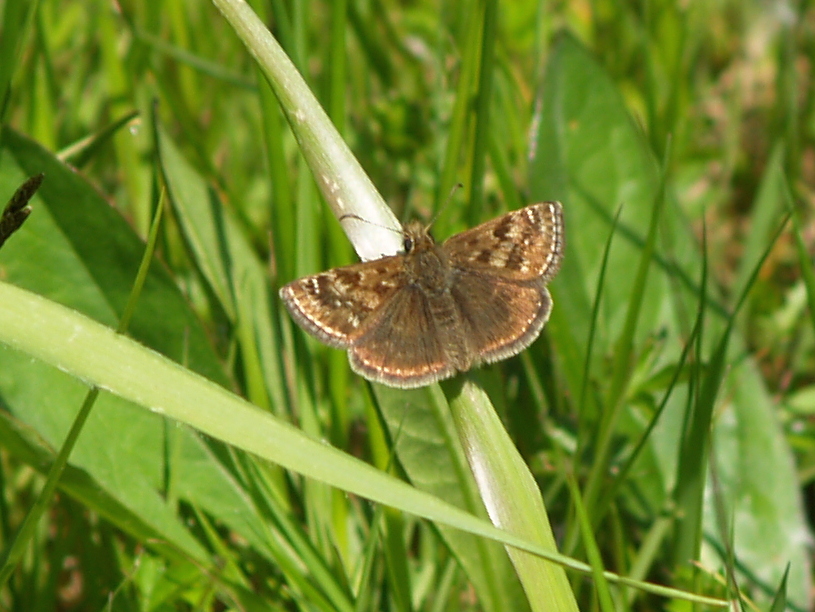
On I went … in the first really interesting field that I like to take a closer look in I spotted quite a number of Small Heaths (Coenonympha pamphilus), they were starting to come out in large numbers! I also spotted a dark little thing … this time I was able to get it on camera in a decent manner … a Dingy Skipper (Erynnis tages). Later in the walk I’d spot a second. This was starting well, it isn’t every day I see a Dingy Skipper. I thought I saw another close by, but the Burnet Companion (Euclidia glyphica), a day-flying moth, that it turned out to be was a bit of a let-down. This species and other day-flying moths will become a feature in the months to come. An inexperienced eye will think “hey butterfly” and that’s what I did … but through endless frustration last year I was slowly learning. However, now for Proyecto Lepides we also record moths we see … so, hey, this is an easy one (i.e. don’t have to go out at night to see it)!
Dingy Skipper in Cantabria, Spain. 25.04.16
For most of the rest of the walk there was more standard stuff, always good to see, but after a while those species become a touch boring.
Sooty Copper (male) in Cantabria, Spain. 25.04.16
I did see my first Sooty Copper (Lycaena tityrus) of the year, a male. I quite like this butterfly, and it is reasonably common around here during the summer months. The females have a spectacular mix of orange and brown. The males are more “drab” dark blackish brown (sooty is a fitting name for the males). But when they thus fly you see flashed from their white underside wings … so for males you get a neat black/white strobe-action going. They aren’t the greatest of flyers, so do not go far if you disturb them and hence are easy to follow. One of my goals this year is to see as many Copper species as possible. There are 6 species in this area of Spain, but three are rare and one of those is really extremely rare … and apparently the most common I cannot seem to come across here (just once last year)!
Orange-tip (male) in Cantabria, Spain. 25.04.16
Towards the end of my walk I saw another year-first … an Orange-tip (Anthocharis cardamines). Again apparently a common sort that I do not come across much here … I’d actually seen a female earlier in April during a stroll, and those are difficult to spot … but males should be easy with their flashy orange wing-tips. Usually, I just seen them flying up and down a path, relentlessly, never seeming to stop for a drink of nectar. I was thus very happy to see one drinking away, and quickly took a picture before it zipped off again.
During the walk I’d also seen three butterflies I had not been able to ID, one was probably a moth and the other two were darkish-looking in flight (one a Small Tortoiseshell?!). Still again, even though I was a touch disappointed with my daily haul, I had some hope for if the weather should turn good for a more extended period.
(I wrote the above but did not finish the post … it is now just into May and we’ve got a couple of excellent days of sun ahead … will go out this Wednesday for my monthly walk, it is looking to be amazing weather … keeping my fingers crossed for some real dazzle!)
Jan. to April Summary
The month of April is almost at a close and it has been a mixed bag … both of butterflies, and of hopes and expectations … for the year.
With regards to 2015, I’m at the exact same numbers, for the year till the end of April I had seen 19 species, of which I’d seen 17 in April. I should also note that of the April species, 3 (of the 17) were not in 30TVN09 (I was not a volunteer yet either), and for the year that number was at 4 (of the 19).
The species I’d seen in 2015 but not so far this year are; Carcharodus alceae, Papilio machaon*, Pieris brassicae, Callophrys rubi*, Cupido argriades, Vanessa cardui* and Aglais urticae. The ones with a * are non-30TVN09.
I realise that some of these are pure luck due to the migratory nature of the species (Pm, Vc, and Au) and the others will surely be seen in May – the one exception to all being Callophyrs rubi, I cannot understand why I have not seen this species in 30TVN09 yet. It is apparently very common but I’ve only seen this butterfly once – however, I cannot but feel slight disappointment with how the sightings have gone this year. Especially seeing as the first months (Jan. and Feb.) looked to be building up quite well. I thought that with a bit more knowledge and experience I’d be able to ID more butterflies, but that has not been the case. Most I’ve seen I’ve been able to ID this year, but I’ve not seen many new species. I assume this has to do with:
– Habitat.
– Weather.
– Luck.
And it is with the last two categories that frustration comes in …
But it is thus also with a bit of luck that I’ve seen two new excellent species so far this year … Boloria dia and the Pyrgus spec. … both not the most common of butterflies in these parts.
I guess what I should take from this is that I should focus more on the positives of 2016 so far … there’s still a lot to go in the year and May looks to be exciting with a friend coming over and the possibility to explore some new areas!
Summary – Lasiocampa quercus (a moth – caterpillar). – Leptidea sinapis – a few, around 5-8.
– Pararge aegeria – reasonable amount 10-15. – Gonepteryx rhamni – a small number, around 5 in total.
– Coenonympha pamphilus – around 20.
– Colias croceus – quite a few, maybe 10.
– Erynnis tages – 2 in total.
– Euclidia glyphica (a moth) – 2 in total.
– Pieris napi.
– Lycaena tityrus – first of the year, 2 in total.
– Anthocharis cardamines – first of the year.
Species year total — 19 (2015 – 45). 16 species seen in April. Notes:
– Only species of butterflies are counted, I really have no knowledge of moths, but they are part of Proyecto Lepides goals and results so, I mention them in write-ups.
Further Reading
– My sightings for the walk on Observation.org.
– Overview of what has been happening with Proyecto Lepides and butterfly sightings all over Spain. Note the lack of “action” in the north.
Introduction
The end of March gave hope for a good April and also April 2015 had been quite excellent with 17 species seen (although 2 of those were not in the area here) even though I was just starting out in the world of butterflies. A year on I’m a bit wiser, but with still so much ahead of me to learn …
Anyway, back to the start of this month. Work was a bit on the slow side, so in that sense I had time off … but illness hit the kids hard so they were home and needed close attention. The month started of with reasonable weather but a little gusty in the wind department … as the month went on the rains came when I had little to do and the sun was out when work was staring at me in the face … very frustrating! The 2016 butterfly-bug was starting to hit hard.
I was able to do a few truncated rounds of Recorrido A in the first days of April … pushing the least ill kid around in the pram so he could get some rest outside of the stuffy house where his brother was busy vomiting every time a spoon came close to his mouth … anyway, the usual suspects were out: Pieris napi, Pararge aegeria, Aglias io, Colias croceus to name but a few.
It was on the 1st of April when totally unexpectedly two new species popped infront of my camera lens … Boloria dia (Violet/Weavers Fritillary) and Erynnis tages (Dingy Skipper) … both within a couple of meters from each other. I spotted the one when I’d spotted the other. I was drawn to the fritillary due to colouring and patterns on the wings and only got a couple of poor shots off of the skipper, luckily one was good enough for a positive ID. I got quite a few decent photos of the fritillary and knew I needed some underside pictures for a proper ID, with with some patience I managed to get (though poor lighting! still just enough for an ID). This fritillary is not very common and a great find. Where these the butterflies I’d seen a few days earlier in the same spot but without being able to find out what they were? It sure seemed that way and I was well pleased even though some initial complaints had started coming from the pram telling me it was time to head home.
Both were a first for me and thus also a first for the area/transect, even though I was not officially walking the transect.
Violet (Weavers) Fritillary in Cantabria, Spain. 01.04.16
Violet (Weavers) Fritillary in Cantabria, Spain. 01.04.16
On the 3rd of April I again went for a walk (with same kid) but this time around grandma’s house (very nearby here and also in 30TVN09). The wind was blowing so hard I almost decided not to go out, but the sun was out in full force, so who knew …
I went to a favourite spot, a sheltered field on the side of a sunny hill. A little dirt trail runs along the bottom of the hill accompanied by a shrub-lined brook. The wind was whipping high around the trees with the occasional gust through my hair … but I slowly walked the track with the sun as my guide … and there it was, amongst many other larger whites a relatively smaller white flying just that little bit different. The first Leptidea sinapis (Wood White) of the year. Only male genital analysis will tell us if it is this species or in fact Real’s Wood White that flies here, so until that day I’ll keep it to the more common of the two species.
Comma in Cantabria, Spain. 03.04.16
As the track started to climb I decided to turn around and while walking back my next new species … Polygonia c-album (Comma Butterfly). For me this has always been an elusive species so I was again elated to see it. It sat on a sand bank and flew around a bit, happy for me to take pictures. Again a first for the year.
After this came two frustrating weeks of bad weather or no time. In the weekend I marked a day that looked to be good for the following week …
Recorrido A – 19.04.16 – 30TVN09, Casar de Periedo … but it ended up being poor … continually overcast (after a sunny morning – no time, argh!) and with strong gusts of wind. The temperature was the only thing going for the day, just above 20C, when I headed out.
Even with the poor weather I saw the first butterflies instantly, flying up and down along the scrub. Dutifully checking the first few I came across it was clear they were probably all Pieris napi (Green-veined White). This white butterfly will be so plentiful in the coming months that it will drive me crazy.
It was a while before I saw something else fly by, this time it was a disturbed Pararge aegeria (Speckled Wood), again common stuff, though again this time around not as plentiful as in earlier months of this year.
A little later I spotted the first Leptidea sinapis (Wood White) for the transect this year, bouncing around in a field before it got swept away by a strong gust of wind.
I was feeling a bit hopeless, the poor weather was getting me down. Even a decent number of Colias croceus (15-20) (Clouded Yellow) zipping around just above the various Plantago spec. flowers at great speeds (wind no deterring factor for those excellent fliers) could not cheer me up. With a sigh I looked down and scratched my beard, what to do? It was staring right back at me … A colourful caterpillar, a blazing warning signal amidst the green grasses. This caterpillar (Zygaena spec.) looked about ready to start building a case. In a month+ the field I was standing at would be filled with the day flying moths that this caterpillar would turn in to. I’d have to wait until then to find out the exact species of vivid black and red moth that it will become. If I saw one I might see other caterpillars out …
Within 30cm was the next, this time a rich green with some light striping. I’d need to search internet for this difficult ID (turned out to be probably be the common Maniola jurtina – Meadow Brown – that will also be ever-present in a month or two).
Valeria jaspidea in Cantabria, Spain. 19.04.16
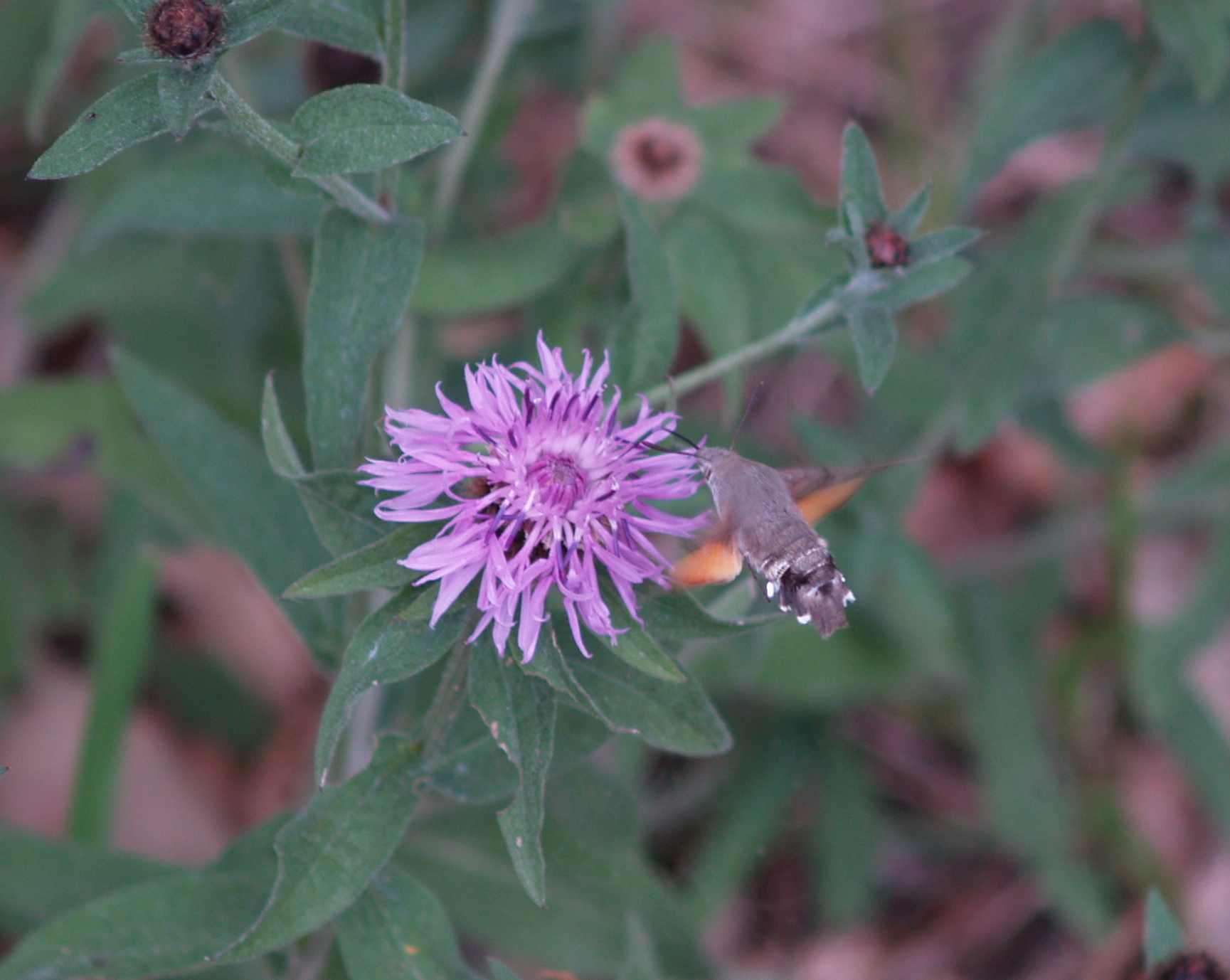
Humming-bird Hawk Moth in Cantabria, Spain. 19.04.16
I walked on, keeping my eyes peeled to the ground. This helped me spot a beautiful moth, Valeria jaspidea, on a small concrete post in the field. Incredibly subtly coloured, what a beauty. A bit further I spotted more Zygaena spec. caterpillars (3) and the weird but wonderful Macroglossum stellatarum (Humming-bird Hawk Moth) hovering and taking nectar from a knapweed.
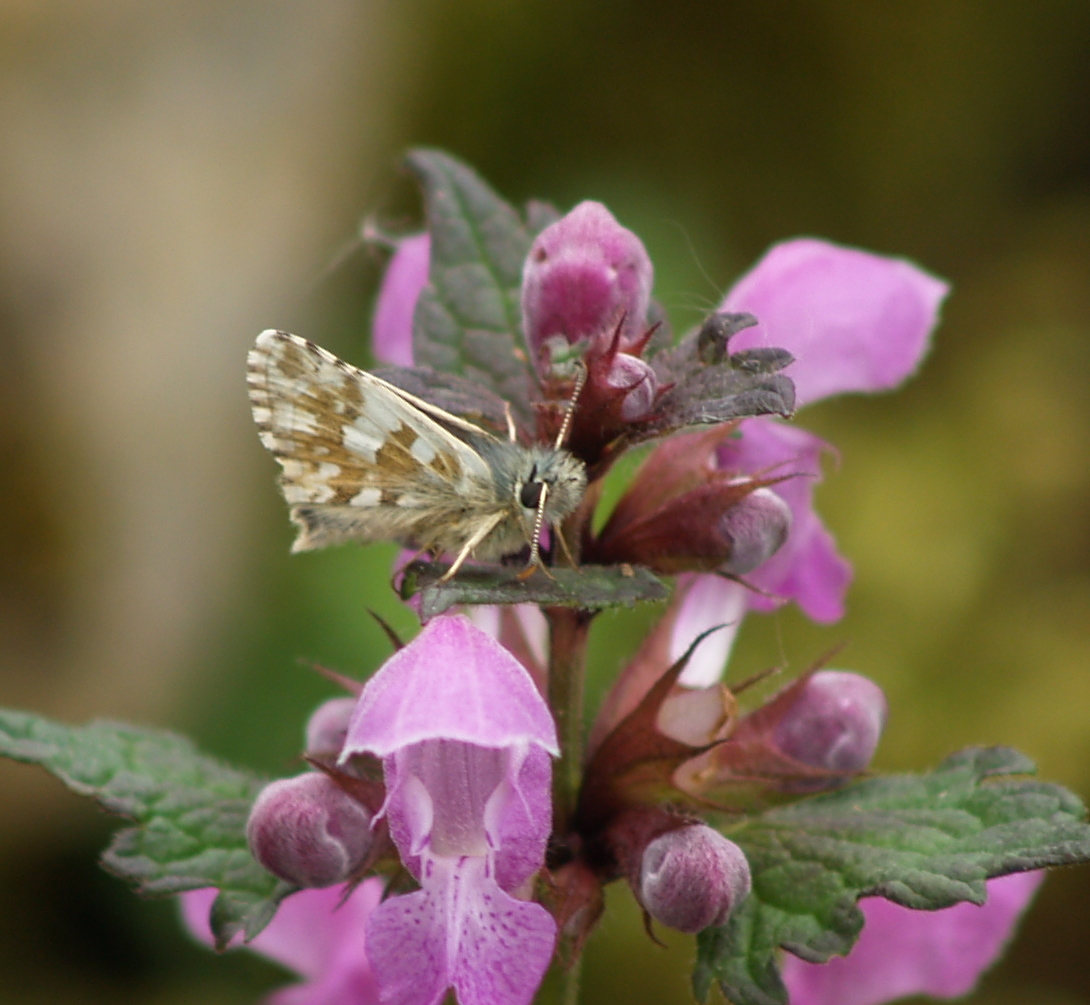
Not at all bad after all … and then came the highlight of the day … I’d stopped at a favourite spot of mine to look at 4-5 different species of bumblebee when I spotted an incredibly small whitish fluffy thing zip by, at a crazy speed. By pure luck I had been able to track it with sight, I quickly whipped up my binoculars to get a closer look … what was that!? I took some quick pictures, as it was clear I’d never seen something of the sort before. Slowly I circled around inching forward and getting a better look from the other side. I almost lost sight of it as I made sure I had proper footing.
A Pyrgus spec., a tiny butterfly that at times resembles a moth. I was able to get quite close, but it refused to open its wings (or move for that matter). Without further scientific examination it is impossible to say whether it was a Pyrgus onopordi (Rosy Grizzled Skipper) or a Pyrgus armoricanus (Oberthür’s Grizzled Skipper). The second is slightly more probable, but either way, both are rare in Spain and especially here.
Due to the stubbornness to not open its wings I decided to call it a day and left. I do not see many butterflies of this family here so I was keen to get home and see what I’d seen (at that time I didn’t know an exact determination was impossible).
Skipper in Cantabria, Spain. 19.04.16
Summary – Pieris napi.
– Pararge aegeria.
– Leptidea sinapis.
– Maniola jurtina (caterpillar).
– Zygaena spec. (a moth – caterpillar). – Colias croceus.
– Valeria jaspidea (a moth) – a first for me.
– Celastrina argiolus.
– Macroglossum stellatarum (a moth) – first of the year.
– Pyrgus spec. – first on all accounts; me, year and transect!
Species year total — 17 (2015 – 45). 11 species over March 2016. Notes:
– Not counting caterpillar species, as there is uncertainty around the ID and did not add those to the 2015 results. There will be plenty of Maniola jurtina imagos in a short while.
– Pyrgus spec. has been counted as one species.
– Only species of butterflies are counted, I really have no knowledge of moths, but they are part of Proyecto Lepides goals and results so … I will mention them in write-ups.
Further Reading
– My sightings (butterflies only) for the month of April so far on Observation.org.
Introduction
It had been raining on a fairly continual, daily basis since the 21st of February. I spotted two good days in the weather report, the Monday and Tuesday and so decided to go the second day to give the butterflies a chance to warm up. I’d been out walking during some overcast, and quite fresh, days previously and had spotted around 5 species of bumbelbee. I was quietly hoping for an eventful early afternoon …
Recorrido A – 15.03.16 – 30TVN09, Casar de Periedo When I headed out at around 13:00, the thermometer read 14C and the sun was out without a cloud in the sky, though it was slightly hazy and there was a little breeze (from east to west) that made it fairly chilly in the shade. By the time I got home 2 and a half hours later it was at 15C with the rest still the same. I got home with a very light sunburn actually, hadn’t expected it to be so sunny throughout.
The fields were quite wet, there was a lot of squelching every time I stepped off the track. My first butterfly was again a Red Admiral (Vanessa atalanta) in the same area where I saw one the month before, this time it was flying around actively and chased another butterfly (uncertain the species). A little later, as I was looking intently into some shrubs as I through I saw a snake or large lizard a Small White (Pieris rapae) bobbed by (took care to ID it by looking at the hindwing underside – more on this later).
I still had a lot of ground to cover so off I went. However, as I went on it started to dawn on me that my hopes for an eventful (in the positive sense) afternoon would not come to fruition. The first was that I hardly saw any Speckled Wood (Pararge aegeria). This does not happen often, as they are usually everywhere. The road along the edge of the woods had the usual butterflies on offer, but I couldn’t help but feel slightly disappointed. I’d been hoping for a first blue or something special, but alas.
What I did see a lot of was Pieris napi (Green-veined White) … last year they had been so plentiful throughout that I grew a bit tired of seeing so many. And here they were, out in great numbers already! But every butterfly counts and this is my 10th species of the year. Although, from now on IDing will be a task between Pieris rapae and P. napi, as they are fairly similar and you have to spot the underside to make sure. P. napi have an extensive range of uppersides here, with regards to black markings so IDing them in flight is difficult. The two species also have a different style of flying, but I’m not yet there to distinguish them in that manner, will probably get the by the end of this year though as both are really common here!
The frustration came in not being able to positively ID a Cleopatra and also in seeing one butterfly that flew very distinctly to those I see here and which I could not follow (maybe a Small Tortoiseshell?) well enough with my binoculars and I tried to spot it landing in the distance.
Oh and not one photo ended up being usable.
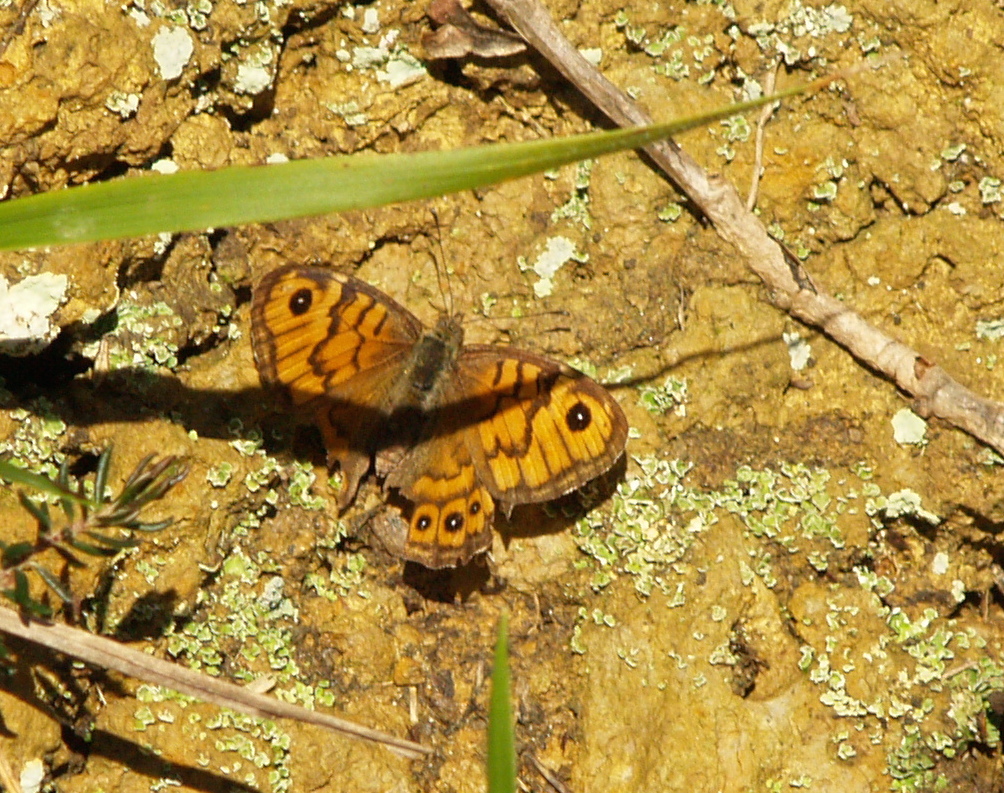
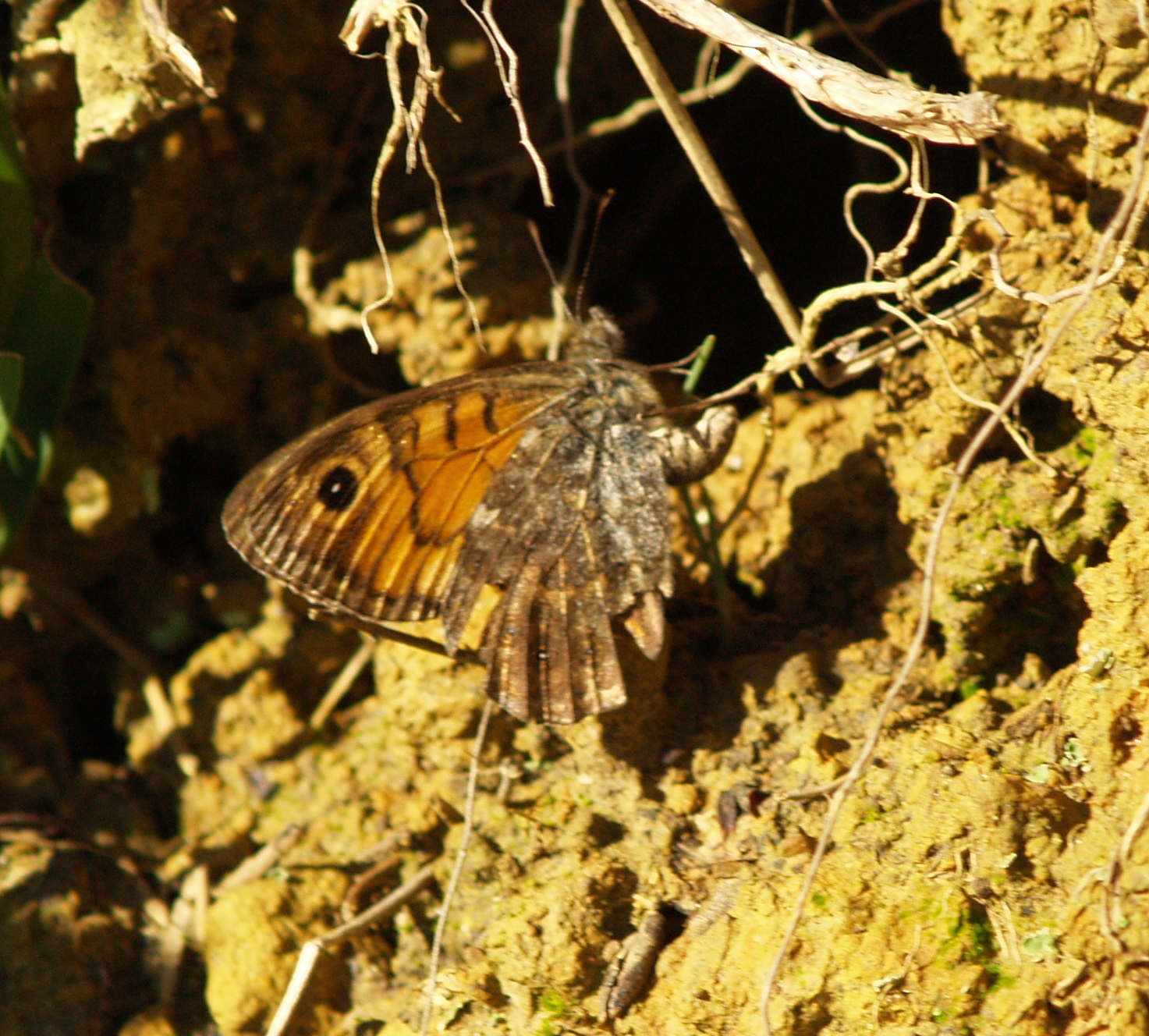
The day ended me one neat ID, a Wall Brown (Lasiommata megera) that I just spotted as I came out of some scrub and climbed up a bank onto the gravel road. Not the most common of butterflies around here.
The denouement came at home, when I took of my sweater in the kitchen and off fell two ticks! That’s what you get for trouncing around the scrub. Luckily none had found a way into a nice spot to bore into my skin, but I’ll have to be more careful the next time around.
Hopefully, with a few free days ahead I’ll be able to catch up on some species entries. Up next a bumblebee of the spring season …
Summary – Vanessa atalanta — between 3 to 5.
– Pieris rapae — 2.
– Gonepteryx rhamni — around 15 in total.
– Pieris napi — stopped counting after 20 (first of the year on this transect).
– Colias croceus — 2.
– Pararge aegeria — 5, a lot less than normal.
– Aglais io — 1.
– Lasiommata megera — 1.
Species year total — 10 (2015 – 45).
Further Reading
– My sightings for the day on Observation.org.
Introduction
When I woke up, at around 7am, it was still fairly dark out but I could see if would be a nice morning. By 10am I was ready to go and knew that I’d still have a window of sunshine before the rain would come back. Since the start of the month it has been raining almost non-stop.
Recorrido A – 13.02.16 – 30TVN09, Casar de Periedo The weather was quite good to start with, I didn’t need to wear a sweater. It was sunny with no clouds in sight and no wind at all, at 10am it was 14C. About halfway it was probably up to 17C or so, but towards the end of the route, the wind picked up a bit (not too much) and there was a lot of cloud cover all of a sudden, was back down to 16C when I got home around 12 noon. A little while later the rain was out (in good amounts too!).
I wasn’t expecting much … the rain had been almost constant over the previous days and the ground was really soggy everywhere in the fields. I stopped to look at some birds, when I spotted something dark flittering through this strange soggy/grassy area … I quickly aimed my binoculars in the distance and as I was focusing in saw flashes of white on the wing-tips
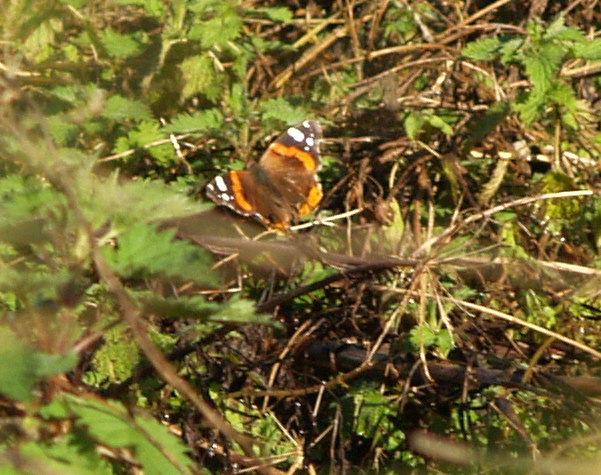
Red Admiral in Cantabria, Spain. 13.02.16
… I instantly recognised this from the previous year … Vanessa atalanta (Red Admiral) … the butterfly dipped behind a large tussock of grass and so I dived into the soggy field to get confirmation (mostly for myself, as I really like to be sure about an ID, especially so early in the year). With some difficulty I was able to get a couple of bad photographs in (that thankfully do show the required characteristics) for a positive ID.
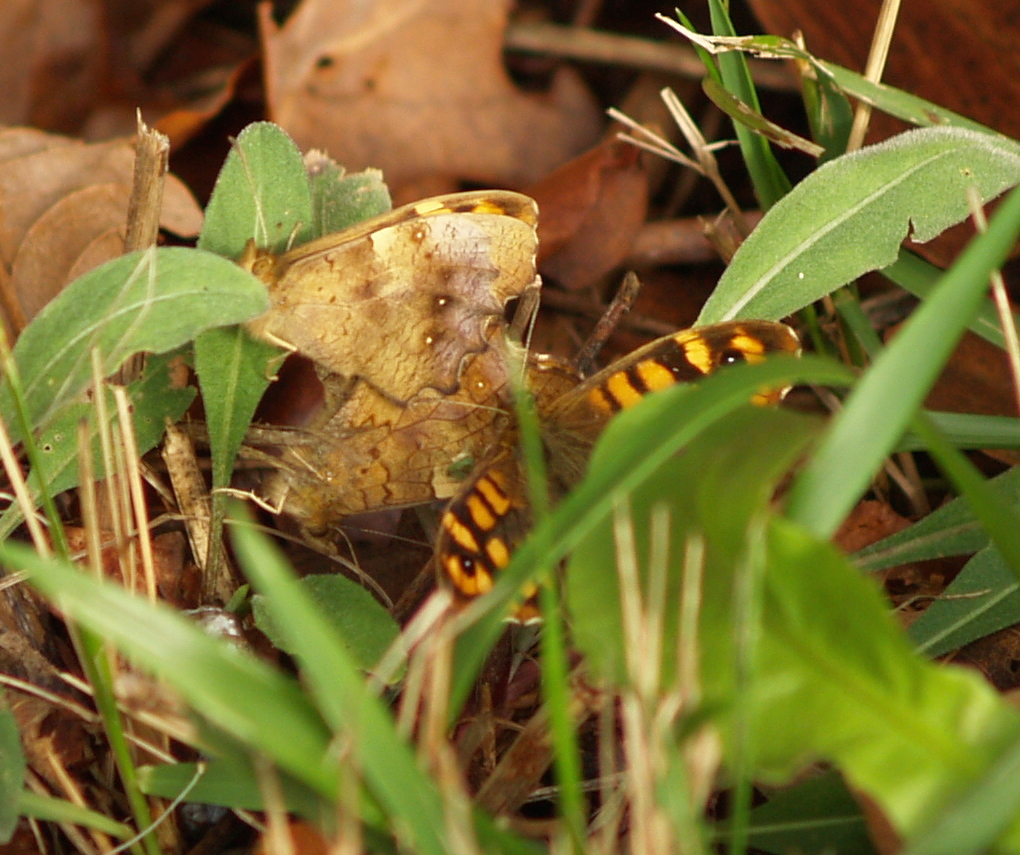
After a short while there were three in fairly quick succession along the route (I took a 15 min. detour to see if I could buy something for my son at the gas-station) and those were the regular patrons along the transect; Gonepteryx rhamni (Brimstone), Pieris rapae (Small White) and Pararge aegeria (Speckled Wood). At one point I’d seen so many Speckled Wood that I stopped counting, I also didn’t take pictures anymore, they were just everywhere. Although, I did take one funny snapshot of a copula and a male sitting on the two, waiting.
Speckled Wood in Cantabria, Spain. 13.02.16 – copula + male
It was at my favourite spot along the transect that I spotted something odd … I thought it was a Speckled Wood by the general colouring, but I found it strange that the butterfly was so small (max. 2/3 of what I’d normally expect) and it was behaving in a strange manner. It hugged along a vertical embankment along the road, stopping here and there, usually under grass, twigs etc. What was this? I took many pictures, hoping to get an underside picture, but that proved very difficult (though in the end I managed it). I had an idea what it might be, but I’d only seen this butterfly once before and it had been exceptionally difficult to photograph too. Later when I got home I conformed my suspicion … Lasiommata megera (Wall Brown) … and I also saw that she was placing eggs (or so it seems!). I cursed that I hadn’t picked up that detail in the field.
Wall Brown in Cantabria, Spain. 13.02.16
Wall Brown in Cantabria, Spain. 13.02.16 – underside.
I continued on, within a minute both a Colias croceus (Clouded Yellow) and Aglais io (Peacock) flew by at great speeds. Luckily those are fairly easy to ID in flight, especially as the Clouded Yellow was a male. A week earlier, on a walk nearby I’d been surprised to see a Clouded Yellow … I’d been pushing the stroller, looking at the ground and spotted a strange yellow leaf, strange as everything else was brown in mud, fallen leaves etc. I was able to get really close to it (was practically next to me anyway when I walked past it) and got some good pictures.
On I went, looking at butterflies through my binoculars, checking out the Buteo buteo (Common Buzzards) circling overhead … and then, as I was looking at a Brimstone (or so I thought) zip by I noticed flashes of orange … wait a minute … Brimstone don’t have orange, but Cleopatra do! I jogged along after it till it settled down (luckily not far off) and took some pictures. I also made sure to take one just as it set of for its next short journey, the flash of orange was clear on the picture, Gonepteryx cleopatra (Cleopatra), my first confirmed ID of this species by photo.
Cleopatra in Cantabria, Spain. 13.02.16
Cleopatra in Cantabria, Spain. 13.02.16
Picking up the pace a bit I headed home, the wind was picking up and it was starting to feel a bit chilly (had left my jacket at home), but was happy that I’d spotted a new species (the Cleopatra) for the UTM square I am monitoring.
Summary – Vanessa atalanta — 1 (first of the year).
– Gonepteryx rhamni — around 10 in total.
– Pieris rapae — 3.
– Pararge aegeria — I stopped counting after 20 … maybe 30 in total?
– Lasiommata megera — 1 (first of the year).
– Colias croceus — 1 (I’d seen one a week earlier but not along this transect).
– Aglais io — between 10 and 15 in total.
– Gonepteryx cleopatra — 1 certain, probably 2 (first of the year).
Species year total — 9 (2015 – 45).
Further Reading
– My sightings for the day on Observation.org.
Introduction
One of the reasons for stating this blog was because in June 2015 I became a butterfly “counting” volunteer with Proyecto Lepides, a Spanish organisation similar to Butterfly Conservation in the UK, but then on a small scale (at this moment in time anyway). The goal is to be able to create a map of Spain for all the butterfly species that fly here. Will write more on the organisation in a later post.
As volunteer, I walk a number of transects (recorridos in Spanish) within the 10km x 10km UTM square 30TVN09, which lies in the northern Spanish province of Cantabria (handily I live in the UTM square I monitor).
A few days ago was the first time in 2016 that I walked the transect hoping to spot some butterflies … below is an account of what I saw.
Recorrido A – 23.01.16 – 30TVN09, Casar de Periedo
The weather was quite nice for this time of year. I’d usually expect temperatures around the 5-10C with clouds and rain. It was around 19C when I headed out (2PM) and it was sunny with no clouds in sight. To top it off, there was zero sign of wind … basically the perfect weather for a spring day of butterflying, only it was still winter …
As I walked down the first stretch of dirt road I suddenly spotted my first butterfly of the year, a white one zipped by, heading south. I whipped up my binoculars, but could not get a clear ID. I could only make an educated guess of Pieris rapae (Small White), which are very, very common in this area. It did provide hope and … A short period later my second butterfly, again I could not be 100% sure and my best guess for the streak of yellow flying south was Gonepteryx rhamni (Brimstone).
I had hope I’d see more, but kept my fingers crossed they’d not all be in a rush to get somewhere I wasn’t going.
I was on a small tarmac road and I turned onto the road that runs along the bottom of a hill … full in the sun at the bottom of the south facing slope, perfect. This is my favourite stretch of the transect and I knew that the next 500m would be crucial if I was to head home with a positive ID.
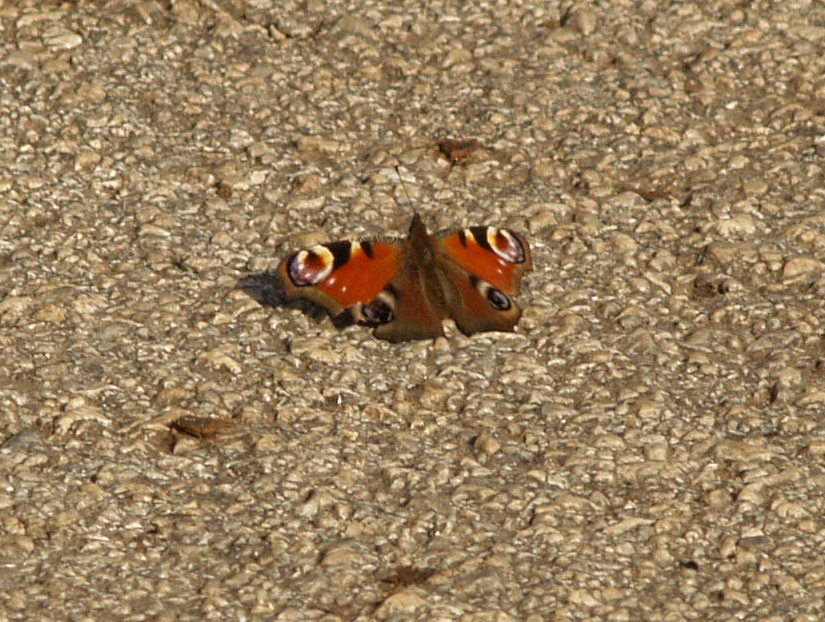
Peacock in Cantabria, Spain. 23.01.16
Within a couple of steps I got it … zipping around my head a really dark butterfly. I watched it bob up and down and twist around before settling down along the side of the road … in flight you always notice the deeply dark undersides and when they land, out pop the eyes … even without my binoculars I could see it was an Aglais io (Peacock) … my first certain ID butterfly of 2016 was the exact same as that of the previous year! It sat there, full in the sun and I took a few quick photos before heading further down the road.
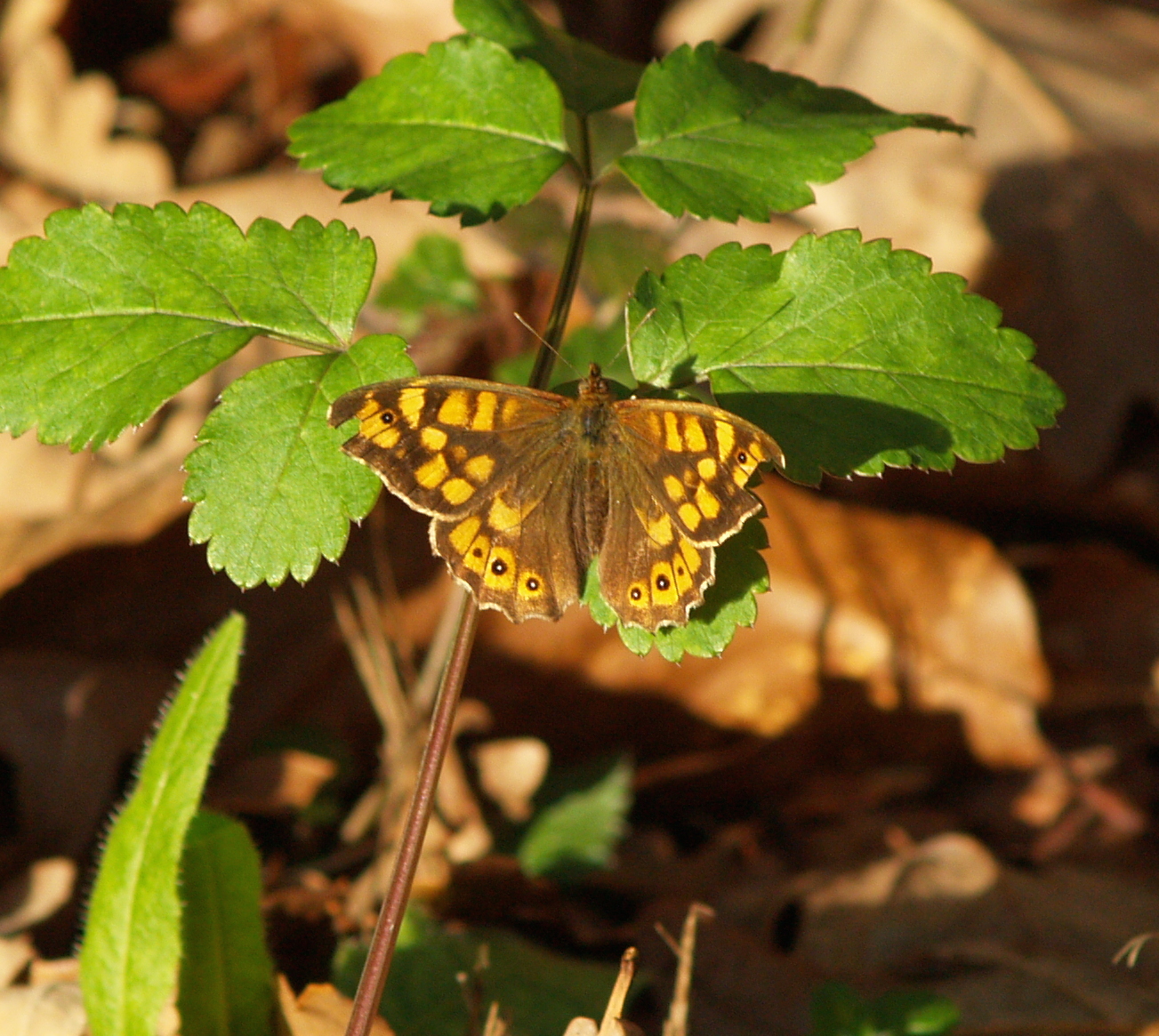
The road was now flanked by trees on both sides (not only the hill to the north) and within some of the splotches of sun shining through the trees I saw the second species sitting sunning itself … within seconds it was joined by 2 others and the three battled a bit for the rights to the sunny patches … the ever present Pararge aegeria (Speckled Wood).
When I got to my absolute favourite spot on the route I stopped to take a closer look at the surrounds … nothing … when I headed further, 5 minutes later, I hadn’t started walking before I saw a tiny dab of grey shakily fluttering about … Cacyreus marschalli (Geranium Bronze), an invasive species from South Africa. What was it doing so far away from the village where I usually saw this species?
Speckled Wood in Cantabria, Spain. 23.01.16
And then I came to butterfly heaven on that day … every 20m or so I’d spot another Speckled Wood sunning along the sides of the road. However, just before I turned back onto the dirt track … there they were … everywhere I looked more and more Peacock butterflies, mostly drinking nectar from dandelions (Taraxacum spec.) or sunning on the warm road. Zipping around me, it was kinda crazy. I’d only seen this many at one time when I saw them as caterpillar.
As I was enjoying the spectacle I saw a big fat yellow butterfly drinking from a dandelion … yup, this time I knew it for sure, a Brimstone.Then when I turned onto the dirt track a white butterfly came zipping by and landed on a dandelion nearby … I just had time to take a couple of pictures for a positive ID at home … Small White.
Walking down the dirt track, slowly on my way home I marveled, 5 species in January, nuts. I looked back and could see tiny specks of white zipping between the trees where I’d just been standing … but I had to head home, my oldest son was waking up (I’d been pushing him in the stroller during the walk … siesta time for him).
Other insects seen … Bombus terrestris/lucorum and Apis mellifera.
Geranium Bronze in Cantabria, Spain. 23.01.16
Brimstone in Cantabria, Spain. 23.01.16
Summary
Small White in Cantabria, Spain. 23.01.16
– Pieris rapae — 1 certain, 1 probable.
– Gonepteryx rhamni — 1 certain, 1 probable.
– Aglais io — between 10 and 15 in total.
– Cacyreus marschalli — 1.
– Pararge aegeria — between 10 and 15 in total.
Further Reading
– My sightings for the day on Observation.org.
– Proyecto Lepides blog entry for January 2016. Summary of butterflies seen in Spain during January.






 Searching for Cullum's Bee