Proyecto Lepides – Recorrido A, 30TVN09, Casar de Periedo – 15.03.16

Introduction
It had been raining on a fairly continual, daily basis since the 21st of February. I spotted two good days in the weather report, the Monday and Tuesday and so decided to go the second day to give the butterflies a chance to warm up. I’d been out walking during some overcast, and quite fresh, days previously and had spotted around 5 species of bumbelbee. I was quietly hoping for an eventful early afternoon …

Recorrido A – 15.03.16 – 30TVN09, Casar de Periedo
When I headed out at around 13:00, the thermometer read 14C and the sun was out without a cloud in the sky, though it was slightly hazy and there was a little breeze (from east to west) that made it fairly chilly in the shade. By the time I got home 2 and a half hours later it was at 15C with the rest still the same. I got home with a very light sunburn actually, hadn’t expected it to be so sunny throughout.

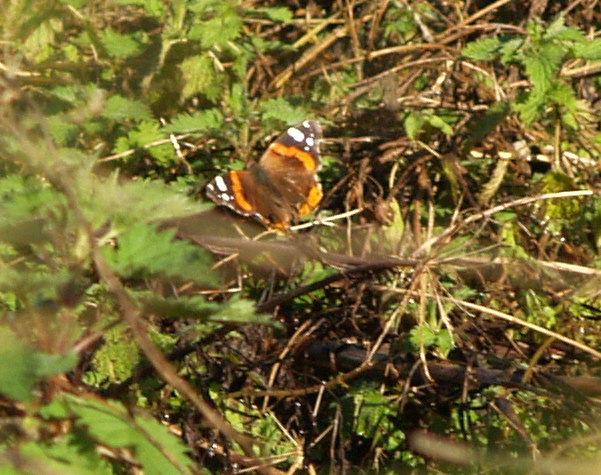
The fields were quite wet, there was a lot of squelching every time I stepped off the track. My first butterfly was again a Red Admiral (Vanessa atalanta) in the same area where I saw one the month before, this time it was flying around actively and chased another butterfly (uncertain the species). A little later, as I was looking intently into some shrubs as I through I saw a snake or large lizard a Small White (Pieris rapae) bobbed by (took care to ID it by looking at the hindwing underside – more on this later).

I still had a lot of ground to cover so off I went. However, as I went on it started to dawn on me that my hopes for an eventful (in the positive sense) afternoon would not come to fruition. The first was that I hardly saw any Speckled Wood (Pararge aegeria). This does not happen often, as they are usually everywhere. The road along the edge of the woods had the usual butterflies on offer, but I couldn’t help but feel slightly disappointed. I’d been hoping for a first blue or something special, but alas.

What I did see a lot of was Pieris napi (Green-veined White) … last year they had been so plentiful throughout that I grew a bit tired of seeing so many. And here they were, out in great numbers already! But every butterfly counts and this is my 10th species of the year. Although, from now on IDing will be a task between Pieris rapae and P. napi, as they are fairly similar and you have to spot the underside to make sure. P. napi have an extensive range of uppersides here, with regards to black markings so IDing them in flight is difficult. The two species also have a different style of flying, but I’m not yet there to distinguish them in that manner, will probably get the by the end of this year though as both are really common here!

The frustration came in not being able to positively ID a Cleopatra and also in seeing one butterfly that flew very distinctly to those I see here and which I could not follow (maybe a Small Tortoiseshell?) well enough with my binoculars and I tried to spot it landing in the distance.
Oh and not one photo ended up being usable.

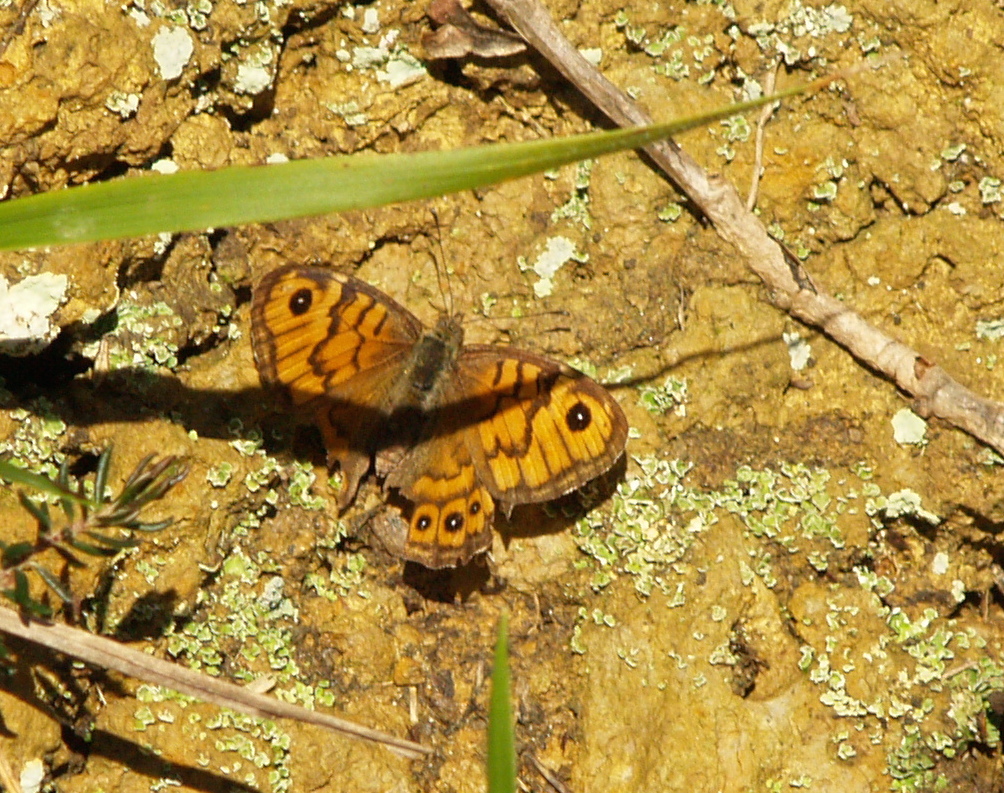
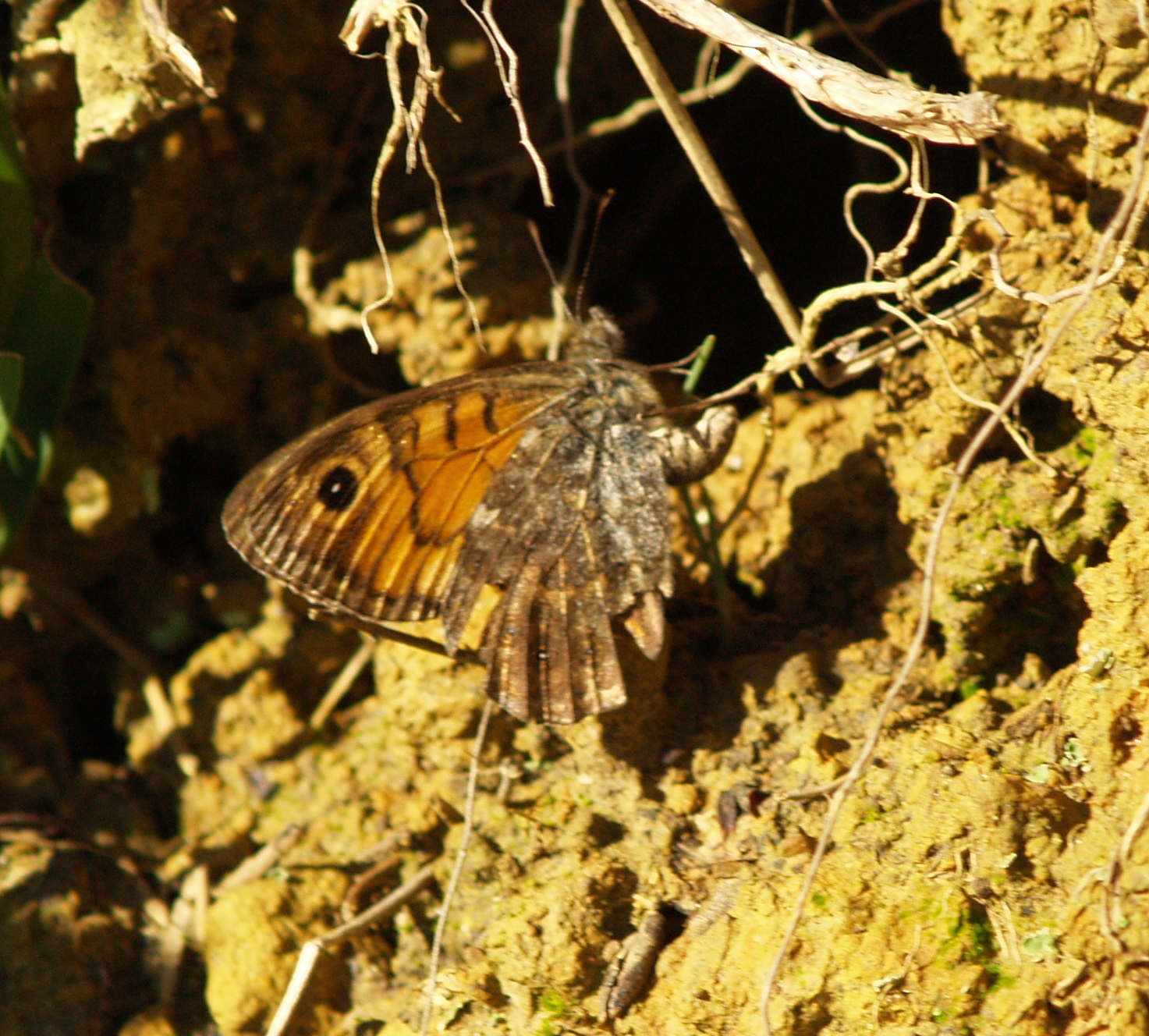
The day ended me one neat ID, a Wall Brown (Lasiommata megera) that I just spotted as I came out of some scrub and climbed up a bank onto the gravel road. Not the most common of butterflies around here.

The denouement came at home, when I took of my sweater in the kitchen and off fell two ticks! That’s what you get for trouncing around the scrub. Luckily none had found a way into a nice spot to bore into my skin, but I’ll have to be more careful the next time around.
Hopefully, with a few free days ahead I’ll be able to catch up on some species entries. Up next a bumblebee of the spring season …

Summary
Vanessa atalanta — between 3 to 5.
Pieris rapae — 2.
Gonepteryx rhamni — around 15 in total.
Pieris napi — stopped counting after 20 (first of the year on this transect).
Colias croceus — 2.
Pararge aegeria — 5, a lot less than normal.
Aglais io — 1.
Lasiommata megera — 1.

Species year total — 10 (2015 – 45).

Further Reading
– My sightings for the day on Observation.org.
Proyecto Lepides – Recorrido A, 30TVN09, Casar de Periedo – 15.03.16

Proyecto Lepides – Recorrido A, 30TVN09, Casar de Periedo – 13.02.16

Introduction
When I woke up, at around 7am, it was still fairly dark out but I could see if would be a nice morning. By 10am I was ready to go and knew that I’d still have a window of sunshine before the rain would come back. Since the start of the month it has been raining almost non-stop.

Recorrido A – 13.02.16 – 30TVN09, Casar de Periedo
The weather was quite good to start with, I didn’t need to wear a sweater. It was sunny with no clouds in sight and no wind at all, at 10am it was 14C. About halfway it was probably up to 17C or so, but towards the end of the route, the wind picked up a bit (not too much) and there was a lot of cloud cover all of a sudden, was back down to 16C when I got home around 12 noon. A little while later the rain was out (in good amounts too!).

I wasn’t expecting much … the rain had been almost constant over the previous days and the ground was really soggy everywhere in the fields. I stopped to look at some birds, when I spotted something dark flittering through this strange soggy/grassy area … I quickly aimed my binoculars in the distance and as I was focusing in saw flashes of white on the wing-tips

Red Admiral in Cantabria, Spain. 13.02.16

… I instantly recognised this from the previous year … Vanessa atalanta (Red Admiral) … the butterfly dipped behind a large tussock of grass and so I dived into the soggy field to get confirmation (mostly for myself, as I really like to be sure about an ID, especially so early in the year). With some difficulty I was able to get a couple of bad photographs in (that thankfully do show the required characteristics) for a positive ID.


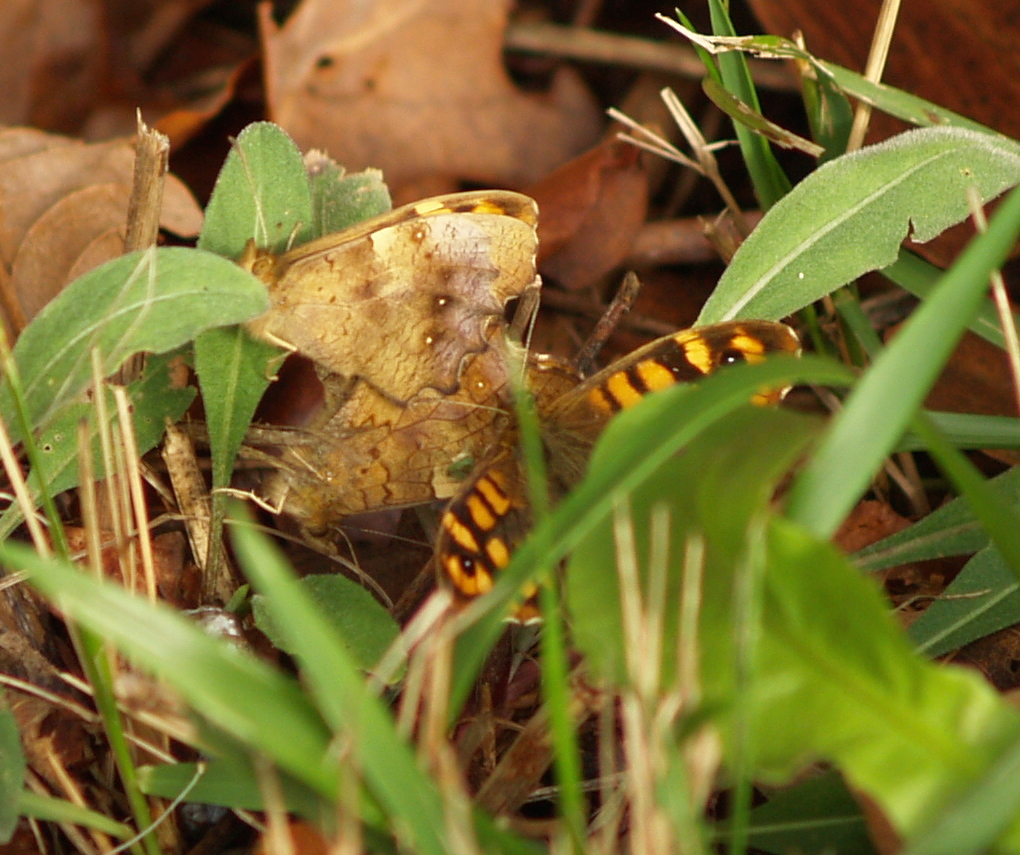
After a short while there were three in fairly quick succession along the route (I took a 15 min. detour to see if I could buy something for my son at the gas-station) and those were the regular patrons along the transect; Gonepteryx rhamni (Brimstone), Pieris rapae (Small White) and Pararge aegeria (Speckled Wood). At one point I’d seen so many Speckled Wood that I stopped counting, I also didn’t take pictures anymore, they were just everywhere. Although, I did take one funny snapshot of a copula and a male sitting on the two, waiting.

Speckled Wood in Cantabria, Spain. 13.02.16 - copula + male
Speckled Wood in Cantabria, Spain. 13.02.16 – copula + male

It was at my favourite spot along the transect that I spotted something odd … I thought it was a Speckled Wood by the general colouring, but I found it strange that the butterfly was so small (max. 2/3 of what I’d normally expect) and it was behaving in a strange manner. It hugged along a vertical embankment along the road, stopping here and there, usually under grass, twigs etc. What was this? I took many pictures, hoping to get an underside picture, but that proved very difficult (though in the end I managed it). I had an idea what it might be, but I’d only seen this butterfly once before and it had been exceptionally difficult to photograph too. Later when I got home I conformed my suspicion … Lasiommata megera (Wall Brown) … and I also saw that she was placing eggs (or so it seems!). I cursed that I hadn’t picked up that detail in the field.

Wall Brown in Cantabria, Spain. 13.02.16
Wall Brown in Cantabria, Spain. 13.02.16 - underside.
Wall Brown in Cantabria, Spain. 13.02.16 – underside.

I continued on, within a minute both a Colias croceus (Clouded Yellow) and Aglais io (Peacock) flew by at great speeds. Luckily those are fairly easy to ID in flight, especially as the Clouded Yellow was a male. A week earlier, on a walk nearby I’d been surprised to see a Clouded Yellow … I’d been pushing the stroller, looking at the ground and spotted a strange yellow leaf, strange as everything else was brown in mud, fallen leaves etc. I was able to get really close to it (was practically next to me anyway when I walked past it) and got some good pictures.


On I went, looking at butterflies through my binoculars, checking out the Buteo buteo (Common Buzzards) circling overhead … and then, as I was looking at a Brimstone (or so I thought) zip by I noticed flashes of orange … wait a minute … Brimstone don’t have orange, but Cleopatra do! I jogged along after it till it settled down (luckily not far off) and took some pictures. I also made sure to take one just as it set of for its next short journey, the flash of orange was clear on the picture, Gonepteryx cleopatra (Cleopatra), my first confirmed ID of this species by photo.

Cleopatra in Cantabria, Spain. 13.02.16


Picking up the pace a bit I headed home, the wind was picking up and it was starting to feel a bit chilly (had left my jacket at home), but was happy that I’d spotted a new species (the Cleopatra) for the UTM square I am monitoring.

Summary
Vanessa atalanta — 1 (first of the year).
Gonepteryx rhamni — around 10 in total.
Pieris rapae — 3.
Pararge aegeria — I stopped counting after 20 … maybe 30 in total?
Lasiommata megera — 1 (first of the year).
Colias croceus — 1 (I’d seen one a week earlier but not along this transect).
Aglais io — between 10 and 15 in total.
Gonepteryx cleopatra — 1 certain, probably 2 (first of the year).

Species year total — 9 (2015 – 45).

Further Reading
– My sightings for the day on Observation.org.
Proyecto Lepides – Recorrido A, 30TVN09, Casar de Periedo – 13.02.16